















U.S. Nasal Splints Market Outlook to 2030
Region:North America
Author(s):Shivani Mehra
Product Code:KROD11454
December 2024
82
About the Report
U.S. Nasal Splints Market Overview
- The U.S. nasal splints market, valued at approximately USD 418.66 million, is primarily driven by the increasing prevalence of nasal surgeries, such as rhinoplasty and septoplasty, aimed at correcting nasal deformities and improving breathing functions. Advancements in medical technology and a growing awareness of post-surgical care have further propelled the demand for nasal splints.
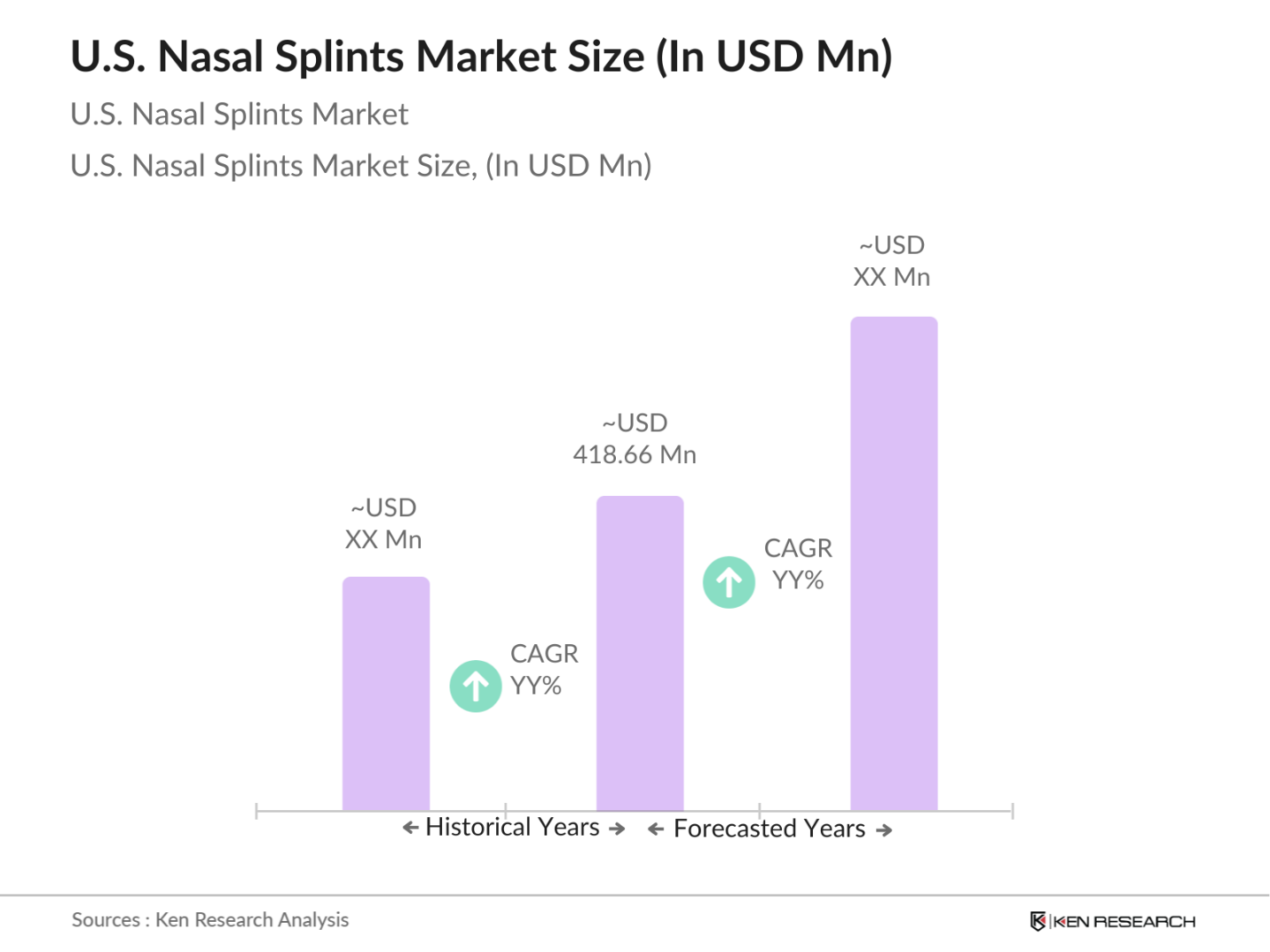
- Major metropolitan areas, including New York, Los Angeles, and Chicago, dominate the U.S. nasal splints market. This dominance is attributed to the high concentration of specialized healthcare facilities, a significant number of practicing otolaryngologists and plastic surgeons, and a population with higher disposable incomes, leading to increased elective nasal procedures.
- Governments globally are providing grants and subsidies to promote innovation in the medical device sector, particularly for advanced technologies like bioabsorbable materials and 3D printing. For example, the U.S. Department of Health and Human Services allocated significant funds to support research and development in bioabsorbable materials for medical use in 2023, aiming to improve patient outcomes and reduce post-surgical complications. Such initiatives accelerate the production and availability of advanced nasal splints.
U.S. Nasal Splints Market Segmentation
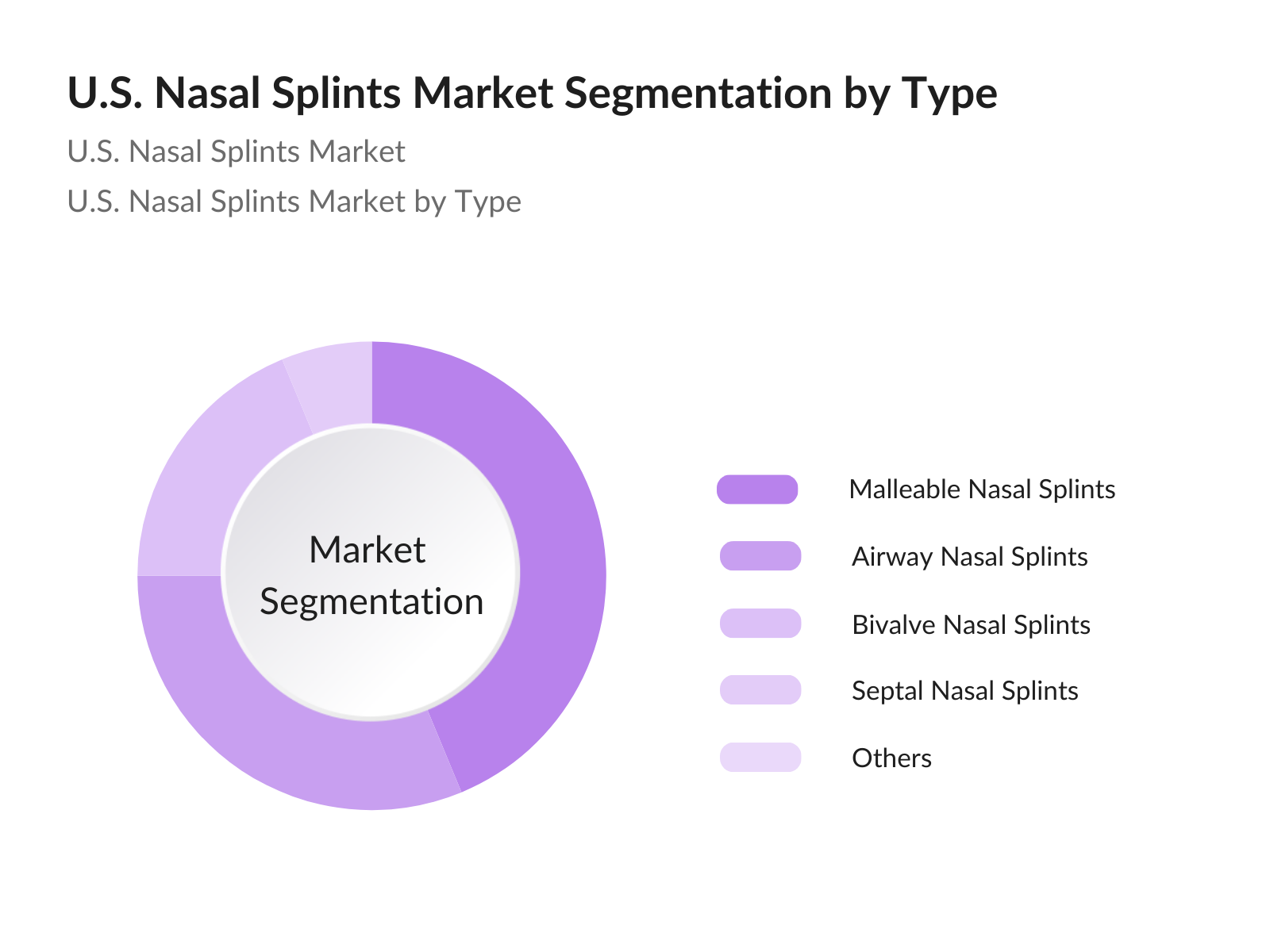
- By Type: The U.S. nasal splints market is segmented by type into malleable nasal splints, airway nasal splints, bivalve nasal splints, septal nasal splints, and others. Malleable nasal splints hold a dominant market share due to their flexibility, ease of insertion, and ability to conform to individual nasal anatomies, making them a preferred choice among surgeons for various nasal procedures.
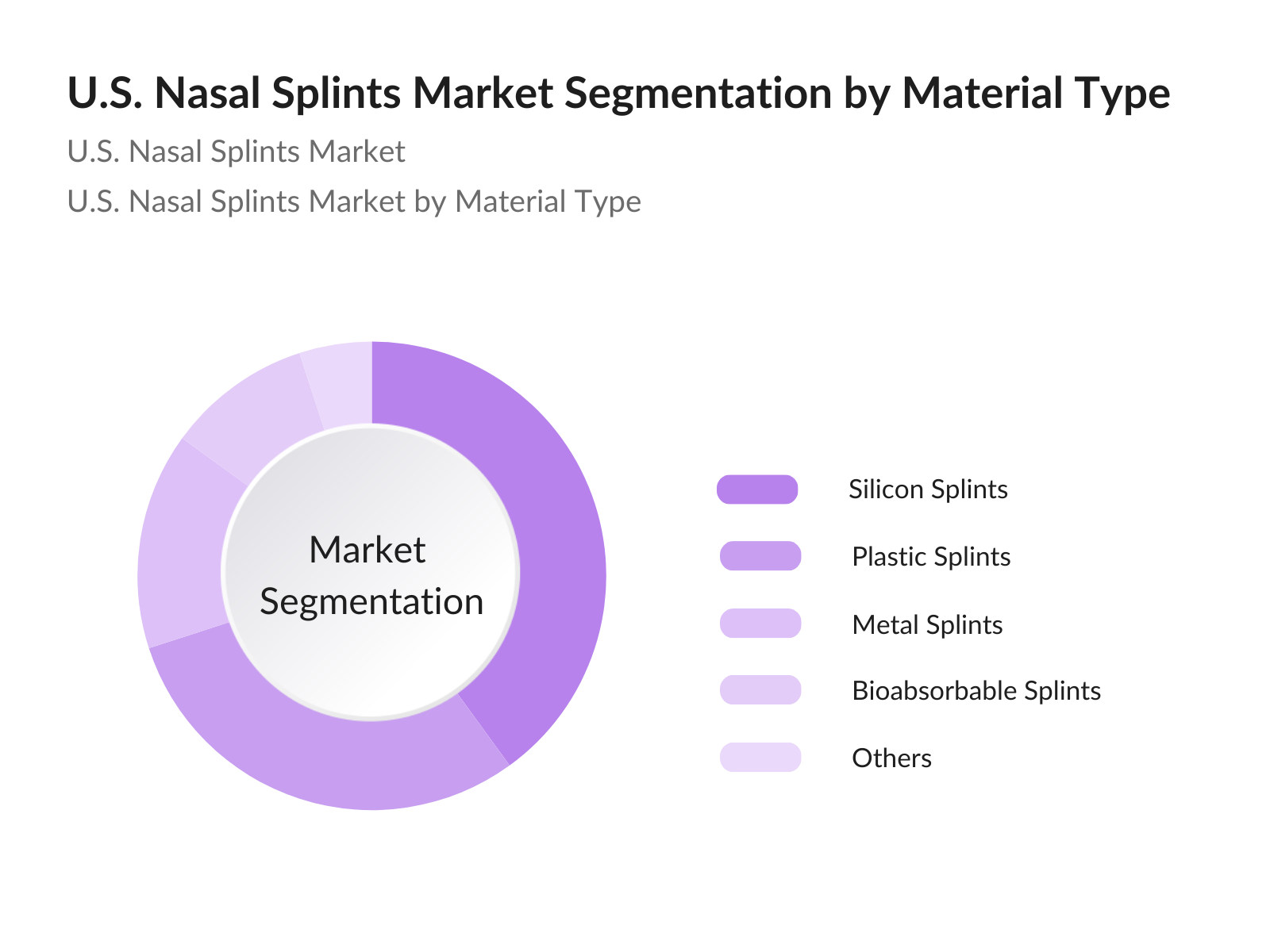
- By Material Type: The market is further segmented by material type into plastic splints, metal splints, silicon splints, bioabsorbable splints, and others. Silicon splints are leading the market share owing to their biocompatibility, flexibility, and patient comfort. Their inert nature reduces the risk of allergic reactions, and their pliability allows for easy customization during surgical procedures.
U.S. Nasal Splints Market Competitive Landscape
The U.S. nasal splints market is characterized by the presence of several key players, each contributing to the market's growth through innovation and extensive distribution networks.
|
Company Name |
Establishment Year |
Headquarters Location |
Number of Employees |
Annual Revenue (USD Million) |
Product Portfolio |
Market Share (%) |
Recent Developments |
Strategic Initiatives |
|
Medtronic plc |
1949 |
Dublin, Ireland |
- |
- |
- |
- |
- |
- |
|
Smith & Nephew plc |
1856 |
London, UK |
- |
- |
- |
- |
- |
- |
|
Stryker Corporation |
1941 |
Kalamazoo, MI, USA |
- |
- |
- |
- |
- |
- |
|
Olympus Corporation |
1919 |
Tokyo, Japan |
- |
- |
- |
- |
- |
- |
|
Boston Medical Products |
1980 |
Shrewsbury, MA, USA |
- |
- |
- |
- |
- |
- |
U.S. Nasal Splints Market Analysis
Market Growth Drivers
- Increasing Prevalence of Nasal Surgeries: The global rise in nasal surgeries, including rhinoplasty and septoplasty, is a significant driver for the nasal splints market. In 2022, the American Society of Plastic Surgeons reported over 220,000 rhinoplasty procedures in the United States alone, highlighting a growing demand for postoperative care products like nasal splints. This trend is mirrored globally, with countries such as Brazil and South Korea also reporting high numbers of cosmetic nasal surgeries.
- Advancements in Medical Technology: Technological innovations have led to the development of more effective and comfortable nasal splints. The introduction of bioabsorbable materials and 3D-printed custom splints has improved patient outcomes and satisfaction. For instance, the use of 3D printing in medical applications is projected to reach significant adoption, enhancing the customization of medical devices, including nasal splints.
- Rising Awareness of Post-Surgical Care: There is an increasing emphasis on the importance of post-surgical care in patient recovery. Healthcare providers are educating patients about the benefits of using nasal splints to ensure proper healing and maintain nasal structure after surgery. This awareness is contributing to the growing adoption of nasal splints in postoperative care protocols.
Market Challenges:
- High Cost of Advanced Nasal Splints: Advanced nasal splints, especially those made from bioabsorbable materials or customized through 3D printing, can be expensive. This high cost may limit their adoption, particularly in regions with limited healthcare budgets or among patients without adequate insurance coverage. The affordability of these devices remains a significant challenge in the market.
- Limited Awareness in Rural Areas: In many rural regions, there is a lack of awareness about the availability and benefits of nasal splints in postoperative care. This gap in knowledge can lead to suboptimal recovery outcomes for patients undergoing nasal surgeries. Efforts to educate healthcare providers and patients in these areas are essential to improve the adoption of nasal splints.
U.S. Nasal Splints Market Future Outlook
Over the next five years, the U.S. nasal splints market is expected to experience steady growth, driven by continuous advancements in medical technology, an increasing number of nasal surgical procedures, and a growing emphasis on patient comfort and post-operative care. The adoption of bioabsorbable materials and the integration of 3D printing technology for customized splints are anticipated to further propel market expansion.
Market Opportunities:
- Technological Innovations in Nasal Splint Design: Advancements in materials science and manufacturing technologies present opportunities for developing more effective and patient-friendly nasal splints. The integration of bioabsorbable materials and 3D printing allows for customized splints that enhance patient comfort and improve healing outcomes. These innovations can drive market growth by meeting the evolving needs of patients and healthcare providers.
- Growing Medical Tourism: The rise in medical tourism, particularly for cosmetic surgeries, is expanding the market for nasal splints. Countries like Thailand, Mexico, and Turkey are becoming popular destinations for affordable and high-quality nasal surgeries. This trend increases the demand for postoperative care products, including nasal splints, as patients seek comprehensive surgical solutions abroad.
Scope of the Report
|
By Type |
Malleable Nasal Splints Airway Nasal Splints Bivalve Nasal Splints Septal Nasal Splints Others |
|
By Material Type |
Plastic Splints |
|
By Application |
Rhinoplasty |
|
By Mechanism |
Intranasal |
|
By Region |
North-East Midwest West Coast Southern States |
Products
Key Target Audience
Otolaryngologists
Plastic Surgeons
Hospital Procurement Departments
Ambulatory Surgical Centers
Medical Device Distributors
Healthcare Regulatory Bodies (e.g., FDA)
Investment and Venture Capital Firms
Government and Regulatory Bodies (e.g., Centers for Medicare & Medicaid Services)
Companies
Players Mentioned in the Report
Medtronic plc
Smith & Nephew plc
Stryker Corporation
Olympus Corporation
Boston Medical Products Inc.
Summit Medical LLC
DTR Medical Ltd.
Network Medical Products Ltd.
Surgiform Technologies LLC
Hemostasis LLC
Anthony Products Inc.
Traumec Health Technology
Audio Technologies Srl
Websinger Ges.m.b.H.
SPIGGLE & THEIS Medizintechnik GmbH
Table of Contents
1. Market Overview
1.1 Definition and Scope
1.2 Market Taxonomy
1.3 Market Growth Rate
1.4 Market Segmentation Overview
2. Market Size (USD Billion)
2.1 Historical Market Size
2.2 Year-On-Year Growth Analysis
2.3 Key Market Developments and Milestones
3. Market Analysis
3.1 Growth Drivers
3.1.1 Increasing Prevalence of Nasal Surgeries
3.1.2 Advancements in Medical Technology
3.1.3 Rising Awareness of Post-Surgical Care
3.1.4 Expansion of Healthcare Infrastructure
3.2 Market Challenges
3.2.1 High Cost of Advanced Nasal Splints
3.2.2 Limited Awareness in Rural Areas
3.2.3 Regulatory Hurdles
3.3 Opportunities
3.3.1 Technological Innovations in Nasal Splint Design
3.3.2 Growing Medical Tourism
3.3.3 Untapped Markets in Emerging Regions
3.4 Trends
3.4.1 Adoption of Bioabsorbable Materials
3.4.2 Customization through 3D Printing
3.4.3 Integration with Minimally Invasive Procedures
3.5 Regulatory Landscape
3.5.1 FDA Guidelines and Approvals
3.5.2 Reimbursement Policies
3.5.3 Compliance Requirements
3.6 SWOT Analysis
3.7 Stakeholder Ecosystem
3.8 Porters Five Forces Analysis
3.9 Competitive Landscape
4. Market Segmentation
4.1 By Type (Value %)
4.1.1 Malleable Nasal Splints
4.1.2 Airway Nasal Splints
4.1.3 Bivalve Nasal Splints
4.1.4 Septal Nasal Splints
4.1.5 Others
4.2 By Material Type (Value %)
4.2.1 Plastic Splints
4.2.2 Metal Splints
4.2.3 Silicon Splints
4.2.4 Bioabsorbable Splints
4.2.5 Others
4.3 By Application (Value %)
4.3.1 Rhinoplasty
4.3.2 Septoplasty
4.3.3 Nasal Fractures
4.3.4 Plastic Surgeries
4.3.5 Others
4.4 By Mechanism (Value %)
4.4.1 Intranasal
4.4.2 External
4.5 By End-User (Value %)
4.5.1 Hospitals
4.5.2 ENT Clinics
4.5.3 Ambulatory Surgical Centers
4.5.4 Homecare Settings
4.5.5 Others
5. Competitive Analysis
5.1 Detailed Profiles of Major Companies
5.1.1 Stryker Corporation
5.1.2 Smith & Nephew plc
5.1.3 Medtronic plc
5.1.4 Boston Medical Products Inc.
5.1.5 Summit Medical LLC
5.1.6 Olympus Corporation
5.1.7 DTR Medical Ltd.
5.1.8 Network Medical Products Ltd.
5.1.9 Surgiform Technologies LLC
5.1.10 Hemostasis LLC
5.1.11 Anthony Products Inc.
5.1.12 Traumec Health Technology
5.1.13 Audio Technologies Srl
5.1.14 Websinger Ges.m.b.H.
5.1.15 SPIGGLE & THEIS Medizintechnik GmbH
5.1.16 Cross Comparison Parameters
5.2 Number of Employees
5.3 Headquarters Location
5.4 Year of Establishment
5.5 Annual Revenue
5.6 Product Portfolio
5.7 Market Share
5.8 Recent Developments
5.9 Strategic Initiatives
5.10 Market Share Analysis
5.11 Strategic Initiatives
5.11.1 Mergers and Acquisitions
5.11.2 Investment Analysis
5.11.3 Venture Capital Funding
5.11.4 Government Grants
5.11.5 Private Equity Investments
6. Regulatory Framework
6.1 Environmental Standards
6.2 Compliance Requirements
6.3 Certification Processes
7. Future Market Size (USD Billion)
7.1 Future Market Size Projections
7.2 Key Factors Driving Future Market Growth
8. Future Market Segmentation
8.1 By Type (Value %)
8.2 By Material Type (Value %)
8.3 By Application (Value %)
8.4 By Mechanism (Value %)
8.5 By End-User (Value %)
9. Analysts Recommendations
9.1 Total Addressable Market (TAM), Serviceable Available Market (SAM), and Serviceable Obtainable Market (SOM) Analysis
9.2 Customer Cohort Analysis
9.3 Marketing Initiatives
9.4 White Space Opportunity Analysis
Research Methodology
Step 1: Identification of Key Variables
The initial phase involves constructing an ecosystem map encompassing all major stakeholders within the U.S. nasal splints market. This step is underpinned by extensive desk research, utilizing a combination of secondary and proprietary databases to gather comprehensive industry-level information. The primary objective is to identify and define the critical variables that influence market dynamics.
Step 2: Market Analysis and Construction
In this phase, we compile and analyze historical data pertaining to the U.S. nasal splints market. This includes assessing market penetration, the ratio of marketplaces to service providers, and the resultant revenue generation. Furthermore, an evaluation of service quality statistics is conducted to ensure the reliability and accuracy of the revenue estimates.
Step 3: Hypothesis Validation and Expert Consultation
Market hypotheses are developed and subsequently validated through computer-assisted telephone interviews (CATIs) with industry experts representing a diverse array of companies. These consultations provide valuable operational and financial insights directly from industry practitioners, which are instrumental in refining and corroborating the market data.
Step 4: Research Synthesis and Final Output
The final phase involves direct engagement with multiple nasal splint manufacturers to acquire detailed insights into product segments, sales performance, consumer preferences, and other pertinent factors.
Frequently Asked Questions
01. How big is the U.S. nasal splints market?
The U.S. nasal splints market was valued at approximately USD 418.66 million, driven by increasing demand for nasal surgeries and advancements in medical technology.
02. What are the main drivers of growth in the U.S. nasal splints market?
Growth in this market is driven by rising numbers of nasal surgeries, increasing awareness of post-operative care, and technological innovations in medical devices, which improve patient comfort and recovery.
03. Which type of nasal splint holds the highest market share?
Malleable nasal splints dominate due to their adaptability, ease of use, and ability to conform to diverse nasal anatomies, making them highly popular in various nasal procedures.
04. What challenges does the U.S. nasal splints market face?
The market faces challenges, including high costs of advanced splints, limited awareness in certain areas, and regulatory hurdles related to product approvals and insurance reimbursements.
Why Buy From Us?

What makes us stand out is that our consultants follows Robust, Refine and Result (RRR) methodology. i.e. Robust for clear definitions, approaches and sanity checking, Refine for differentiating respondents facts and opinions and Result for presenting data with story

We have set a benchmark in the industry by offering our clients with syndicated and customized market research reports featuring coverage of entire market as well as meticulous research and analyst insights.

While we don't replace traditional research, we flip the method upside down. Our dual approach of Top Bottom & Bottom Top ensures quality deliverable by not just verifying company fundamentals but also looking at the sector and macroeconomic factors.

With one step in the future, our research team constantly tries to show you the bigger picture. We help with some of the tough questions you may encounter along the way: How is the industry positioned? Best marketing channel? KPI's of competitors? By aligning every element, we help maximize success.

Our report gives you instant access to the answers and sources that other companies might choose to hide. We elaborate each steps of research methodology we have used and showcase you the sample size to earn your trust.

If you need any support, we are here! We pride ourselves on universe strength, data quality, and quick, friendly, and professional service.