
US Orphan Drugs Market Outlook to 2030
Region:United States
Author(s):Shreya Garg
Product Code:KROD9062
Region:United States
Author(s):Shreya Garg
Product Code:KROD9062
December 2024
85
Listen to the audio summary
By Drug Type: The market is segmented by drug type into biologics and small molecules. Recently, biologics have held a dominant share in this segment due to their ability to address complex diseases, especially in the fields of oncology and rare genetic disorders. Biologics, which include monoclonal antibodies, gene therapies, and advanced biologic drugs, offer innovative treatments that are more targeted and effective compared to traditional small molecules. The high development cost and longer clinical trial phases are offset by government incentives, making this sub-segment a primary driver of market growth. 
By Therapeutic Area: The market is segmented by therapeutic area into oncology, neurology, hematology, endocrinology, and cardiovascular. Oncology remains the largest therapeutic area, driven by the increasing prevalence of rare cancers and significant advancements in cancer research. This segment benefits from extensive R&D funding, with numerous orphan drug approvals specifically targeting rare forms of cancer. Companies focusing on orphan oncology drugs are also supported by patient advocacy groups, which further amplifies market growth in this sub-segment. 
The US Orphan Drugs market is dominated by a few major players, including global pharmaceutical giants and specialized biotech firms. These companies maintain a competitive edge through continuous R&D investments, strategic collaborations, and a focus on orphan drug development. The consolidation of the market highlights the influence of these key players, as they hold multiple orphan drug designations and lead in both drug discovery and commercialization.
|
Company Name |
Established Year |
Headquarters |
No. of Orphan Drug Approvals |
Revenue (USD Bn) |
R&D Spending (%) |
Product Pipeline |
FDA Designations |
Number of Clinical Trials |
Strategic Collaborations |
|
Novartis AG |
1996 |
Basel, Switzerland |
|||||||
|
Pfizer Inc. |
1849 |
New York, USA |
|||||||
|
Roche Holding AG |
1896 |
Basel, Switzerland |
|||||||
|
Amgen Inc. |
1980 |
Thousand Oaks, USA |
|||||||
|
Vertex Pharmaceuticals |
1989 |
Boston, USA |
Over the next five years, the US Orphan Drugs market is expected to see significant expansion driven by continuous government support, advancements in biotechnology, and increasing R&D investments. The rising prevalence of rare diseases and increasing patient awareness are also key factors contributing to this growth. Additionally, the FDA's fast-track approval processes for orphan drugs will further accelerate the introduction of new treatments to the market. As biopharma companies continue to collaborate with research institutions and patient advocacy groups, the future of the orphan drugs market remains promising.
|
Drug Type |
Biologics Small Molecules |
|
Therapeutic Area |
Oncology Neurology Hematology Endocrinology Cardiovascular |
|
Distribution Channel |
Hospital Pharmacies Specialty Pharmacies Online Pharmacies |
|
Route of Administration |
Oral Injectable Others |
|
Region |
Northeast Midwest South West |
1.1. Definition and Scope
1.2. Market Taxonomy
1.3. Market Growth Rate
1.4. Market Segmentation Overview
2.1. Historical Market Size
2.2. Year-On-Year Growth Analysis
2.3. Key Market Developments and Milestones
3.1. Growth Drivers
3.1.1. Orphan Drug Designation by FDA (Key Driver)
3.1.2. Increasing Prevalence of Rare Diseases (Key Driver)
3.1.3. Favorable Government Incentives (Tax Credits, Market Exclusivity)
3.1.4. Growing Investments in Biotech and Pharmaceuticals
3.2. Market Challenges
3.2.1. High Development Costs (R&D Spending)
3.2.2. Limited Patient Population (Market Size)
3.2.3. Regulatory Complexities (FDA Approval Process)
3.3. Opportunities
3.3.1. Advancements in Gene Therapy and Precision Medicine
3.3.2. Expansion into New Therapeutic Areas
3.3.3. Collaborations with Academic and Research Institutions
3.4. Trends
3.4.1. Increased Use of Biologics and Advanced Therapies
3.4.2. Surge in Personalized Treatment Approaches (Genomic Medicine)
3.4.3. Adoption of Patient-Centric Models (Patient Registries)
3.5. Government Regulation
3.5.1. Orphan Drug Act and Amendments
3.5.2. FDA Regulatory Pathways (Accelerated Approval, Breakthrough Therapy Designation)
3.5.3. NIH Funding and Research Initiatives
3.6. SWOT Analysis
3.7. Stakeholder Ecosystem
3.7.1. Drug Manufacturers
3.7.2. Patient Advocacy Groups
3.7.3. Regulatory Bodies
3.7.4. Research Institutions
3.8. Porters Five Forces Analysis
3.9. Competition Ecosystem
4.1. By Drug Type (In Value %)
4.1.1. Biologics
4.1.2. Small Molecules
4.2. By Therapeutic Area (In Value %)
4.2.1. Oncology
4.2.2. Neurology
4.2.3. Hematology
4.2.4. Endocrinology
4.2.5. Cardiovascular
4.3. By Distribution Channel (In Value %)
4.3.1. Hospital Pharmacies
4.3.2. Specialty Pharmacies
4.3.3. Online Pharmacies
4.4. By Route of Administration (In Value %)
4.4.1. Oral
4.4.2. Injectable
4.4.3. Others
4.5. By Region (In Value %)
4.5.1. Northeast
4.5.2. Midwest
4.5.3. South
4.5.4. West
5.1. Detailed Profiles of Major Companies
5.1.1. Novartis AG
5.1.2. Pfizer Inc.
5.1.3. Roche Holding AG
5.1.4. Bristol-Myers Squibb
5.1.5. AbbVie Inc.
5.1.6. Alexion Pharmaceuticals
5.1.7. Amgen Inc.
5.1.8. Sanofi
5.1.9. Vertex Pharmaceuticals
5.1.10. Biogen Inc.
5.1.11. Regeneron Pharmaceuticals
5.1.12. Gilead Sciences
5.1.13. Bayer AG
5.1.14. Takeda Pharmaceutical
5.1.15. Jazz Pharmaceuticals
5.2. Cross Comparison Parameters (R&D Investment, Orphan Drug Designations, Product Pipeline, Clinical Trials)
5.3. Market Share Analysis
5.4. Strategic Initiatives
5.5. Mergers and Acquisitions
5.6. Investment Analysis
5.7. Venture Capital Funding
5.8. Government Grants
5.9. Private Equity Investments
6.1. Orphan Drug Act
6.2. FDA Approval Process for Orphan Drugs
6.3. Incentives and Financial Support for R&D
7.1. Future Market Size Projections
7.2. Key Factors Driving Future Market Growth
8.1. By Drug Type (In Value %)
8.2. By Therapeutic Area (In Value %)
8.3. By Distribution Channel (In Value %)
8.4. By Route of Administration (In Value %)
8.5. By Region (In Value %)
9.1. TAM/SAM/SOM Analysis
9.2. Customer Cohort Analysis
9.3. Marketing Initiatives
9.4. White Space Opportunity Analysis
The initial step involves constructing a comprehensive market ecosystem map, identifying major stakeholders including pharmaceutical companies, biotech firms, research institutions, and government bodies within the US Orphan Drugs market. Extensive desk research, including secondary data and proprietary databases, is employed to gather detailed industry information. The primary aim is to identify the key variables influencing market growth and dynamics.
During this phase, we compile and analyze historical market data for the US Orphan Drugs sector. This involves examining key metrics such as drug approvals, patient population, and market penetration. Furthermore, we evaluate R&D expenditures and government incentives to ensure the reliability of revenue projections and market trends.
To validate market hypotheses, we conduct consultations through computer-assisted telephone interviews (CATIs) with industry experts, including executives from leading pharmaceutical firms, healthcare professionals, and regulatory authorities. These consultations provide valuable insights into market dynamics and serve to refine the data collected in previous phases.
The final phase involves synthesizing data gathered from primary and secondary sources, including direct engagement with drug manufacturers. This ensures a comprehensive and accurate analysis of the US Orphan Drugs market. The final output includes a detailed report that is reviewed and validated by industry experts to ensure its accuracy and relevance.
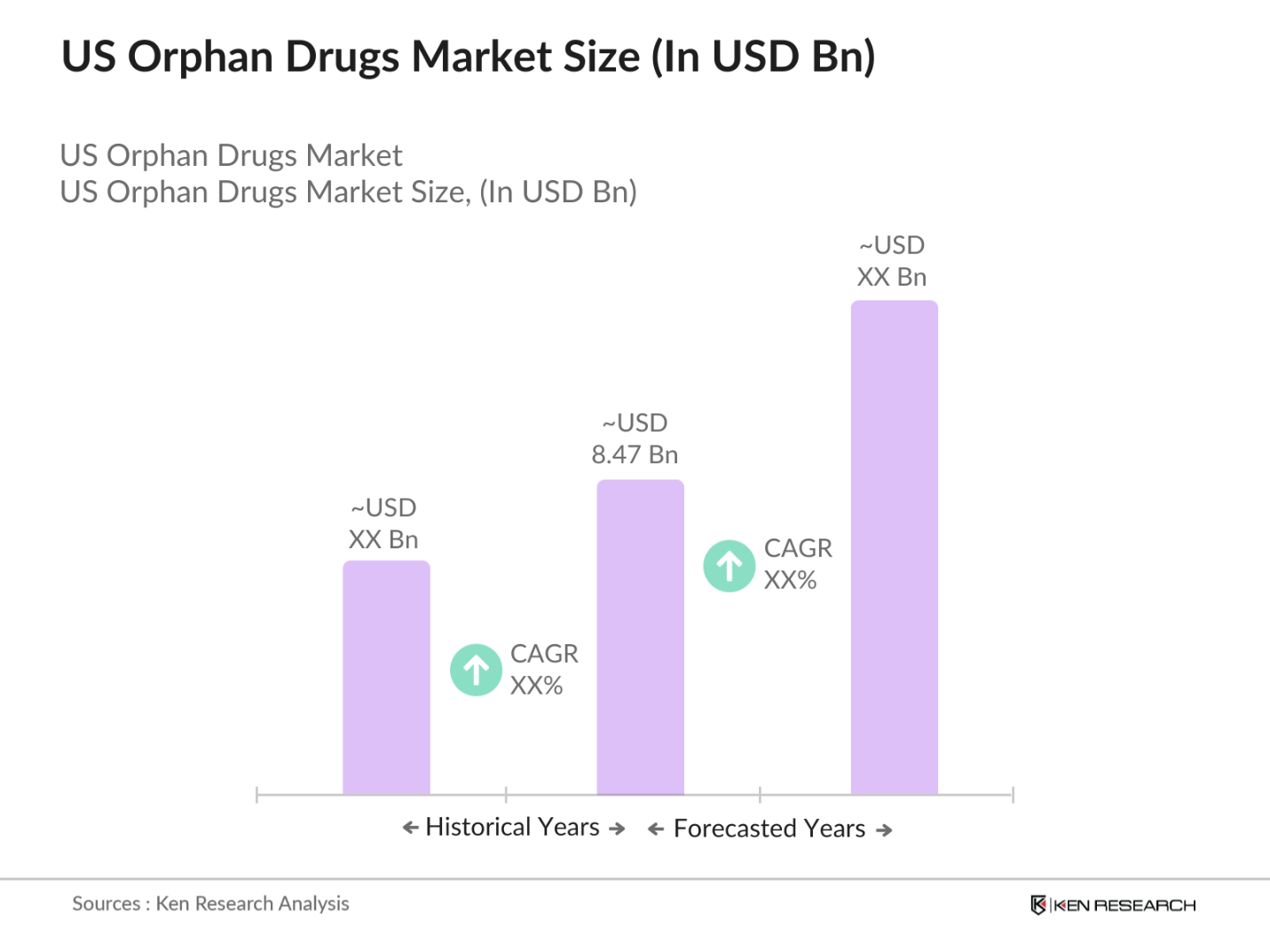
The US Orphan Drugs market is valued at USD 8.47 billion, driven by strong government support, increasing R&D investments, and a rising number of FDA-approved orphan drugs.
Challenges in the US Orphan Drugs market include high development costs, regulatory complexities, and a limited patient population for many orphan drugs, which can restrict revenue potential for pharmaceutical companies.
Key players in the US Orphan Drugs market include Novartis AG, Pfizer Inc., Roche Holding AG, Amgen Inc., and Vertex Pharmaceuticals. These companies lead the market due to their extensive R&D investments and multiple orphan drug approvals.
The US Orphan Drugs market is driven by favorable government incentives, advancements in biotechnology, and the increasing prevalence of rare diseases. Additionally, patient advocacy and FDA support play a crucial role in market expansion.
Key trends in the US Orphan Drugs market include the rise of biologics and gene therapies, a focus on personalized medicine, and the increasing role of patient advocacy in driving drug development and approval processes.

What makes us stand out is that our consultants follows Robust, Refine and Result (RRR) methodology. i.e. Robust for clear definitions, approaches and sanity checking, Refine for differentiating respondents facts and opinions and Result for presenting data with story

We have set a benchmark in the industry by offering our clients with syndicated and customized market research reports featuring coverage of entire market as well as meticulous research and analyst insights.

While we don't replace traditional research, we flip the method upside down. Our dual approach of Top Bottom & Bottom Top ensures quality deliverable by not just verifying company fundamentals but also looking at the sector and macroeconomic factors.

With one step in the future, our research team constantly tries to show you the bigger picture. We help with some of the tough questions you may encounter along the way: How is the industry positioned? Best marketing channel? KPI's of competitors? By aligning every element, we help maximize success.

Our report gives you instant access to the answers and sources that other companies might choose to hide. We elaborate each steps of research methodology we have used and showcase you the sample size to earn your trust.

If you need any support, we are here! We pride ourselves on universe strength, data quality, and quick, friendly, and professional service.