















U.S. Small Refrigerator Market Outlook to 2030
Region:North America
Author(s):Shubham Kashyap
Product Code:KROD9204
December 2024
99
About the Report
U.S. Small Refrigerator Market Overview
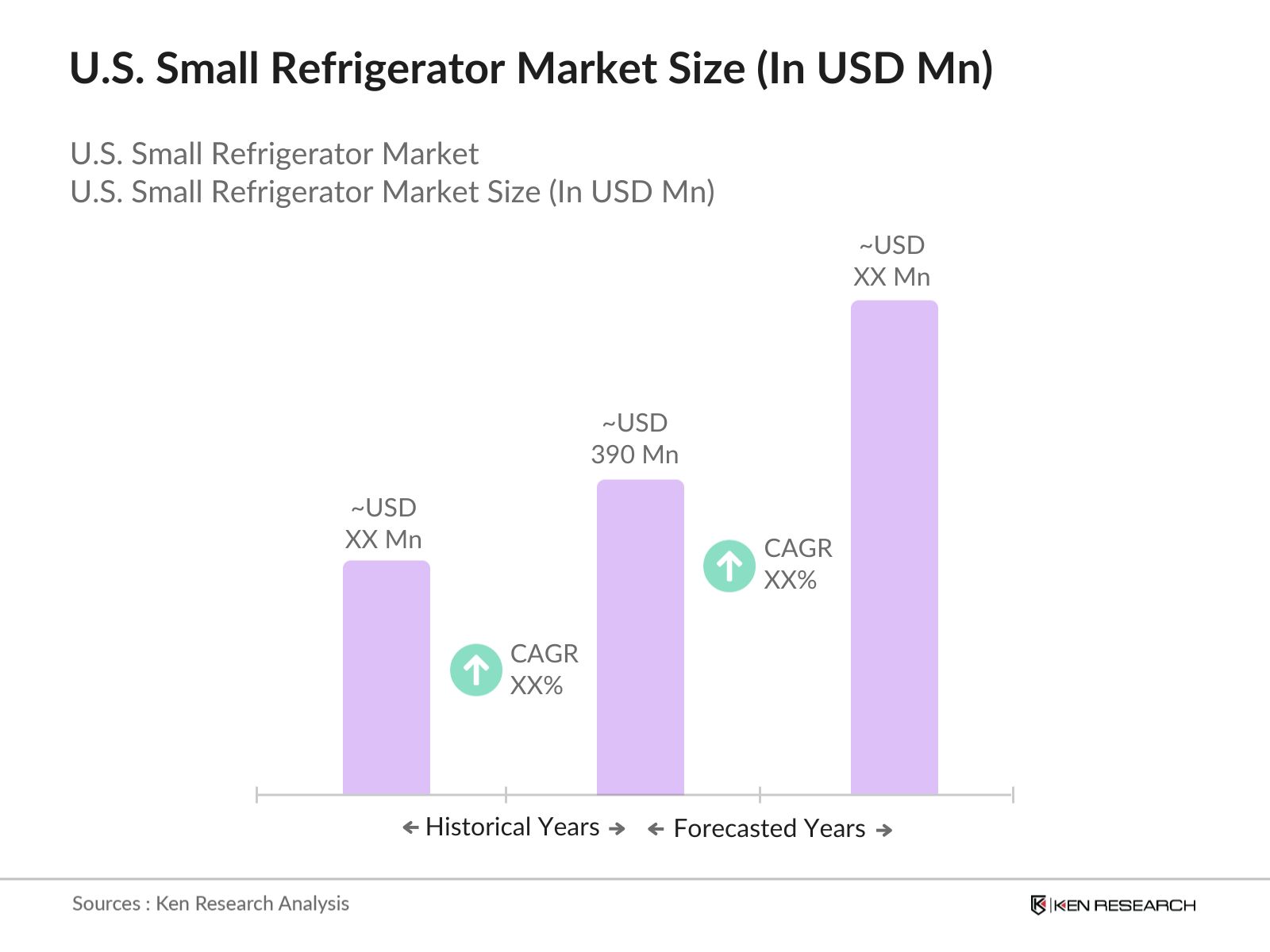
- The U.S. Small Refrigerator Market is valued at USD 390 million, primarily driven by the increasing demand for compact, energy-efficient refrigerators suitable for small living spaces. This demand is largely propelled by urbanization trends, the rise of single-person households, and the growing popularity of remote work setups. Additionally, advancements in refrigeration technology, including smart features and improved energy efficiency, contribute to market growth. With consumers prioritizing convenience and sustainability, small refrigerators are becoming essential in various applications, reinforcing the U.S. as a key market for compact refrigeration solutions.
- Major demand centers for small refrigerators in the U.S. include cities such as New York, Los Angeles, and Chicago, where population density and apartment living are prevalent. These cities drive market demand due to limited living spaces and the need for practical, compact appliances. The hospitality industry in these urban areas also significantly contributes to the market, as hotels, short-term rentals, and vacation properties require small refrigerators to cater to guest needs, thereby fueling market expansion.
- Energy efficiency standards in North America are becoming more stringent, with federal regulations requiring higher performance for materials used in building and construction. The U.S. Department of Energys recent policies mandate a reduction in building energy consumption by over 20% by 2025. Self-healing materials play a vital role in meeting these standards by offering enhanced insulation and durability, reducing energy losses.
U.S. Small Refrigerator Market Segmentation
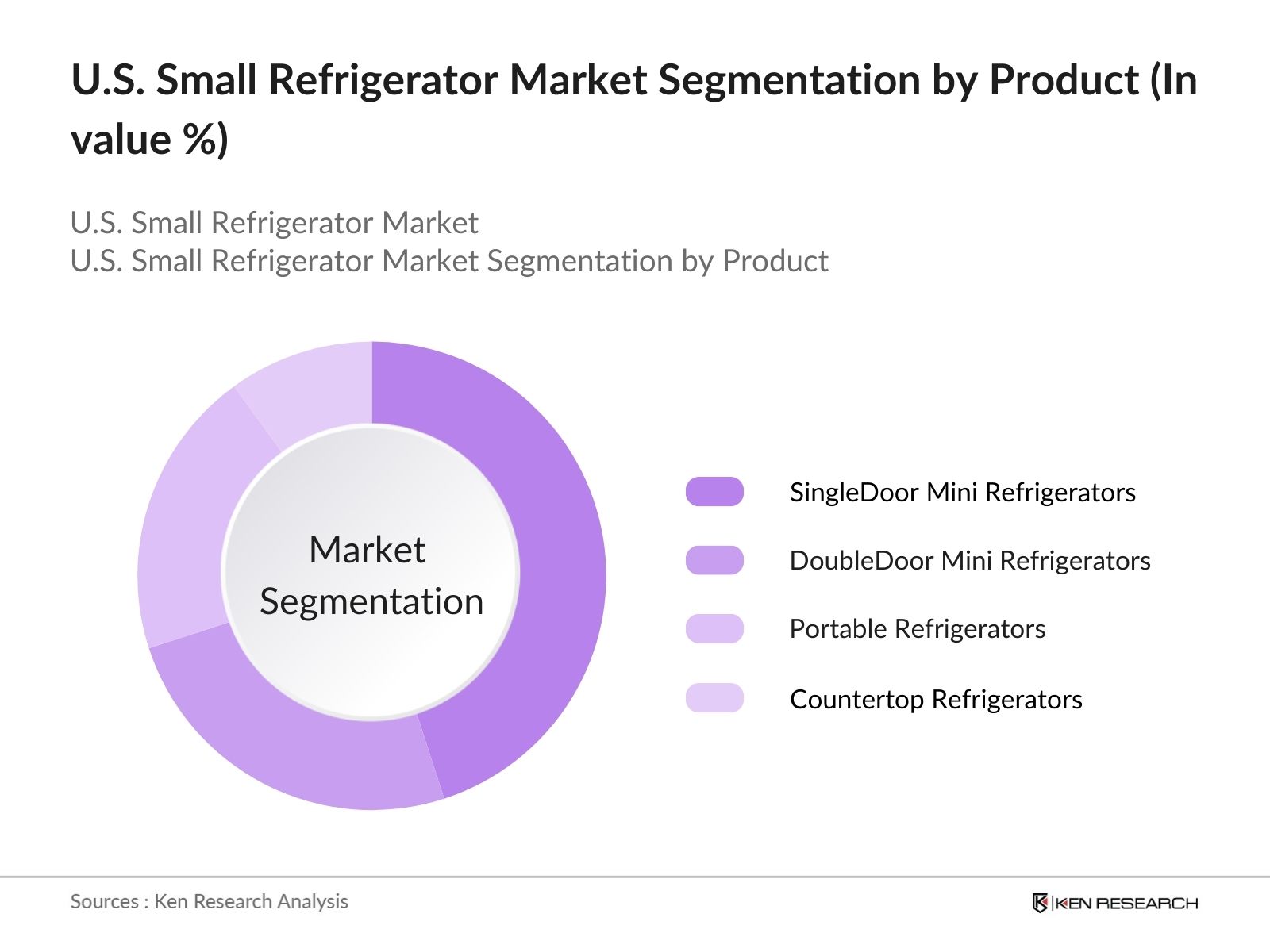
- By Product Type: The Market is segmented by product type into single door mini refrigerators, double-door mini refrigerators, portable refrigerators, and countertop refrigerators. Single door mini refrigerators hold a dominant market share due to their cost-effectiveness, space-saving design, and sufficient storage capacity. They cater to a wide range of consumers, including students, professionals, and individuals living in small spaces. These refrigerators are especially popular in dorm rooms, small apartments, and offices, where affordability and compact design are prioritized by consumers seeking functional and efficient cooling solutions.
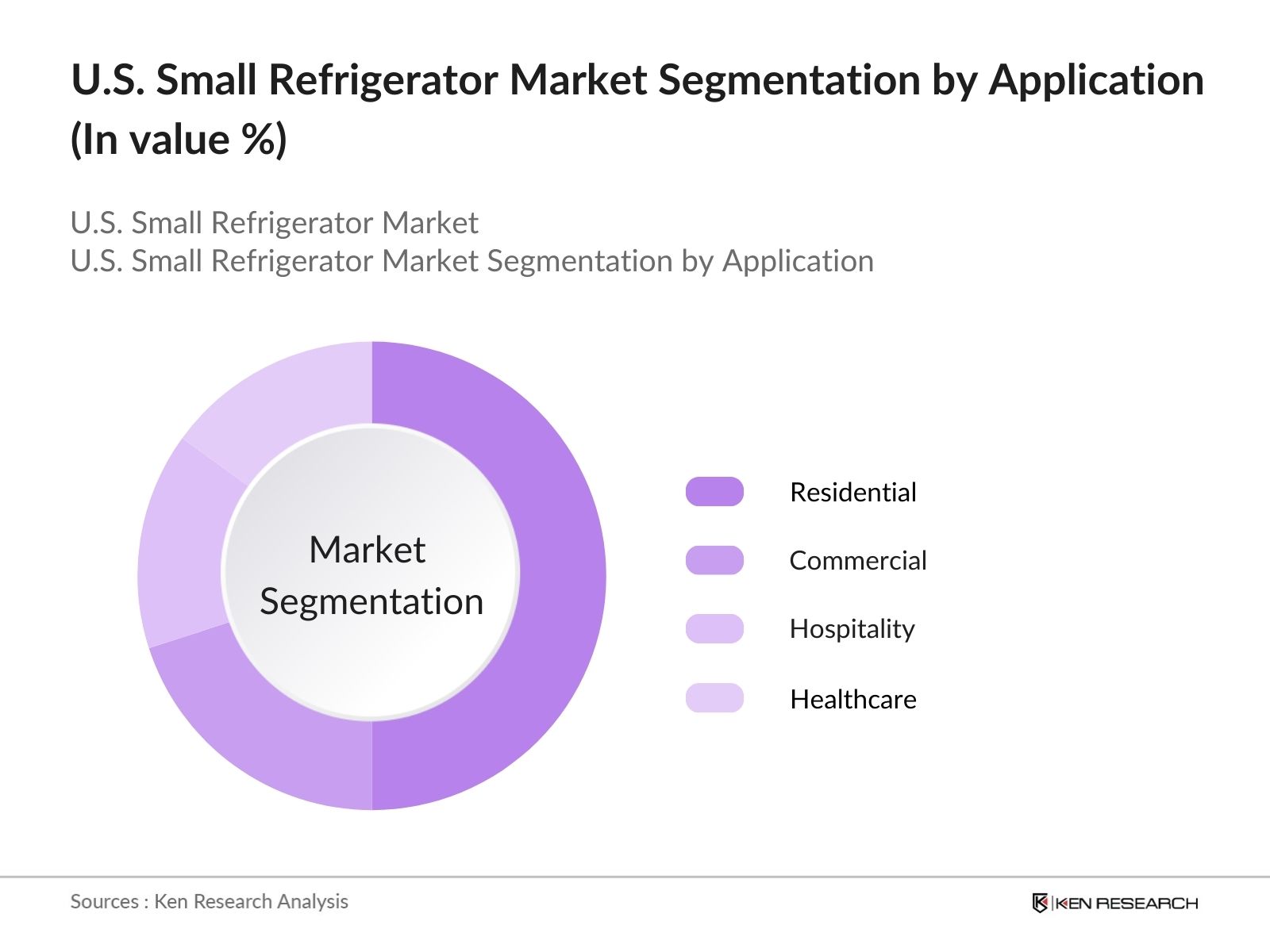
- By Application: The market is segmented by application into residential, commercial, hospitality, and healthcare. The residential segment leads the market, driven by the demand for compact and efficient refrigerators among urban dwellers and smaller households. As people increasingly seek appliances that fit within limited spaces without compromising functionality, small refrigerators are becoming a staple in U.S. homes. The convenience and energy efficiency offered by these appliances align with the needs of modern households, where space is often at a premium, and environmental considerations are influential factors in purchasing decisions.
U.S. Small Refrigerator Market Competitive Landscape
The U.S. small refrigerator market is characterized by the presence of both established domestic brands and international companies. This competitive landscape is shaped by product innovation, energy efficiency standards, and the integration of smart technology, which help brands differentiate themselves and capture market share. With multiple players in the market, consumers have a wide range of options, fostering a dynamic and competitive environment. 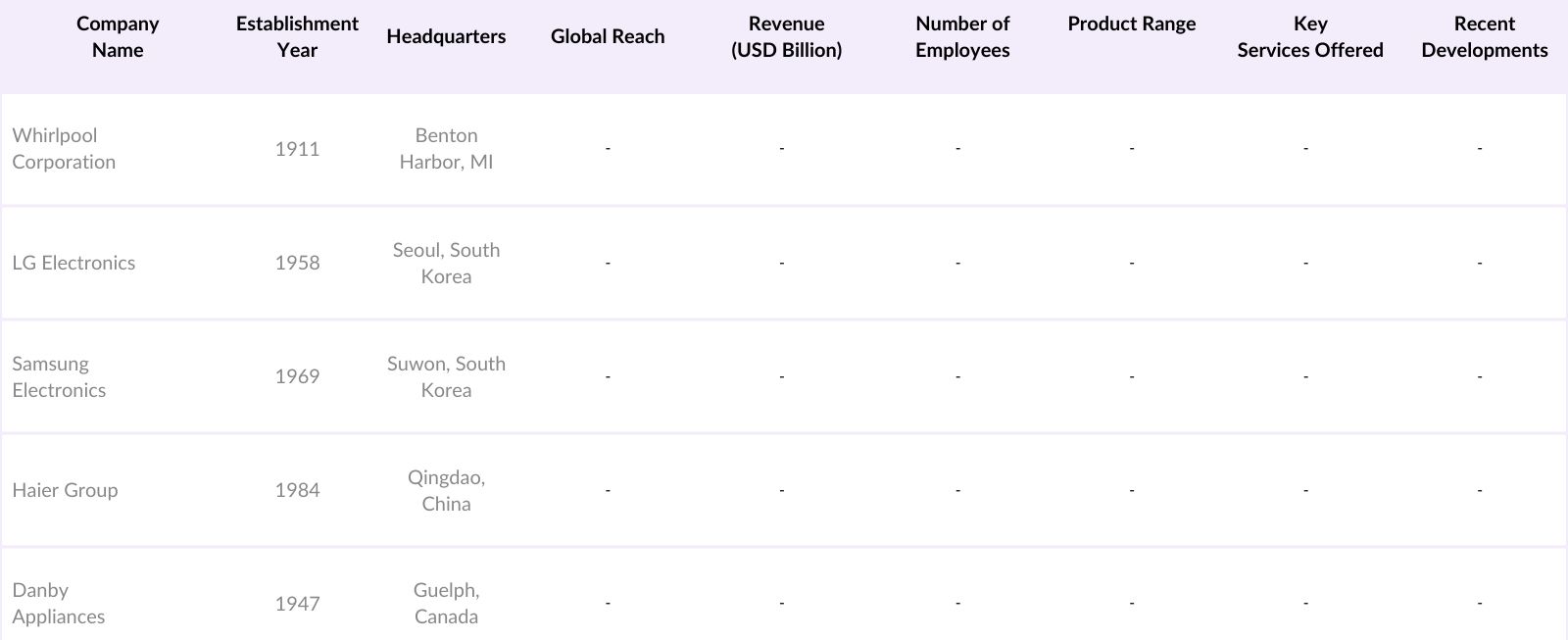
U.S. Small Refrigerator Market Analysis
Growth Drivers
- Increasing Demand in Urban and Residential Sectors: As urbanization progresses rapidly in North America, population density in urban areas is expected to increase by over 1 million new residents annually, according to the United States Census Bureau. This shift drives demand for advanced, durable products that can adapt to high-usage environments. Housing expansion, supported by investments in infrastructure, further promotes the adoption of self-healing materials, particularly in high-traffic zones. With cities like New York and Los Angeles expanding urban redevelopment projects by over 2% year-on-year, infrastructure materials that reduce long-term maintenance costs are critical for sustaining urban growth and operational efficiency in major North American cities.
- Rising Disposable Income: The disposable income of households in North America has shown a notable increase, averaging over USD 64,700 per household in the U.S. as per the U.S. Bureau of Economic Analysis. With higher purchasing power, consumers are increasingly investing in premium, resilient materials that offer cost-saving benefits over time. This trend is especially evident in the real estate and automotive industries, where higher disposable incomes enable buyers to prioritize quality and durability, spurring demand for self-healing materials that enhance product life span, lower maintenance, and increase consumer value in sectors ranging from home renovation to electric vehicles.
- Technological Advancements: The self-healing materials market is benefiting from substantial R&D investment in nanotechnology and material science, with federal agencies allocating over USD 72 million to innovative materials research in the 2023 fiscal year. Advancements are driving product enhancements that improve self-repair capabilities, especially in construction and electronics sectors. For instance, companies are leveraging new polymer technologies to develop materials that can self-heal within seconds of minor damage, offering significant advantages in reducing operational downtimes and lowering maintenance costs. This ongoing investment accelerates innovation, positioning North America at the forefront of high-performance, self-healing solutions.
Challenges
- High Competition from Imports: The influx of low-cost imported materials, particularly from Asia, poses a significant competitive challenge for North American manufacturers. The availability of advanced, affordable materials from overseas drives competition and pressures local producers to innovate while maintaining quality standards. This competitive environment demands that North American companies establish unique value propositions and uphold stringent standards. The preference for cost-effective imports affects domestic companies, especially small and mid-sized firms, as they compete in terms of price and durability, requiring them to balance innovation with cost-effectiveness.
- Fluctuating Raw Material Prices: The volatility of raw material prices in recent years has impacted manufacturing costs for self-healing materials. Price fluctuations in chemical feedstocks, influenced by changes in energy costs, create challenges for companies in managing production budgets and stabilizing supply chains. As key materials like polymers and resins experience price variations, manufacturers face the challenge of maintaining affordability while incorporating self-healing capabilities. This volatility particularly impacts sectors such as automotive and consumer electronics, where cost sensitivity is essential, pushing companies to find solutions that can balance performance and price stability.
U.S. Small Refrigerator Market Future Outlook
The U.S. Small Refrigerator Market is anticipated to show steady growth, driven by the ongoing demand for compact, energyefficient solutions. Technological advancements, such as smart features and ecofriendly designs, will likely play a pivotal role in market expansion. Additionally, the ecommerce boom is expected to widen market access, providing consumers with greater choice and competitive pricing. Manufacturers are anticipated to increase investment in R&D, aiming to enhance product quality, energy efficiency, and integration with smart home systems.
Future Market Opportunities
- Expansion into Smart Home Integration: The smart home market in North America, has witnessed remarkable growth in recent years. This expansion opens significant opportunities for self-healing materials to enhance device longevity and reliability in high-tech home applications. Self-healing coatings in smart home devices reduce wear and tear, minimizing maintenance needs. As smart home adoption rises, projected to reach over 40% of households in the U.S. by the end of 2024, self-healing solutions offer an attractive value proposition, enhancing product resilience and integrating with sustainability-driven consumer preferences.
- Growth in E-commerce Channels: E-commerce in North America has become a primary sales channel, with a projected USD 1 trillion in annual sales by the end of 2024. The growth of online shopping platforms allows self-healing materials manufacturers to reach a broader audience, especially for consumer products. With high online spending and increasing consumer demand for quality products, e-commerce offers a direct path to market, bypassing traditional retail constraints. This growth provides an accessible platform for companies to showcase innovations and reach environmentally conscious consumers actively seeking advanced materials.
Scope of the Report
|
By Product Type |
Single Door Mini Refrigerators |
|
By Application |
Residential |
|
By Distribution Channel |
Online Retail |
|
By Capacity |
Up to 1.5 cu. ft. |
|
By Region |
Northeast |
Products
Key Target Audience
Home Appliance Manufacturers
Electronics Retailers
Hospitality Industry Stakeholders
Healthcare Facility Managers
Real Estate Developers
Investors and Venture Capitalist Firms
Banks and Financial Institutions
Government and Regulatory Bodies (e.g., U.S. Department of Energy)
Companies
Players Mentioned in the Report
Whirlpool Corporation
LG Electronics
Samsung Electronics
Haier Group
Danby Appliances
Electrolux AB
Hisense
Midea Group
Avanti Products
Smeg USA
Liebherr Appliances
GE Appliances
Bosch Home Appliances
Frigidaire
Magic Chef
Table of Contents
1. U.S. Small Refrigerator Market Overview
1.1 Definition and Scope
1.2 Market Taxonomy
1.3 Market Growth Rate
1.4 Market Segmentation Overview
2. U.S. Small Refrigerator Market Size (in USD Million)
2.1 Historical Market Size
2.2 Year-On-Year Growth Analysis
2.3 Key Market Developments and Milestones
3. U.S. Small Refrigerator Market Analysis
3.1 Growth Drivers
3.1.1 Urbanization
3.1.2 Rising Disposable Income
3.1.3 Technological Advancements
3.1.4 Increasing Demand for Energy-Efficient Appliances
3.2 Market Challenges
3.2.1 High Competition from Imports
3.2.2 Fluctuating Raw Material Prices
3.2.3 Regulatory Compliance
3.3 Opportunities
3.3.1 Expansion into Smart Home Integration
3.3.2 Growth in E-commerce Channels
3.3.3 Demand in Hospitality and Healthcare Sectors
3.4 Trends
3.4.1 Adoption of Smart Technologies
3.4.2 Preference for Compact and Portable Designs
3.4.3 Emphasis on Sustainability and Eco-Friendly Products
3.5 Government Regulations
3.5.1 Energy Efficiency Standards
3.5.2 Environmental Protection Policies
3.5.3 Trade Tariffs and Import Regulations
3.6 SWOT Analysis
3.7 Stakeholder Ecosystem
3.8 Porter’s Five Forces Analysis
3.9 Competitive Landscape
4. U.S. Small Refrigerator Market Segmentation
4.1 By Product Type (in Value %)
4.1.1 Single Door Mini Refrigerators
4.1.2 Double Door Mini Refrigerators
4.1.3 Portable Refrigerators
4.1.4 Countertop Refrigerators
4.2 By Application (in Value %)
4.2.1 Residential
4.2.2 Commercial
4.2.3 Hospitality
4.2.4 Healthcare
4.3 By Distribution Channel (in Value %)
4.3.1 Online Retail
4.3.2 Offline Retail
4.3.2.1 Specialty Stores
4.3.2.2 Supermarkets/Hypermarkets
4.3.2.3 Department Stores
4.4 By Capacity (in Value %)
4.4.1 Up to 1.5 cu. ft.
4.4.2 1.5 to 3.0 cu. ft.
4.4.3 Above 3.0 cu. ft.
4.5 By Region (in Value %)
4.5.1 Northeast
4.5.2 Midwest
4.5.3 South
4.5.4 West
5. U.S. Small Refrigerator Market Competitive Analysis
5.1 Detailed Profiles of Major Companies
Whirlpool Corporation
LG Electronics
Samsung Electronics
Haier Group Corporation
Electrolux AB
Hisense
Midea Group
Danby Appliances
Avanti Products
Smeg USA
Liebherr Appliances
GE Appliances
Bosch Home Appliances
Frigidaire
Magic Chef
5.2 Cross Comparison Parameters
5.2.1 Number of Employees
5.2.2 Headquarters Location
5.2.3 Year of Establishment
5.2.4 Revenue
5.2.5 Product Portfolio
5.2.6 Market Share
5.2.7 Recent Developments
5.2.8 Strategic Initiatives
5.3 Market Share Analysis
5.4 Strategic Initiatives
Mergers and Acquisitions
Investment Analysis
Venture Capital Funding
Government Grants
Private Equity Investments
6. U.S. Small Refrigerator Market Regulatory Framework
6.1 Environmental Standards
6.2 Compliance Requirements
6.3 Certification Processes
7. U.S. Small Refrigerator Market Future Projections
7.1 Future Market Size (in USD Million)
7.2 Future Market Size Projections
7.3 Key Factors Driving Future Market Growth
8. U.S. Small Refrigerator Market Future Segmentation
8.1 By Product Type (in Value %)
8.2 By Application (in Value %)
8.3 By Distribution Channel (in Value %)
8.4 By Capacity (in Value %)
8.5 By Region (in Value %)
9. U.S. Small Refrigerator Market Analysts' Recommendations
9.1 Total Addressable Market (TAM), Serviceable Available Market (SAM), and Serviceable Obtainable Market (SOM) Analysis
9.2 Customer Cohort Analysis
9.3 Marketing Initiatives
9.4 White Space Opportunity Analysis
10. Disclaimer
10.1 Contact Us
Research Methodology
Step 1: Identification of Key Variables
The initial phase of the research methodology involves identifying the primary factors influencing the U.S. Small Refrigerator Market. This includes extensive desk research to develop a comprehensive understanding of the market's ecosystem, encompassing manufacturers, suppliers, distributors, and endusers. Key variables such as product innovation, pricing, consumer preferences, and energy efficiency standards are defined to shape the study’s focus.
Step 2: Market Analysis and Data Collection
In this phase, historical data on the U.S. Small Refrigerator Market is compiled from a variety of sources, including industry reports, government publications, and company financials. Quantitative and qualitative analyses are conducted to evaluate market trends, growth drivers, and barriers. Primary research through surveys and interviews with industry experts further enhances the accuracy and depth of data.
Step 3: Data Validation through Expert Consultation
To ensure data accuracy and reliability, hypotheses are validated through interviews with key stakeholders in the industry, including manufacturers, suppliers, and retail partners. This step involves ComputerAssisted Telephone Interviews (CATIs) and online surveys with professionals who offer insights into market conditions, operational trends, and future growth potential. This expert validation serves to refine and verify findings.
Step 4: Data Synthesis and Final Output
In the final stage, all collected data is synthesized into a comprehensive market report, which is structured to provide detailed insights into current market dynamics and future projections. Data is analyzed using bottomup and top-down approaches, ensuring a thorough, well-rounded assessment of the U.S. Small Refrigerator Market. The final report is reviewed for accuracy and relevance before publication.
Frequently Asked Questions
01. How big is the U.S. Small Refrigerator Market?
The U.S. Small Refrigerator Market is valued at USD 390 million, driven by growing consumer demand for compact, energy-efficient refrigeration solutions suitable for small living spaces, especially in urban areas.
02. What are the primary growth drivers of the U.S. Small Refrigerator Market?
The U.S. Small Refrigerator market is driven by urbanization trends, the rise of single-person households, advancements in energy-efficient technologies, and the increasing adoption of smart home appliances, all of which contribute to the demand for small refrigerators.
03. Who are the major players in the U.S. Small Refrigerator Market?
Key players in the U.S. Small Refrigerator market include Whirlpool Corporation, LG Electronics, Samsung Electronics, Haier Group, and Danby Appliances. These companies dominate due to their strong brand presence, product innovation, and extensive distribution networks.
04. What challenges does the U.S. Small Refrigerator Market face?
Challenges in the U.S. Small Refrigerator market include high competition, which leads to pricing pressures, as well as volatility in raw material prices, which can impact manufacturing costs and, consequently, profit margins for manufacturers.
Why Buy From Us?

What makes us stand out is that our consultants follows Robust, Refine and Result (RRR) methodology. i.e. Robust for clear definitions, approaches and sanity checking, Refine for differentiating respondents facts and opinions and Result for presenting data with story

We have set a benchmark in the industry by offering our clients with syndicated and customized market research reports featuring coverage of entire market as well as meticulous research and analyst insights.

While we don't replace traditional research, we flip the method upside down. Our dual approach of Top Bottom & Bottom Top ensures quality deliverable by not just verifying company fundamentals but also looking at the sector and macroeconomic factors.

With one step in the future, our research team constantly tries to show you the bigger picture. We help with some of the tough questions you may encounter along the way: How is the industry positioned? Best marketing channel? KPI's of competitors? By aligning every element, we help maximize success.

Our report gives you instant access to the answers and sources that other companies might choose to hide. We elaborate each steps of research methodology we have used and showcase you the sample size to earn your trust.

If you need any support, we are here! We pride ourselves on universe strength, data quality, and quick, friendly, and professional service.