US Sustainable Apparel & Online Fashion Market

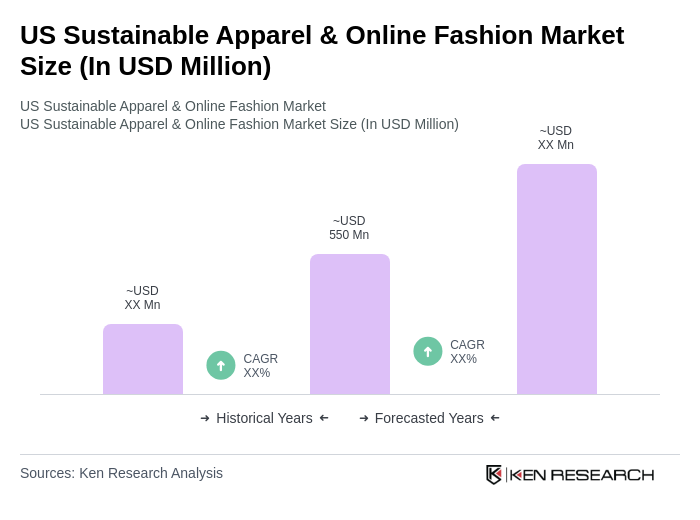
The US Sustainable Apparel & Online Fashion Market, valued at $550 Mn, is growing due to demand for eco-friendly products, e-commerce rise, and sustainable innovations.

Region:North America

Author(s):Geetanshi

Product Code:KRAA3729

Pages:97

Published On:September 2025
About the Report

Base Year 2024

US Sustainable Apparel & Online Fashion Market Overview

  • The US Sustainable Apparel & Online Fashion Market is valued at USD 550 million, based on a five-year historical analysis. This growth is primarily driven by increasing consumer awareness of environmental sustainability, the rise of ethical fashion, and the demand for transparency in supply chains. The market has seen a significant shift towards sustainable practices, with brands adopting eco-friendly materials such as organic cotton, bamboo fibers, and recycled fabrics, as well as circular economy models to minimize waste and extend product lifecycles. The integration of blockchain technology in supply chains is also enhancing transparency, allowing consumers to track the journey of their products from raw materials to finished goods, further driving consumer trust and market growth .
  • Key players in this market are concentrated in major cities such as New York, Los Angeles, and San Francisco, which dominate due to their established fashion industries, innovative startups, and access to a large, eco-conscious consumer base. These cities are recognized hubs for sustainability initiatives, attracting brands that prioritize eco-friendly practices and resonate with environmentally aware consumers .
  • In 2023, the State of New York introduced the Fashion Sustainability and Social Accountability Act, which requires fashion retailers and manufacturers doing business in New York and generating over USD 100 million in global revenue to map at least 50% of their supply chain, disclose environmental and social due diligence policies, and report on the impact of their operations. This regulation, issued by the New York State Legislature, aims to promote transparency and accountability in the fashion industry, encouraging companies to adopt sustainable practices and improve their overall environmental footprint .
US Sustainable Apparel & Online Fashion Market Size

US Sustainable Apparel & Online Fashion Market Segmentation

By Type:The market is segmented into various types of sustainable apparel and fashion products. The subsegments include Organic Cotton Apparel, Recycled Polyester Clothing, Eco-friendly Footwear, Sustainable Activewear, Vegan Leather Products, Upcycled Fashion Items, and Others. Among these,Organic Cotton Apparelis currently leading the market due to its widespread acceptance and consumer preference for natural fibers that are less harmful to the environment. The growing trend of eco-conscious consumerism, coupled with increased brand adoption of organic cotton and recycled fabrics, has significantly boosted the demand for these segments .
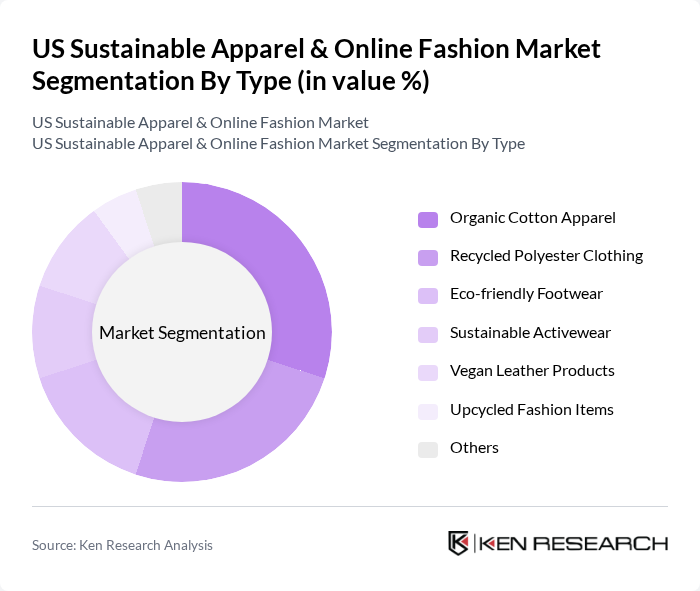
US Sustainable Apparel & Online Fashion Market segmentation by Type.

By End-User:The market is also segmented by end-user demographics, which include Men, Women, and Children.Women’s appareldominates this segment, driven by higher engagement in fashion trends and a growing interest in sustainable options. Women are increasingly seeking out brands that align with their values, particularly those that emphasize sustainability and ethical production practices. This trend is further supported by marketing strategies that target female consumers, making them the primary drivers of growth in the sustainable apparel market .

US Sustainable Apparel & Online Fashion Market segmentation by End-User.

US Sustainable Apparel & Online Fashion Market Competitive Landscape

The US Sustainable Apparel & Online Fashion Market is characterized by a dynamic mix of regional and international players. Leading participants such as Patagonia, Inc., Eileen Fisher, Inc., Allbirds, Inc., Reformation, Inc., Everlane, Inc., Tentree International, Inc., Outerknown, LLC, Amour Vert, Inc., TOMS Shoes, LLC, Veja North America, Inc., PACT Apparel, LLC, Thought Clothing, Ltd., Nisolo, Inc., Frank And Oak, Inc., Girlfriend Collective, Inc. contribute to innovation, geographic expansion, and service delivery in this space.

Patagonia, Inc.

1973

Ventura, California

Eileen Fisher, Inc.

1984

Irvington, New York

Allbirds, Inc.

2016

San Francisco, California

Reformation, Inc.

2009

Los Angeles, California

Everlane, Inc.

2010

San Francisco, California

Company

Establishment Year

Headquarters

Group Size (Large, Medium, or Small as per industry convention)

Revenue Growth Rate (YoY %)

Gross Margin (%)

Customer Acquisition Cost (CAC)

Average Order Value (AOV)

Customer Retention Rate (%)

US Sustainable Apparel & Online Fashion Market Industry Analysis

Growth Drivers

  • Increasing Consumer Demand for Sustainable Products:The US sustainable apparel market is witnessing a surge in consumer demand, with sales reaching approximately $6.9 billion in future. This growth is driven by a growing awareness of environmental issues, as 75% of consumers express a preference for brands that prioritize sustainability. The trend is further supported by the projected increase in eco-conscious spending, expected to reach $160 billion in future, highlighting a significant shift in consumer behavior towards sustainable products.
  • Rise of E-commerce Platforms:E-commerce sales in the US are projected to exceed $1.2 trillion in future, significantly impacting the sustainable apparel sector. Online platforms provide greater accessibility to sustainable brands, with 65% of consumers preferring to shop online for eco-friendly products. The convenience of e-commerce, combined with targeted marketing strategies, is expected to drive a 30% increase in online sales of sustainable apparel, further solidifying the market's growth trajectory.
  • Innovations in Sustainable Materials:The development of sustainable materials is revolutionizing the apparel industry, with the market for recycled textiles projected to reach $12 billion in future. Innovations such as bio-based fabrics and waterless dyeing technologies are gaining traction, reducing environmental impact. Companies investing in these technologies are expected to see a 35% reduction in production waste, appealing to environmentally conscious consumers and enhancing brand loyalty in the sustainable apparel market.

Market Challenges

  • High Production Costs:The production costs for sustainable apparel are significantly higher than traditional garments, with estimates indicating a 25-35% premium. This cost disparity poses a challenge for brands aiming to maintain competitive pricing while adhering to sustainable practices. As a result, many companies struggle to balance profitability with sustainability, potentially limiting market growth and consumer adoption of eco-friendly apparel options.
  • Limited Consumer Awareness:Despite the growing interest in sustainable fashion, consumer awareness remains a significant barrier. Research indicates that only 45% of consumers can identify sustainable brands, which hampers market penetration. This lack of awareness is compounded by misinformation regarding sustainable practices, making it essential for brands to invest in educational marketing strategies to enhance consumer understanding and drive demand for sustainable apparel.

US Sustainable Apparel & Online Fashion Market Future Outlook

The future of the US sustainable apparel market appears promising, driven by increasing consumer awareness and technological advancements. As brands adopt innovative practices and materials, the market is expected to evolve towards greater transparency and circularity. Additionally, the integration of digital solutions will enhance consumer engagement, allowing for personalized shopping experiences. These trends indicate a robust growth trajectory, positioning sustainable apparel as a key player in the broader fashion industry landscape.

Market Opportunities

  • Expansion of Online Retail Channels:The growth of online retail channels presents a significant opportunity for sustainable apparel brands. With e-commerce projected to account for 30% of total retail sales in future, brands can leverage digital platforms to reach a broader audience. This shift allows for targeted marketing and enhanced customer engagement, driving sales and brand loyalty in the sustainable fashion sector.
  • Growth in Second-hand and Rental Markets:The second-hand and rental apparel markets are expected to grow to $70 billion in future, driven by sustainability trends. This growth presents an opportunity for sustainable brands to tap into the circular economy, offering consumers eco-friendly alternatives. By promoting rental and resale options, brands can attract environmentally conscious consumers while reducing waste and extending product life cycles.

Scope of the Report

SegmentSub-Segments
By Type

Organic Cotton Apparel

Recycled Polyester Clothing

Eco-friendly Footwear

Sustainable Activewear

Vegan Leather Products

Upcycled Fashion Items

Others

By End-User

Men

Women

Children

By Sales Channel

Online Retail

Brick-and-Mortar Stores

Direct-to-Consumer

Wholesale Distribution

By Price Range

Budget

Mid-range

Premium

By Material

Organic Fabrics (cotton, hemp, linen)

Recycled Fabrics (polyester, nylon)

Natural Fibers (bamboo, wool)

Regenerated Fabrics (Tencel, modal)

Blended Fabrics

By Consumer Demographics

Millennials

Gen Z

Baby Boomers

By Sustainability Certification

GOTS Certified

Fair Trade Certified

OEKO-TEX Certified

Others

Key Target Audience

Investors and Venture Capitalist Firms

Government and Regulatory Bodies (e.g., Environmental Protection Agency, Federal Trade Commission)

Manufacturers and Producers

Distributors and Retailers

Fashion Brands and Designers

Non-Governmental Organizations (NGOs) focused on sustainability

Logistics and Supply Chain Companies

Certification Bodies for Sustainable Practices

Players Mentioned in the Report:

Patagonia, Inc.

Eileen Fisher, Inc.

Allbirds, Inc.

Reformation, Inc.

Everlane, Inc.

Tentree International, Inc.

Outerknown, LLC

Amour Vert, Inc.

TOMS Shoes, LLC

Veja North America, Inc.

PACT Apparel, LLC

Thought Clothing, Ltd.

Nisolo, Inc.

Frank And Oak, Inc.

Girlfriend Collective, Inc.

Table of Contents

Market Assessment Phase

1. Executive Summary and Approach


2. US Sustainable Apparel & Online Fashion Market Overview

2.1 Key Insights and Strategic Recommendations

2.2 US Sustainable Apparel & Online Fashion Market Overview

2.3 Definition and Scope

2.4 Evolution of Market Ecosystem

2.5 Timeline of Key Regulatory Milestones

2.6 Value Chain & Stakeholder Mapping

2.7 Business Cycle Analysis

2.8 Policy & Incentive Landscape


3. US Sustainable Apparel & Online Fashion Market Analysis

3.1 Growth Drivers

3.1.1 Increasing Consumer Demand for Sustainable Products
3.1.2 Rise of E-commerce Platforms
3.1.3 Innovations in Sustainable Materials
3.1.4 Government Support for Sustainable Practices

3.2 Market Challenges

3.2.1 High Production Costs
3.2.2 Limited Consumer Awareness
3.2.3 Supply Chain Complexity
3.2.4 Competition from Fast Fashion Brands

3.3 Market Opportunities

3.3.1 Expansion of Online Retail Channels
3.3.2 Collaborations with Eco-friendly Brands
3.3.3 Growth in Second-hand and Rental Markets
3.3.4 Increasing Investment in Sustainable Technologies

3.4 Market Trends

3.4.1 Shift Towards Circular Fashion
3.4.2 Personalization and Customization in Apparel
3.4.3 Increased Transparency in Supply Chains
3.4.4 Adoption of Digital Fashion Solutions

3.5 Government Regulation

3.5.1 Environmental Protection Regulations
3.5.2 Labor Standards and Fair Trade Practices
3.5.3 Waste Management Policies
3.5.4 Tax Incentives for Sustainable Practices

4. SWOT Analysis


5. Stakeholder Analysis


6. Porter's Five Forces Analysis


7. US Sustainable Apparel & Online Fashion Market Market Size, 2019-2024

7.1 By Value

7.2 By Volume

7.3 By Average Selling Price


8. US Sustainable Apparel & Online Fashion Market Segmentation

8.1 By Type

8.1.1 Organic Cotton Apparel
8.1.2 Recycled Polyester Clothing
8.1.3 Eco-friendly Footwear
8.1.4 Sustainable Activewear
8.1.5 Vegan Leather Products
8.1.6 Upcycled Fashion Items
8.1.7 Others

8.2 By End-User

8.2.1 Men
8.2.2 Women
8.2.3 Children

8.3 By Sales Channel

8.3.1 Online Retail
8.3.2 Brick-and-Mortar Stores
8.3.3 Direct-to-Consumer
8.3.4 Wholesale Distribution

8.4 By Price Range

8.4.1 Budget
8.4.2 Mid-range
8.4.3 Premium

8.5 By Material

8.5.1 Organic Fabrics (cotton, hemp, linen)
8.5.2 Recycled Fabrics (polyester, nylon)
8.5.3 Natural Fibers (bamboo, wool)
8.5.4 Regenerated Fabrics (Tencel, modal)
8.5.5 Blended Fabrics

8.6 By Consumer Demographics

8.6.1 Millennials
8.6.2 Gen Z
8.6.3 Baby Boomers

8.7 By Sustainability Certification

8.7.1 GOTS Certified
8.7.2 Fair Trade Certified
8.7.3 OEKO-TEX Certified
8.7.4 Others

9. US Sustainable Apparel & Online Fashion Market Competitive Analysis

9.1 Market Share of Key Players

9.2 Cross Comparison of Key Players

9.2.1 Company Name
9.2.2 Group Size (Large, Medium, or Small as per industry convention)
9.2.3 Revenue Growth Rate (YoY %)
9.2.4 Gross Margin (%)
9.2.5 Customer Acquisition Cost (CAC)
9.2.6 Average Order Value (AOV)
9.2.7 Customer Retention Rate (%)
9.2.8 Online Sales Share (%)
9.2.9 Market Penetration Rate (%)
9.2.10 Brand Awareness Index
9.2.11 Sustainability Index Score (e.g., % of sustainable materials, certifications held)

9.3 SWOT Analysis of Top Players

9.4 Pricing Analysis

9.5 Detailed Profile of Major Companies

9.5.1 Patagonia, Inc.
9.5.2 Eileen Fisher, Inc.
9.5.3 Allbirds, Inc.
9.5.4 Reformation, Inc.
9.5.5 Everlane, Inc.
9.5.6 Tentree International, Inc.
9.5.7 Outerknown, LLC
9.5.8 Amour Vert, Inc.
9.5.9 TOMS Shoes, LLC
9.5.10 Veja North America, Inc.
9.5.11 PACT Apparel, LLC
9.5.12 Thought Clothing, Ltd.
9.5.13 Nisolo, Inc.
9.5.14 Frank And Oak, Inc.
9.5.15 Girlfriend Collective, Inc.

10. US Sustainable Apparel & Online Fashion Market End-User Analysis

10.1 Procurement Behavior of Key Ministries

10.1.1 Government Initiatives for Sustainable Procurement
10.1.2 Budget Allocations for Sustainable Apparel
10.1.3 Collaboration with Sustainable Brands

10.2 Corporate Spend on Infrastructure & Energy

10.2.1 Investment in Sustainable Apparel Initiatives
10.2.2 Budgeting for Eco-friendly Practices
10.2.3 Partnerships with Sustainable Suppliers

10.3 Pain Point Analysis by End-User Category

10.3.1 Cost vs. Sustainability Trade-offs
10.3.2 Availability of Sustainable Options
10.3.3 Quality Concerns with Sustainable Apparel

10.4 User Readiness for Adoption

10.4.1 Awareness of Sustainable Practices
10.4.2 Willingness to Pay for Sustainability
10.4.3 Accessibility of Sustainable Products

10.5 Post-Deployment ROI and Use Case Expansion

10.5.1 Measurement of Sustainability Impact
10.5.2 Long-term Cost Savings from Sustainable Practices
10.5.3 Expansion into New Sustainable Product Lines

11. US Sustainable Apparel & Online Fashion Market Future Size, 2025-2030

11.1 By Value

11.2 By Volume

11.3 By Average Selling Price


Go-To-Market Strategy Phase

1. Whitespace Analysis + Business Model Canvas

1.1 Identification of Market Gaps

1.2 Business Model Development

1.3 Value Proposition Canvas

1.4 Competitive Landscape Analysis

1.5 Customer Segmentation

1.6 Revenue Streams

1.7 Cost Structure


2. Marketing and Positioning Recommendations

2.1 Branding Strategies

2.2 Product USPs

2.3 Target Audience Identification

2.4 Marketing Channels

2.5 Messaging and Communication

2.6 Performance Metrics


3. Distribution Plan

3.1 Urban Retail Strategies

3.2 Rural NGO Tie-ups

3.3 E-commerce Distribution

3.4 Logistics and Supply Chain Management

3.5 Partnerships with Retailers


4. Channel & Pricing Gaps

4.1 Underserved Routes

4.2 Pricing Bands Analysis

4.3 Competitor Pricing Strategies

4.4 Consumer Price Sensitivity

4.5 Recommendations for Pricing Adjustments


5. Unmet Demand & Latent Needs

5.1 Category Gaps in Sustainable Apparel

5.2 Consumer Segments with High Potential

5.3 Emerging Trends in Consumer Preferences

5.4 Recommendations for Product Development


6. Customer Relationship

6.1 Loyalty Programs

6.2 After-sales Service

6.3 Customer Feedback Mechanisms

6.4 Community Engagement Strategies

6.5 Building Brand Loyalty


7. Value Proposition

7.1 Sustainability as a Core Value

7.2 Integrated Supply Chains

7.3 Transparency in Sourcing

7.4 Customer-Centric Innovations

7.5 Long-term Value Creation


8. Key Activities

8.1 Regulatory Compliance

8.2 Branding Initiatives

8.3 Distribution Setup

8.4 Marketing Campaigns

8.5 Stakeholder Engagement


9. Entry Strategy Evaluation

9.1 Domestic Market Entry Strategy

9.1.1 Product Mix Considerations
9.1.2 Pricing Band Strategy
9.1.3 Packaging Innovations

9.2 Export Entry Strategy

9.2.1 Target Countries for Expansion
9.2.2 Compliance Roadmap for Exports

10. Entry Mode Assessment

10.1 Joint Ventures

10.2 Greenfield Investments

10.3 Mergers & Acquisitions

10.4 Distributor Model


11. Capital and Timeline Estimation

11.1 Capital Requirements

11.2 Timelines for Market Entry


12. Control vs Risk Trade-Off

12.1 Ownership vs Partnerships


13. Profitability Outlook

13.1 Breakeven Analysis

13.2 Long-term Sustainability Strategies


14. Potential Partner List

14.1 Distributors

14.2 Joint Ventures

14.3 Acquisition Targets


15. Execution Roadmap

15.1 Phased Plan for Market Entry

15.1.1 Market Setup
15.1.2 Market Entry
15.1.3 Growth Acceleration
15.1.4 Scale & Stabilize

15.2 Key Activities and Milestones

15.2.1 Milestone Planning
15.2.2 Activity Tracking

Research Methodology

ApproachModellingSample

Phase 1: Approach1

Desk Research

  • Analysis of industry reports from organizations such as the Sustainable Apparel Coalition
  • Review of market trends and consumer behavior studies published by fashion industry analysts
  • Examination of government publications on sustainability regulations affecting the apparel sector

Primary Research

  • Interviews with sustainability officers at leading apparel brands
  • Surveys targeting consumers focused on sustainable fashion purchasing habits
  • Focus groups with industry experts and fashion influencers discussing trends in sustainable apparel

Validation & Triangulation

  • Cross-validation of findings through multiple data sources including sales data and consumer surveys
  • Triangulation of insights from expert interviews and desk research findings
  • Sanity checks conducted through peer reviews with industry specialists

Phase 2: Market Size Estimation1

Top-down Assessment

  • Estimation of market size based on overall apparel market growth and sustainability trends
  • Segmentation of the market by product categories such as activewear, casual wear, and formal wear
  • Incorporation of consumer spending data on sustainable apparel from national surveys

Bottom-up Modeling

  • Collection of sales data from key sustainable apparel brands and retailers
  • Estimation of average price points for sustainable apparel products
  • Volume calculations based on production data and retail sales figures

Forecasting & Scenario Analysis

  • Utilization of time-series analysis to project future market growth based on historical data
  • Scenario modeling based on varying levels of consumer adoption of sustainable practices
  • Assessment of potential impacts from regulatory changes and economic factors on market growth

Phase 3: CATI Sample Composition1

Scope Item/SegmentSample SizeTarget Respondent Profiles
Consumer Attitudes towards Sustainable Fashion120Fashion Consumers, Eco-conscious Shoppers
Retailer Perspectives on Sustainable Apparel90Retail Managers, Brand Executives
Supply Chain Insights in Sustainable Apparel60Supply Chain Managers, Logistics Coordinators
Impact of Regulations on Apparel Production50Compliance Officers, Sustainability Consultants
Trends in Online Fashion Shopping100E-commerce Managers, Digital Marketing Specialists

Frequently Asked Questions

What is the current value of the US Sustainable Apparel & Online Fashion Market?

The US Sustainable Apparel & Online Fashion Market is valued at approximately USD 550 million, reflecting a significant shift towards sustainable practices driven by consumer awareness and demand for transparency in supply chains.

What are the main drivers of growth in the sustainable apparel market?

Which cities are leading in the sustainable apparel market?

What types of sustainable apparel are most popular?

Other Regional/Country Reports

Indonesia Sustainable Apparel & Online Fashion Market

Malaysia Sustainable Apparel & Online Fashion Market

KSA Sustainable Apparel & Online Fashion Market

APAC Sustainable Apparel & Online Fashion Market

SEA Sustainable Apparel & Online Fashion Market

Vietnam Sustainable Apparel & Online Fashion Market

Other Adjacent Reports

Brazil Sustainable Textiles Market

Malaysia Ethical Fashion Market

Japan Circular Economy Fashion Market

Oman Eco-Friendly Footwear Market

UAE Vegan Leather Products Market

Germany Online Fashion Retail Market

KSA Recycled Materials Apparel Market

Singapore Sustainable Activewear Market

Bahrain Fashion E-Commerce Platforms Market

Brazil Green Supply Chain Market

Why Buy From Us?

Refine Robust Result (RRR) Framework

What makes us stand out is that our consultants follow Robust, Refine and Result (RRR) methodology. Robust for clear definitions, approaches and sanity checking, Refine for differentiating respondents' facts and opinions, and Result for presenting data with story.

Our Reach Is Unmatched

We have set a benchmark in the industry by offering our clients with syndicated and customized market research reports featuring coverage of entire market as well as meticulous research and analyst insights.

Shifting the Research Paradigm

While we don't replace traditional research, we flip the method upside down. Our dual approach of Top Bottom & Bottom Top ensures quality deliverable by not just verifying company fundamentals but also looking at the sector and macroeconomic factors.

More Insights-Better Decisions

With one step in the future, our research team constantly tries to show you the bigger picture. We help with some of the tough questions you may encounter along the way: How is the industry positioned? Best marketing channel? KPI's of competitors? By aligning every element, we help maximize success.

Transparency and Trust

Our report gives you instant access to the answers and sources that other companies might choose to hide. We elaborate each steps of research methodology we have used and showcase you the sample size to earn your trust.

Round the Clock Support

If you need any support, we are here! We pride ourselves on universe strength, data quality, and quick, friendly, and professional service.

Why Clients Choose Us?

400000+
Reports in repository
150+
Consulting projects a year
100+
Analysts
8000+
Client Queries in 2022








