
USA 3D Cell Culture Market Outlook to 2030
Region:North America
Author(s):Meenakshi Bisht
Product Code:KROD2882
December 2024
98
About the Report
USA 3D Cell Culture Market Overview
- The USA 3D Cell Culture Market is valued at USD 511 million, based on a comprehensive five-year historical analysis. This market growth is driven by significant advancements in biotechnology, particularly in the areas of cancer research, drug discovery, and regenerative medicine. Increasing investments from both private and government sectors, as well as the rising adoption of organ-on-chip models, are propelling market expansion. Additionally, pharmaceutical companies are shifting from traditional 2D cultures to 3D cultures to enhance the accuracy and efficacy of drug testing and development.

- In terms of geographic dominance, cities such as Boston, San Francisco, and New York are at the forefront of the market. This is attributed to the presence of leading research institutions, a high concentration of pharmaceutical and biotech companies, and extensive government funding for medical and biological research. These cities are also hubs for innovation in biotechnology and stem cell research, providing a conducive environment for the adoption and growth of 3D cell culture technologies.
- By 2025, the U.S. FDA is expected to approve 10 to 20 cell and gene therapy products annually, driven by current clinical success rates and a strong product pipeline. Additionally, technological advancements, favorable government legislation, and increased funding for stem cell research have accelerated the adoption of 3D culture models in biomedical research and therapy development.
USA 3D Cell Culture Market Segmentation
By Product Type: The USA 3D cell culture market is segmented by product type into scaffold-based cultures, scaffold-free cultures, bioreactors, and 3D cell culture monitoring systems. Among these, scaffold-based cultures dominate the market due to their wide application in tissue engineering and organ transplantation research. These cultures offer a more stable and controlled environment, making them the preferred choice for researchers focusing on complex tissue growth and regenerative medicine. Additionally, scaffold-based cultures are favored by pharmaceutical companies for drug testing due to their reliability in mimicking human tissue behavior.
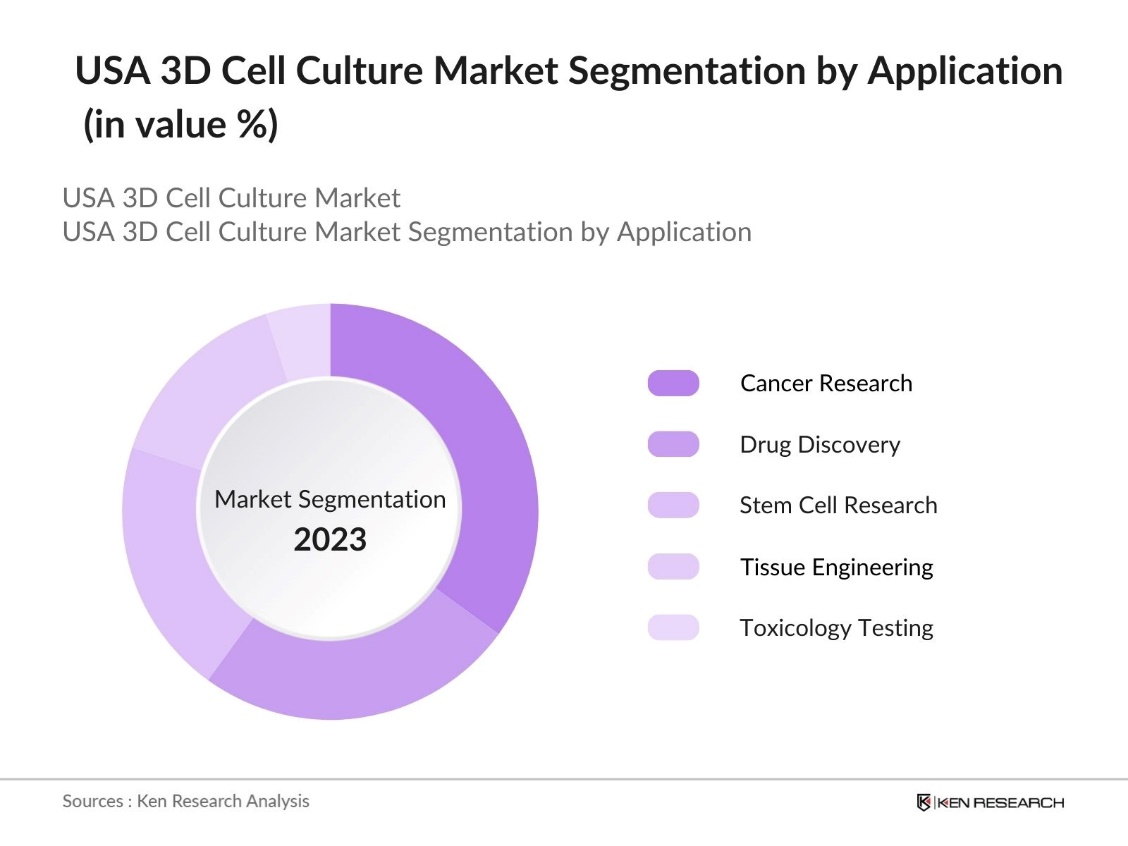
By Application: The market is segmented by application into cancer research, drug discovery, stem cell research, tissue engineering, and toxicology testing. Cancer research dominates this segment, due to the increasing use of 3D cell culture models for simulating the tumor microenvironment, allowing researchers to better understand cancer progression and test new therapies. The ability of 3D cultures to replicate the complexity of cancerous tissues makes them an invaluable tool in developing targeted cancer treatments, which is driving their extensive use in oncology research.
USA 3D Cell Culture Market Competitive Landscape
The USA 3D cell culture market is dominated by key players that have established a strong foothold through innovative product development and strategic partnerships. The market is characterized by competition among global biotechnology firms and specialized 3D cell culture providers, with notable companies driving technological advancements in this field. The market is led by global giants like Thermo Fisher Scientific and Corning Incorporated, who have a strong presence in research-driven sectors such as pharmaceuticals, biotechnology, and academic research.
|
Company Name |
Year Established |
Headquarters |
Revenue (USD Mn) |
Product Portfolio |
R&D Investment (%) |
Patents |
Global Presence |
Collaborations |
Market Share (%) |
|
Thermo Fisher Scientific |
1956 |
Waltham, MA |
|||||||
|
Corning Incorporated |
1851 |
Corning, NY |
|||||||
|
Merck KGaA |
1668 |
Darmstadt, Germany |
|||||||
|
Lonza Group AG |
1897 |
Basel, Switzerland |
|||||||
|
Becton, Dickinson and Company |
1897 |
Franklin Lakes, NJ |
USA 3D Cell Culture Industry Analysis
Growth Drivers
- Increasing Demand for Organ-on-Chip Models: The demand for organ-on-chip models has risen significantly, particularly in the USA's pharmaceutical and biotechnology industries. According to the Food and Drug Administration (FDA), $5 million in funding for fiscal year 2023 for drug testing and disease modeling. This trend aligns with the push towards reducing animal testing, as indicated by the FDAs Alternative Methods Working Group. This shift supports the growth of 3D cell culture technologies.
- Expansion of Stem Cell Research: Stem cell research in the USA has witnessed substantial growth, with the market benefiting from government funding and private investment. According to the NIH, stem cell research received over it will reach 2.22 billion U.S. dollars in 2024, a sharp increase from the previous year. This funding is primarily allocated to developing 3D cell cultures for stem cell therapies, which can address various medical conditions like Parkinsons disease and spinal cord injuries. The expansion in stem cell research is expected to continue fueling demand for 3D cell culture platforms.
- Rising Demand for Personalized Medicine: The USA is witnessing growing demand for personalized medicine, where 3D cell cultures are essential for creating patient-specific treatments. These advanced models help researchers simulate human biology more accurately, enabling better drug testing and development. Personalized therapies, especially in fields like oncology, rely heavily on 3D cell culture technologies to refine and tailor treatments to individual patients. This trend is playing a significant role in the expanding adoption of 3D culture systems across research institutes and pharmaceutical companies, advancing the development of more precise and effective medical treatments.
Market Restraints
- High Initial Investment Costs: The significant upfront investment required to establish 3D cell culture laboratories is a notable barrier to market growth in the USA. The setup involves costs for specialized equipment like bioreactors, scaffold materials, and advanced imaging systems, which can be prohibitive, particularly for smaller research facilities. Additionally, ongoing maintenance and operational expenses add to the financial burden. While government grants and incentives are available, many institutions remain cautious about committing to these high initial costs, which limits the widespread adoption of 3D cell culture technologies.
- Limited Expertise in Advanced 3D Techniques: key challenge in the USA is the shortage of expertise in advanced 3D cell culture techniques. Although the biotech sector has a large pool of professionals, only a small number are trained in specialized 3D culture systems. This skills gap has slowed the adoption of these technologies across research institutions. The limited availability of trained professionals hinders broader application in various fields, from drug development to regenerative medicine, and creates a bottleneck for advancing research in 3D cell culture systems.
USA 3D Cell Culture Market Future Outlook
Over the next five years, the USA 3D cell culture market is expected to experience significant growth, driven by advancements in tissue engineering, cancer research, and drug discovery. Increasing adoption of 3D cell culture models in stem cell research and regenerative medicine, coupled with technological innovations like organ-on-chip systems and bioprinting, are set to shape the future of the market. As pharmaceutical companies and research institutions continue to invest in these technologies, the market is likely to see accelerated growth, providing more efficient solutions for medical research and therapeutic developments.
Market Opportunities
- Growth in Cancer Research Applications: Cancer research presents a significant opportunity for 3D cell culture technologies in the USA. The ability of 3D cultures to replicate the tumor microenvironment with greater accuracy is driving their adoption in drug development and testing. By providing a more realistic model for studying cancer, 3D cell cultures are helping researchers develop more effective therapies. The ongoing collaboration between pharmaceutical companies and research institutions is further accelerating the application of 3D models in cancer research, enhancing the potential for breakthroughs in treatment.
- Integration of AI in 3D Cell Culture Analysis: Artificial intelligence (AI) is playing an increasingly important role in the analysis of 3D cell cultures, offering improved accuracy and efficiency in data interpretation. AI tools help researchers analyze complex datasets generated from 3D cultures, providing deeper insights into cell behavior and interactions. This integration is advancing the precision of cell-based models and unlocking new research possibilities, enabling scientists to make more informed decisions in areas like drug development and disease modeling. As AI continues to evolve, its role in enhancing 3D cell culture applications is expected to grow further.
Scope of the Report
|
By Product Type |
Scaffold-Based Scaffold-Free Bioreactors Monitoring Systems |
|
By Application |
Cancer Research Drug Discovery Stem Cell Research Tissue Engineering Toxicology |
|
By Technology |
Scaffold-Based Scaffold-Free Microfluidics |
|
By End-User |
Biotechnology Companies Academic Institutes CROs Hospitals |
|
By Region |
Northeast Midwest Southern Western |
Products
Key Target Audience
Pharmaceutical and Biotechnology Companies
Hospitals and Diagnostic Centers
Contract Research Organizations (CROs)
Regenerative Medicine Firms
Investments and Venture Capitalist Firms
Government and Regulatory Bodies (FDA, NIH)
Biomanufacturing Firms
Companies
Players Mentioned in the Report
Thermo Fisher Scientific
Corning Incorporated
Merck KGaA
Lonza Group AG
Becton, Dickinson and Company
Greiner Bio-One
Insphero AG
Tecan Group Ltd.
3D Biotek LLC
Avantor, Inc.
Mimetas BV
ReproCELL Europe Ltd.
Nanofiber Solutions
3D BioMatrix
VWR International LLC
Table of Contents
1. USA 3D Cell Culture Market Overview
1.1 Definition and Scope
1.2 Market Taxonomy
1.3 Market Growth Rate
1.4 Market Segmentation Overview
2. USA 3D Cell Culture Market Size (In USD Mn)
2.1 Historical Market Size
2.2 Year-On-Year Growth Analysis
2.3 Key Market Developments and Milestones
3. USA 3D Cell Culture Market Analysis
3.1 Growth Drivers
3.1.1 Advancements in Cell-Based Research
3.1.2 Increasing Demand for Organ-on-Chip Models
3.1.3 Expansion of Stem Cell Research
3.1.4 Rising Demand for Personalized Medicine
3.2 Market Restraints
3.2.1 High Initial Investment Costs
3.2.2 Limited Expertise in Advanced 3D Techniques
3.2.3 Lack of Standardized Protocols
3.3 Opportunities
3.3.1 Growth in Cancer Research Applications
3.3.2 Integration of AI in 3D Cell Culture Analysis
3.3.3 Collaboration between Research Institutes and Biotech Companies
3.4 Trends
3.4.1 Shift Toward Scaffold-Free Techniques
3.4.2 Development of Organ-Specific 3D Cultures
3.4.3 Increased Use of Bioprinting Technologies
3.5 Government Regulation
3.5.1 FDA Guidelines for 3D Bioprinting
3.5.2 NIH Funding for Regenerative Medicine
3.5.3 Safety Regulations for Clinical Trials
3.6 SWOT Analysis
3.7 Stake Ecosystem
3.8 Porters Five Forces
3.9 Competition Ecosystem
4. USA 3D Cell Culture Market Segmentation
4.1 By Product Type (In Value %)
4.1.1 Scaffold-Based 3D Cell Culture
4.1.2 Scaffold-Free 3D Cell Culture
4.1.3 Bioreactors
4.1.4 3D Cell Culture Monitoring Systems
4.2 By Application (In Value %)
4.2.1 Cancer Research
4.2.2 Drug Discovery
4.2.3 Stem Cell Research
4.2.4 Tissue Engineering
4.2.5 Toxicology
4.3 By Technology (In Value %)
4.3.1 Scaffold-Based
4.3.2 Scaffold-Free
4.3.3 Microfluidics
4.4 By End-User (In Value %)
4.4.1 Biotechnology and Pharmaceutical Companies
4.4.2 Academic and Research Institutes
4.4.3 Contract Research Organizations
4.4.4 Hospitals and Diagnostic Centers
4.5 By Region (In Value %)
4.5.1 Northeast USA
4.5.2 Midwest USA
4.5.3 Southern USA
4.5.4 Western USA
5. USA 3D Cell Culture Market Competitive Analysis
5.1 Detailed Profiles of Major Companies
5.1.1 Thermo Fisher Scientific
5.1.2 Corning Incorporated
5.1.3 Merck KGaA
5.1.4 Lonza Group AG
5.1.5 Becton, Dickinson and Company
5.1.6 Greiner Bio-One
5.1.7 Insphero AG
5.1.8 Tecan Group Ltd.
5.1.9 3D Biotek LLC
5.1.10 Avantor, Inc.
5.1.11 Mimetas BV
5.1.12 ReproCELL Europe Ltd.
5.1.13 Nanofiber Solutions
5.1.14 3D BioMatrix
5.1.15 VWR International LLC
5.2 Cross Comparison Parameters (Revenue, Product Portfolio, R&D Investment, No. of Patents, Key Collaborations, Geographical Reach, Product Launches, Market Share)
5.3 Market Share Analysis
5.4 Strategic Initiatives
5.5 Mergers and Acquisitions
5.6 Investment Analysis
5.7 Venture Capital Funding
5.8 Government Grants
5.9 Private Equity Investments
6. USA 3D Cell Culture Market Regulatory Framework
6.1 FDA Compliance Requirements
6.2 NIH Research Funding
6.3 Certification Processes for Biotech Products
7. USA 3D Cell Culture Future Market Size (In USD Mn)
7.1 Future Market Size Projections
7.2 Key Factors Driving Future Market Growth
8. USA 3D Cell Culture Future Market Segmentation
8.1 By Product Type (In Value %)
8.2 By Application (In Value %)
8.3 By Technology (In Value %)
8.4 By End-User (In Value %)
8.5 By Region (In Value %)
9. USA 3D Cell Culture Market Analysts Recommendations
9.1 TAM/SAM/SOM Analysis
9.2 Customer Cohort Analysis
9.3 Marketing Initiatives
9.4 White Space Opportunity Analysis
Research Methodology
Step 1: Identification of Key Variables
The initial phase involves constructing a stakeholder map, identifying all major players in the USA 3D cell culture market. This step includes comprehensive desk research utilizing secondary and proprietary databases to capture the critical variables driving market trends, including technology adoption and market penetration.
Step 2: Market Analysis and Construction
In this phase, historical data on market penetration and revenue generation for the USA 3D cell culture market are analyzed. This includes assessing technological advancements, application-specific market trends, and the impact of regulatory frameworks.
Step 3: Hypothesis Validation and Expert Consultation
Key market hypotheses are validated through telephonic consultations with industry experts from leading biotechnology firms, research institutions, and product manufacturers. Their insights will help refine data and provide financial and operational insights into the market.
Step 4: Research Synthesis and Final Output
The final step involves cross-referencing gathered data with industry reports and direct feedback from major market players, ensuring the accuracy and reliability of the final market report. This comprehensive approach ensures that the report offers an in-depth understanding of the market's current and future dynamics.
Frequently Asked Questions
01. How big is the USA 3D Cell Culture Market?
The USA 3D Cell Culture Market was valued at USD 511 million in 2023, driven by the increased demand for advanced cell models in drug discovery and cancer research, along with advancements in tissue engineering.
02. What are the challenges in the USA 3D Cell Culture Market?
Challenges in the USA 3D cell culture market include the high cost of setting up 3D cell culture labs, the lack of standardized protocols, and the limited expertise in using these advanced techniques.
03. Who are the major players in the USA 3D Cell Culture Market?
Key players in the USA 3D cell culture market include Thermo Fisher Scientific, Corning Incorporated, Merck KGaA, Lonza Group AG, and Becton, Dickinson and Company. These companies dominate the market due to their extensive product portfolios and strong research and development capabilities.
04. What are the growth drivers of the USA 3D Cell Culture Market?
Growth drivers in USA 3D cell culture market include the increasing use of 3D cell culture models in cancer research, drug discovery, and regenerative medicine, as well as advancements in technologies like bioprinting and organ-on-chip models.
Why Buy From Us?

What makes us stand out is that our consultants follows Robust, Refine and Result (RRR) methodology. i.e. Robust for clear definitions, approaches and sanity checking, Refine for differentiating respondents facts and opinions and Result for presenting data with story

We have set a benchmark in the industry by offering our clients with syndicated and customized market research reports featuring coverage of entire market as well as meticulous research and analyst insights.

While we don't replace traditional research, we flip the method upside down. Our dual approach of Top Bottom & Bottom Top ensures quality deliverable by not just verifying company fundamentals but also looking at the sector and macroeconomic factors.

With one step in the future, our research team constantly tries to show you the bigger picture. We help with some of the tough questions you may encounter along the way: How is the industry positioned? Best marketing channel? KPI's of competitors? By aligning every element, we help maximize success.

Our report gives you instant access to the answers and sources that other companies might choose to hide. We elaborate each steps of research methodology we have used and showcase you the sample size to earn your trust.

If you need any support, we are here! We pride ourselves on universe strength, data quality, and quick, friendly, and professional service.