
USA AI in Agriculture Market Outlook to 2030
Region:North America
Author(s):Yogita Sahu
Product Code:KROD4905
November 2024
90
About the Report
USA AI in Agriculture Market Overview
- The USA AI in Agriculture market is valued at USD 351.09 million, driven by increasing adoption of precision farming techniques and the integration of AI-based tools in farm management systems. These technologies help optimize crop yields, manage resources more efficiently, and minimize waste, which is critical given the rising demand for sustainable agricultural practices.
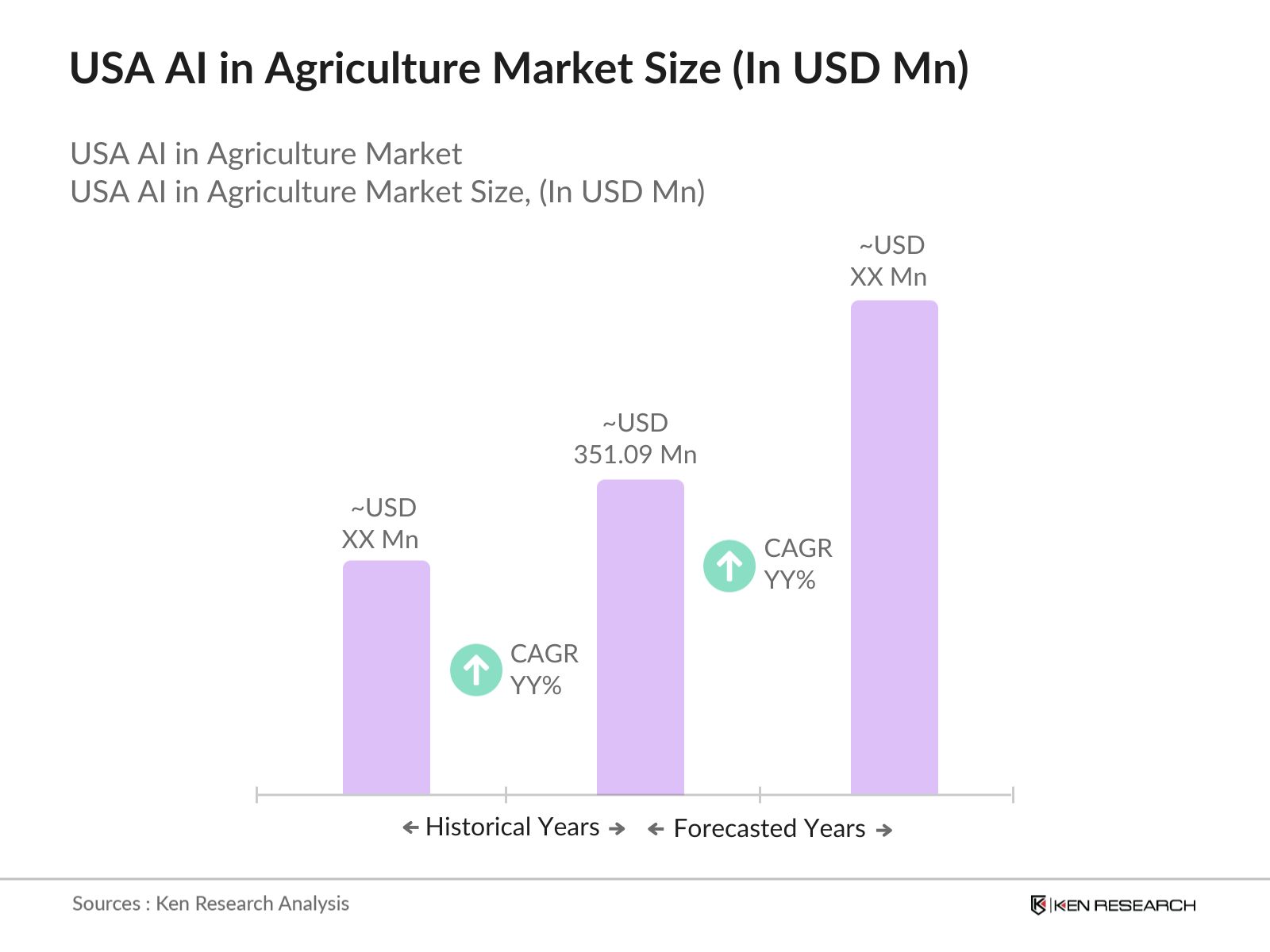
- The USA leads the market, with key cities like San Francisco and regions like the Midwest dominating the landscape. This dominance is driven by the concentration of AI innovation hubs and agricultural technology (AgTech) companies in these regions. San Francisco, for instance, is home to a thriving tech ecosystem, which has fostered the growth of AI startups focused on agriculture.
- In 2024, the USDA launched an initiative to invest $1.2 billion in AI-powered solutions that enhance climate-smart agricultural practices. This program promotes the use of AI technologies for optimizing resource use, reducing greenhouse gas emissions, and improving overall farm sustainability. Over 300 farms have already benefited from AI-powered systems to reduce water and fertilizer consumption while enhancing yields in environmentally sustainable ways.
USA AI in Agriculture Market Segmentation
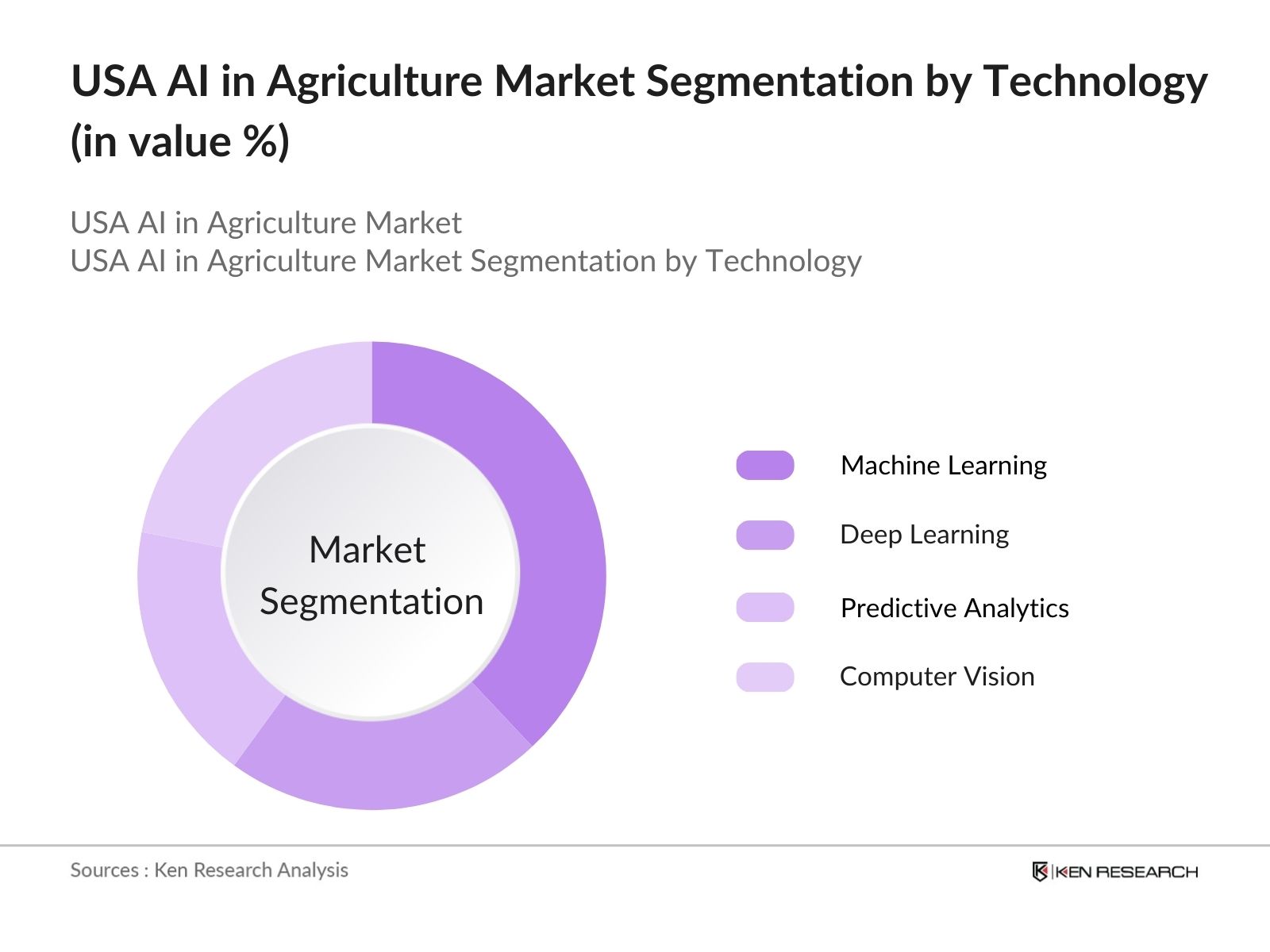
By Technology: The market is segmented by technology into machine learning, deep learning, predictive analytics, and computer vision. Machine learning currently holds a dominant market share due to its widespread application in data analysis for crop management and yield prediction. The ability of machine learning algorithms to process vast amounts of data collected from agricultural sensors allows for more accurate forecasting and decision-making.
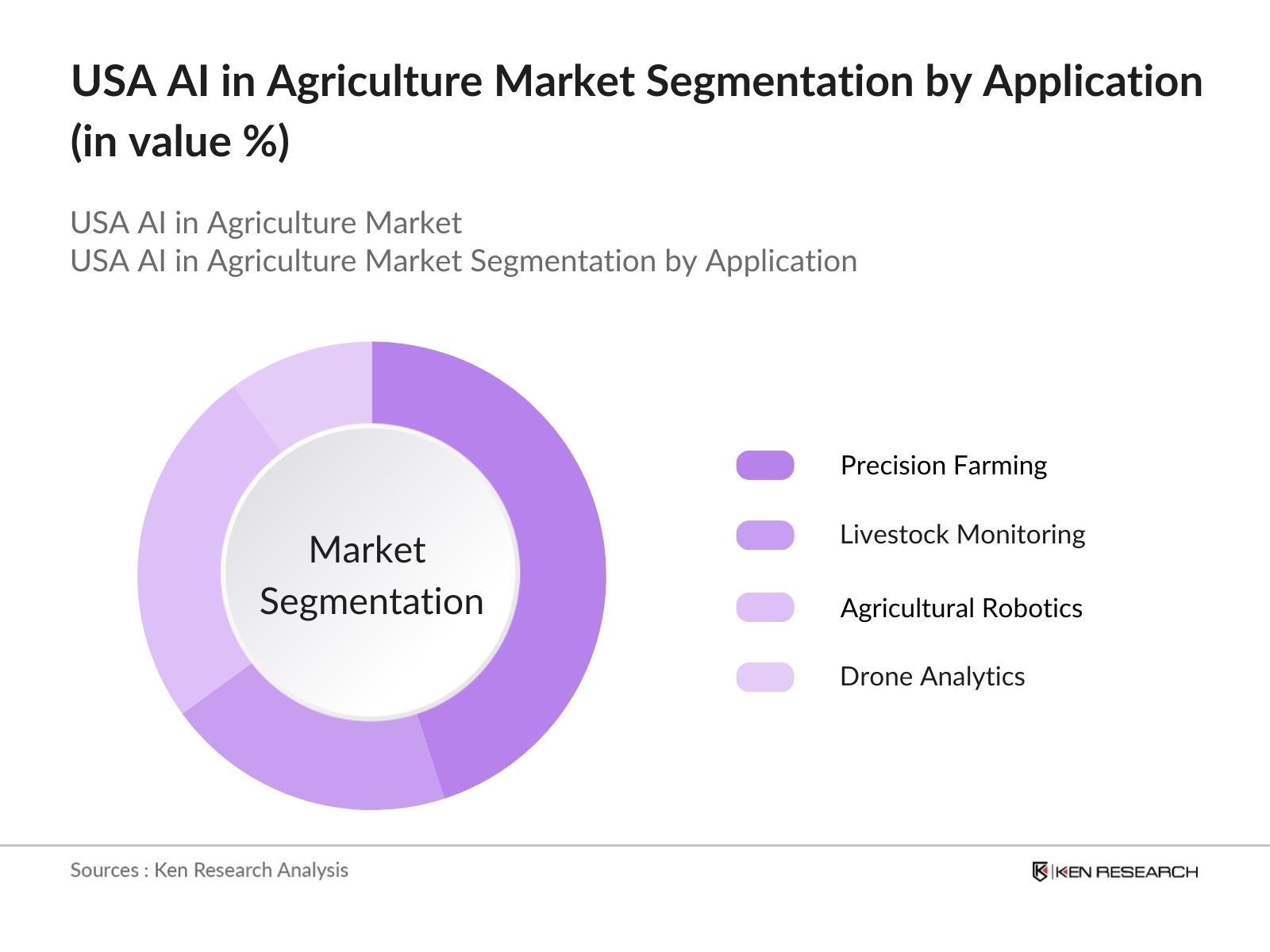
By Application: The market is segmented into precision farming, livestock monitoring, agricultural robotics, and drone analytics. Precision farming leads the segment with a dominant share, as it allows farmers to use AI to monitor soil conditions, manage water resources, and control the application of fertilizers and pesticides. Precision farming solutions are particularly appealing in the USA due to the country's large-scale commercial farming operations, which benefit significantly from the efficiency and scalability of AI-driven technology.
USA AI in Agriculture Market Competitive Landscape
The market is dominated by several key players who drive innovation and adoption in the sector. The consolidation of the market reflects the strength of these companies, particularly in the areas of AI research, cloud computing, and advanced sensor technology. Companies like IBM and Microsoft have entered into strategic partnerships with agricultural equipment manufacturers, enhancing their AI offerings for precision farming and smart irrigation systems.
|
Company Name |
Year Established |
Headquarters |
R&D Investment |
Patents Held |
AI Applications |
Major Partnerships |
Revenue (USD Mn) |
|
IBM Corporation |
1911 |
Armonk, NY |
|||||
|
Microsoft Corporation |
1975 |
Redmond, WA |
|||||
|
John Deere & Company |
1837 |
Moline, IL |
|||||
|
Climate Corporation |
2006 |
San Francisco, CA |
|||||
|
Granular |
2014 |
San Francisco, CA |
USA AI in Agriculture Market Analysis
Market Growth Drivers
- Increased Adoption of AI-driven Precision Farming: The growing adoption of precision farming techniques is a key driver for AI integration in agriculture. In 2024, over 920,000 farms in the U.S. are expected to leverage AI for soil monitoring, predictive crop yield analysis, and water management. AI-powered systems are increasingly used to optimize irrigation, manage pesticides, and monitor crop health, improving productivity and reducing input waste.
- Labor Shortages in Agriculture: The U.S. agricultural sector faces an increasing labor shortage, with over 200,000 unfilled farm worker positions reported in 2023. AI technologies, such as autonomous machinery and robots for planting and harvesting, are filling this gap. These AI-driven machines can perform tasks that would otherwise require human labor, enhancing productivity.
- Climate Change Resilience: Extreme weather conditions and unpredictable climate patterns are becoming more frequent in the U.S., impacting agricultural productivity. AI-powered predictive analytics help farmers better prepare for these challenges. In 2024, it is projected that over 250,000 farms will use AI models to predict weather patterns, optimize crop selection, and improve disaster recovery measures.
Market Challenges
- High Cost of AI Technology Implementation: The upfront cost of adopting AI technologies is prohibitively expensive for small and medium-sized farms in the U.S., where the average farm income was high. AI systems for precision farming and automation often require significant capital investment in machinery, software, and training. Although large farms can absorb these costs, small farms often struggle to adopt AI solutions, slowing market growth.
- Data Privacy and Security Concerns: The growing use of AI in agriculture raises concerns over data privacy and security. In 2024, over 300,000 farm operations are projected to use AI-powered data analytics tools that collect information on soil conditions, crop health, and machinery performance. However, this data collection raises risks of unauthorized access and misuse, particularly given the increasing number of cyber-attacks on agriculture firms.
USA AI in Agriculture Market Future Outlook
Over the next five years, the USA AI in Agriculture industry is expected to experience robust growth driven by continuous advancements in AI technologies, increased investments from both public and private sectors, and growing demand for sustainable farming practices. As AI continues to evolve, its applications in agriculture will expand beyond precision farming to more complex areas like autonomous farm equipment and real-time decision-making tools powered by AI.
Future Market Opportunities
- Increased Use of AI in Autonomous Farm Equipment: Over the next five years, autonomous farming equipment powered by AI is expected to become more prevalent, with more than 50,000 autonomous tractors predicted to be in use by 2029. These tractors will enable farmers to manage larger areas of land with fewer labor inputs, increasing farm efficiency and reducing operational costs.
- AI-driven Supply Chain Optimization: The agriculture supply chain will see further optimization through AI technologies by 2029. AI tools will help farmers predict demand, optimize logistics, and reduce food waste. The adoption of AI in supply chain management is expected to increase by at least 25% annually over the next five years, with large-scale farms leading the charge.
Scope of the Report
|
By Technology |
Machine Learning Deep Learning Predictive Analytics Computer Vision |
|
By Application |
Precision Farming Livestock Monitoring Agricultural Robotics Drone Analytics |
|
By Deployment |
Cloud-based Solutions On-premise Solutions |
|
By Crop Type |
Cereals and Grains Fruits and Vegetables Oilseeds Other Crops |
|
By Region |
North East West South |
Products
Key Target Audience Organizations and Entities Who Can Benefit by Subscribing This Report:
Agricultural Equipment Manufacturers
Drone and Sensor Manufacturers
Government and Regulatory Bodies (USDA, EPA)
Investors and Venture Capitalist Firms
Precision Farming Solutions Providers
Banks and Financial Institutions
Private Equity Firms
Companies
Players Mentioned in the Report:
IBM Corporation
Microsoft Corporation
John Deere & Company
Bayer AG
Climate Corporation
Granular
Blue River Technology
Gamaya
Taranis
AgEagle Aerial Systems
Prospera Technologies
Trimble Inc.
SAS Institute
Raven Industries
Topcon Corporation
Table of Contents
1. USA AI in Agriculture Market Overview
1.1. Definition and Scope
1.2. Market Taxonomy
1.3. Market Growth Rate
1.4. Market Segmentation Overview
2. USA AI in Agriculture Market Size (In USD Mn)
2.1. Historical Market Size
2.2. Year-On-Year Growth Analysis
2.3. Key Market Developments and Milestones
3. USA AI in Agriculture Market Analysis
3.1. Growth Drivers
3.1.1. Increased Use of Precision Farming
3.1.2. Demand for Crop Monitoring and Yield Optimization
3.1.3. Technological Advancements in AI Algorithms
3.1.4. Government Support for Sustainable Agriculture
3.2. Market Challenges
3.2.1. Data Privacy Concerns (Data Collection, GDPR Compliance)
3.2.2. High Cost of Implementation (Initial Investment, AI Tools)
3.2.3. Lack of Technical Expertise (Skilled Workforce, AI Adoption)
3.3. Opportunities
3.3.1. Expansion of AI-enabled Drones and Robotics (Drone Integration)
3.3.2. Growth in Smart Irrigation Systems
3.3.3. Partnerships Between AI Firms and Agribusinesses
3.4. Trends
3.4.1. Integration of Machine Learning in Predictive Analytics
3.4.2. Cloud-based AI Platforms for Farm Management
3.4.3. Adoption of AI-powered Remote Sensing
3.5. Government Regulation
3.5.1. USDA AI Adoption Programs (Subsidies, Policies)
3.5.2. Sustainability Mandates (Carbon Footprint Reduction, Climate-smart Policies)
3.5.3. Regulations on Data Privacy and Cybersecurity in Agriculture (Privacy Acts)
3.6. SWOT Analysis
3.7. Stake Ecosystem (AI Developers, Agritech Companies, Farmers, Consultants)
3.8. Porters Five Forces
3.9. Competition Ecosystem
4. USA AI in Agriculture Market Segmentation
4.1. By Technology (In Value %)
4.1.1. Machine Learning
4.1.2. Deep Learning
4.1.3. Predictive Analytics
4.1.4. Computer Vision
4.2. By Application (In Value %)
4.2.1. Precision Farming
4.2.2. Livestock Monitoring
4.2.3. Agricultural Robotics
4.2.4. Drone Analytics
4.3. By Deployment Model (In Value %)
4.3.1. Cloud-based Solutions
4.3.2. On-premise Solutions
4.4. By Crop Type (In Value %)
4.4.1. Cereals and Grains
4.4.2. Fruits and Vegetables
4.4.3. Oilseeds
4.4.4. Other Crops
4.5. By Region (In Value %)
4.5.1. North
4.5.2. East
4.5.3. West
4.5.4. South
5. USA AI in Agriculture Market Competitive Analysis
5.1 Detailed Profiles of Major Companies
5.1.1. IBM Corporation
5.1.2. Microsoft Corporation
5.1.3. John Deere & Company
5.1.4. Bayer AG
5.1.5. Climate Corporation
5.1.6. Prospera Technologies
5.1.7. Granular
5.1.8. Blue River Technology
5.1.9. Gamaya
5.1.10. Taranis
5.1.11. AgEagle Aerial Systems
5.1.12. Trimble Inc.
5.1.13. SAS Institute
5.1.14. Raven Industries
5.1.15. Topcon Corporation
5.2 Cross Comparison Parameters (Revenue, No. of Patents, AI Applications, R&D Investment, Partnerships)
5.3. Market Share Analysis
5.4. Strategic Initiatives
5.5. Mergers And Acquisitions
5.6. Investment Analysis
5.7 Venture Capital Funding
5.8. Government Grants
5.9. Private Equity Investments
6. USA AI in Agriculture Market Regulatory Framework
6.1. Compliance Requirements
6.2. Certification Processes for AI in Agriculture
6.3. Sustainability Mandates in Agricultural AI Solutions
7. USA AI in Agriculture Future Market Size (In USD Mn)
7.1. Future Market Size Projections
7.2. Key Factors Driving Future Market Growth
8. USA AI in Agriculture Future Market Segmentation
8.1. By Technology (In Value %)
8.2. By Application (In Value %)
8.3. By Deployment Model (In Value %)
8.4. By Crop Type (In Value %)
8.5. By Region (In Value %)
9. USA AI in Agriculture Market Analysts Recommendations
9.1. TAM/SAM/SOM Analysis
9.2. Customer Cohort Analysis
9.3. Marketing Initiatives
9.4. White Space Opportunity Analysis
Research Methodology
Step 1: Identification of Key Variables
The research began by constructing an ecosystem map, identifying all stakeholders involved in the USA AI in Agriculture market. This included a detailed study of companies involved in AI development, agricultural equipment manufacturers, and large-scale farming operations. Extensive desk research and secondary data sources were used to compile a comprehensive overview of the market's key variables.
Step 2: Market Analysis and Construction
Historical data from 2018 to 2023 was analyzed to understand market trends, including AI adoption rates, revenue generation, and the ratio of precision farming solutions in the USA. The accuracy of market estimates was validated through statistical models, ensuring reliability in projecting future growth.
Step 3: Hypothesis Validation and Expert Consultation
The next step involved developing market hypotheses and validating them through interviews with industry experts. These experts provided operational and financial insights, which were critical in refining the market data and ensuring its accuracy.
Step 4: Research Synthesis and Final Output
Finally, a comprehensive synthesis of data was performed, including consultations with multiple AI developers and agricultural equipment manufacturers. This allowed for a final, validated report that accurately reflects the current state and future outlook of the USA AI in Agriculture market.
Frequently Asked Questions
01. How big is the USA AI in Agriculture Market?
The USA AI in Agriculture market is currently valued at USD 351.09 million, driven by the rapid adoption of precision farming and AI-based tools in farm management systems. The market's growth is bolstered by the need for sustainable and efficient farming practices.
02. What are the challenges in the USA AI in Agriculture Market?
Challenges in the USA AI in Agriculture market include the high initial cost of AI solutions, concerns around data privacy, and the lack of skilled personnel to operate these advanced systems. Additionally, integrating AI into traditional farming practices remains a challenge for many farmers.
03. Who are the major players in the USA AI in Agriculture Market?
Major players in the USA AI in Agriculture market include IBM Corporation, Microsoft Corporation, John Deere & Company, Bayer AG, and Climate Corporation. These companies dominate due to their strong AI capabilities, strategic partnerships, and established presence in both technology and agriculture.
04. What are the growth drivers of the USA AI in Agriculture Market?
The USA AI in Agriculture market is driven by the increasing use of precision farming techniques, the demand for resource-efficient farming solutions, and advancements in AI technology. Government support for sustainable agriculture also plays a key role in the market's growth.
05. What are the opportunities in the USA AI in Agriculture Market?
Opportunities in the USA AI in Agriculture market include the expansion of AI-powered drones and robotics, the development of cloud-based AI solutions for farm management, and partnerships between AI firms and large-scale agricultural operations. These advancements are expected to drive future growth in the sector.
Why Buy From Us?

What makes us stand out is that our consultants follows Robust, Refine and Result (RRR) methodology. i.e. Robust for clear definitions, approaches and sanity checking, Refine for differentiating respondents facts and opinions and Result for presenting data with story

We have set a benchmark in the industry by offering our clients with syndicated and customized market research reports featuring coverage of entire market as well as meticulous research and analyst insights.

While we don't replace traditional research, we flip the method upside down. Our dual approach of Top Bottom & Bottom Top ensures quality deliverable by not just verifying company fundamentals but also looking at the sector and macroeconomic factors.

With one step in the future, our research team constantly tries to show you the bigger picture. We help with some of the tough questions you may encounter along the way: How is the industry positioned? Best marketing channel? KPI's of competitors? By aligning every element, we help maximize success.

Our report gives you instant access to the answers and sources that other companies might choose to hide. We elaborate each steps of research methodology we have used and showcase you the sample size to earn your trust.

If you need any support, we are here! We pride ourselves on universe strength, data quality, and quick, friendly, and professional service.