















USA Air Traffic Management Market Outlook to 2030
Region:North America
Author(s):Shubham Kashyap
Product Code:KROD3509
November 2024
81
About the Report
USA Air Traffic Management Market Overview
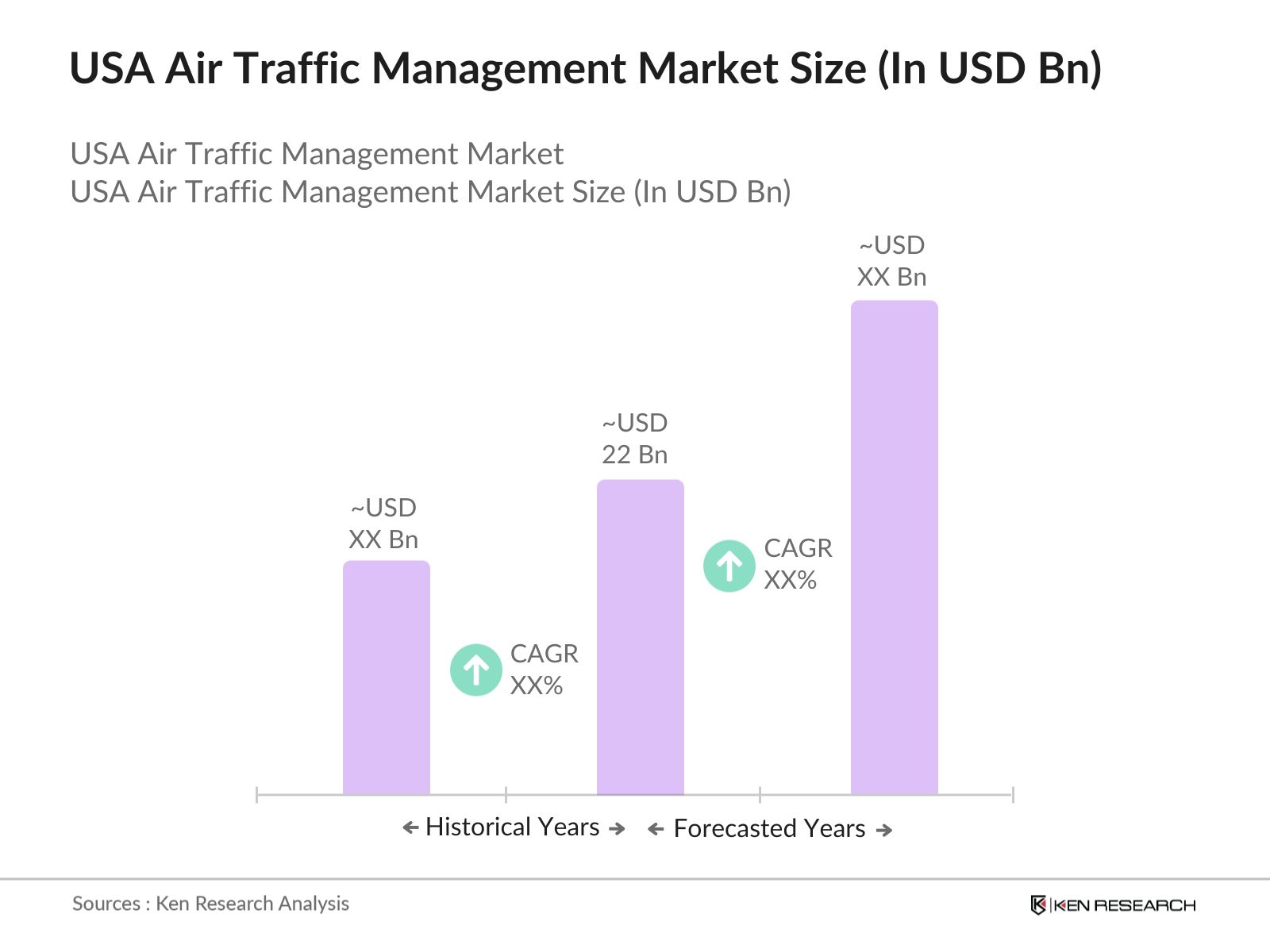
- The USA Air Traffic Management (ATM) Market is valued at USD 22 billion, based on historical data spanning the past five years, driven by increasing air traffic, advancements in air traffic control (ATC) systems, and the growing importance of efficient airspace management to ensure safety and optimize operations. The Federal Aviation Administration (FAA) has been at the forefront, implementing modernization projects to enhance ATM capabilities, particularly under its NextGen program, aimed at transforming the national airspace.
- Major hubs like Atlanta, Chicago, and Dallas-Fort Worth are leading contributors to this market, with these airports seeing record levels of traffic post-pandemic. The rise of commercial aviation, especially with increasing passenger traffic and the resumption of international flights, has put pressure on air traffic control systems to improve efficiency. Rural and regional airports are also seeing increasing demand, thanks to regional air carriers and the growth of freight services, particularly in e-commerce.
- The FAA's regulatory frameworks, such as the Standard Terminal Automation Replacement System (STARS) and the En Route Automation Modernization (ERAM), play a critical role in shaping the USA ATM market. These initiatives have modernized terminal and en route automation systems to handle growing traffic volumes and enhance safety protocols in airspace management.
USA Air Traffic Management Market Segmentation
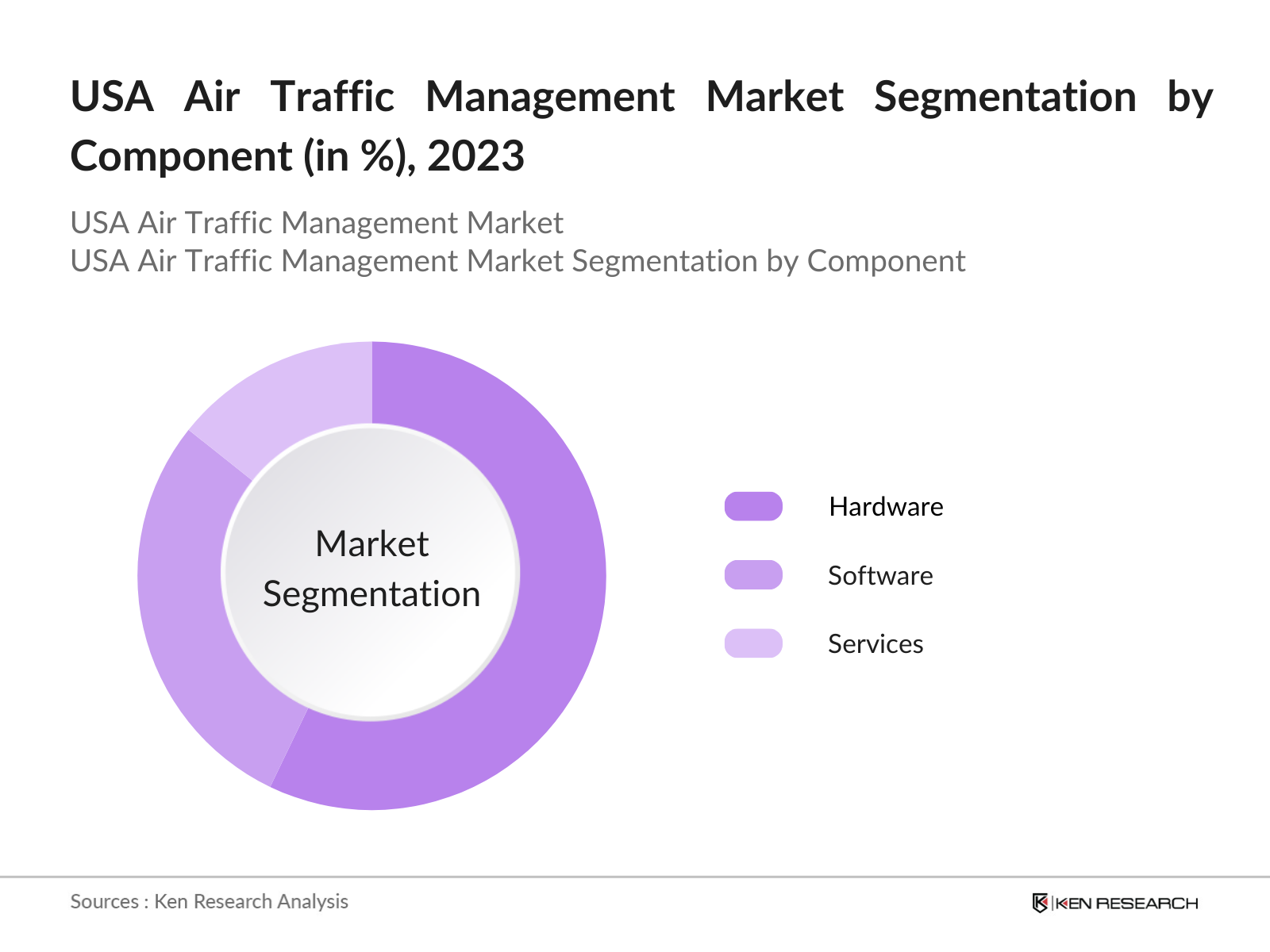
- By Component: The market is segmented into hardware, software, and services. The hardware segment includes radars, communication equipment, and surveillance systems, accounting for a substantial share due to their critical role in real-time monitoring and control of air traffic. Software solutions, primarily focused on automation and data processing, have seen a rapid increase in adoption as air traffic controllers require advanced tools to manage increased traffic volumes. The services segment, covering maintenance, consultancy, and upgrades, is also significant, particularly as ATM systems require ongoing updates and support to function efficiently.
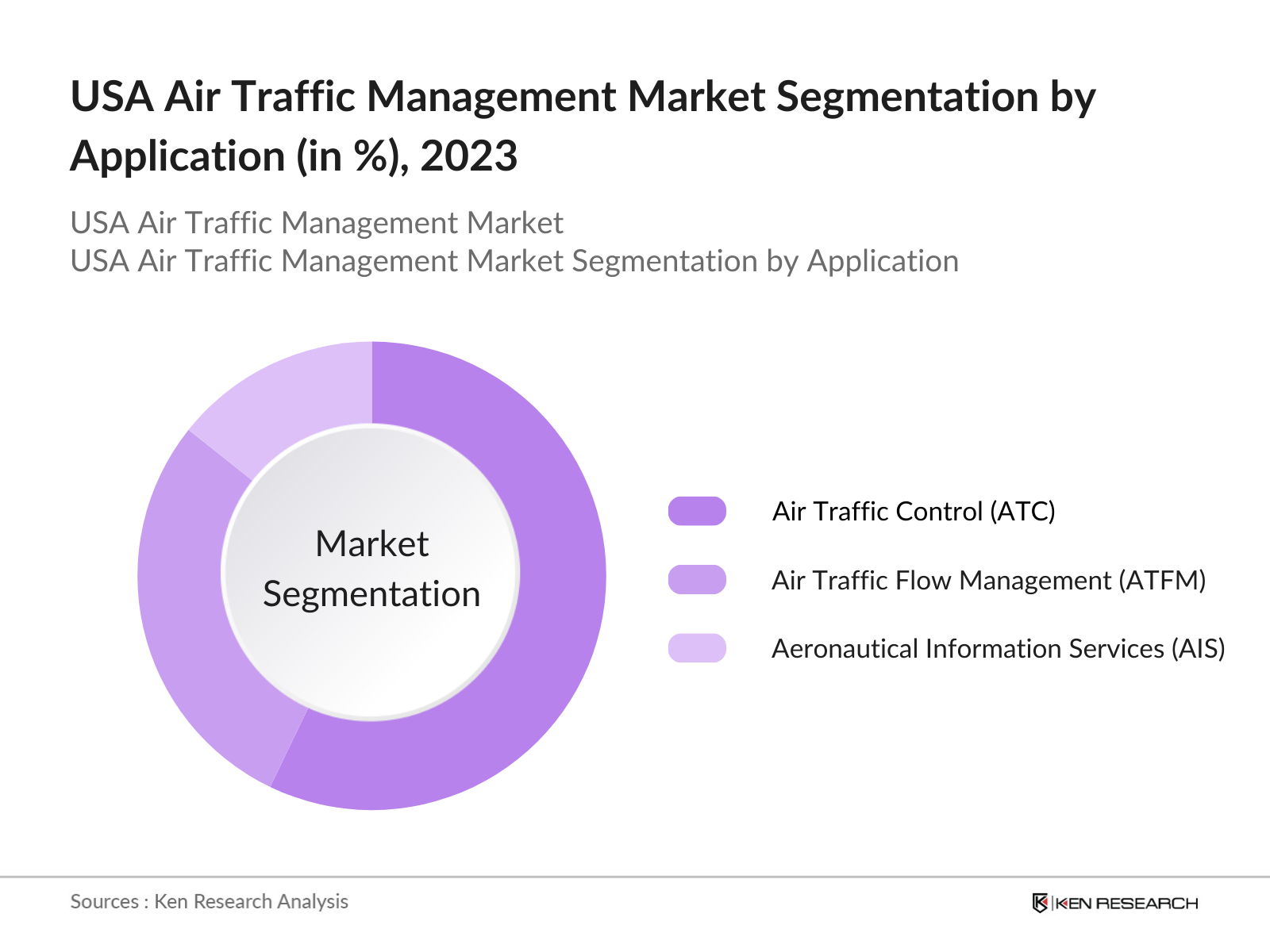
- By Application: The market is segmented by application into Air Traffic Control (ATC), Air Traffic Flow Management (ATFM), and Aeronautical Information Services (AIS). ATC dominates the market, driven by the need for real-time coordination and safety in air traffic management. ATFM, focused on optimizing air traffic flow and reducing delays, is gaining prominence as traffic congestion in major airports rises. AIS, responsible for providing pilots and airlines with crucial flight information, is also expanding as digitalization enhances the accuracy and availability of aeronautical data.
USA Air Traffic Management Market Competitive Landscape
The USA Air Traffic Management Market is highly competitive, with key players continually investing in advanced technologies and systems to enhance air traffic control. Major players include Raytheon Technologies, Lockheed Martin, Harris Corporation, Honeywell International, and Thales Group. These companies are focusing on expanding their product portfolios, collaborating with government agencies like the FAA, and developing next-generation solutions to meet the evolving needs of the market.
|
Company Name |
Establishment Year |
Headquarters |
No. of Employees |
Revenue (USD) |
Key Products |
Sustainability Initiatives |
Geographical Reach |
Technology Adoption |
Partnerships |
|
Raytheon Technologies |
1922 |
Waltham, MA |
|||||||
|
Lockheed Martin |
1912 |
Bethesda, MD |
|||||||
|
Harris Corporation |
1895 |
Melbourne, FL |
|||||||
|
Honeywell International |
1906 |
Charlotte, NC |
|||||||
|
Thales Group |
1893 |
Paris, France |
USA Air Traffic Management Industry Analysis
Growth Drivers
- Increasing Air Traffic Volumes: In 2023, the FAA reported over 45,000 daily flights managed across the U.S., highlighting the necessity of an advanced air traffic management system. With domestic air travel reaching pre-pandemic levels and international flights resuming, the demand for efficient ATM systems has grown exponentially. The FAA's NextGen initiative, which aims to modernize the nation's airspace by implementing satellite-based surveillance and communication systems, is a significant contributor to this trend. The increase in low-cost carriers and the proliferation of commercial UAV (Unmanned Aerial Vehicles) have further intensified airspace congestion, creating an urgent need for more sophisticated ATM solutions.
- Technological Advancements in ATM Systems: The introduction of cutting-edge technologies like AI-driven air traffic control, real-time data analytics, and satellite-based navigation systems has revolutionized air traffic management. As part of the NextGen program, systems such as Automatic Dependent Surveillance-Broadcast (ADS-B) are now widely used, providing more accurate tracking of aircraft and enabling better management of busy airspaces. These innovations ensure the safety and efficiency of flight operations, while reducing fuel consumption and delays, leading to more sustainable air travel.
- UAV Integration into National Airspace: Unmanned Aerial Vehicles (UAVs) are increasingly becoming part of the U.S. airspace. The FAA registered over 900,000 UAVs by the end of 2023, an increase from the 868,000 registered in 2022. The FAA has implemented several measures to integrate UAVs into controlled airspace safely, including the UAS Traffic Management (UTM) system. As UAV operations grow, the demand for robust air traffic management systems will escalate. UAV deliveries are projected to exceed 1.2 million annually by 2025, requiring advanced ATM frameworks to ensure safety and efficiency.
Market Challenges
- High Implementation Costs of ATM Systems: The modernization of air traffic management systems comes with substantial financial burdens, particularly for smaller regional airports. The installation of new hardware, ongoing maintenance, and the training of personnel all contribute to high operational costs. In 2023, the FAA allocated substantial amount in funding to modernize ATC infrastructure under its NextGen initiative. However, despite government support, many airports face challenges in adopting these new technologies due to budget constraints. Smaller airports, in particular, struggle to keep up with the rapid advancements in ATM technologies, creating a digital divide in air traffic management.
- Regulatory Scrutiny and Compliance: The ATM industry is heavily regulated by authorities such as the FAA, ICAO, and the U.S. Department of Transportation. Compliance with stringent safety standards and evolving regulations regarding airspace management, particularly with the introduction of UAVs and autonomous flight technologies, adds to the complexity of managing air traffic. In 2023, the FAA introduced new guidelines for integrating UAVs into national airspace, requiring significant adjustments in ATM systems to accommodate this growing segment of air traffic.
USA Air Traffic Management Market Future Outlook
The USA Air Traffic Management Market is expected to witness sustained growth, driven by rising air traffic volumes, technological advancements, and the implementation of the FAA's NextGen program. The increasing reliance on satellite-based navigation systems and AI-driven air traffic control solutions will further enhance the efficiency and safety of the U.S. airspace.
Future Market Opportunities
- Integration of Unmanned Aerial Vehicles (UAVs) into Airspace: With the rise of drone technology, the FAA has begun efforts to integrate UAVs into the national airspace, creating opportunities for the development of specialized air traffic management systems. In 2023, over 850,000 drones were registered in the U.S., highlighting the need for advanced systems that can manage both manned and unmanned aircraft simultaneously. This integration will require new regulations, advanced traffic management systems, and collaboration between industry stakeholders and government agencies, presenting a significant growth opportunity for ATM solutions providers.
- Expansion of ATM Services in Regional Airports: The growing demand for air travel in regional and rural areas presents a significant opportunity for expanding ATM services beyond major hubs. The FAA's Rural Airport Initiative, launched in 2022, aims to improve air traffic control services in underserved areas, making air travel more accessible and boosting local economies. As regional airports invest in modern ATM infrastructure to support increasing traffic volumes, service providers will have opportunities to expand their presence in this segment of the market.
Scope of the Report
|
Component |
Hardware Software Services |
|
Application |
Air Traffic Control (ATC) Air Traffic Flow Management (ATFM) Aeronautical Information Services (AIS) |
|
End-User |
Commercial Aviation Military Aviation General Aviation |
|
Airspace Type |
Controlled Airspace Uncontrolled Airspace |
|
By Region |
USA Canada |
Products
Key Target Audience
Air Traffic Control Service Providers
Airlines and Commercial Aviation Companies
Airport Authorities and Operators
Government and Regulatory Bodies (FAA, ICAO)
Military and Defense Agencies
Technology Providers and Innovators
Investors and Venture Capitalist Firms
Equipment Manufacturers
Banks and Financial Institutions
Companies
Players Mentioned in the Report
Raytheon Technologies
Lockheed Martin
Harris Corporation
Honeywell International
Thales Group
Northrop Grumman
Leidos
Boeing
Saab AB
Frequentis AG
Comsoft Solutions
Leonardo SpA
BAE Systems
Searidge Technologies
Indra Sistemas
Table of Contents
01 USA Air Traffic Management Market Overview
1.1. Definition and Scope
1.2. Market Taxonomy
1.3. Market Dynamics Overview
1.4. Market Segmentation Overview
02 USA Air Traffic Management Market Size (In USD Bn)
2.1. Historical Market Size
2.2. Year-On-Year Growth Analysis
2.3. Key Market Developments and Milestones
03 USA Air Traffic Management Market Analysis
3.1. Growth Drivers
3.1.1. Rising Air Traffic Volumes (Commercial and Cargo Flights)
3.1.2. Technological Advancements in ATM Systems (Automation, Satellite-Based Technologies)
3.1.3. FAAs NextGen Program (Modernization of Air Traffic Control Infrastructure)
3.1.4. UAV Integration into National Airspace (Unmanned Aerial Vehicles)
3.2. Market Challenges
3.2.1. High Implementation Costs (Hardware and Software Upgrades)
3.2.2. Regulatory and Compliance Complexity (FAA, ICAO Guidelines)
3.2.3. Shortage of Skilled ATM Professionals (Training and Certification Challenges)
3.3. Opportunities
3.3.1. Expansion of ATM Services at Regional Airports (Improving Connectivity)
3.3.2. Integration of AI in Air Traffic Control (Automation and Predictive Analytics)
3.3.3. Adoption of Remote Tower Solutions (Enhancing Efficiency in Small Airports)
3.4. Trends
3.4.1. Growing Use of ADS-B (Automatic Dependent Surveillance-Broadcast)
3.4.2. Implementation of AI-Driven Decision Support Systems
3.4.3. Increasing Investment in Cybersecurity for ATM Systems
3.5. Government Regulation
3.5.1. FAAs Air Traffic Safety Oversight
3.5.2. UAV Integration Regulatory Framework
3.5.3. ICAO Global Air Navigation Plan Compliance
3.5.4. Funding through FAA's Airport Improvement Program (AIP)
3.6. SWOT Analysis
3.7. Ecosystem Analysis
3.8. Porters Five Forces Analysis
3.9. Competition Ecosystem
04 USA Air Traffic Management Market Segmentation
4.1. By Component (In Value %)
4.1.1. Hardware (Radars, Communication Equipment, Surveillance Systems)
4.1.2. Software (Air Traffic Management Software, Data Processing Tools)
4.1.3. Services (Maintenance, Upgrades, Consultancy)
4.2. By Application (In Value %)
4.2.1. Air Traffic Control (ATC)
4.2.2. Air Traffic Flow Management (ATFM)
4.2.3. Aeronautical Information Services (AIS)
4.3. By End-User (In Value %)
4.3.1. Commercial Aviation
4.3.2. Military Aviation
4.3.3. General Aviation
4.4. By Airspace Type (In Value %)
4.4.1. Controlled Airspace
4.4.2. Uncontrolled Airspace
4.5. By Geography (In Value %)
4.5.1. USA
4.5.2. Canada
05 USA Air Traffic Management Market Competitive Analysis
5.1. Detailed Profiles of Major Companies
5.1.1. Raytheon Technologies
5.1.2. Lockheed Martin
5.1.3. Harris Corporation
5.1.4. Honeywell International
5.1.5. Thales Group
5.1.6. Saab AB
5.1.7. Leidos
5.1.8. Northrop Grumman
5.1.9. Indra Sistemas
5.1.10. Frequentis AG
5.1.11. Comsoft Solutions
5.1.12. Leonardo SpA
5.1.13. BAE Systems
5.1.14. Boeing
5.1.15. Searidge Technologies
5.2. Cross Comparison Parameters (No. of Employees, Headquarters, Inception Year, Revenue, Technology Adoption, R&D Investment, Partnerships, Global Reach)
5.3. Market Share Analysis
5.4. Strategic Initiatives
5.5. Mergers and Acquisitions
5.6. Investment Analysis
5.7. Venture Capital Funding
5.8. Government Grants
5.9. Private Equity Investments
06 USA Air Traffic Management Market Regulatory Framework
6.1. FAA Regulations
6.2. ICAO Compliance Requirements
6.3. Airspace Integration Policies (Commercial Aviation and UAVs)
6.4. Certification Processes
07 USA Air Traffic Management Future Market Size (In USD Bn)
7.1. Future Market Size Projections
7.2. Key Factors Driving Future Market Growth
08 USA Air Traffic Management Future Market Segmentation
8.1. By Component (In Value %)
8.2. By Application (In Value %)
8.3. By End-User (In Value %)
8.4. By Airspace Type (In Value %)
8.5. By Geography (In Value %)
09 USA Air Traffic Management Market Analysts Recommendations
9.1. TAM/SAM/SOM Analysis
9.2. Customer Cohort Analysis
9.3. Marketing Initiatives
9.4. White Space Opportunity Analysis
Disclaimer
Contact Us
Research Methodology
Step 1: Identification of Key Variables
The initial phase of research involves mapping out key stakeholders in the USA Air Traffic Management market, including government bodies, airports, airlines, and technology providers. Comprehensive desk research is conducted using trusted databases to gather relevant industry-level data. This step helps in defining critical variables that affect market dynamics, such as air traffic growth rates, technological advancements, and regulatory frameworks.
Step 2: Market Analysis and Construction
In this phase, historical data is compiled to analyze the USA ATM market's performance over recent years. This includes evaluating the penetration of ATM technologies in commercial and military aviation, the infrastructure spending on air traffic control, and the revenue generated from service providers. By scrutinizing key performance indicators, accurate market size estimations are derived.
Step 3: Hypothesis Validation and Expert Consultation
Market hypotheses are developed based on initial findings and are validated through expert interviews. These consultations are conducted with professionals from leading ATM technology providers, FAA representatives, and airport operators, using computer-assisted telephone interviews (CATIs). This step provides direct insights into operational trends, financial performance, and technology adoption across the market.
Step 4: Research Synthesis and Final Output
The final step of the research process involves synthesizing data collected from desk research, market analysis, and expert interviews. This synthesis leads to a comprehensive understanding of market trends, competitive landscape, and future growth opportunities. This output is validated through rigorous cross-checking with multiple sources to ensure data accuracy and relevance.
Frequently Asked Questions
01. How big is the USA Air Traffic Management Market?
The USA Air Traffic Management market is valued at USD 22 billion, driven by increased air traffic volumes, technological advancements in ATC systems, and the FAA's modernization initiatives through its NextGen program.
02. What are the challenges in the USA Air Traffic Management Market?
Key challenges in the USA Air Traffic Management market include the high costs associated with implementing modern ATM systems, regulatory complexities involving UAV integration, and the shortage of skilled air traffic management professionals.
03. Who are the major players in the USA Air Traffic Management Market?
Major players in the USA Air Traffic Management market include Raytheon Technologies, Lockheed Martin, Harris Corporation, Honeywell International, and Thales Group. These companies dominate due to their expertise in providing advanced ATM solutions and their strong partnerships with government agencies like the FAA.
04. What are the growth drivers of the USA Air Traffic Management Market?
Growth drivers in the USA Air Traffic Management market include rising air traffic volumes, advancements in AI-driven ATC systems, and the FAAs NextGen program, which is modernizing air traffic control infrastructure to improve efficiency and safety.
Why Buy From Us?

What makes us stand out is that our consultants follows Robust, Refine and Result (RRR) methodology. i.e. Robust for clear definitions, approaches and sanity checking, Refine for differentiating respondents facts and opinions and Result for presenting data with story

We have set a benchmark in the industry by offering our clients with syndicated and customized market research reports featuring coverage of entire market as well as meticulous research and analyst insights.

While we don't replace traditional research, we flip the method upside down. Our dual approach of Top Bottom & Bottom Top ensures quality deliverable by not just verifying company fundamentals but also looking at the sector and macroeconomic factors.

With one step in the future, our research team constantly tries to show you the bigger picture. We help with some of the tough questions you may encounter along the way: How is the industry positioned? Best marketing channel? KPI's of competitors? By aligning every element, we help maximize success.

Our report gives you instant access to the answers and sources that other companies might choose to hide. We elaborate each steps of research methodology we have used and showcase you the sample size to earn your trust.

If you need any support, we are here! We pride ourselves on universe strength, data quality, and quick, friendly, and professional service.