















USA Automatic Sliding Door Market Outlook to 2030
Region:North America
Author(s):Shreya
Product Code:KROD5505
December 2024
88
About the Report
USA Automatic Sliding Door Market Overview
- The USA Automatic Sliding Door market was valued at USD 6.5 billion, driven by rising demand for automated entry systems in commercial buildings, healthcare facilities, and shopping centers. This growth is fueled by increasing emphasis on accessibility, enhanced safety measures, and improved convenience. Key factors contributing to this market's expansion include advancements in sensor technology, integration with building management systems, and a shift toward sustainable solutions that improve energy efficiency.
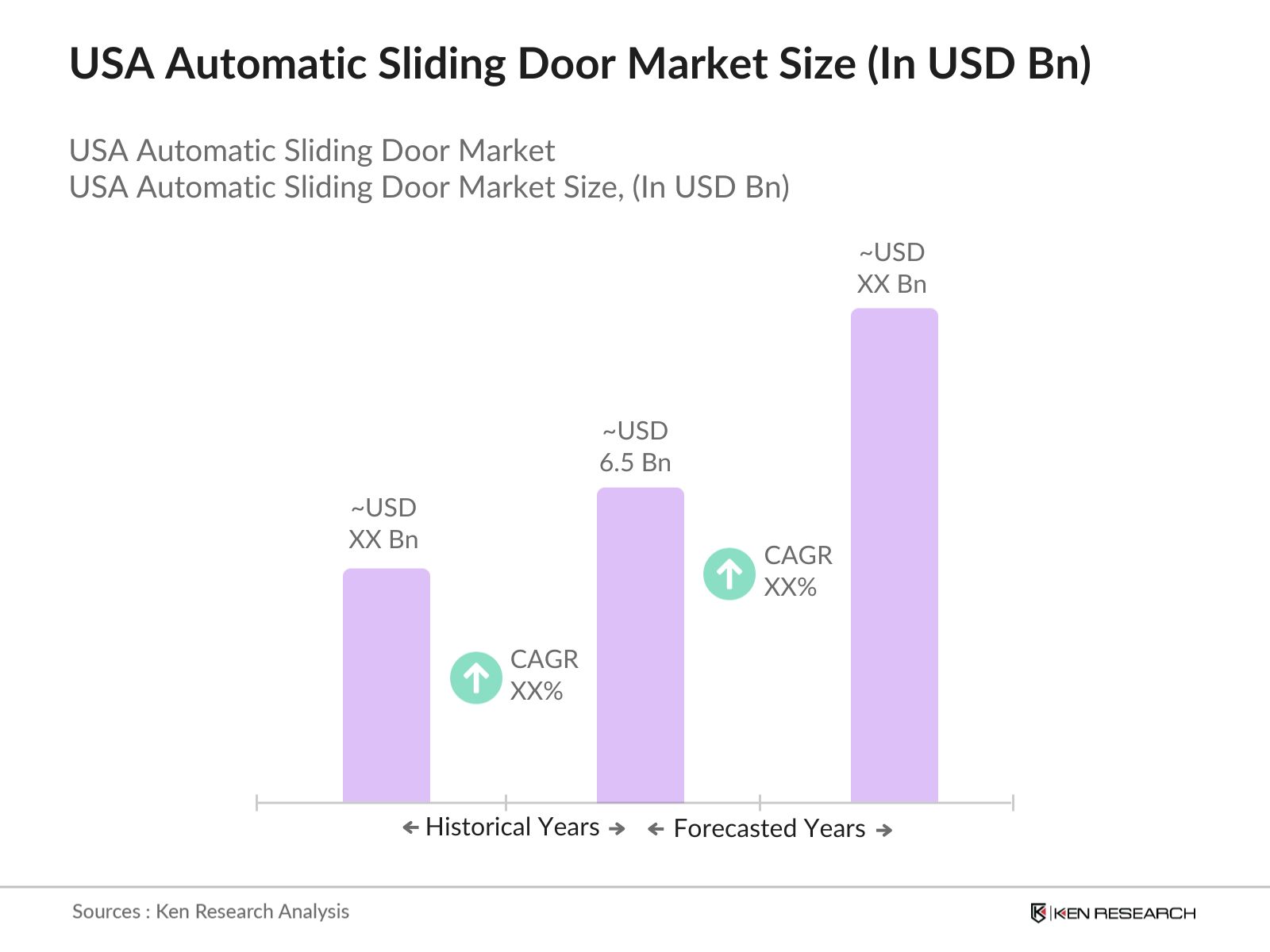
- The market is predominantly influenced by cities such as New York, Los Angeles, and Chicago, which have extensive commercial infrastructure, including retail and healthcare facilities, that heavily utilize automatic sliding doors. These cities lead in adoption due to high urban density, demand for efficient building access solutions, and infrastructure investments that drive modernization of entry systems across large buildings and facilities.
- The U.S. government mandates strict safety standards for automatic doors, especially in public spaces, to reduce accident risks. The Consumer Product Safety Commission enforces these regulations and reported that automatic doors in commercial spaces must meet specific safety protocols, including fail-safe mechanisms to protect users. Compliance with these regulations ensures consumer safety, a crucial requirement in the deployment of automated doors across sectors.
USA Automatic Sliding Door Market Segmentation
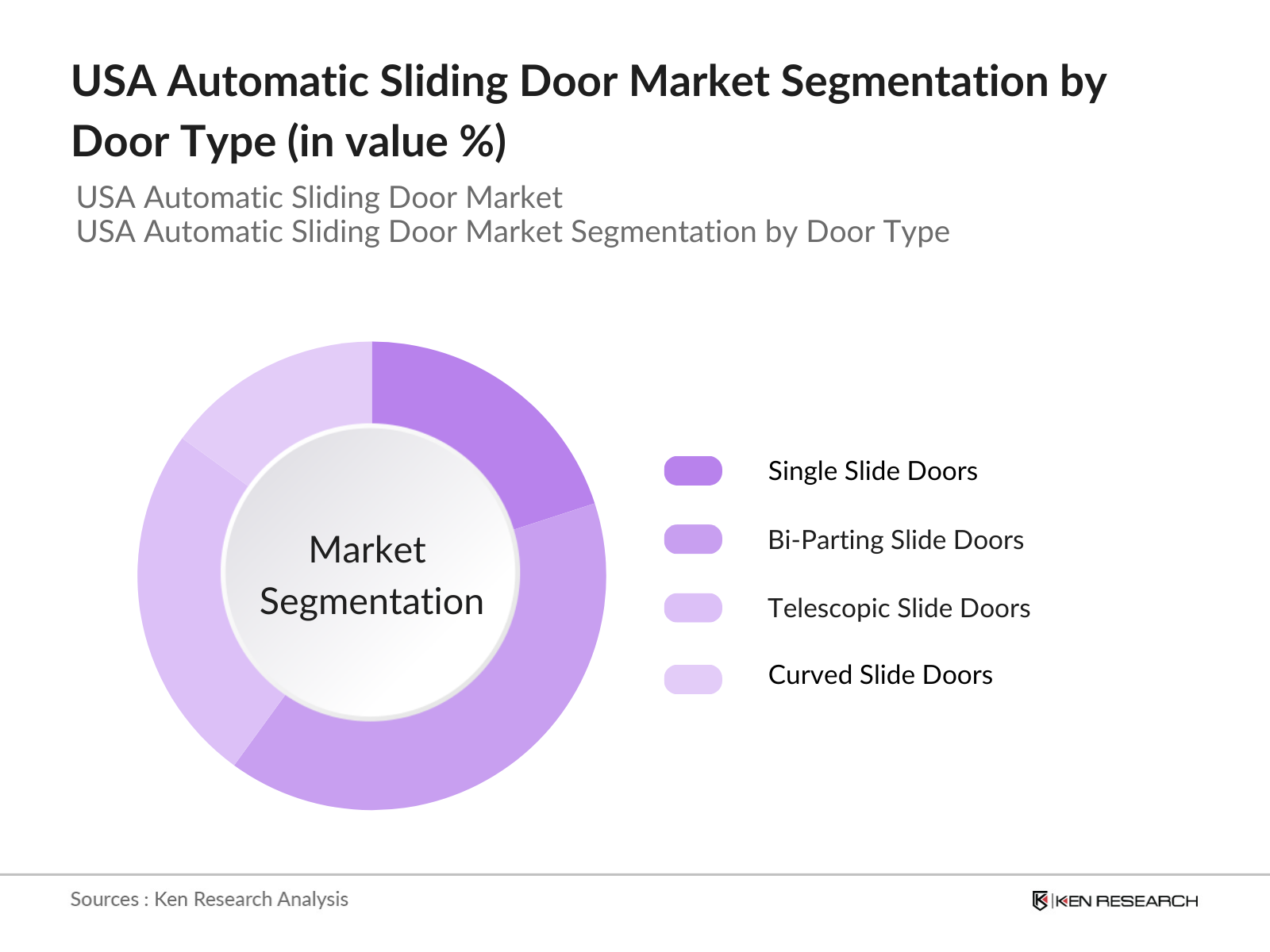
By Door Type: The USA Automatic Sliding Door market is segmented by door type into single slide doors, bi-parting slide doors, telescopic slide doors, and curved slide doors. Bi-parting slide doors have a dominant market share due to their widespread application in commercial and healthcare settings where ease of access and high throughput are critical. This door type provides balanced and wide opening capabilities, which are especially favored in high-traffic zones.
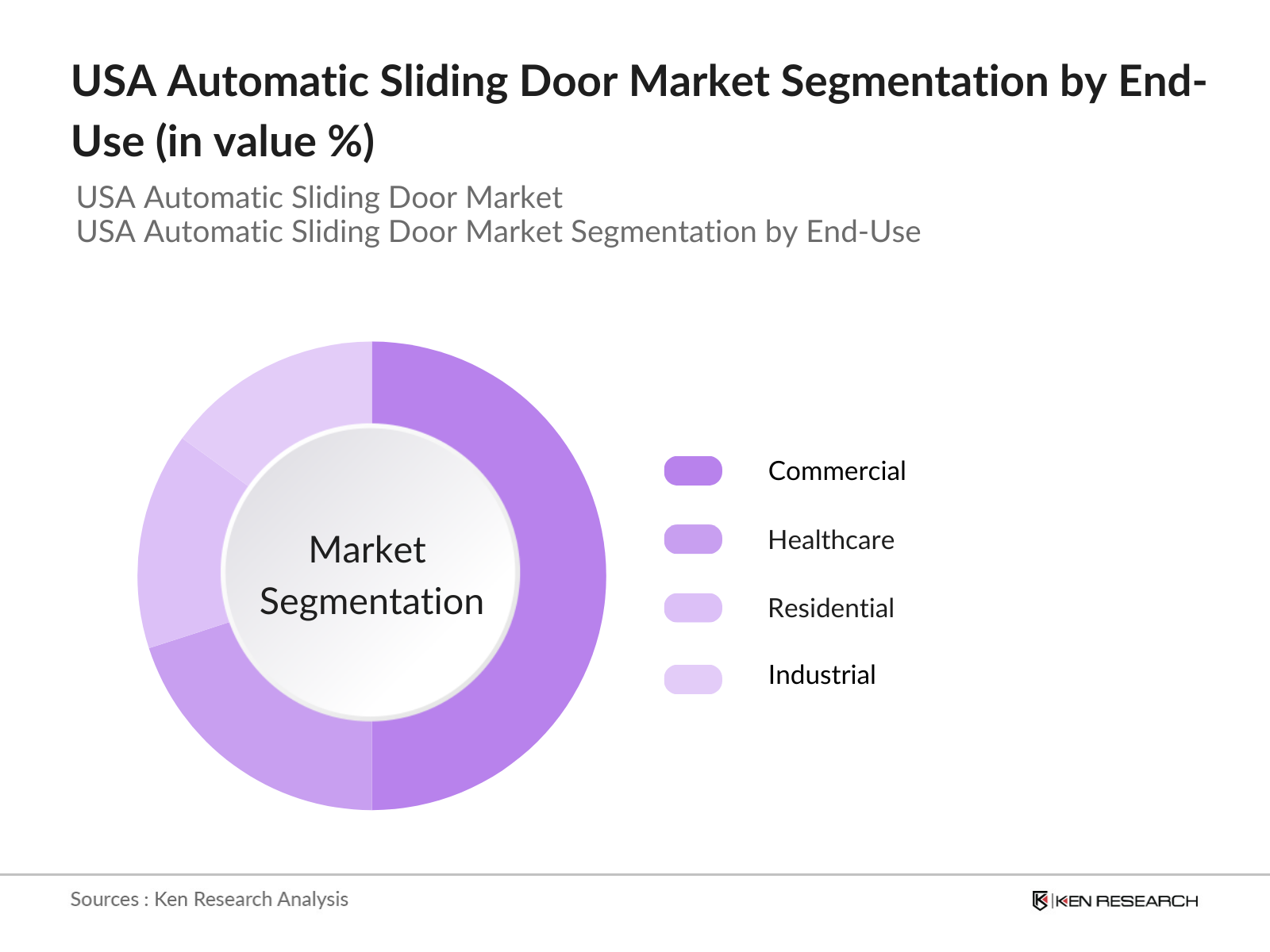
By End-Use: The USA Automatic Sliding Door market is segmented by end-use into commercial, healthcare, residential, and industrial sectors. The commercial sector dominates the market due to the heavy concentration of automated door installations in malls, airports, office buildings, and hotels. This segment benefits from consistent demand for enhanced customer convenience and compliance with ADA (Americans with Disabilities Act) requirements, which mandate accessible entryways in public spaces.
USA Automatic Sliding Door Market Competitive Landscape
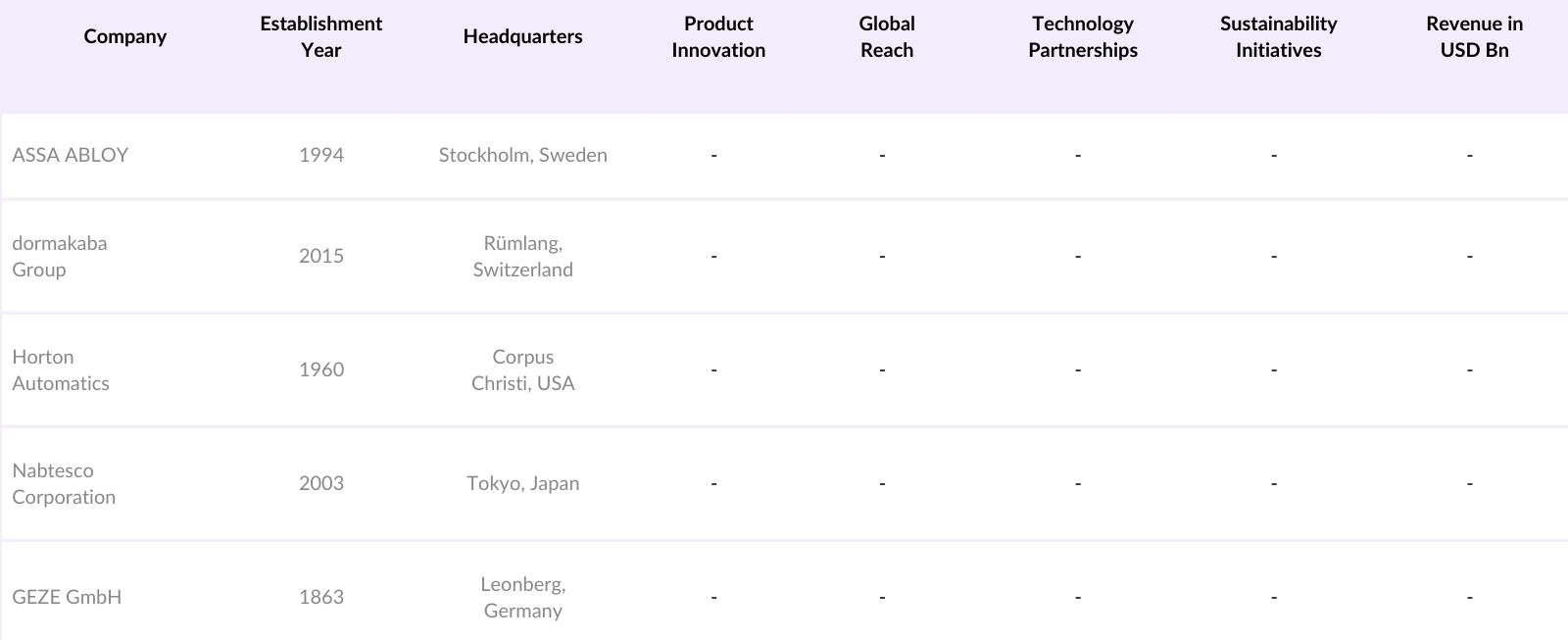
The USA Automatic Sliding Door market is dominated by a mix of established global and domestic players. Key players have established their stronghold through innovative product offerings and strategic alliances that enhance their service and distribution networks.
USA Automatic Sliding Door Industry Analysis
Growth Drivers
- Growing Adoption in Commercial Buildings: The adoption of automatic sliding doors in commercial buildings, such as offices, malls, and retail spaces, is being driven by increasing urbanization and infrastructure spending. According to the U.S. Census Bureau, construction spending in non-residential structures, including commercial buildings, was approximately $470 billion in 2024. This growing investment enhances the demand for accessibility features in commercial properties, where automatic sliding doors provide added convenience and meet ADA compliance.
- Increasing Demand in Healthcare Facilities: Healthcare facilities are expanding their use of automatic sliding doors to improve access and infection control. The U.S. Department of Health & Human Services reported an increase in healthcare infrastructure funding, with $2.7 billion allocated to new and existing healthcare facilities in 2024, contributing to the demand for automated doors. These doors are essential for controlled access to sensitive areas, particularly in hospitals and clinics, which recorded over 900 million patient visits annually. This increase in healthcare infrastructure supports the integration of automatic doors in both public and private healthcare facilities.
- Technological Advancements in Door Automation: Technological advancements in automation, such as the integration of sensor-based mechanisms, are transforming the market for automatic sliding doors. The National Institute of Standards and Technology reported an investment of $1.5 billion in R&D for automation technology in 2024. Innovations, such as radar-based sensors and machine learning capabilities, are enhancing the precision, safety, and efficiency of these doors, making them increasingly popular in both commercial and residential applications. These advancements cater to the need for higher performance in automated entry systems, particularly in high-traffic areas.
Market Challenges
- High Initial Cost and Maintenance: Automatic sliding doors involve a high initial cost, with installation expenses for a standard door estimated at around $3,000 - $5,000, as reported by the U.S. General Services Administration in 2024. Maintenance requirements, including regular servicing of sensors and mechanical components, add to ongoing expenses, especially in high-use commercial settings. This high cost remains a significant challenge for small businesses and low-budget public facilities that are reluctant to adopt high-maintenance automated systems despite their benefits.
- Energy Consumption and Environmental Concerns: Automatic sliding doors have higher energy requirements, often consuming about 0.1 kWh per door activation cycle. The U.S. Environmental Protection Agency highlights that with an estimated 200,000 operational automatic doors nationwide, this translates into notable energy use, creating environmental concerns. This energy consumption issue is further emphasized by the increasing pressure for buildings to achieve energy efficiency targets. In response, some facilities are prioritizing alternative solutions, like revolving doors, which provide better insulation.
USA Automatic Sliding Door Market Future Outlook
Over the coming years, the USA Automatic Sliding Door market is expected to witness steady growth, driven by urban development initiatives, the rise of smart city projects, and increasing adoption in residential sectors. Technological advancements, such as IoT-enabled doors and energy-efficient solutions, will likely play a significant role in this growth, along with a shift towards sustainable, eco-friendly building designs. Moreover, compliance with safety and accessibility standards will further cement automatic sliding doors as a staple in both new and retrofitted buildings.
Future Market Opportunities
- Green Building Initiatives: Green building initiatives are expanding in the U.S., with the Green Building Council noting that 70% of new construction in 2024 incorporates energy-efficient technologies, including automatic sliding doors. These doors reduce energy loss through optimized insulation and controlled access, aligning with LEED certification goals for commercial buildings. As more developers seek LEED certifications, automatic sliding doors are expected to gain further traction as a green building component, supported by state and federal incentives for sustainable construction.
- Expansion in Residential Sector: The residential sector is increasingly adopting automatic sliding doors, particularly in high-end housing developments and smart homes. The U.S. Department of Housing and Urban Development recorded a 15% rise in new residential construction permits in metropolitan areas in 2024. This surge in residential building activity, combined with a $400 million investment in smart home technology integration, supports the expansion of automated systems, including sliding doors, in modern homes.
Scope of the Report
|
By Door Type |
Single Slide Doors |
|
By End-Use |
Commercial |
|
By Mechanism |
Electro-Mechanical |
|
By Application |
Entrance |
|
By Region |
Northeast |
Products
Key Target Audience
Door and Window Manufacturers
Commercial Property Developers
Facility Management Companies
Government and Regulatory Bodies (e.g., ADA Compliance Agencies)
Investment and Venture Capitalist Firms
Healthcare Facility Managers
Industrial Building Contractors
Real Estate Developers and Architects
Companies
Major Players in the USA Automatic Sliding Door Market
ASSA ABLOY
dormakaba Group
Horton Automatics
Nabtesco Corporation
GEZE GmbH
Stanley Black & Decker
KONE Corporation
TORMAX USA Inc.
Boon Edam
Panasonic Corporation
Manusa
Record Automatic Doors
Ditec Entrematic
Overhead Door Corporation
Kenwa Company, Ltd.
Table of Contents
USA Automatic Sliding Door Market Overview
1.1 Definition and Scope
1.2 Market Taxonomy
1.3 Market Growth Rate
1.4 Market Segmentation Overview
USA Automatic Sliding Door Market Size (In USD Bn)
2.1 Historical Market Size
2.2 Year-On-Year Growth Analysis
2.3 Key Market Developments and Milestones
USA Automatic Sliding Door Market Analysis
3.1 Growth Drivers
3.1.1 Growing Adoption in Commercial Buildings
3.1.2 Increasing Demand in Healthcare Facilities
3.1.3 Technological Advancements in Door Automation
3.1.4 Urbanization and Infrastructure Development
3.2 Market Challenges
3.2.1 High Initial Cost and Maintenance
3.2.2 Energy Consumption and Environmental Concerns
3.2.3 Availability of Alternatives
3.3 Opportunities
3.3.1 Green Building Initiatives
3.3.2 Expansion in Residential Sector
3.3.3 Integration with Smart Home Systems
3.4 Trends
3.4.1 Increasing Use of Sensor-Based Sliding Doors
3.4.2 Adoption in Airports and Transit Facilities
3.4.3 Integration of AI and IoT for Enhanced Security
3.5 Government Regulations
3.5.1 Safety Standards for Automatic Doors
3.5.2 ADA Compliance Requirements
3.5.3 Energy Efficiency Standards
3.6 SWOT Analysis
3.7 Stakeholder Ecosystem
3.8 Porters Five Forces Analysis
3.9 Competitive Ecosystem
USA Automatic Sliding Door Market Segmentation
4.1 By Door Type (In Value %)
4.1.1 Single Slide Doors
4.1.2 Bi-Parting Slide Doors
4.1.3 Telescopic Slide Doors
4.1.4 Curved Slide Doors
4.2 By End-Use (In Value %)
4.2.1 Commercial
4.2.2 Healthcare
4.2.3 Residential
4.2.4 Industrial
4.3 By Mechanism (In Value %)
4.3.1 Electro-Mechanical
4.3.2 Hydraulic
4.4 By Application (In Value %)
4.4.1 Entrance
4.4.2 Interior
4.5 By Region (In Value %)
4.5.1 Northeast
4.5.2 Midwest
4.5.3 South
4.5.4 West
USA Automatic Sliding Door Market Competitive Analysis
5.1 Detailed Profiles of Major Companies
5.1.1 ASSA ABLOY
5.1.2 dormakaba Group
5.1.3 Horton Automatics
5.1.4 Nabtesco Corporation
5.1.5 GEZE GmbH
5.1.6 Stanley Black & Decker
5.1.7 TORMAX USA Inc.
5.1.8 KONE Corporation
5.1.9 Boon Edam
5.1.10 Manusa
5.1.11 Panasonic Corporation
5.1.12 Ditec Entrematic
5.1.13 Record Automatic Doors
5.1.14 Overhead Door Corporation
5.1.15 Kenwa Company, Ltd.
5.2 Cross Comparison Parameters (No. of Employees, Headquarters, Revenue, Product Range, Innovation Index, Market Share, Distribution Network, Sustainability Initiatives)
5.3 Market Share Analysis
5.4 Strategic Initiatives
5.5 Mergers and Acquisitions
5.6 Investment Analysis
5.7 Venture Capital Funding
5.8 Government Grants
5.9 Private Equity Investments
USA Automatic Sliding Door Market Regulatory Framework
6.1 Safety Standards
6.2 ADA Compliance Requirements
6.3 Certification Processes
USA Automatic Sliding Door Future Market Size (In USD Bn)
7.1 Future Market Size Projections
7.2 Key Factors Driving Future Market Growth
USA Automatic Sliding Door Future Market Segmentation
8.1 By Door Type (In Value %)
8.2 By End-Use (In Value %)
8.3 By Mechanism (In Value %)
8.4 By Application (In Value %)
8.5 By Region (In Value %)
USA Automatic Sliding Door Market Analysts Recommendations
9.1 TAM/SAM/SOM Analysis
9.2 Customer Cohort Analysis
9.3 Marketing Initiatives
9.4 White Space Opportunity Analysis
Disclaimer Contact UsResearch Methodology
Step 1: Identification of Key Variables
This initial step involves identifying core variables that impact the USA Automatic Sliding Door market, such as entry technology, regulatory compliance, and consumer preferences. This is achieved through extensive desk research, utilizing secondary and proprietary databases.
Step 2: Market Analysis and Construction
This step compiles historical data on the market, including revenue generation by segment, to estimate the size and structure of the industry. Market penetration and competitive landscapes are assessed to understand overall dynamics.
Step 3: Hypothesis Validation and Expert Consultation
Market hypotheses are formulated and validated via expert consultations, where insights from industry veterans are obtained through phone interviews, offering a nuanced understanding of market trends and factors.
Step 4: Research Synthesis and Final Output
Engagement with sliding door manufacturers and end-users further refines data, providing an accurate and comprehensive view of the market. This final synthesis ensures that the report reflects market realities, aligning closely with industry trends and demand patterns.
Frequently Asked Questions
01. How big is the USA Automatic Sliding Door Market?
The USA Automatic Sliding Door Market is valued at USD 6.5 billion, driven by urban development and demand for accessible, secure entry solutions in commercial and healthcare sectors.
02. What are the challenges in the USA Automatic Sliding Door Market?
Key challenges in the USA Automatic Sliding Door Market include high installation costs, maintenance requirements, and energy efficiency concerns, which can impact adoption among budget-conscious sectors.
03. Who are the major players in the USA Automatic Sliding Door Market?
Leading companies in the USA Automatic Sliding Door Market include ASSA ABLOY, dormakaba Group, Horton Automatics, Nabtesco Corporation, and GEZE GmbH, which dominate through extensive distribution networks and strong product offerings.
04. What drives the demand for automatic sliding doors in the USA?
The demand in the USA Automatic Sliding Door Market is primarily driven by the need for accessible entry systems in public and commercial buildings, as well as the integration of smart technology in building management.
05. What future trends are expected in the USA Automatic Sliding Door Market?
Trends in the USA Automatic Sliding Door Market include IoT integration, energy-efficient designs, and sustainable door systems, as well as increasing use in residential applications due to evolving home automation.
Why Buy From Us?

What makes us stand out is that our consultants follows Robust, Refine and Result (RRR) methodology. i.e. Robust for clear definitions, approaches and sanity checking, Refine for differentiating respondents facts and opinions and Result for presenting data with story

We have set a benchmark in the industry by offering our clients with syndicated and customized market research reports featuring coverage of entire market as well as meticulous research and analyst insights.

While we don't replace traditional research, we flip the method upside down. Our dual approach of Top Bottom & Bottom Top ensures quality deliverable by not just verifying company fundamentals but also looking at the sector and macroeconomic factors.

With one step in the future, our research team constantly tries to show you the bigger picture. We help with some of the tough questions you may encounter along the way: How is the industry positioned? Best marketing channel? KPI's of competitors? By aligning every element, we help maximize success.

Our report gives you instant access to the answers and sources that other companies might choose to hide. We elaborate each steps of research methodology we have used and showcase you the sample size to earn your trust.

If you need any support, we are here! We pride ourselves on universe strength, data quality, and quick, friendly, and professional service.