















USA Automotive Solenoid Market Outlook to 2030
Region:North America
Author(s):Shubham Kashyap
Product Code:KROD6483
December 2024
99
About the Report
USA Automotive Solenoid Market Overview
- The USA Automotive Solenoid Market is valued at USD 2.2 billion, fueled by the expansion of electric vehicles, advancements in automotive electronics, and the integration of automation in vehicle systems. Solenoids, used to control fuel injectors, automatic transmissions, and anti-lock braking systems, are increasingly vital in improving vehicle efficiency and performance. The demand for solenoids has seen consistent growth, with automotive manufacturers focusing on solutions that offer enhanced control and energy efficiency. The market's growth is also underpinned by technological advancements in solenoid materials and designs, contributing to their reliability in diverse automotive applications.
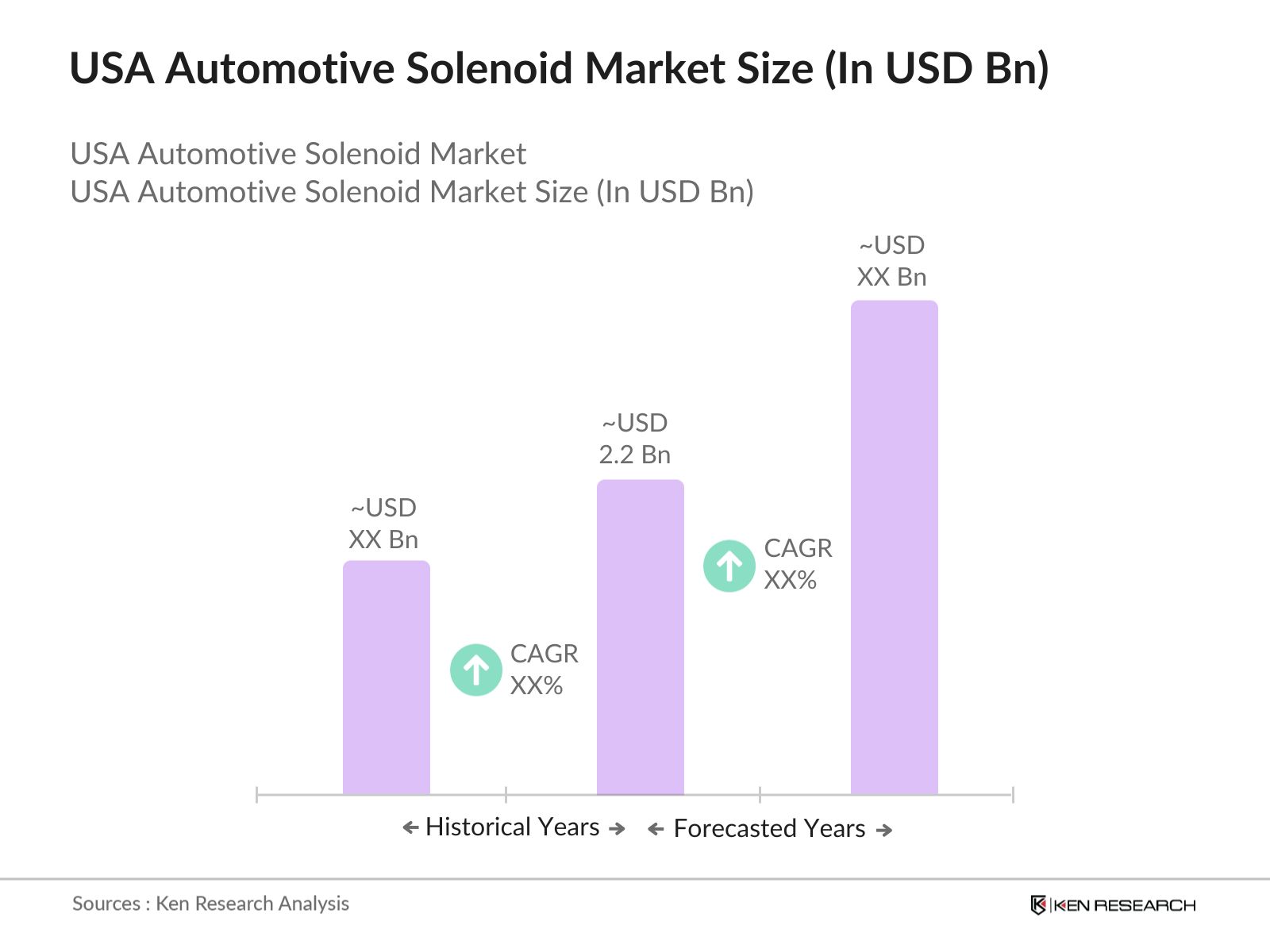
- Key states such as California, Texas, and Michigan dominate the USA Automotive Solenoid Market. Californias leadership in EV adoption and stringent emissions standards drive demand for efficient vehicle control systems. Texas is an automotive manufacturing hub with a robust supply chain supporting solenoid production. Michigan, with its legacy automotive infrastructure and innovation centers, contributes significantly by fostering advancements in vehicle control technology, particularly in automated and electric vehicles. Together, these states bolster solenoid adoption by providing a well-established ecosystem and regulatory support for automotive innovations.
- Stringent U.S. emission standards necessitate cleaner, more efficient solenoid technologies. The Environmental Protection Agency (EPA) has enforced Tier 3 standards requiring reduced emissions, impacting solenoid specifications in fuel systems. Solenoids in fuel control systems are essential in meeting emission standards by optimizing fuel efficiency. Compliance data indicate a notable improvement in fuel economy in vehicles adopting solenoids for emission control systems, highlighting their role in meeting regulatory requirements.
USA Automotive Solenoid Market Segmentation
- By Application: The USA Automotive Solenoid Market is segmented by application into transmission control, engine management, braking system, and HVAC system. Among these, transmission control holds a significant market share, attributed to its crucial role in facilitating automated transmissions, which are increasingly favored for smoother operation and fuel efficiency. The use of solenoids in automatic and dual-clutch transmissions allows for precise control of gear shifts, reducing fuel consumption and enhancing driving comfort, making it indispensable in modern vehicles.

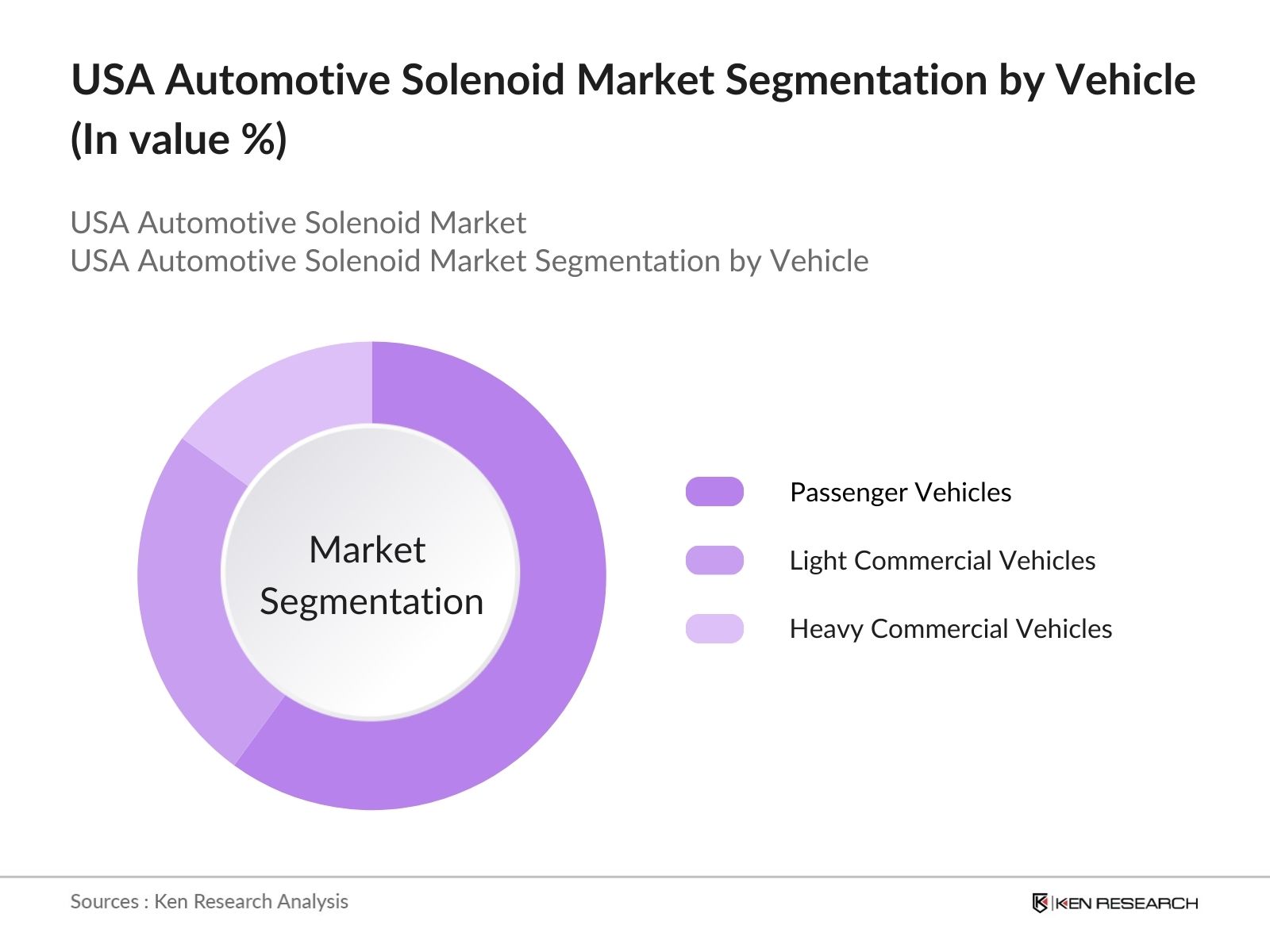
- By Vehicle Type: The market is also segmented by vehicle type into passenger vehicles, light commercial vehicles, and heavy commercial vehicles. Passenger vehicles dominate this segment, as they constitute the largest share of the automotive market. The demand for automated systems, comfort features, and energy efficiency is especially high in passenger vehicles, necessitating the integration of solenoids for engine management, braking, and transmission systems. Consequently, solenoids are vital components in passenger vehicles, supporting enhanced driving experiences and safety features.
USA Automotive Solenoid Market Competitive Landscape
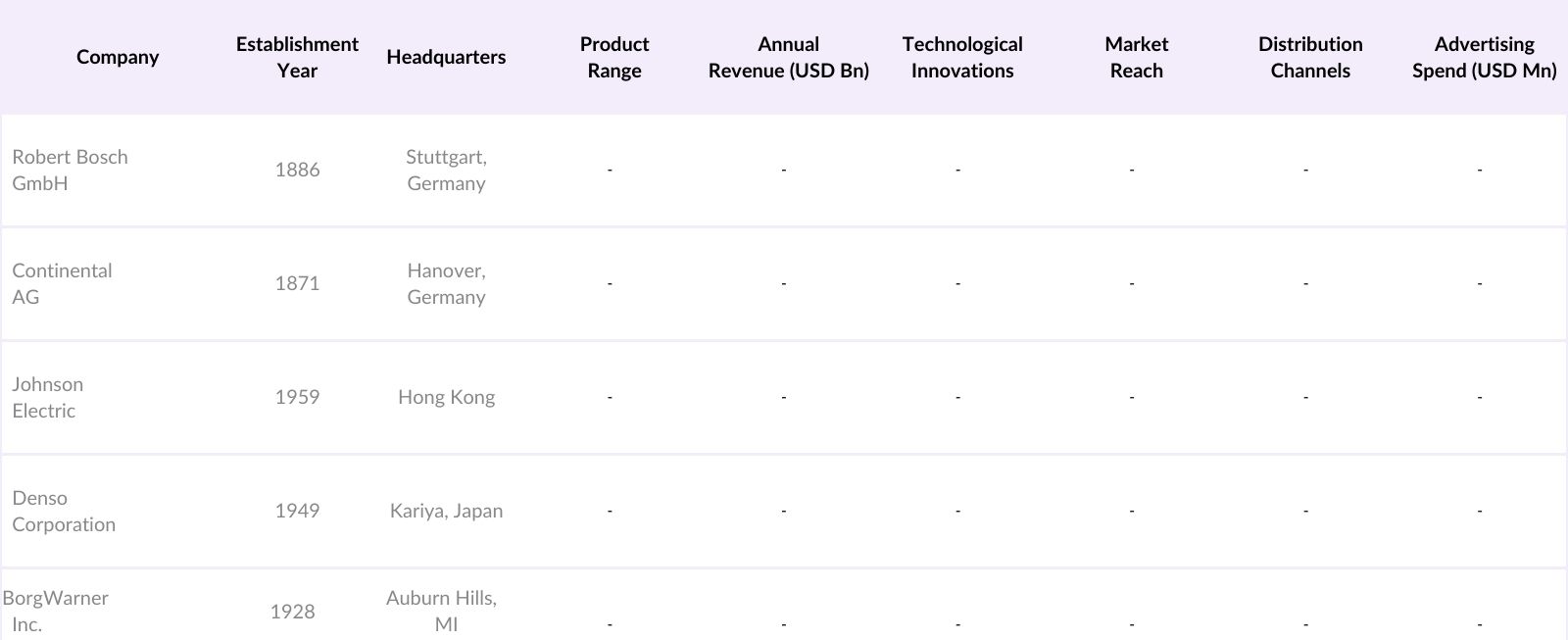
The USA Automotive Solenoid Market is competitive, with prominent players such as Robert Bosch GmbH, Continental AG, and Johnson Electric driving technological advancements and maintaining extensive production capacities. These companies compete on product innovation, distribution networks, and R&D investments to meet the rising demand for solenoid applications across vehicle types. The competitive landscape reflects a concentration of established global players with high production capacities and substantial R&D investments, enabling them to innovate and cater to the evolving requirements of the automotive industry.
USA Automotive Solenoid Market Analysis
Growth Drivers
- Increased Vehicle Electrification: With vehicle electrification on the rise, the demand for automotive solenoids is increasing significantly, driven by the U.S. governments strong push for electric vehicles (EVs). The Department of Energy (DOE) has allocated $3 billion to support the domestic EV supply chain, significantly boosting components like solenoids used in electric drivetrains. Additionally, the Energy Information Administration (EIA) reports that EV usage could reach 10 million vehicles by 2030 in the U.S., which requires an extensive infrastructure of electric components, including solenoids for effective operation.
- Adoption of Advanced Driver Assistance Systems (ADAS): The adoption of ADAS has surged in recent years, with over 18 million vehicles in the U.S. equipped with ADAS by 2023, per National Highway Traffic Safety Administration (NHTSA) data. ADAS features heavily rely on solenoid technology to ensure system reliability, especially in braking and steering applications. Federal Motor Vehicle Safety Standards mandate these systems in many new vehicles, further boosting demand for automotive solenoids.
- Rising Demand for Automated Transmission: Automated transmission systems, which require high-functioning solenoids, are now used in majority of new U.S. vehicles, according to the Bureau of Transportation Statistics. This shift is linked to consumer demand for fuel efficiency and ease of driving, particularly in urban areas where automatic transmissions are preferred. The demand for solenoids in these applications will likely continue to grow as vehicle manufacturers increasingly replace manual transmissions with automated solutions.
Challenges
- Fluctuating Raw Material Costs: The automotive solenoid industry faces ongoing challenges due to the volatility in raw material costs, especially for metals like copper and aluminum. With copper prices reaching over $9,000 per metric ton in 2023, according to the International Copper Study Group, production costs are heavily impacted, pushing manufacturers to adjust pricing strategies to remain competitive. This price fluctuation forces companies to adopt cost-cutting measures and seek alternative suppliers to mitigate the financial impact of these raw material instabilities.
- Regulatory Compliance and Environmental Concerns: Environmental regulations governing emissions and sustainable material sourcing place additional compliance burdens on automotive solenoid manufacturers. For instance, Californias stringent emission standards require manufacturers to invest in low-emission technologies, raising operational costs by up to 10% in highly regulated states, according to the California Air Resources Board. Adhering to these robust standards drives a need for eco-friendly practices, making it essential for manufacturers to explore recyclable materials and energy-efficient processes in production.
USA Automotive Solenoid Market Future Outlook
The USA Automotive Solenoid Market is projected to grow steadily, supported by increasing adoption of electric and autonomous vehicles, advancements in solenoid applications, and favorable regulatory policies. The push for sustainability and lightweight vehicle components is expected to drive innovation in solenoid technology, offering growth opportunities in diverse automotive applications. Additionally, ongoing developments in electric vehicle infrastructure will likely stimulate demand for solenoids, particularly in battery management and control systems, further propelling market growth.
Future Market Opportunities
- Expansion in EV Components: The rising adoption of electric vehicles is expanding demand for high-quality, efficient solenoids essential in power management and braking systems. According to the U.S. Department of Transportation, there were 1.4 million EVs on the road in 2023, with growing requirements for compact solenoids that ensure efficient energy use. This increase opens a strong market for manufacturers to specialize in EV-compatible solenoids, addressing the energy-efficiency needs of the EV industry.
- Technological Advancements in Solenoids: Innovations in materials science are enhancing solenoid durability and efficiency, meeting the evolving requirements of electric and automated vehicles. By 2023, the National Institute of Standards and Technology (NIST) noted that improved materials have reduced solenoid failure rates substantially, making them more reliable for automotive applications. Such advancements are key in automotive applications that demand long-lasting, durable components, such as ADAS and EV systems.
Scope of the Report
|
By Function |
Fluid Control Gas Control Motion Control |
|
By Valve Design |
2-Way Solenoid Valve 3-Way Solenoid Valve 4-Way Solenoid Valve 5-Way Solenoid Valve |
|
By Application |
Body Control & Interiors Engine Control & Cooling System Fuel & Emission Control HVAC Systems Safety & Security |
|
By Vehicle Type |
Passenger Vehicles Light Commercial Vehicles Heavy Commercial Vehicles |
|
By Region |
North America Europe Asia-Pacific Latin America Middle East & Africa |
Products
Key Target Audience
Automotive Manufacturers
Electric Vehicle Manufacturers
Tier 1 Automotive Suppliers
Solenoid Component Distributors
Investors and Venture Capitalist Firms
Banks and Financial Institutions
Environmental Regulatory Bodies (EPA, CARB)
Automotive R&D Organizations
Companies
Players Mentioned in the Report
Robert Bosch GmbH
Continental AG
Johnson Electric
Denso Corporation
BorgWarner Inc.
Mitsubishi Electric Corporation
Aptiv PLC
Nidec Corporation
Schaeffler Group
ZF Friedrichshafen AG
Valeo SA
Hitachi, Ltd.
Emerson Electric Co.
Magneti Marelli S.p.A
Stoneridge Inc.
Table of Contents
01 USA Automotive Solenoid Market Overview
1.1 Definition and Scope
1.2 Market Taxonomy
1.3 Market Growth Rate
1.4 Market Segmentation Overview
02 USA Automotive Solenoid Market Size (USD Bn)
2.1 Historical Market Size
2.2 Year-On-Year Growth Analysis
2.3 Key Market Developments and Milestones
03 USA Automotive Solenoid Market Analysis
3.1 Growth Drivers
3.1.1 Rising Demand for Electric and Hybrid Vehicles
3.1.2 Expansion in Automated and ADAS Systems
3.1.3 Increasing Focus on Emission Control
3.1.4 Growth in Vehicle Production and Infrastructure
3.2 Market Challenges
3.2.1 High Production and Integration Costs
3.2.2 Technical Complexity of Automotive Solenoids
3.2.3 Fluctuations in Raw Material Costs
3.3 Opportunities
3.3.1 Development of Advanced and Sustainable Solenoid Technologies
3.3.2 Regional Expansion and Aftermarket Opportunities
3.4 Trends
3.4.1 Shift Toward Electric Vehicles (EVs)
3.4.2 Increasing Use of Solenoids in Advanced Driver-Assistance Systems (ADAS)
3.4.3 Advancements in Electronic and Sensor Integration
3.5 Government Regulations
3.5.1 Environmental Standards and Emission Regulations
3.5.2 Federal Support for EV and Hybrid Vehicles
3.6 Competitive Landscape (Porters Five Forces)
3.7 SWOT Analysis
3.8 Stakeholder Ecosystem
04 USA Automotive Solenoid Market Segmentation
4.1 By Application
4.1.1 Engine Control Systems
4.1.2 Fuel and Emission Control
4.1.3 Safety and Security Systems
4.1.4 Body Control & Interiors
4.1.5 HVAC Systems
4.2 By Vehicle Type
4.2.1 Passenger Cars
4.2.2 Light Commercial Vehicles (LCVs)
4.2.3 Heavy Commercial Vehicles (HCVs)
4.2.4 Electric Vehicles (EVs)
4.3 By Solenoid Type
4.3.1 2-Way Valve
4.3.2 3-Way Valve
4.3.3 4-Way Valve
4.3.4 Others
4.4 By Sales Channel
4.4.1 OEMs
4.4.2 Aftermarket
4.5 By Region
4.5.1 North America
4.5.2 Europe
4.5.3 Asia-Pacific
4.5.4 Latin America
4.5.5 Middle East & Africa
05 USA Automotive Solenoid Market Competitive Analysis
5.1 Profiles of Key Competitors
5.1.1 BorgWarner Inc.
5.1.2 DENSO Corporation
5.1.3 Emerson Electric Co.
5.1.4 Delphi Technologies PLC
5.1.5 General Motors Co.
5.1.6 Robert Bosch GmbH
5.1.7 Johnson Electric Holdings Ltd.
5.1.8 Hitachi Ltd.
5.1.9 Nidec Corporation
5.1.10 TLX Technologies
5.1.11 Continental AG
5.1.12 Mitsubishi Electric Corporation
5.1.13 Rotex Automation
5.1.14 Stoneridge, Inc.
5.1.15 Schaeffler AG
5.2 Cross-Comparison Parameters (Annual Revenue, Market Share, Product Range, R&D Expenditure, Global Presence, Sales Channel Distribution, Product Quality, and Innovation Capabilities)
5.3 Market Share Analysis
5.4 Strategic Initiatives
5.4.1 Mergers and Acquisitions
5.4.2 Partnerships and Collaborations
5.5 Investment Analysis
5.6 Funding and Grants (Government and Private Sector)
5.7 Venture Capital Funding Trends
5.8 Private Equity Investments
06 USA Automotive Solenoid Market Regulatory Framework
6.1 Compliance Standards and Certifications
6.2 National Emission Standards
6.3 Vehicle Safety Regulations
07 USA Automotive Solenoid Future Market Size (USD Bn)
7.1 Future Market Size Projections
7.2 Key Factors Influencing Future Market Growth
08 USA Automotive Solenoid Market Analysts Recommendations
8.1 TAM/SAM/SOM Analysis
8.2 Customer Cohort Analysis
8.3 Market Penetration and Expansion Opportunities
8.4 White Space and Innovation Opportunities
Disclaimer Contact UsResearch Methodology
Step 1: Identification of Key Variables
The initial phase involves mapping all key stakeholders and defining critical variables such as market drivers, restraints, and opportunities specific to the USA Automotive Solenoid Market. This is achieved through extensive desk research, leveraging proprietary databases to gather relevant information.
Step 2: Market Analysis and Data Collection
Historical data is collected to assess growth trends and market performance. This includes segmentation analysis and evaluating market drivers like automotive electrification. The data is cross-validated with industry reports and third-party databases.
Step 3: Hypothesis Development and Validation
Hypotheses about market trends are formulated and validated through expert interviews with stakeholders, including automotive engineers and component suppliers. This feedback refines data accuracy and provides insights into real-world market dynamics.
Step 4: Data Synthesis and Report Compilation
Finally, data synthesis is conducted, incorporating both primary and secondary data sources. The compiled report provides a validated analysis, ensuring comprehensive coverage of the USA Automotive Solenoid Market.
Frequently Asked Questions
01 How big is the USA Automotive Solenoid Market?
The USA Automotive Solenoid Market is valued at USD 2.2 billion, driven by rising automation in vehicle systems and growing demand for electric vehicles.
02 What are the main challenges in the USA Automotive Solenoid Market?
Key challenges in the USA Automotive Solenoid Market include high production costs, complex design requirements, and the need for continuous innovation to meet evolving automotive technology standards.
03 Who are the major players in the USA Automotive Solenoid Market?
Prominent players in the USA Automotive Solenoid Market include Robert Bosch GmbH, Continental AG, Denso Corporation, Mitsubishi Electric Corporation, and Aptiv PLC, all recognized for their strong market presence and technological innovations.
04 What are the growth drivers for the USA Automotive Solenoid Market?
Growth drivers in the USA Automotive Solenoid Market encompass increased adoption of ADAS systems, the expansion of electric vehicles, and regulatory measures focusing on emissions and fuel efficiency.
Why Buy From Us?

What makes us stand out is that our consultants follows Robust, Refine and Result (RRR) methodology. i.e. Robust for clear definitions, approaches and sanity checking, Refine for differentiating respondents facts and opinions and Result for presenting data with story

We have set a benchmark in the industry by offering our clients with syndicated and customized market research reports featuring coverage of entire market as well as meticulous research and analyst insights.

While we don't replace traditional research, we flip the method upside down. Our dual approach of Top Bottom & Bottom Top ensures quality deliverable by not just verifying company fundamentals but also looking at the sector and macroeconomic factors.

With one step in the future, our research team constantly tries to show you the bigger picture. We help with some of the tough questions you may encounter along the way: How is the industry positioned? Best marketing channel? KPI's of competitors? By aligning every element, we help maximize success.

Our report gives you instant access to the answers and sources that other companies might choose to hide. We elaborate each steps of research methodology we have used and showcase you the sample size to earn your trust.

If you need any support, we are here! We pride ourselves on universe strength, data quality, and quick, friendly, and professional service.