















USA Autonomous Mobile Robot Market Outlook to 2030
Region:North America
Author(s):Shubham Kashyap
Product Code:KROD4005
December 2024
96
About the Report
USA Autonomous Mobile Robot Market Overview
- The USA Autonomous Mobile Robot (AMR) market is witnessing rapid growth, currently valued at USD 1.1 Bn, driven by increasing automation across various industries, advancements in AI and robotics technologies, and a growing need for operational efficiency in logistics and manufacturing. The AMR market is supported by widespread adoption in sectors such as e-commerce, automotive, healthcare, and food and beverage, where demand for automated material handling and warehouse management is high. With the increasing implementation of Industry 4.0, many companies are transitioning from traditional manual operations to automation-driven systems.
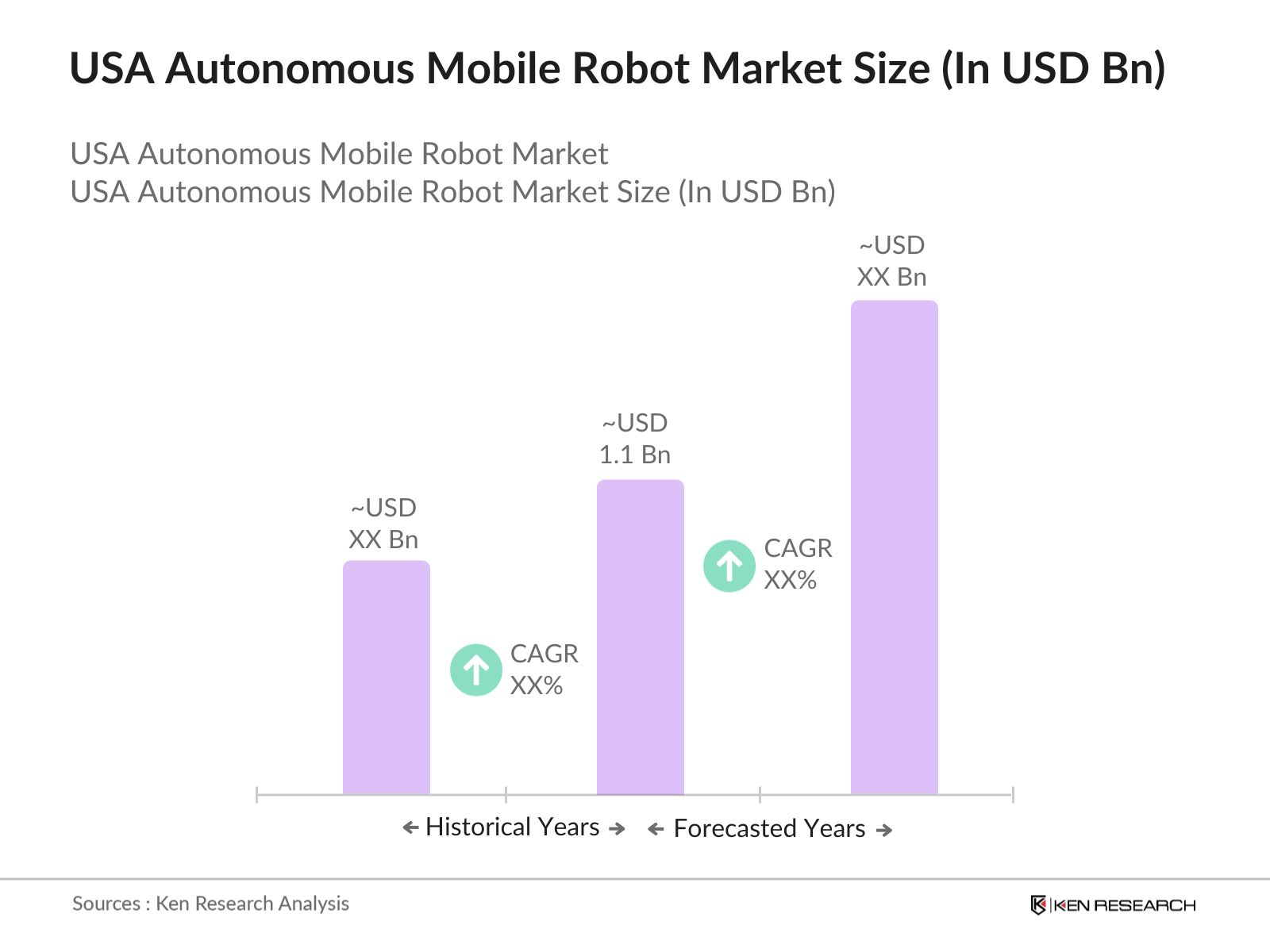
- Key regions in the USA, including California, Texas, and Illinois, are leading contributors to the adoption of AMRs, given their high industrial output and technological advancements. The rise of e-commerce, with giants like Amazon and Walmart heavily investing in robotics for warehouse management, has significantly driven the market. Post-pandemic supply chain challenges have underscored the importance of automation, pushing industries to adopt AMR solutions to ensure uninterrupted operations and improve cost efficiency.
- The regulatory landscape in the USA, with guidelines from agencies such as the Occupational Safety and Health Administration (OSHA) and the National Institute of Standards and Technology (NIST), ensures that AMR solutions adhere to safety and efficiency standards. These regulations have played a critical role in shaping the AMR market by setting frameworks for safe deployment across various industries.
USA Autonomous Mobile Robot Market Segmentation
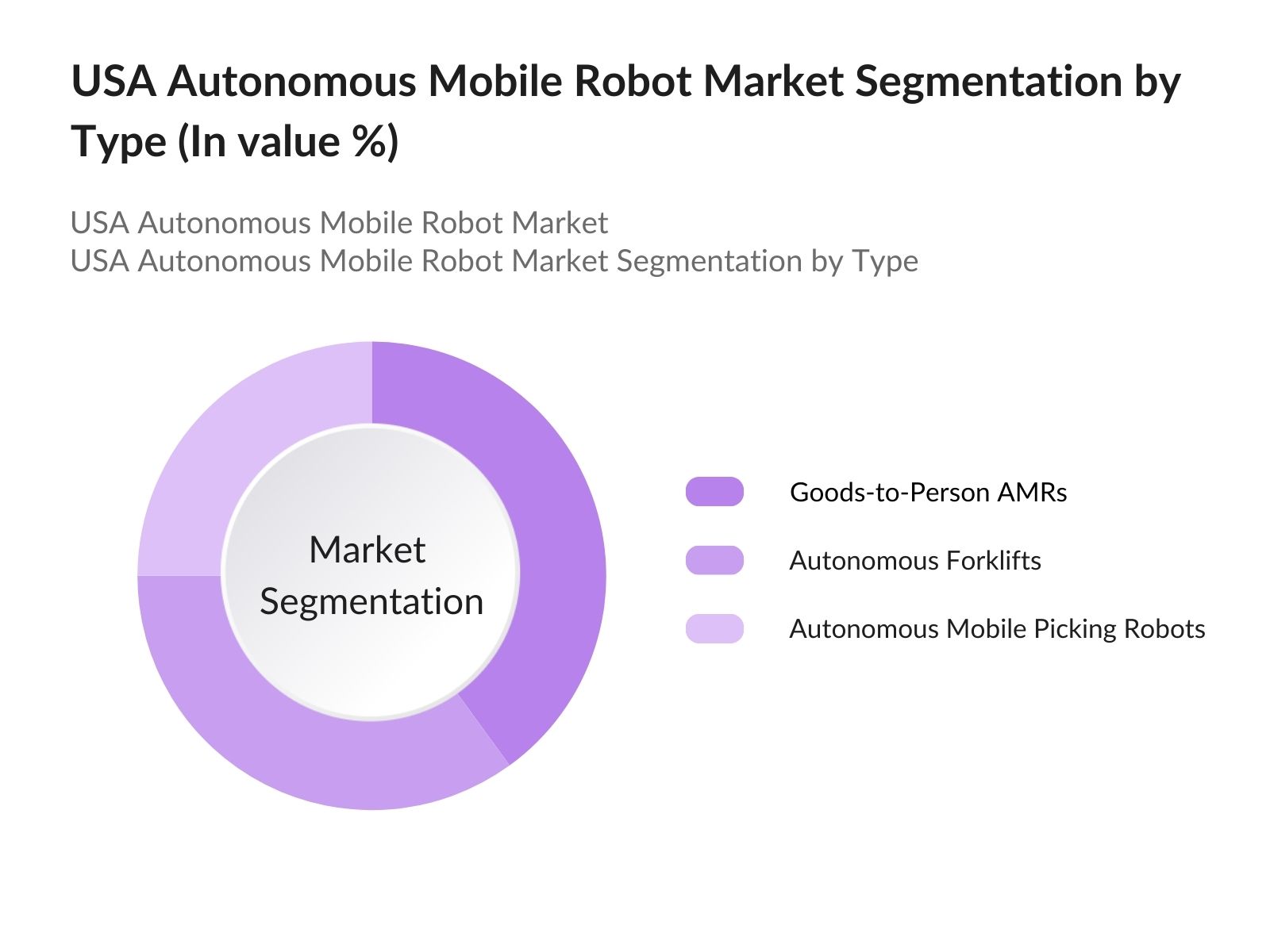
- By Type: The market is segmented into goods-to-person AMRs, autonomous forklifts, and autonomous mobile picking robots. Goods-to-person AMRs, which transport goods directly to human workers, are gaining widespread traction in sectors like e-commerce and retail, accounting for a significant market share. Autonomous forklifts, used in logistics and manufacturing for pallet transportation, are witnessing a strong uptick due to their ability to handle heavy loads efficiently. Autonomous mobile picking robots, primarily used in warehouses, are seeing increased adoption due to their accuracy in picking and sorting operations, reducing human error and increasing productivity.
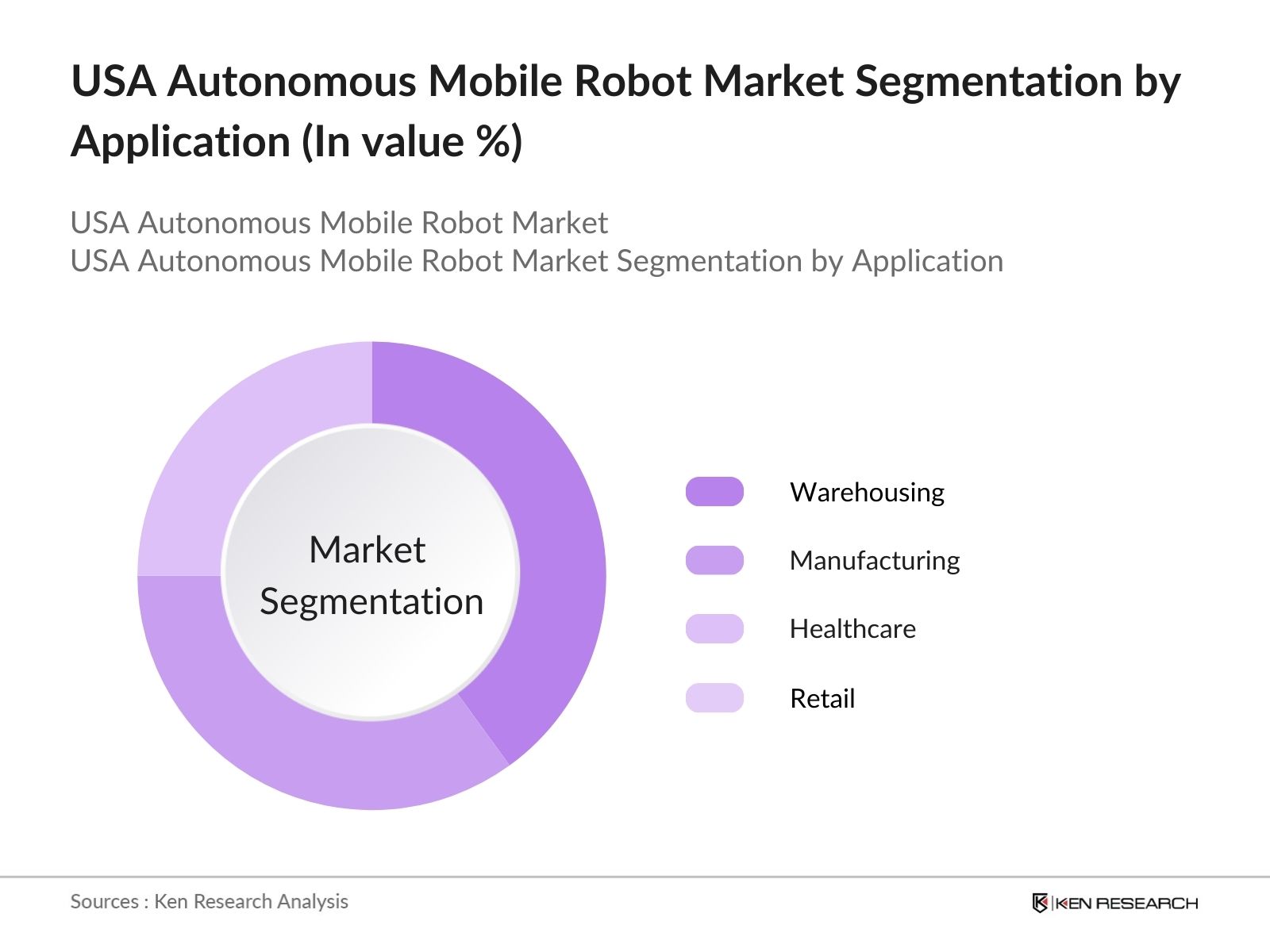
- By Application: The market is segmented by application into warehousing, manufacturing, healthcare, and retail. Warehousing dominates the market, with companies focusing on improving efficiency in inventory management and order fulfillment. Manufacturing follows closely, with AMRs automating processes such as material transport and assembly line operations. The healthcare sector is also increasingly adopting AMRs for tasks like material delivery and patient care assistance, while the retail industry is utilizing AMRs to optimize in-store operations and enhance customer experiences through automated services.
USA Autonomous Mobile Robot Market Competitive Landscape
The USA Autonomous Mobile Robot market is highly competitive, with key players continually investing in research and development to enhance AMR capabilities. Leading companies in the market include Amazon Robotics, Clearpath Robotics, Locus Robotics, Fetch Robotics, and Geek+. These companies are focused on expanding their product portfolios, collaborating with industry players, and integrating advanced technologies like artificial intelligence, machine learning, and 5G connectivity into their AMR solutions to meet the evolving needs of the market.
|
Company Name |
Establishment Year |
Headquarters |
No. of Employees |
Revenue (USD) |
Key Products |
Sustainability Initiatives |
Geographical Reach |
Technology Adoption |
Partnerships |
|
Amazon Robotics |
2012 |
Seattle, WA |
|||||||
|
Clearpath Robotics |
2009 |
Kitchener, ON |
|||||||
|
Locus Robotics |
2014 |
Wilmington, MA |
|||||||
|
Fetch Robotics |
2014 |
San Jose, CA |
|||||||
|
Geek+ |
2015 |
Beijing, China |
USA Autonomous Mobile Robot Industry Analysis
Growth Drivers
- Increasing Demand for Automation in Warehousing and Manufacturing: The U.S. warehousing and manufacturing sectors are experiencing increased automation due to the adoption of Autonomous Mobile Robots (AMRs). In 2023, U.S. industrial output grew by 1.9%, while labor shortages contributed to the rise of automation. AMRs are being deployed to manage tasks such as picking and palletizing, with companies like Walmart automating distribution centers. The U.S. Bureau of Labor Statistics (BLS) reported a decrease in manufacturing labor force availability by 1.4 million from 2021 to 2023, further driving AMR demand in the industry. Automation also boosts productivity, contributing to a 5.0% increase in manufacturing output.
- Advancements in AI and Robotics Technology: Technological advancements in artificial intelligence (AI) and robotics are transforming the autonomous mobile robot market in the U.S. By 2023, the country witnessed a substantial increase in AI-driven robotics patent filings, indicating rapid innovation in the sector. Additionally, the U.S. government allocated USD 45 billion for AI research and development in 2022 to foster innovation in robotics and automation. This increased funding is enabling the development of more advanced perception, decision-making, and mobility capabilities in AMRs, significantly enhancing their efficiency and effectiveness in industrial environments.
- Rising Demand in E-commerce and Retail Sector: The U.S. e-commerce sector saw a revenue increase of USD 1.19 trillion in 2023, up from USD 1.04 trillion in 2022, according to U.S. Census Bureau data. As online shopping continues to grow, so does the demand for faster and more efficient order fulfillment, driving AMR adoption in retail warehouses. Retail giants such as Amazon and Target have significantly increased their AMR usage to enhance warehouse automation and meet delivery timelines. By integrating AMRs, these companies have reduced shipping times substantially in the last two years, contributing to higher consumer satisfaction.
Market Challenges
- High Initial Investment and Maintenance Costs: While AMRs offer substantial long-term benefits, the high upfront costs and ongoing maintenance expenses remain a significant barrier, especially for small and medium-sized enterprises (SMEs). Implementing AMR systems requires substantial initial capital investment, which varies depending on the complexity of the application. In addition to the purchase price, businesses must account for ongoing operational expenses such as software updates, sensor recalibration, and battery replacements. These recurring costs add to the financial burden, making it more challenging for smaller businesses to adopt automation technology on par with larger competitors.
- Regulatory Concerns and Safety Compliance: The implementation of AMRs in the U.S. is subject to stringent regulatory frameworks, particularly regarding safety standards. Agencies such as the Occupational Safety and Health Administration (OSHA) and the National Institute of Standards and Technology (NIST) have established mandatory safety guidelines for the use of autonomous systems in industrial environments. Compliance with these regulations is essential to avoid financial penalties, but it can also increase operational complexity and costs. These regulatory requirements often slow down the deployment process, making it harder for businesses to swiftly integrate AMRs into their operations.
USA Autonomous Mobile Robot Market Future Outlook
The USA Autonomous Mobile Robot market is poised for substantial growth, fueled by continued advancements in AI, increasing automation across industries, and the rapid expansion of e-commerce. The integration of 5G technology is expected to enhance real-time data processing capabilities, improving the performance and efficiency of AMRs in various applications. As industries increasingly prioritize automation to meet growing consumer demands and mitigate supply chain disruptions, the adoption of AMRs is projected to accelerate.
Future Market Opportunities
- Expansion into Healthcare Applications: The healthcare sector in the U.S. presents a significant growth opportunity for AMRs. In 2023, U.S. healthcare spending reached USD 4.8 trillion, representing 17.6% of the GDP, with hospitals seeking to enhance operational efficiency. AMRs can be used to transport medical supplies, waste, and linens, reducing the need for human labor and minimizing errors. Hospitals like the Cleveland Clinic have started using AMRs for logistics, contributing to substantial reduction in operational costs. The aging population, expected to rise to 21% of the U.S. population by 2030, will further drive the need for automation in healthcare facilities.
- Growing Need for Autonomous Forklifts in Manufacturing: Autonomous forklifts are gaining traction in the U.S. manufacturing sector due to labor shortages and increased demand for operational efficiency. In 2023, U.S. manufacturing employment fell by 1.2%, according to the Bureau of Labor Statistics, while the demand for autonomous forklifts increased. These machines reduce the need for manual labor and improve safety by preventing accidents. Major automakers like Tesla and Ford are already deploying autonomous forklifts in their production lines, resulting in reduction in operational costs.
Scope of the Report
|
By Type |
Goods-to-Person AMRs Autonomous Forklifts Autonomous Picking Robots |
|
By Application |
Warehousing Manufacturing Healthcare Retail |
|
By Technology |
AI-powered Navigation Systems Lidar and Vision Systems Cloud-based AMR Solutions |
|
By Region |
North East South West |
Products
Key Target Audience
Investors and Venture Capitalist Firms
Logistics and E-commerce Companies
Warehousing Operators
Healthcare Providers
Government and Regulatory Bodies (OSHA, NIST)
Manufacturing Companies
Robotics and Automation Solution Providers
Retail Industry Leaders
Banks and Financial Institutions
Companies
Major Players Mentioned in the Report
Amazon Robotics
Clearpath Robotics
Locus Robotics
Fetch Robotics
Geek+
OTTO Motors
Seegrid
MiR (Mobile Industrial Robots)
6 River Systems
Aethon
IAM Robotics
Boston Dynamics
Vecna Robotics
GreyOrange
Savioke
Table of Contents
01 USA Autonomous Mobile Robot Market Overview
1.1 Definition and Scope
1.2 Market Taxonomy
1.3 Market Growth Rate
1.4 Market Segmentation Overview
02 USA Autonomous Mobile Robot Market Size (In USD Bn)
2.1 Historical Market Size
2.2 Year-On-Year Growth Analysis
2.3 Key Market Developments and Milestones
03 USA Autonomous Mobile Robot Market Analysis
3.1 Growth Drivers
3.1.1 Increasing Adoption of AMRs in Warehousing and Manufacturing
3.1.2 Technological Advancements in AI and Robotics
3.1.3 Rising Demand in E-commerce and Retail Sector
3.1.4 Integration with Industry 4.0 and Smart Factories
3.2 Market Challenges
3.2.1 High Initial Costs and Maintenance Expenses
3.2.2 Regulatory Compliance and Safety Standards
3.2.3 Operational Scalability Issues in Smaller Facilities
3.3 Opportunities
3.3.1 Expansion into Healthcare Applications
3.3.2 Growing Need for Autonomous Forklifts in Manufacturing
3.3.3 Development of AI-driven Navigation Systems
3.4 Trends
3.4.1 Adoption of 5G for Enhanced Real-time Data Processing
3.4.2 Increased Use of AMRs in Collaborative Robotics (Cobots)
3.4.3 Rising Demand for Cloud-integrated AMR Solutions
3.5 Government Regulation
3.5.1 Safety Compliance Frameworks (OSHA, NIST)
3.5.2 Regulatory Guidelines for Industrial Automation
3.5.3 Impact of U.S. Infrastructure Development Policies
3.6 SWOT Analysis
3.7 Stake Ecosystem
3.8 Porters Five Forces Analysis
3.9 Competition Ecosystem
04 USA Autonomous Mobile Robot Market Segmentation
4.1 By Type (In Value %)
4.1.1 Goods-to-Person AMRs
4.1.2 Autonomous Forklifts
4.1.3 Autonomous Picking Robots
4.2 By Application (In Value %)
4.2.1 Warehousing
4.2.2 Manufacturing
4.2.3 Healthcare
4.2.4 Retail
4.3 By Technology (In Value %)
4.3.1 AI-powered Navigation Systems
4.3.2 Lidar and Vision Systems
4.3.3 Cloud-based AMR Solutions
4.4 By Region (In Value %)
4.4.1 North
4.4.2 East
4.4.3 West
4.4.4 South
05 USA Autonomous Mobile Robot Market Competitive Analysis
5.1 Detailed Profiles of Major Companies
5.1.1 Amazon Robotics
5.1.2 Clearpath Robotics
5.1.3 Locus Robotics
5.1.4 Fetch Robotics
5.1.5 Geek+
5.1.6 OTTO Motors
5.1.7 Seegrid
5.1.8 MiR (Mobile Industrial Robots)
5.1.9 6 River Systems
5.1.10 Aethon
5.1.11 IAM Robotics
5.1.12 Boston Dynamics
5.1.13 Vecna Robotics
5.1.14 GreyOrange
5.1.15 Savioke
5.2 Cross Comparison Parameters (No. of Employees, Headquarters, Inception Year, Revenue, Key Technologies, Market Reach, Key Industry Sectors, Partnership Initiatives)
5.3 Market Share Analysis
5.4 Strategic Initiatives
5.5 Mergers and Acquisitions
5.6 Investment Analysis
5.7 Venture Capital Funding
5.8 Government Grants
5.9 Private Equity Investments
06 USA Autonomous Mobile Robot Market Regulatory Framework
6.1 Industrial Safety Standards for AMRs
6.2 Compliance Requirements for Robotics in Warehousing
6.3 Certification Processes for Autonomous Systems
07 USA Autonomous Mobile Robot Future Market Size (In USD Bn)
7.1 Future Market Size Projections
7.2 Key Factors Driving Future Market Growth
08 USA Autonomous Mobile Robot Future Market Segmentation
8.1 By Type (In Value %)
8.2 By Application (In Value %)
8.3 By Technology (In Value %)
8.4 By Region (In Value %)
09 USA Autonomous Mobile Robot Market Analysts Recommendations
9.1 TAM/SAM/SOM Analysis
9.2 Customer Cohort Analysis
9.3 Marketing Initiatives
9.4 White Space Opportunity Analysis
Research Methodology
Step 1: Identification of Key Variables
The initial phase involves constructing an ecosystem map encompassing all major stakeholders within the USA Autonomous Mobile Robot Market. This step is underpinned by extensive desk research, utilizing a combination of secondary and proprietary databases to gather comprehensive industry-level information. The primary objective is to identify and define the critical variables that influence market dynamics.
Step 2: Market Analysis and Construction
In this phase, we compile and analyze historical data pertaining to the USA Autonomous Mobile Robot Market. This includes assessing market penetration, the ratio of marketplaces to service providers, and the resultant revenue generation. An evaluation of service quality statistics is conducted to ensure the reliability and accuracy of the revenue estimates.
Step 3: Hypothesis Validation and Expert Consultation
Market hypotheses are developed and subsequently validated through computer-assisted telephone interviews (CATIs) with industry experts representing a diverse array of companies. These consultations provide valuable operational and financial insights directly from industry practitioners, instrumental in refining and corroborating the market data.
Step 4: Research Synthesis and Final Output
The final phase involves direct engagement with multiple autonomous mobile robot manufacturers to acquire detailed insights into product segments, sales performance, consumer preferences, and other pertinent factors. This interaction serves to verify and complement the statistics derived from the bottom-up approach, ensuring a comprehensive, accurate, and validated analysis of the USA Autonomous Mobile Robot market.
Frequently Asked Questions
01. How big is the USA Autonomous Mobile Robot Market?
The USA Autonomous Mobile Robot market is valued at USD 1.1 billion, based on a five-year historical analysis, driven by the rising adoption of automation in sectors like e-commerce and healthcare.
02. What are the challenges in the USA Autonomous Mobile Robot Market?
Challenges in the USA Autonomous Mobile Robot market include high initial investment and maintenance costs, along with compliance issues regarding safety standards set by regulatory bodies like OSHA and NIST.
03. Who are the major players in the USA Autonomous Mobile Robot Market?
Key players in the USA Autonomous Mobile market include Amazon Robotics, Clearpath Robotics, Fetch Robotics, Geek+, and Locus Robotics, all contributing to the rapid technological advancements in the market.
04. What are the growth drivers of the USA Autonomous Mobile Robot Market?
The USA Autonomous Mobile market is driven by increasing automation in industries like warehousing and manufacturing, advancements in AI and robotics technologies, and the surge in e-commerce activities.
Why Buy From Us?

What makes us stand out is that our consultants follows Robust, Refine and Result (RRR) methodology. i.e. Robust for clear definitions, approaches and sanity checking, Refine for differentiating respondents facts and opinions and Result for presenting data with story

We have set a benchmark in the industry by offering our clients with syndicated and customized market research reports featuring coverage of entire market as well as meticulous research and analyst insights.

While we don't replace traditional research, we flip the method upside down. Our dual approach of Top Bottom & Bottom Top ensures quality deliverable by not just verifying company fundamentals but also looking at the sector and macroeconomic factors.

With one step in the future, our research team constantly tries to show you the bigger picture. We help with some of the tough questions you may encounter along the way: How is the industry positioned? Best marketing channel? KPI's of competitors? By aligning every element, we help maximize success.

Our report gives you instant access to the answers and sources that other companies might choose to hide. We elaborate each steps of research methodology we have used and showcase you the sample size to earn your trust.

If you need any support, we are here! We pride ourselves on universe strength, data quality, and quick, friendly, and professional service.