
USA Bicycles Market Outlook to 2030
Region:United States
Author(s):Abhinav kumar
Product Code:KROD3732
Region:United States
Author(s):Abhinav kumar
Product Code:KROD3732
December 2024
85
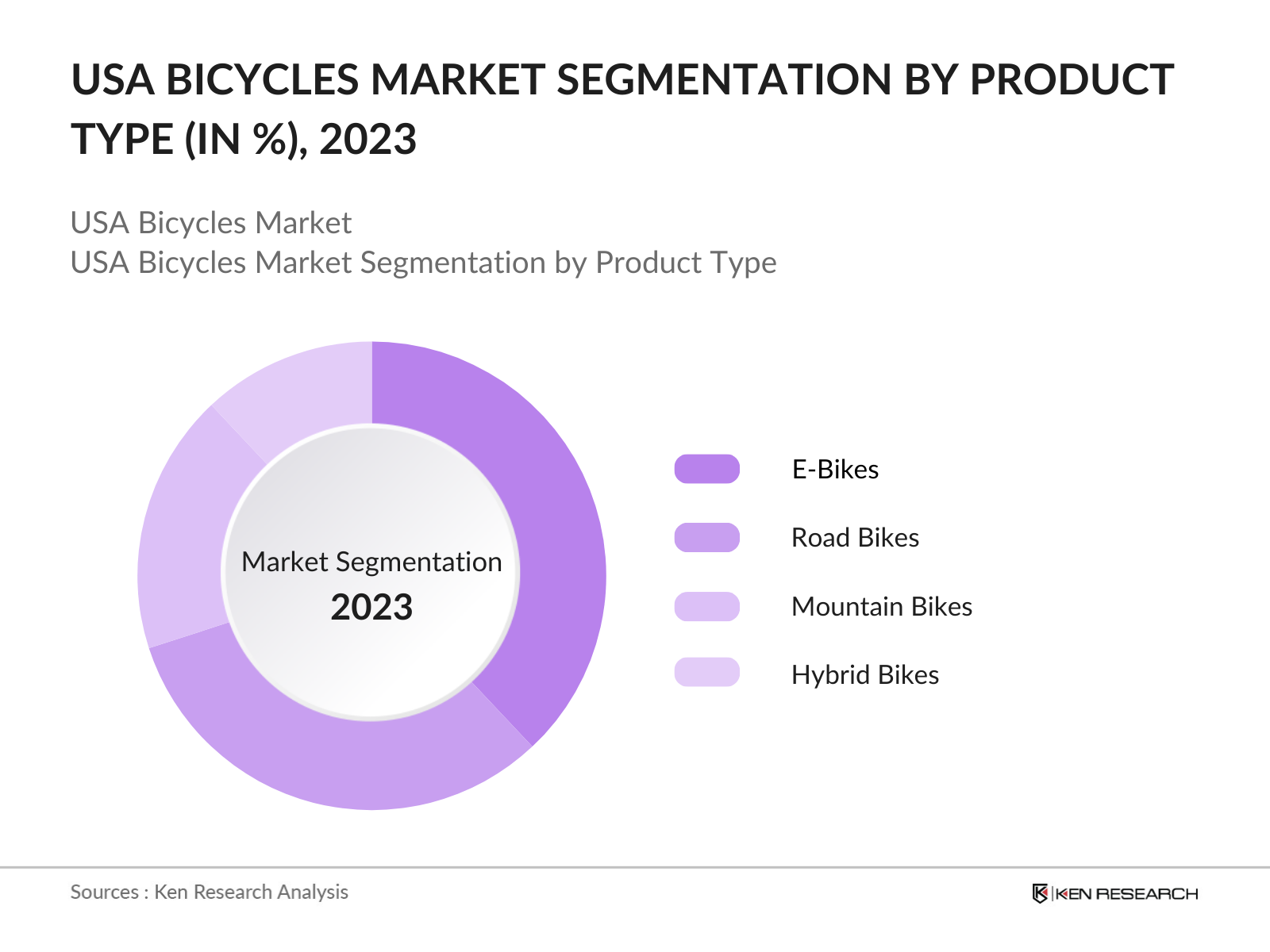
By Product Type: The USA bicycles market is segmented by product type into e-bikes, road bikes, mountain bikes, hybrid bikes, and folding bikes. Recently, e-bikes have captured a significant share of the market due to their convenience and appeal to both commuters and fitness enthusiasts. The shift toward electric mobility, combined with the ease of using e-bikes for longer distances, has driven this sub-segments dominance. Government incentives for electric vehicles and urban congestion also make e-bikes an attractive option.
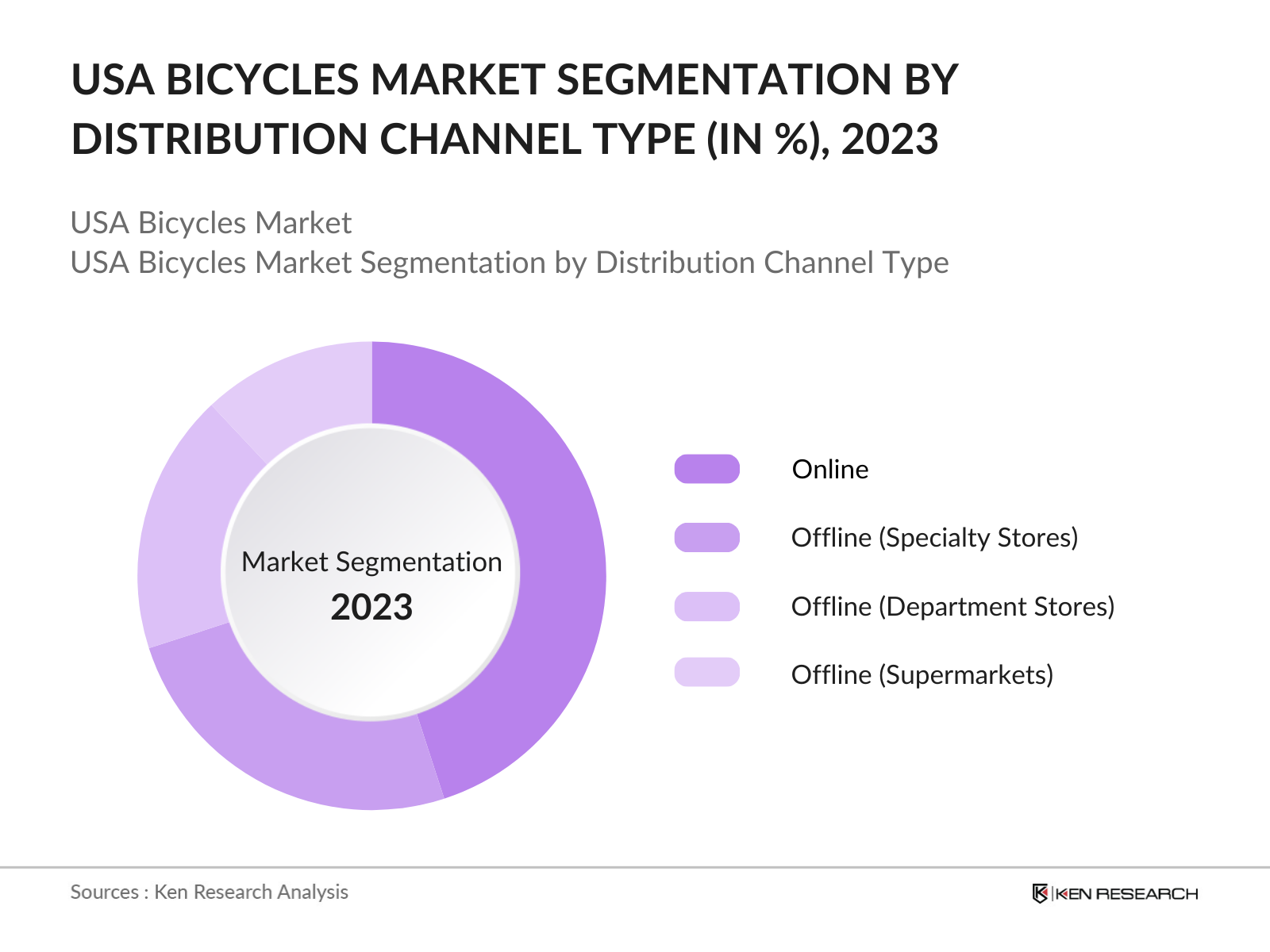
By Distribution Channel: The USA bicycles market is segmented by distribution channels into online and offline platforms, including specialty stores, department stores, and supermarkets. Online sales channels have been growing rapidly, especially during the pandemic, which shifted consumer purchasing behavior. The ease of access, wide selection, and home delivery options have made online channels the dominant segment.
The USA bicycles market is dominated by a mix of domestic and international players, ranging from manufacturers of premium bicycles to companies specializing in mass-market models. The market consolidation is largely due to the strength of key companies that have established extensive distribution networks, brand loyalty, and innovative product lines. The competitive landscape shows that larger brands, such as Trek and Specialized, dominate through their advanced manufacturing processes and sustainable business models, while global players like Giant also maintain a strong presence.
|
Company Name |
Establishment Year |
Headquarters |
Product Range |
Global Presence |
R&D Investment |
Sustainability Practices |
Revenue |
Market Share |
Distribution Channels |
|
Trek Bicycle Corporation |
1976 |
Wisconsin, USA |
- |
- |
- |
- |
- |
- |
- |
|
Specialized Bicycle Components |
1974 |
California, USA |
- |
- |
- |
- |
- |
- |
- |
|
Giant Manufacturing Co., Ltd |
1972 |
Taiwan |
- |
- |
- |
- |
- |
- |
- |
|
Cannondale (Dorel Industries) |
1971 |
Connecticut, USA |
- |
- |
- |
- |
- |
- |
- |
|
Schwinn (Pacific Cycle) |
1895 |
Illinois, USA |
- |
- |
- |
- |
- |
- |
- |
Over the next five years, the USA bicycles market is expected to witness strong growth driven by the rising demand for electric bikes, continuous government support for eco-friendly transportation, and the adoption of cycling as a mainstream fitness trend. With more cities investing in cycling infrastructure and bike-sharing programs, the demand for bicycles, especially e-bikes, is likely to continue its upward trajectory. Technological advancements such as connected bikes with smart features will further contribute to market growth, catering to urban commuters and health-conscious consumers.
|
Product Type |
E-Bikes Road Bikes Mountain Bikes Hybrid Bikes Folding Bikes |
|
Distribution Channel |
Online Offline |
|
Customer Type |
Commuters Leisure Riders Professional Cyclists Fitness Enthusiasts Students |
|
Technology Type |
Manual Bikes Electric Bikes Smart/Connected Bikes |
|
Region |
Northeast Midwest South West Pacific |
1.1. Definition and Scope
1.2. Market Taxonomy
1.3. Market Growth Rate
1.4. Market Segmentation Overview
2.1. Historical Market Size
2.2. Year-on-Year Growth Analysis
2.3. Key Market Developments and Milestones
3.1. Growth Drivers (Urban cycling infrastructure, Fitness trends, E-bike adoption, Government incentives)
3.1.1. Cycling Infrastructure Investments
3.1.2. Rising Fitness Awareness
3.1.3. E-Bike Popularity
3.1.4. Government Support and Incentives
3.2. Market Challenges (High cost of e-bikes, Seasonal demand fluctuations, Limited distribution channels, Competitive pricing)
3.2.1. High Manufacturing Costs
3.2.2. Seasonality Impact
3.2.3. Distribution Barriers
3.2.4. Competitive Pricing Pressure
3.3. Opportunities (Sustainability demand, Smart-bike technology, Rental services, Eco-conscious consumer segments)
3.3.1. Sustainability Focus
3.3.2. Technological Integration in Bikes
3.3.3. Expansion of Bicycle Rental Services
3.3.4. Targeting Eco-Conscious Consumers
3.4. Trends (E-bike growth, Customization demand, Smart bikes, Bicycle-sharing programs)
3.4.1. Customization and Personalization
3.4.2. Smart and Connected Bicycles
3.4.3. Expansion of Bicycle-Sharing Programs
3.5. Government Regulations (Subsidies for eco-friendly transport, Safety regulations, Infrastructure policies, Import tariffs)
3.5.1. Bicycle Subsidy Programs
3.5.2. Safety Regulations for Cyclists
3.5.3. National Cycling Infrastructure Policies
3.5.4. Tariffs on Imported Bicycle Parts
3.6. SWOT Analysis
3.7. Stakeholder Ecosystem
3.8. Porters Five Forces
3.9. Competition Ecosystem
4.1. By Product Type (In Value %)
4.1.1. E-Bikes
4.1.2. Road Bikes
4.1.3. Mountain Bikes
4.1.4. Hybrid Bikes
4.1.5. Folding Bikes
4.2. By Distribution Channel (In Value %)
4.2.1. Online
4.2.2. Offline (Specialty Stores, Department Stores, Supermarkets)
4.3. By Customer Type (In Value %)
4.3.1. Commuters
4.3.2. Leisure Riders
4.3.3. Professional Cyclists
4.3.4. Fitness Enthusiasts
4.3.5. Students
4.4. By Technology Type (In Value %)
4.4.1. Manual Bikes
4.4.2. Electric Bikes
4.4.3. Smart/Connected Bikes
4.5. By Region (In Value %)
4.5.1. Northeast
4.5.2. Midwest
4.5.3. South
4.5.4. West
4.5.5. Pacific
5.1. Detailed Profiles of Major Companies
5.1.1. Trek Bicycle Corporation
5.1.2. Specialized Bicycle Components
5.1.3. Giant Manufacturing Co., Ltd
5.1.4. Cannondale (Dorel Industries)
5.1.5. Schwinn (Pacific Cycle)
5.1.6. Brompton Bicycle
5.1.7. Scott Sports SA
5.1.8. Santa Cruz Bicycles
5.1.9. Yeti Cycles
5.1.10. Cervlo Cycles
5.1.11. Merida Industry Co., Ltd.
5.1.12. Orbea
5.1.13. Colnago
5.1.14. Felt Bicycles
5.1.15. Pinarello
5.2. Cross Comparison Parameters (No. of Employees, Product Range, Global Presence, Manufacturing Capacity, Innovation Rate, Sustainability Practices, Revenue, Market Share)
5.3. Market Share Analysis
5.4. Strategic Initiatives
5.5. Mergers and Acquisitions
5.6. Investment Analysis
5.7. Venture Capital Funding
5.8. Government Grants
5.9. Private Equity Investments
6.1. Environmental Standards
6.2. Safety Compliance and Certification Requirements
6.3. Cycling Infrastructure Support Policies
7.1. Future Market Size Projections
7.2. Key Factors Driving Future Market Growth
8.1. By Product Type (In Value %)
8.2. By Distribution Channel (In Value %)
8.3. By Customer Type (In Value %)
8.4. By Technology Type (In Value %)
8.5. By Region (In Value %)
9.1. TAM/SAM/SOM Analysis
9.2. Customer Cohort Analysis
9.3. Marketing Initiatives
9.4. White Space Opportunity Analysis
The initial phase involves identifying all the critical variables that drive the USA bicycles market. This includes gathering data from government agencies, industry reports, and proprietary databases. The goal is to define essential factors such as product preferences, distribution trends, and consumer behavior.
This phase focuses on historical market data analysis. The revenue generation by key players and market penetration by sub-segments such as e-bikes, road bikes, and hybrid bikes is examined to estimate accurate market shares and growth rates.
Industry experts are consulted to validate the research hypotheses through structured interviews. These interviews provide deeper insights into the sales performance, market challenges, and emerging trends, allowing for the refinement of market estimates.
The final stage consolidates all the gathered data, cross-verifying the trends and figures with market insights from multiple bicycle manufacturers and distributors. This ensures the final report reflects the most accurate and comprehensive overview of the USA bicycles market.
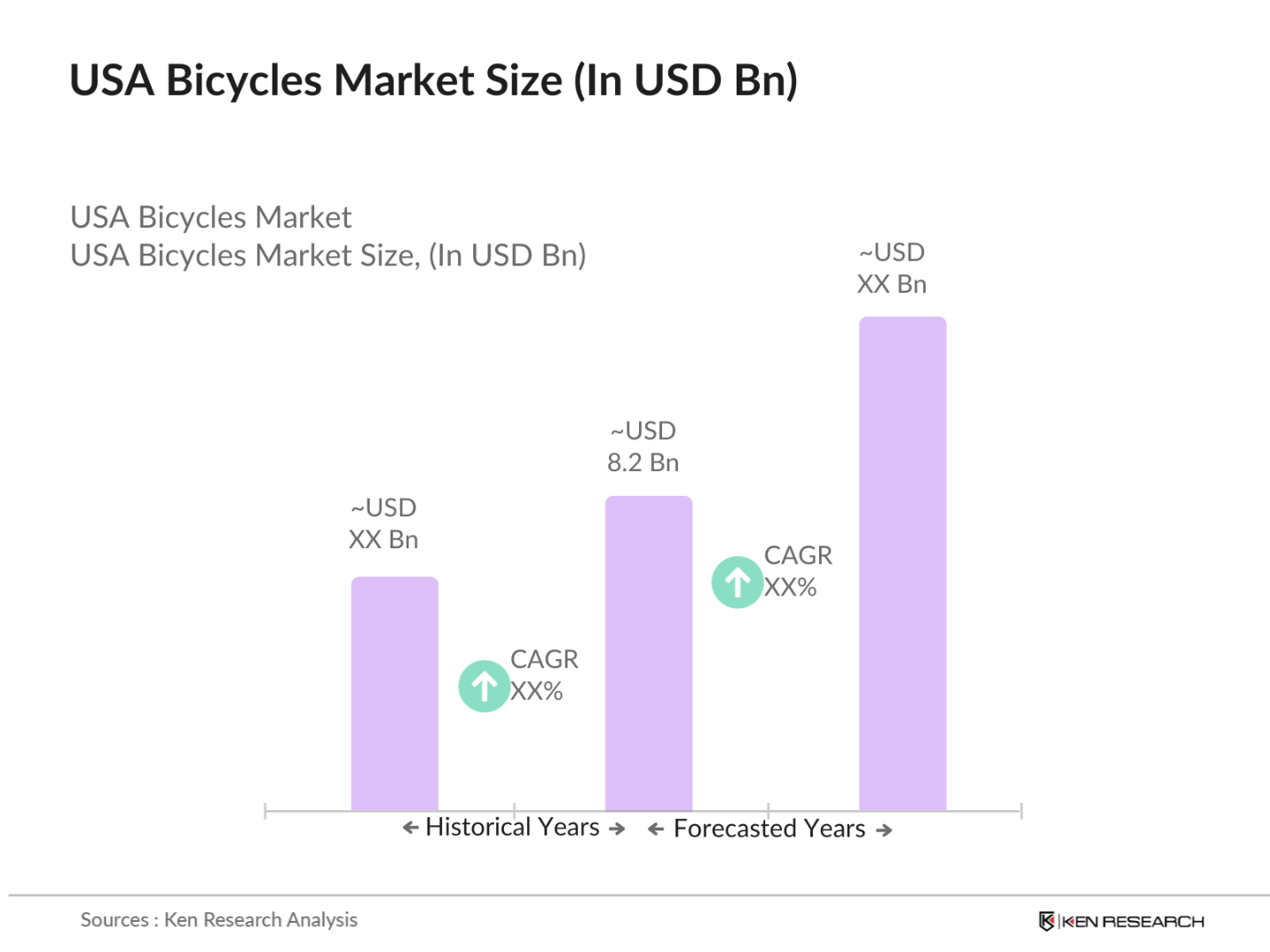
The USA bicycles market is valued at USD 8.2 billion, driven by rising demand for e-bikes, cycling infrastructure development, and government support for green transportation.
Challenges in the USA bicycles market include high costs of electric bikes, seasonal demand fluctuations, and the intense competition from both domestic and international players.
Key players in the market include Trek Bicycle Corporation, Specialized Bicycle Components, Giant Manufacturing Co., Ltd, Cannondale (Dorel Industries), and Schwinn (Pacific Cycle).
The market is driven by factors such as the increasing popularity of e-bikes, government incentives for eco-friendly transport, and rising awareness of cycling as a fitness trend.
Key trends include the growing adoption of e-bikes, the expansion of bicycle-sharing programs, and technological advancements in smart and connected bicycles.

What makes us stand out is that our consultants follows Robust, Refine and Result (RRR) methodology. i.e. Robust for clear definitions, approaches and sanity checking, Refine for differentiating respondents facts and opinions and Result for presenting data with story

We have set a benchmark in the industry by offering our clients with syndicated and customized market research reports featuring coverage of entire market as well as meticulous research and analyst insights.

While we don't replace traditional research, we flip the method upside down. Our dual approach of Top Bottom & Bottom Top ensures quality deliverable by not just verifying company fundamentals but also looking at the sector and macroeconomic factors.

With one step in the future, our research team constantly tries to show you the bigger picture. We help with some of the tough questions you may encounter along the way: How is the industry positioned? Best marketing channel? KPI's of competitors? By aligning every element, we help maximize success.

Our report gives you instant access to the answers and sources that other companies might choose to hide. We elaborate each steps of research methodology we have used and showcase you the sample size to earn your trust.

If you need any support, we are here! We pride ourselves on universe strength, data quality, and quick, friendly, and professional service.