
USA Business Process Management (BPM) Market Outlook to 2030
Region:United States
Author(s):Meenakshi Bisht
Product Code:KROD4457
Region:United States
Author(s):Meenakshi Bisht
Product Code:KROD4457
December 2024
89
By Component: The USA BPM market is segmented by component into platforms and services (consulting, implementation, support & maintenance). Recently, platforms have gained a dominant market share due to their pivotal role in automating processes and integrating workflows across cloud and on-premise systems. Companies in sectors like BFSI, manufacturing, and healthcare increasingly rely on these platforms to reduce human error and boost operational efficiency. Services, though essential, play a supporting role by providing custom configurations, system integrations, and post-implementation support.

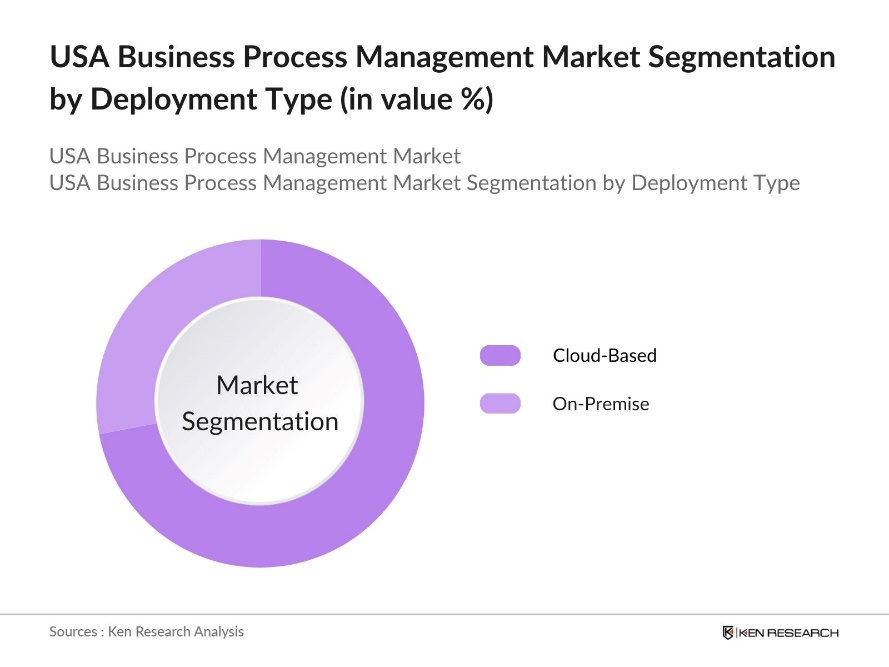
By Deployment Type: By deployment type, the BPM market in the USA is divided into cloud-based and on-premise solutions. Cloud-based solutions hold the majority share, attributed to their flexibility, cost-effectiveness, and ability to scale easily. Cloud BPM platforms allow businesses to access and manage their workflows remotely, making them especially valuable for companies with decentralized operations or remote workforces. On-premise solutions remain relevant in industries with stringent regulatory requirements, such as banking and healthcare.
The market is dominated by a few key players, each contributing significantly to market growth through technological innovation, strategic partnerships, and expansion into various industries. Companies such as IBM, Oracle, and Appian lead the pack, particularly in offering integrated cloud solutions that enhance business agility and productivity. This consolidation of major players highlights the importance of comprehensive BPM solutions in enabling digital transformation.
|
Company Name |
Establishment Year |
Headquarters |
Revenue (USD Bn) |
Key Offerings |
No. of Employees |
Cloud Solutions |
R&D Investments |
Technology Platforms |
|
IBM Corporation |
1911 |
Armonk, NY |
||||||
|
Oracle Corporation |
1977 |
Redwood Shores, CA |
||||||
|
Appian Corporation |
1999 |
McLean, VA |
||||||
|
Pegasystems Inc. |
1983 |
Cambridge, MA |
||||||
|
Microsoft |
1975 |
Redmond, WA |
Over the next five years, the USA BPM market is expected to experience significant growth, driven by ongoing digital transformation initiatives across industries, advancements in artificial intelligence and robotic process automation (RPA), and a growing demand for customer-centric BPM solutions. The expansion of cloud-based BPM platforms will also play a crucial role, allowing businesses to enhance scalability, flexibility, and efficiency in their operations.
|
Component |
Platforms Services (Consulting, Implementation, Support & Maintenance) |
|
Deployment Type |
Cloud-Based On-Premise |
|
Organization Size |
Small and Medium Enterprises (SMEs) Large Enterprises |
|
Industry Vertical |
BFSI IT and Telecommunications Retail and E-Commerce Healthcare and Life Sciences Manufacturing |
|
Region |
North East South West |
1.1. Definition and Scope
1.2. Market Taxonomy
1.3. Market Growth Rate
1.4. Market Segmentation Overview
2.1. Historical Market Size
2.2. Year-on-Year Growth Analysis
2.3. Key Market Developments and Milestones
3.1. Growth Drivers
3.1.1. Cloud Adoption (Cloud infrastructure integration)
3.1.2. Digital Transformation Initiatives (Automation and AI adoption)
3.1.3. Regulatory Compliance and Governance (Government regulations in finance and healthcare sectors)
3.1.4. Rise of Remote Work (Impact on workflow automation and optimization)
3.2. Market Challenges
3.2.1. Integration Complexity (Challenges with legacy systems)
3.2.2. High Cost of Implementation (Initial setup and ongoing maintenance)
3.2.3. Data Security and Privacy Concerns (Handling sensitive data in BPM processes)
3.3. Opportunities
3.3.1. Artificial Intelligence (AI) and Machine Learning (ML) Integration
3.3.2. Expansion into SMEs (Increased affordability and accessibility for smaller enterprises)
3.3.3. Business Process as a Service (BPaaS) Adoption
3.3.4. Automation in Customer Experience Management (Focus on improving CX with BPM tools)
3.4. Trends
3.4.1. Low-Code/No-Code Platforms (User-friendly BPM solutions)
3.4.2. Hyperautomation (Combination of BPM, AI, and RPA)
3.4.3. Industry-Specific BPM Solutions (Tailored BPM systems for finance, healthcare, etc.)
3.5. Government Regulation
3.5.1. Data Compliance Standards (e.g., GDPR, HIPAA)
3.5.2. Cloud Service Regulations (NIST, FedRAMP in the USA)
3.5.3. Financial Industry Regulations (SOX, Dodd-Frank compliance)
3.5.4. Public Sector Adoption of BPM (Federal and state-level BPM initiatives)
3.6. SWOT Analysis
3.7. Stakeholder Ecosystem (Vendors, system integrators, consultants)
3.8. Porters Five Forces Analysis (Bargaining power of suppliers, buyers, etc.)
3.9. Competitive Ecosystem (Strategic alliances, partnerships)
4.1. By Component (In Value %)
4.1.1. Platforms
4.1.2. Services (Consulting, Implementation, Support & Maintenance)
4.2. By Deployment Type (In Value %)
4.2.1. Cloud-Based
4.2.2. On-Premise
4.3. By Organization Size (In Value %)
4.3.1. Small and Medium Enterprises (SMEs)
4.3.2. Large Enterprises
4.4. By Industry Vertical (In Value %)
4.4.1. Banking, Financial Services, and Insurance (BFSI)
4.4.2. IT and Telecommunications
4.4.3. Retail and E-Commerce
4.4.4. Healthcare and Life Sciences
4.4.5. Manufacturing
4.5. By Region (In Value %)
4.5.1. North
4.5.2. East
4.5.3. South
4.5.4. West
5.1. Detailed Profiles of Major Companies
5.1.1. IBM Corporation
5.1.2. Oracle Corporation
5.1.3. Appian Corporation
5.1.4. Pegasystems Inc.
5.1.5. SAP SE
5.1.6. Software AG
5.1.7. Microsoft Corporation
5.1.8. Nintex
5.1.9. TIBCO Software Inc.
5.1.10. OpenText Corporation
5.1.11. Bizagi Group
5.1.12. K2 Software
5.1.13. Kissflow
5.1.14. Bonitasoft
5.1.15. Newgen Software Technologies Ltd.
5.2. Cross Comparison Parameters (Revenue, Number of Employees, Key Offerings, R&D Investments, Geographical Presence, Technology Platforms, Client Industries, Product Innovation)
5.3. Market Share Analysis
5.4. Strategic Initiatives (Joint Ventures, Strategic Alliances, Product Developments)
5.5. Mergers and Acquisitions
5.6. Investment Analysis (Private Equity, Venture Capital)
5.7. Government Grants and Initiatives
5.8. Private Equity Investments
6.1. Compliance Requirements (SOX, GDPR, HIPAA)
6.2. Certification Processes (ISO 9001, ISO/IEC 27001)
7.1. Future Market Size Projections
7.2. Key Factors Driving Future Market Growth
8.1. By Component (In Value %)
8.2. By Deployment Type (In Value %)
8.3. By Organization Size (In Value %)
8.4. By Industry Vertical (In Value %)
8.5. By Region (In Value %)
9.1. Total Addressable Market (TAM) Analysis
9.2. Serviceable Addressable Market (SAM) Analysis
9.3. Serviceable Obtainable Market (SOM) Analysis
9.4. Marketing and Growth Strategies
The first step in this research process involves identifying key stakeholders in the USA BPM market. This was achieved by conducting extensive secondary research to create an ecosystem map, leveraging proprietary databases and publicly available sources. Critical variables such as market trends, technological adoption, and customer demand were defined to outline the framework for the BPM market.
This phase involved compiling and analyzing historical market data to assess BPM market penetration in the USA. The research examined market size, deployment type ratios, and technological adoption rates. Revenue generation patterns were evaluated, with a focus on cloud and on-premise deployments across key industries such as BFSI, healthcare, and IT.
Market assumptions were validated through consultations with industry experts via computer-assisted telephone interviews (CATIs). Insights were gathered on business process automation trends, technological adoption, and future market outlooks. These interactions with BPM practitioners provided crucial data for refining market forecasts and validating the bottom-up approach used in revenue projections.
The final step involved engaging with leading BPM platform providers to gather detailed data on product segments, customer feedback, and sales performance. This engagement enabled the verification of statistical data from a bottom-up approach, ensuring a robust and accurate market analysis of the USA BPM market.
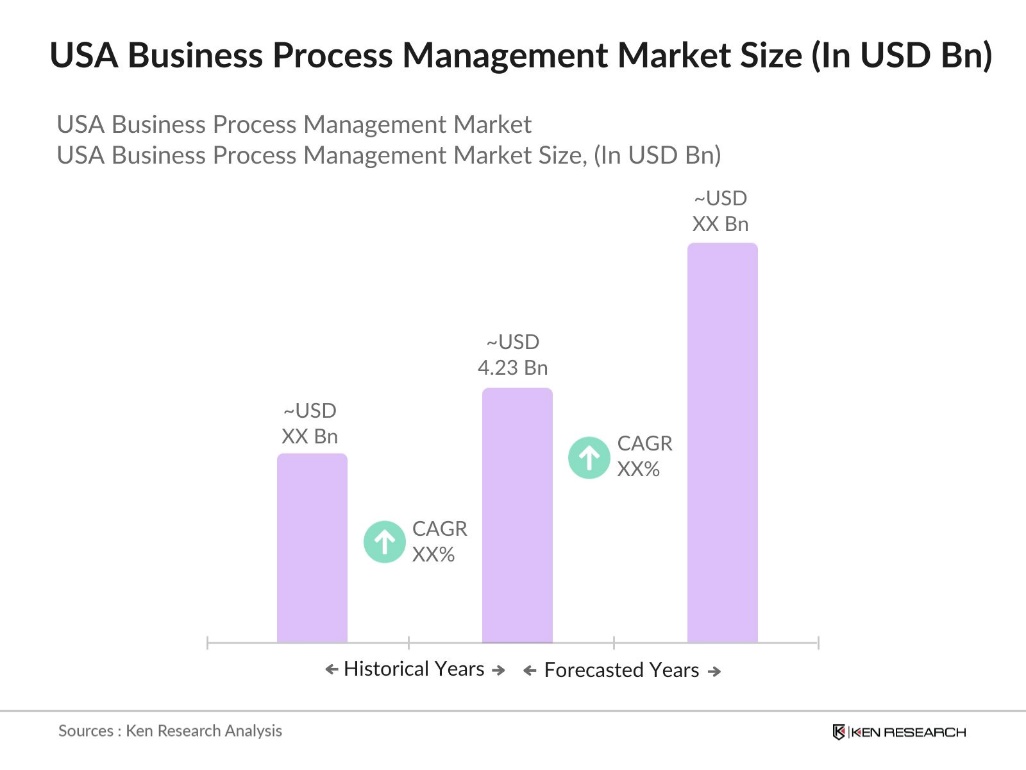
The USA BPM Market was valued at USD 4.23 billion, driven by the increasing need for operational efficiency, digital transformation, and automation in industries such as BFSI, healthcare, and manufacturing.
Challenges in the BPM market include integration complexities with legacy systems, high implementation costs, and concerns over data privacy and security. These issues are particularly significant for highly regulated industries such as finance and healthcare.
Key players in the USA BPM market include IBM, Oracle, Appian, Pegasystems, and Microsoft. These companies dominate due to their comprehensive BPM offerings, cloud capabilities, and strategic partnerships with various industries.
The USA BPM Market growth drivers include the increasing adoption of cloud-based solutions, the rise of low-code BPM platforms, and advancements in AI and machine learning, all of which are enhancing business process automation and efficiency.

What makes us stand out is that our consultants follows Robust, Refine and Result (RRR) methodology. i.e. Robust for clear definitions, approaches and sanity checking, Refine for differentiating respondents facts and opinions and Result for presenting data with story

We have set a benchmark in the industry by offering our clients with syndicated and customized market research reports featuring coverage of entire market as well as meticulous research and analyst insights.

While we don't replace traditional research, we flip the method upside down. Our dual approach of Top Bottom & Bottom Top ensures quality deliverable by not just verifying company fundamentals but also looking at the sector and macroeconomic factors.

With one step in the future, our research team constantly tries to show you the bigger picture. We help with some of the tough questions you may encounter along the way: How is the industry positioned? Best marketing channel? KPI's of competitors? By aligning every element, we help maximize success.

Our report gives you instant access to the answers and sources that other companies might choose to hide. We elaborate each steps of research methodology we have used and showcase you the sample size to earn your trust.

If you need any support, we are here! We pride ourselves on universe strength, data quality, and quick, friendly, and professional service.