















USA Cell Signaling Market Outlook to 2030
Region:North America
Author(s):Sanjna
Product Code:KROD11198
December 2024
91
About the Report
USA Cell Signaling Market Overview
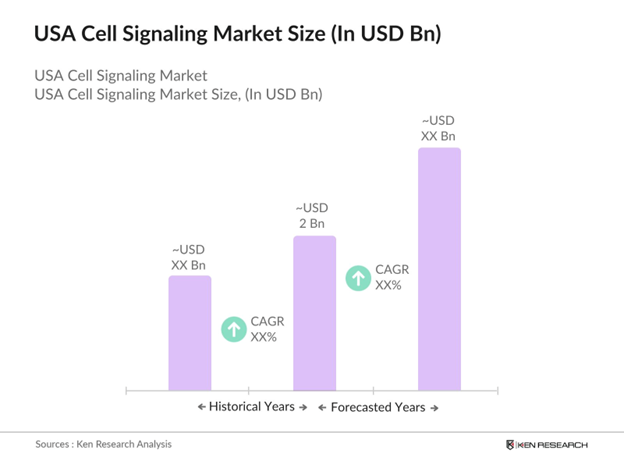
- The U.S. cell signaling market, valued at USD 2.5 billion, is driven by the rising incidence of chronic diseases like cancer and diabetes. These conditions demand advanced diagnostic and therapeutic solutions focused on specific signaling pathways, enabling targeted treatment options. The increasing investment in biotechnology and healthcare innovation further supports market growth, making it a crucial area for ongoing research and development.
- Major cities such as Boston and San Francisco lead the U.S. cell signaling market due to their established biotechnology ecosystems. These areas boast numerous research institutions, strong pharmaceutical company networks, and a focus on developing new therapies. Their infrastructure and resources make them key innovation hubs for cell signaling technology and related therapeutic advancements, giving these cities a competitive edge in driving market dynamics.
- The U.S. Food and Drug Administration (FDA) provides comprehensive guidelines for the development and approval of cell-based therapies. In April 2024, A new draft guidance titledSafety Testing of Human Allogeneic Cells Expanded for Use in Cell-Based Medical Productswas issued. This guidance provides recommendations for sponsors regarding cell safety testing of human-origin allogeneic cells, emphasizing robust testing protocols to ensure the safety and efficacy of these therapies.
USA Cell Signaling Market Segmentation
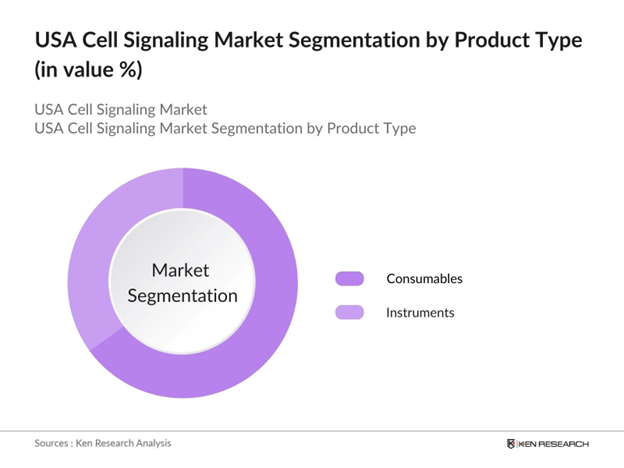
By Product Type: The U.S. cell signaling market is segmented by product type into consumables and instruments. Consumables hold a dominant share due to their high and recurring demand across research and clinical settings. Products like reagents, assay kits, and antibodies are essential for various studies, reinforcing the importance of consumables in cell signaling research. This recurring use and necessity position consumables as a crucial segment within the cell signaling market.
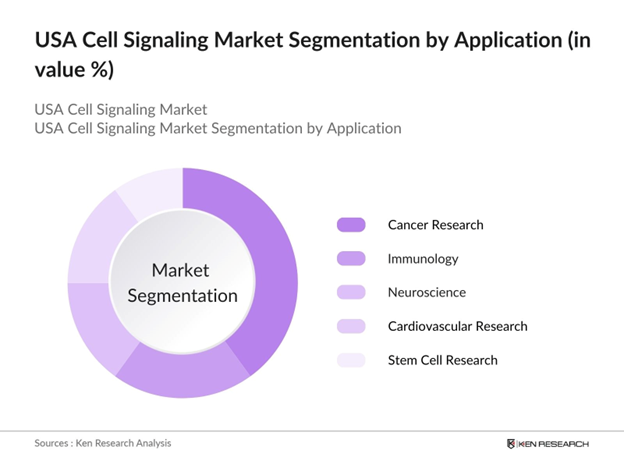
By Application: In application-based segmentation, cancer research leads, driven by the significant role cell signaling pathways play in understanding tumor development and progression. Targeted therapies rely heavily on research focused on cell signaling mechanisms in cancer, necessitating a large volume of studies in this area. This demand establishes cancer research as the leading application segment, underscoring the critical focus on developing effective treatments through cell signaling insights.
USA Cell Signaling Market Competitive Landscape
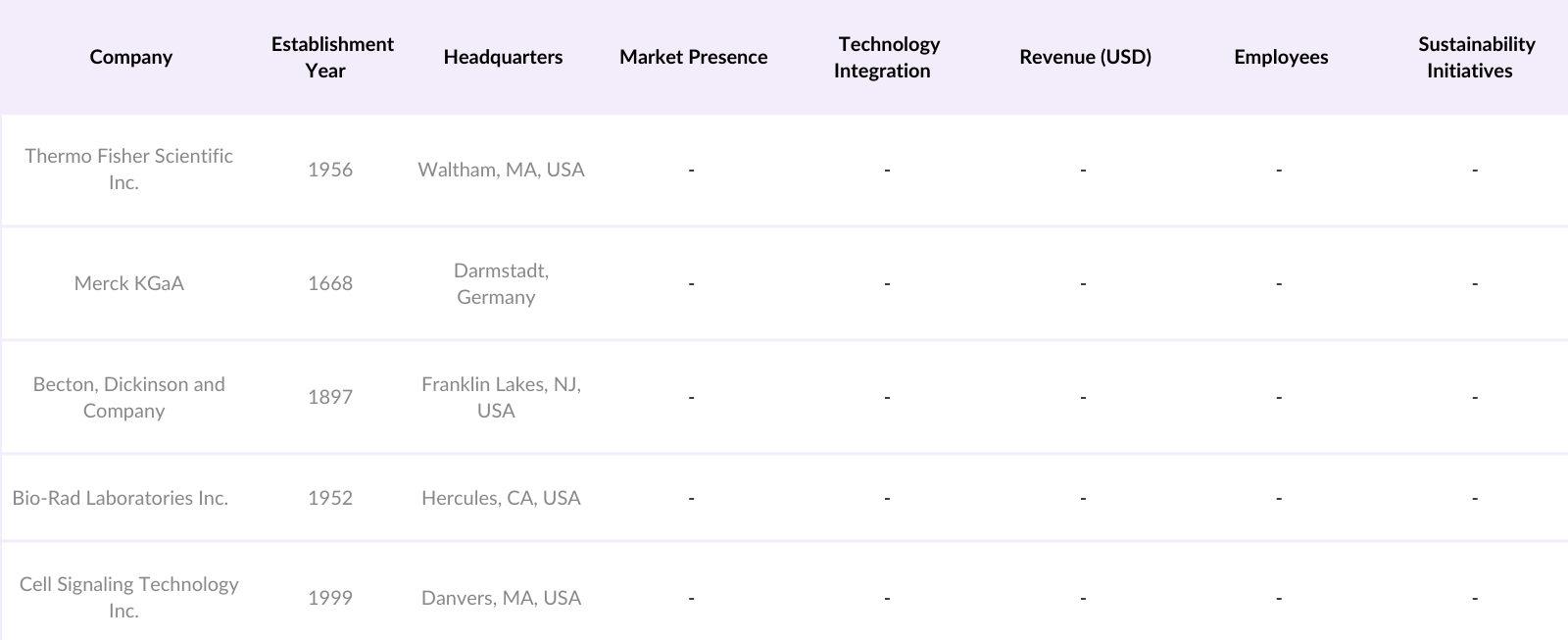
The U.S. cell signaling market is characterized by the presence of key players such as Thermo Fisher Scientific Inc., Merck KGaA, and Becton, Dickinson and Company, which dominate due to their extensive product portfolios, strong research and development capabilities, and strategic acquisitions.
USA Cell Signaling Market Analysis
Growth Drivers
- Increasing Prevalence of Chronic Diseases: The United States is experiencing a significant rise in chronic diseases, which is propelling the demand for advanced cell signaling research. According to the Centers for Disease Control and Prevention (CDC), six in ten adults in the U.S. have a chronic disease, and four in ten have two or more. This surge necessitates innovative therapeutic approaches, making cell signaling pathways crucial for developing targeted treatments, emphasizing the importance of understanding cellular mechanisms in disease progression.
- Advancements in Biotechnology and Drug Discovery: Technological progress in biotechnology is revolutionizing drug discovery processes. The U.S. Food and Drug Administration (FDA) approved 37 novel drugs in 2022, highlighting the rapid pace of pharmaceutical innovation. Techniques such as CRISPR-Cas9 gene editing and high-throughput screening are enhancing the understanding of cell signaling pathways, leading to the development of more effective therapies. The Biotechnology Innovation Organization reported that U.S. biotech firms invested over $100 billion in research and development in 2022, underscoring the sector's commitment to advancing medical science.
- Rising Investment in Research and Development: Investment in biomedical research is on the rise in the U.S. The NIH's budget increased to $49.3 billion in 2023, reflecting a national emphasis on scientific discovery. Private sector contributions are also substantial; for instance, pharmaceutical companies collectively invested $102 billion in R&D in 2022, as reported by the Pharmaceutical Research and Manufacturers of America (PhRMA). These investments are facilitating advancements in cell signaling research, leading to novel therapeutic developments.
Challenges
- High Cost of Cell Signaling Systems: The development and implementation of cell signaling technologies involve significant financial investment. Advanced equipment, such as flow cytometers and mass spectrometers, can cost upwards of $500,000, posing a barrier for smaller research institutions. Additionally, the maintenance and operational costs add to the financial burden, potentially limiting widespread adoption and hindering research progress.
- Ethical and Regulatory Constraints: Research involving cell signaling, particularly studies using human embryonic stem cells, faces ethical and regulatory scrutiny. The Dickey-Wicker Amendment prohibits federal funding for research that involves the destruction of human embryos, impacting certain areas of cell signaling research. Navigating these ethical considerations and regulatory frameworks can delay research timelines and complicate funding opportunities.
USA Cell Signaling Market Future Outlook
Over the next five years, the U.S. cell signaling market is expected to experience significant growth, driven by continuous advancements in biotechnology, increasing investment in research and development, and the rising demand for personalized medicine.
Market Opportunities
- Technological Advancements in Cell-Based Research: Innovations in cell-based research technologies are creating new opportunities in the cell signaling market. The development of single-cell RNA sequencing allows for the analysis of gene expression at the individual cell level, providing deeper insights into cellular functions. Additionally, advancements in imaging technologies, such as super-resolution microscopy, enable detailed visualization of signaling events within cells, facilitating more precise research outcomes.
- Expansion into Emerging Therapeutic Areas: Understanding cell signaling pathways is opening avenues in emerging therapeutic areas, including immunotherapy and regenerative medicine. For example, CAR-T cell therapies, which modify a patient's T-cells to target cancer cells, have shown promising results in treating certain types of cancer. The FDA approved two CAR-T therapies in 2022, indicating a growing acceptance and potential for these treatments.
Scope of the Report
|
Segment |
Sub-Segments |
|
Product Type |
Consumables |
|
Signaling Type |
Endocrine Signaling |
|
Technology |
Flow Cytometry |
|
Application |
Cancer Research |
|
End-User |
Academic and Research Institutions |
Products
Key Target Audience
Pharmaceutical and Biotechnology Companies
Academic and Research Institutions
Clinical Diagnostic Laboratories
Contract Research Organizations
Healthcare Providers
Diagnostic Equipment Manufacturers
Investors and Venture Capitalist Firms
Government and Regulatory Bodies (e.g., U.S. Food and Drug Administration)
Companies
Players Mentioned in the Report
Thermo Fisher Scientific Inc.
Merck KGaA
Becton, Dickinson and Company
Bio-Rad Laboratories Inc.
Cell Signaling Technology Inc.
Danaher Corporation (Beckman Coulter Inc.)
PerkinElmer Inc.
Bio-Techne Corporation
Promega Corporation
QIAGEN N.V.
Table of Contents
1. U.S. Cell Signaling Market Overview
1.1 Definition and Scope
1.2 Market Taxonomy
1.3 Market Growth Rate
1.4 Market Segmentation Overview
2. U.S. Cell Signaling Market Size (In USD Million)
2.1 Historical Market Size
2.2 Year-On-Year Growth Analysis
2.3 Key Market Developments and Milestones
3. U.S. Cell Signaling Market Analysis
3.1 Growth Drivers
3.1.1 Increasing Prevalence of Chronic Diseases
3.1.2 Advancements in Biotechnology and Drug Discovery
3.1.3 Rising Investment in Research and Development
3.1.4 Adoption of Personalized Medicine
3.2 Market Challenges
3.2.1 High Cost of Cell Signaling Systems
3.2.2 Ethical and Regulatory Constraints
3.2.3 Technical Complexities in Signaling Pathways
3.3 Opportunities
3.3.1 Technological Advancements in Cell-Based Research
3.3.2 Expansion into Emerging Therapeutic Areas
3.3.3 Collaborations and Partnerships
3.4 Trends
3.4.1 Integration of Artificial Intelligence in Cell Signaling Research
3.4.2 Development of Targeted Therapies
3.4.3 Increasing Use of High-Throughput Screening Techniques
3.5 Government Regulation
3.5.1 FDA Guidelines on Cell-Based Therapies
3.5.2 NIH Funding for Cell Signaling Research
3.5.3 Compliance with Good Laboratory Practices (GLP)
3.6 SWOT Analysis
3.7 Stakeholder Ecosystem
3.8 Porter’s Five Forces
3.9 Competitive Landscape
4. U.S. Cell Signaling Market Segmentation
4.1 By Product Type (In Value %)
4.1.1 Consumables
4.1.2 Instruments
4.2 By Signaling Type (In Value %)
4.2.1 Endocrine Signaling
4.2.2 Paracrine Signaling
4.2.3 Autocrine Signaling
4.2.4 Juxtacrine Signaling
4.3 By Technology (In Value %)
4.3.1 Flow Cytometry
4.3.2 Microscopy
4.3.3 Western Blotting
4.3.4 ELISA
4.3.5 Mass Spectrometry
4.4 By Application (In Value %)
4.4.1 Cancer Research
4.4.2 Immunology
4.4.3 Neuroscience
4.4.4 Cardiovascular Research
4.4.5 Stem Cell Research
4.5 By End-User (In Value %)
4.5.1 Academic and Research Institutions
4.5.2 Pharmaceutical and Biotechnology Companies
4.5.3 Clinical Diagnostic Laboratories
4.5.4 Contract Research Organizations
5. U.S. Cell Signaling Market Competitive Analysis
5.1 Detailed Profiles of Major Companies
5.1.1 Thermo Fisher Scientific Inc.
5.1.2 Merck KGaA
5.1.3 Becton, Dickinson and Company
5.1.4 Bio-Rad Laboratories Inc.
5.1.5 Cell Signaling Technology Inc.
5.1.6 Danaher Corporation (Beckman Coulter Inc.)
5.1.7 PerkinElmer Inc.
5.1.8 Bio-Techne Corporation
5.1.9 Promega Corporation
5.1.10 QIAGEN N.V.
5.2 Cross Comparison Parameters (Number of Employees, Headquarters, Inception Year, Revenue, Product Portfolio, R&D Investment, Market Share, Strategic Initiatives)
5.3 Market Share Analysis
5.4 Strategic Initiatives
5.5 Mergers and Acquisitions
5.6 Investment Analysis
5.7 Venture Capital Funding
5.8 Government Grants
5.9 Private Equity Investments
6. U.S. Cell Signaling Market Regulatory Framework
6.1 FDA Approval Processes
6.2 Compliance Requirements
6.3 Certification Processes
7. U.S. Cell Signaling Future Market Size (In USD Million)
7.1 Future Market Size Projections
7.2 Key Factors Driving Future Market Growth
8. U.S. Cell Signaling Future Market Segmentation
8.1 By Product Type (In Value %)
8.2 By Signaling Type (In Value %)
8.3 By Technology (In Value %)
8.4 By Application (In Value %)
8.5 By End-User (In Value %)
9. U.S. Cell Signaling Market Analysts’ Recommendations
9.1 Total Addressable Market (TAM), Serviceable Available Market (SAM), and Serviceable Obtainable Market (SOM) Analysis
9.2 Customer Cohort Analysis
9.3 Marketing Initiatives
9.4 White Space Opportunity Analysis
Disclaimer
Contact Us
Research Methodology
Step 1: Identification of Key Variables
The initial phase involves constructing an ecosystem map encompassing all major stakeholders within the U.S. Cell Signaling Market. This step is underpinned by extensive desk research, utilizing a combination of secondary and proprietary databases to gather comprehensive industry-level information. The primary objective is to identify and define the critical variables that influence market dynamics.
Step 2: Market Analysis and Construction
In this phase, we compile and analyze historical data pertaining to the U.S. Cell Signaling Market. This includes assessing market penetration, the ratio of marketplaces to service providers, and the resultant revenue generation. Furthermore, an evaluation of service quality statistics is conducted to ensure the reliability and accuracy of the revenue estimates.
Step 3: Hypothesis Validation and Expert Consultation
Market hypotheses are developed and subsequently validated through computer-assisted telephone interviews (CATIs) with industry experts representing a diverse array of companies. These consultations provide valuable operational and financial insights directly from industry practitioners, which are instrumental in refining and corroborating the market data
Step 4: Research Synthesis and Final Output
The final phase involves direct engagement with multiple biotechnology and pharmaceutical companies to acquire detailed insights into product segments, sales performance, consumer preferences, and other pertinent factors. This interaction serves to verify and complement the statistics derived from the bottom-up approach, thereby ensuring a comprehensive, accurate, and validated analysis of the U.S. Cell Signaling Market.
Frequently Asked Questions
01. How big is the U.S. Cell Signaling Market?
The U.S. cell signaling market is valued at USD 2.5 billion, driven by the increasing prevalence of chronic diseases and advancements in biotechnology.
02. What are the challenges in the U.S. Cell Signaling Market?
Challenges in U.S. cell signaling market include the high cost of cell signaling systems, ethical and regulatory constraints, and technical complexities in understanding and manipulating signaling pathways.
03. Who are the major players in the U.S. Cell Signaling Market?
Key players in U.S. cell signaling market include Thermo Fisher Scientific Inc., Merck KGaA, Becton, Dickinson and Company, Bio-Rad Laboratories Inc., and Cell Signaling Technology Inc. These players dominate due to their extensive product portfolios, strong research and development capabilities, and strategic acquisitions.
04. What are the growth drivers of the U.S. Cell Signaling Market?
Growth drivers in U.S. cell signaling market encompass the increasing prevalence of chronic diseases, advancements in biotechnology and drug discovery, rising investment in research and development, and the adoption of personalized medicine.
Why Buy From Us?

What makes us stand out is that our consultants follows Robust, Refine and Result (RRR) methodology. i.e. Robust for clear definitions, approaches and sanity checking, Refine for differentiating respondents facts and opinions and Result for presenting data with story

We have set a benchmark in the industry by offering our clients with syndicated and customized market research reports featuring coverage of entire market as well as meticulous research and analyst insights.

While we don't replace traditional research, we flip the method upside down. Our dual approach of Top Bottom & Bottom Top ensures quality deliverable by not just verifying company fundamentals but also looking at the sector and macroeconomic factors.

With one step in the future, our research team constantly tries to show you the bigger picture. We help with some of the tough questions you may encounter along the way: How is the industry positioned? Best marketing channel? KPI's of competitors? By aligning every element, we help maximize success.

Our report gives you instant access to the answers and sources that other companies might choose to hide. We elaborate each steps of research methodology we have used and showcase you the sample size to earn your trust.

If you need any support, we are here! We pride ourselves on universe strength, data quality, and quick, friendly, and professional service.