
USA Cold Storage Market Outlook to 2030
Region:North America
Author(s):Meenakshi Bisht
Product Code:KROD6770
December 2024
86
About the Report
USA Cold Storage Market Overview
- The USA Cold Storage Market is valued at USD 36.8 billion, driven by the rapid expansion of the food and beverage, pharmaceutical, and e-commerce industries. Increasing demand for perishable food items, including meat, dairy, and frozen goods, has fueled the need for advanced cold storage solutions.
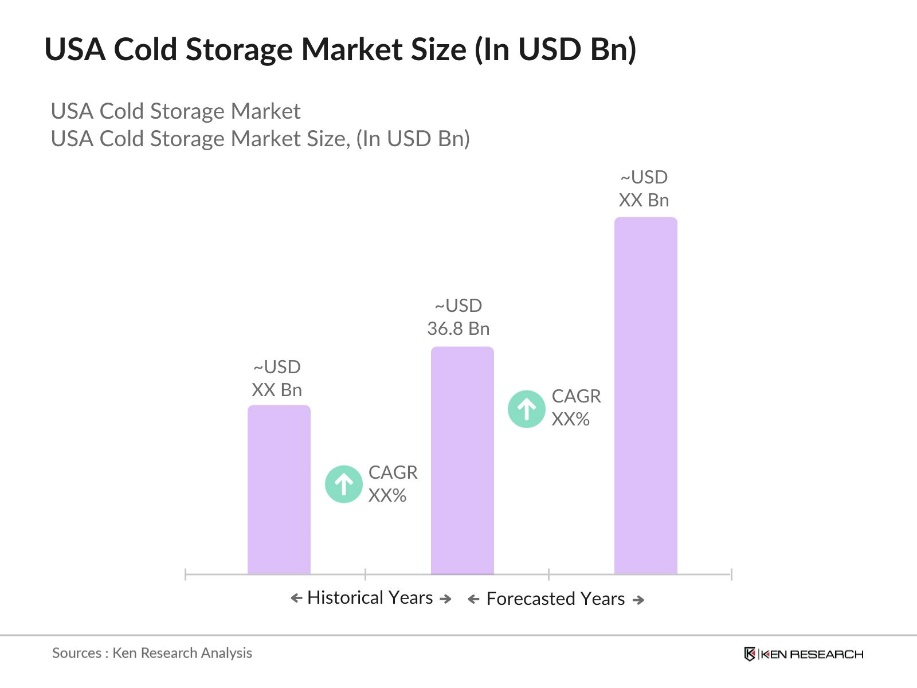
- The dominance of cities like Chicago, Los Angeles, and New York in the cold storage market is primarily due to their strategic location in major transport hubs, proximity to ports, and significant consumer bases. These cities serve as crucial nodes in the national food supply chain, ensuring quick and efficient transportation of perishable goods.
- Different states in the U.S. implement their own regulations for cold storage providers, in addition to federal laws. For example, California mandates that all new cold storage facilities must incorporate renewable energy sources as part of its Clean Energy Act. As of 2023, 25% of new cold storage constructions in the state integrated solar panels to meet these regulations.
USA Cold Storage Market Segmentation
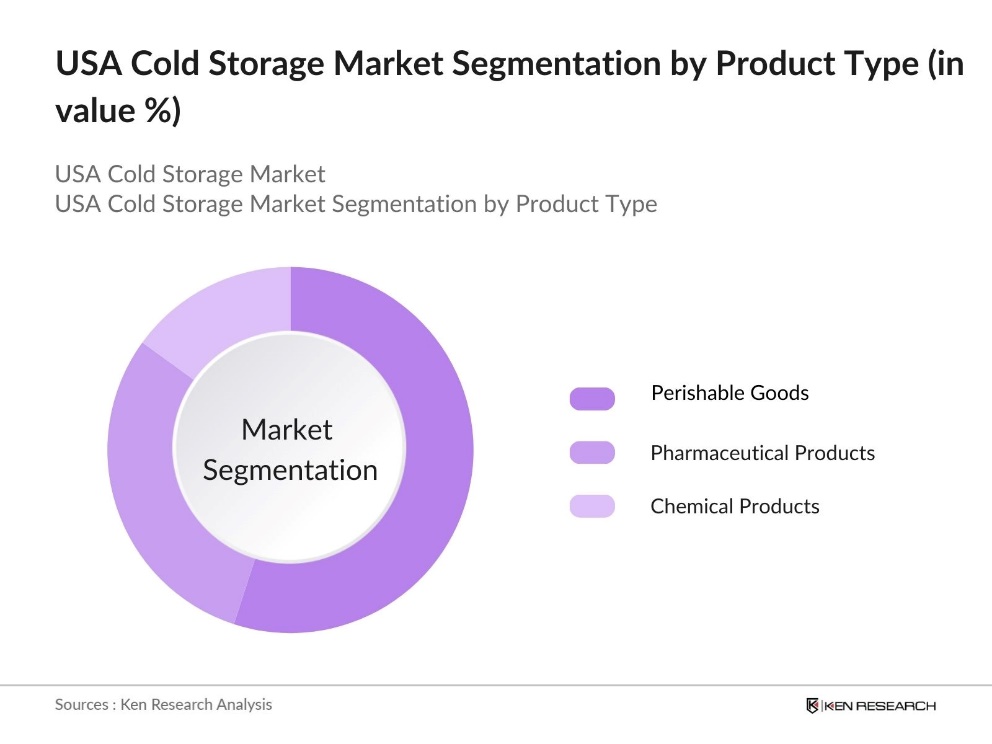
By Product Type: The USA cold storage market is segmented by product type into perishable goods, pharmaceutical products, and chemical products. Perishable goods, including fruits, vegetables, meat, and seafood, currently dominate the product type segment, accounting for the highest market share. This is attributed to the rising consumer demand for fresh produce, along with the increased consumption of ready-to-eat frozen meals. Major food suppliers rely heavily on cold storage facilities to maintain the freshness of their products, especially with the growing popularity of online grocery shopping.
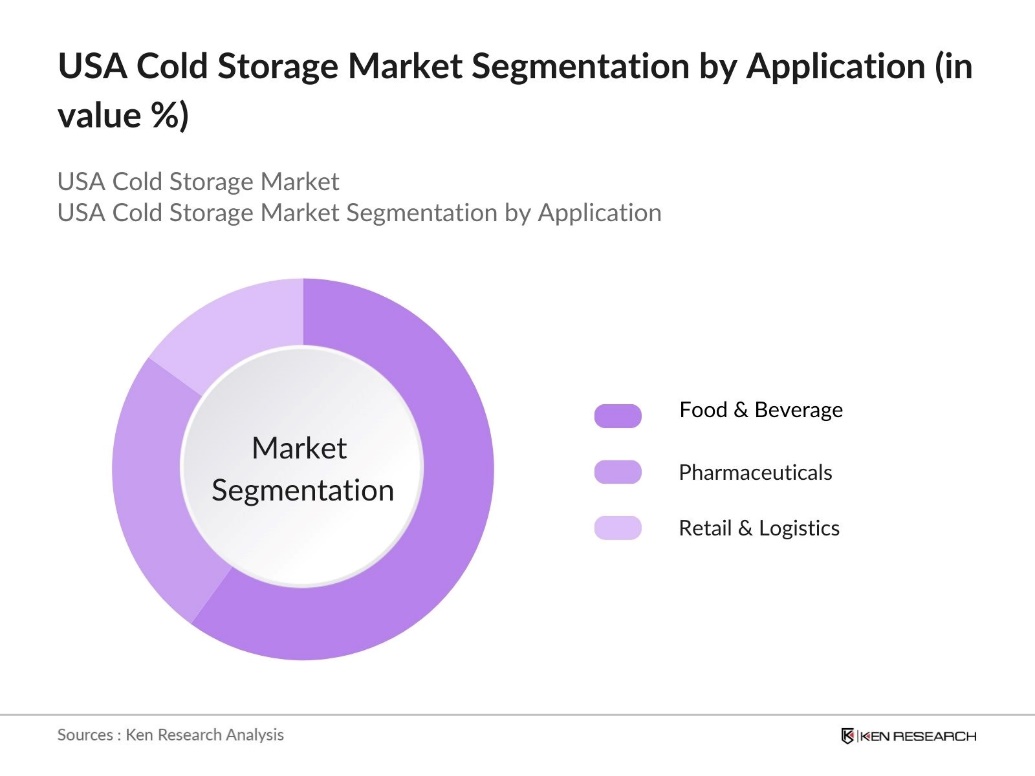
By Application: The USA cold storage market is also segmented by application into food & beverage, pharmaceuticals, and retail & logistics. The food & beverage sector dominates this segment due to the sheer volume of perishable food items that require cold storage to maintain their freshness and safety. The growing popularity of online grocery shopping has further contributed to the demand for cold storage within the food & beverage industry. The pharmaceutical sector follows closely, with an increasing need for specialized cold storage solutions to store temperature-sensitive products like vaccines and biologics.
USA Cold Storage Market Competitive Landscape
The market is dominated by a few key players who have established strong networks of facilities, operational efficiency, and technological innovations. Companies like Americold Logistics and Lineage Logistics are leading the market with their large-scale storage facilities and cutting-edge temperature monitoring systems. The industry is seeing increasing consolidation, with several mergers and acquisitions shaping the competitive landscape. The growing demand for sustainability is also prompting companies to adopt green technology and renewable energy solutions in their storage operations.
|
Company Name |
Established Year |
Headquarters |
Storage Capacity |
Number of Facilities |
Technological Advancements |
Sustainability Initiatives |
Service Regions |
Revenue (2023) |
|
Americold Logistics |
1931 |
Atlanta, Georgia |
||||||
|
Lineage Logistics |
2008 |
Novi, Michigan |
||||||
|
United States Cold Storage |
1897 |
Camden, New Jersey |
||||||
|
Burris Logistics |
1925 |
Milford, Delaware |
||||||
|
VersaCold Logistics |
1946 |
Vancouver, Canada |
USA Cold Storage Industry Analysis
Growth Drivers
- E-commerce and Online Grocery Demand: The rising demand for cold storage is significantly driven by the growing e-commerce and online grocery markets. According to the USDA's biennial report released in January 2024, the gross refrigerated storage capacity in the U.S. was estimated at around 104.8 million cubic meters (3.70 billion cubic feet) in 2023. Companies are investing in advanced cold chain logistics to meet growing demand, enabling faster and more efficient service.
- Growth in Food & Beverage Sector: The food and beverage sector is a key driver for cold storage expansion in the U.S. As of 2023, this sector has seen steady growth, according to the U.S. Department of Commerce. The rise in demand for frozen foods, which accounted for 30% of total grocery sales in 2023, fuels the need for advanced cold storage facilities. Major retailers and distributors are increasing frozen product lines, directly increasing the demand for cold storage infrastructure to handle inventory.
- Rising Pharmaceutical Storage Needs: The pharmaceutical sector is experiencing significant demand for cold storage facilities due to the increasing requirement for temperature-sensitive drugs and vaccines. Cold storage plays a crucial role in maintaining the integrity of biologics, vaccines, and other pharmaceutical products that must be stored at controlled temperatures. With the growing production and distribution of vaccines, particularly in response to global health needs, the demand for cold storage infrastructure is expanding.
Market Challenges
- High Energy Costs: The market faces challenges due to the high energy consumption of refrigeration systems, which significantly impacts operating costs. Companies are focusing on adopting energy-efficient technologies to reduce these expenses while maintaining temperature control for sensitive products. Balancing the need for cost reduction with energy efficiency is essential for sustaining profitability and addressing environmental concerns in this energy-intensive industry.
- Limited Infrastructure in Rural Areas: Rural U.S. regions face challenges in cold storage development, with limited infrastructure compared to urban areas. This gap affects the distribution of temperature-sensitive goods, causing delays and increasing costs for perishable products. Expanding cold storage infrastructure in rural areas is essential to improve supply chain efficiency and ensure timely delivery of fresh and frozen goods to underserved communities.
USA Cold Storage Market Future Outlook
Over the next few years, the USA cold storage market is expected to experience significant growth driven by rising consumer demand for frozen food and pharmaceutical products requiring temperature-controlled environments. The advancement of automation technologies and increasing adoption of IoT will enhance the efficiency of cold storage operations. Sustainability efforts will also push the development of eco-friendly refrigeration systems, such as CO2-based cooling technologies, reducing energy consumption and carbon footprints.
Market Opportunities
- Increased Use of Automated Systems: The U.S. cold storage market is increasingly adopting automation to enhance operational efficiency. Automated systems, including storage and retrieval technologies, streamline workflows and reduce labor dependency. Robotics and AI-driven systems are also being integrated to improve productivity and inventory management. This shift helps companies address labor shortages while optimizing processes, making cold storage operations faster and more cost-effective.
- IoT and Blockchain for Supply Chain Transparency: Cold storage providers are integrating IoT and blockchain technologies to improve transparency and traceability within the supply chain. IoT sensors monitor real-time temperature and conditions, while blockchain ensures secure, immutable records of product storage. These innovations enhance compliance with regulatory standards and help preserve the quality of perishable goods throughout their journey.
Scope of the Report
|
Product Type |
Perishable Goods Pharmaceutical Products Chemical Products |
|
Application |
Food & Beverage Pharmaceuticals Retail & Logistics |
|
Temperature Type |
Refrigerated Frozen |
|
Storage Type |
Public Warehouses Private Warehouses Semi-Private Facilities |
|
Region |
North East West South |
Products
Key Target Audience
Food and Beverage Industry
Perishable goods manufacturers
Pharmaceutical companies
Logistics and supply chain companies
Government and regulatory bodies (FDA, USDA)
Investors and venture capital Firms
Banks and Financial Institutions
Companies
Players Mentioned in the Report
Americold Logistics
Lineage Logistics
United States Cold Storage
XPO Logistics
Burris Logistics
VersaCold Logistics
Henningsen Cold Storage
Cloverleaf Cold Storage
NewCold Advanced Cold Logistics
Congebec Logistics
Table of Contents
1. USA Cold Storage Market Overview
1.1. Definition and Scope
1.2. Market Taxonomy (Product Type, End-Use Industry, Temperature Type, Storage Type)
1.3. Market Growth Rate (YoY, CAGR, Revenue Growth)
1.4. Market Segmentation Overview (Temperature Control, Application Type, Region, Capacity Utilization, Ownership Type)
2. USA Cold Storage Market Size (In USD Bn)
2.1. Historical Market Size (Revenue, Volume, Number of Facilities)
2.2. Year-On-Year Growth Analysis (Storage Capacity, Operational Efficiency)
2.3. Key Market Developments and Milestones (Expansion of Facilities, Technological Advancements)
3. USA Cold Storage Market Analysis
3.1. Growth Drivers (Technological Advancements, Increasing Demand for Frozen Products, Regulatory Compliance)
3.1.1. E-commerce and Online Grocery Demand
3.1.2. Growth in Food & Beverage Sector
3.1.3. Government Regulations on Food Safety (FSMA)
3.1.4. Rising Pharmaceutical Storage Needs
3.2. Market Challenges (Cost Structure, Energy Efficiency, Labor Shortage)
3.2.1. High Energy Costs
3.2.2. Limited Infrastructure in Rural Areas
3.2.3. Increasing Competition Among Service Providers
3.3. Opportunities (Automation, IoT Integration, Expansion in Rural and Remote Areas)
3.3.1. Increased Use of Automated Systems
3.3.2. IoT and Blockchain for Supply Chain Transparency
3.3.3. Expansion of Cold Chain Logistics for Perishables
3.4. Trends (Automation, Sustainability, Third-Party Logistics Growth)
3.4.1. Automated Cold Storage Facilities
3.4.2. Use of Renewable Energy Solutions
3.4.3. Increasing Use of Temperature Monitoring Technologies
3.5. Government Regulation (Regulatory Requirements, Compliance, and Food Safety)
3.5.1. USDA Regulations on Food Storage
3.5.2. FSMA Compliance for Cold Storage Providers
3.5.3. State-Specific Cold Storage Laws and Initiatives
3.6. SWOT Analysis (Strengths, Weaknesses, Opportunities, Threats)
3.7. Stake Ecosystem (Facility Providers, Logistics Operators, End Users)
3.8. Porters Five Forces (Threat of New Entrants, Bargaining Power of Suppliers, Industry Rivalry)
3.9. Competition Ecosystem (Market Share by Competitors, Competitive Landscape)
4. USA Cold Storage Market Segmentation
4.1. By Product Type (In Value %)
4.1.1. Perishable Goods (Fruits, Vegetables, Meat, Seafood)
4.1.2. Pharmaceutical Products
4.1.3. Chemical Products
4.2. By Application (In Value %)
4.2.1. Food & Beverage
4.2.2. Pharmaceuticals
4.2.3. Retail & Logistics
4.3. By Temperature Type (In Value %)
4.3.1. Refrigerated
4.3.2. Frozen
4.4. By Storage Type (In Value %)
4.4.1. Public Warehouses
4.4.2. Private Warehouses
4.4.3. Semi-Private Facilities
4.5. By Region (In Value %)
4.5.1. North
4.5.2. East
4.5.3. West
4.5.4. South
5. USA Cold Storage Market Competitive Analysis
5.1. Detailed Profiles of Major Companies
5.1.1. Americold Logistics
5.1.2. Lineage Logistics
5.1.3. United States Cold Storage
5.1.4. XPO Logistics
5.1.5. Burris Logistics
5.1.6. VersaCold Logistics
5.1.7. Henningsen Cold Storage
5.1.8. Cloverleaf Cold Storage
5.1.9. NewCold Advanced Cold Logistics
5.1.10. Congebec Logistics
5.1.11. Preferred Freezer Services
5.1.12. AGRO Merchants Group
5.1.13. A M King
5.1.14. Nichirei Corporation
5.1.15. Superfrio Logstica
5.2. Cross Comparison Parameters (No. of Employees, Headquarters, Inception Year, Storage Capacity, Energy Efficiency, Revenue, Facility Locations, Sustainability Initiatives)
5.3. Market Share Analysis
5.4. Strategic Initiatives
5.5. Mergers and Acquisitions
5.6. Investment Analysis
5.7. Venture Capital Funding
5.8. Government Grants
5.9. Private Equity Investments
6. USA Cold Storage Market Regulatory Framework
6.1. USDA Cold Storage Guidelines
6.2. FSMA Compliance Requirements
6.3. HACCP Certification Processes
6.4. FDA Temperature Control Regulations
7. USA Cold Storage Future Market Size (In USD Bn)
7.1. Future Market Size Projections (Revenue, Storage Capacity)
7.2. Key Factors Driving Future Market Growth
8. USA Cold Storage Market Future Segmentation
8.1. By Product Type (In Value %)
8.2. By Application (In Value %)
8.3. By Temperature Type (In Value %)
8.4. By Storage Type (In Value %)
8.5. By Region (In Value %)
9. USA Cold Storage Market Analysts Recommendations
9.1. TAM/SAM/SOM Analysis
9.2. Customer Cohort Analysis
9.3. Marketing Initiatives
9.4. White Space Opportunity Analysis
Research Methodology
Step 1: Identification of Key Variables
The initial phase involved mapping out the cold storage ecosystem in the USA. This step utilized proprietary databases and secondary research to gather key information on the stakeholders, ranging from facility operators to logistics providers. Key variables such as storage capacity, technological advancements, and operational efficiency were identified as primary factors influencing market dynamics.
Step 2: Market Analysis and Construction
In this phase, historical data regarding cold storage capacity and usage trends were analyzed. Market penetration rates, demand for frozen goods, and service quality were studied to assess the revenue generation potential and market competition.
Step 3: Hypothesis Validation and Expert Consultation
Market hypotheses were validated through consultations with industry experts, including cold storage operators and logistics managers. These interviews provided insights into operational challenges, technological adoption, and growth opportunities, ensuring the accuracy of the findings.
Step 4: Research Synthesis and Final Output
The final stage included a synthesis of the data collected from both primary and secondary sources, validated through industry expert feedback. This comprehensive research output offers an accurate and reliable analysis of the USA cold storage market.
Frequently Asked Questions
01. How big is the USA Cold Storage Market?
The USA Cold Storage Market is valued at USD 36.8 billion, driven by increasing demand for perishable goods, pharmaceuticals, and e-commerce logistics.
02. What are the challenges in the USA Cold Storage Market?
Challenges in USA Cold Storage Market include high operational costs due to energy consumption, the need for technological advancements, and a shortage of skilled labor to manage sophisticated storage facilities.
03. Who are the major players in the USA Cold Storage Market?
Major players in USA Cold Storage Market include Americold Logistics, Lineage Logistics, United States Cold Storage, and XPO Logistics, among others.
04. What are the growth drivers of the USA Cold Storage Market?
The USA Cold Storage Market growth is driven by rising consumer demand for frozen food, pharmaceutical products requiring temperature control, and advancements in cold storage technologies.
Why Buy From Us?

What makes us stand out is that our consultants follows Robust, Refine and Result (RRR) methodology. i.e. Robust for clear definitions, approaches and sanity checking, Refine for differentiating respondents facts and opinions and Result for presenting data with story

We have set a benchmark in the industry by offering our clients with syndicated and customized market research reports featuring coverage of entire market as well as meticulous research and analyst insights.

While we don't replace traditional research, we flip the method upside down. Our dual approach of Top Bottom & Bottom Top ensures quality deliverable by not just verifying company fundamentals but also looking at the sector and macroeconomic factors.

With one step in the future, our research team constantly tries to show you the bigger picture. We help with some of the tough questions you may encounter along the way: How is the industry positioned? Best marketing channel? KPI's of competitors? By aligning every element, we help maximize success.

Our report gives you instant access to the answers and sources that other companies might choose to hide. We elaborate each steps of research methodology we have used and showcase you the sample size to earn your trust.

If you need any support, we are here! We pride ourselves on universe strength, data quality, and quick, friendly, and professional service.