
USA Communication Industry Outlook to 2030
Region:United States
Author(s):Sanjana
Product Code:KROD3376
Region:United States
Author(s):Sanjana
Product Code:KROD3376
October 2024
98
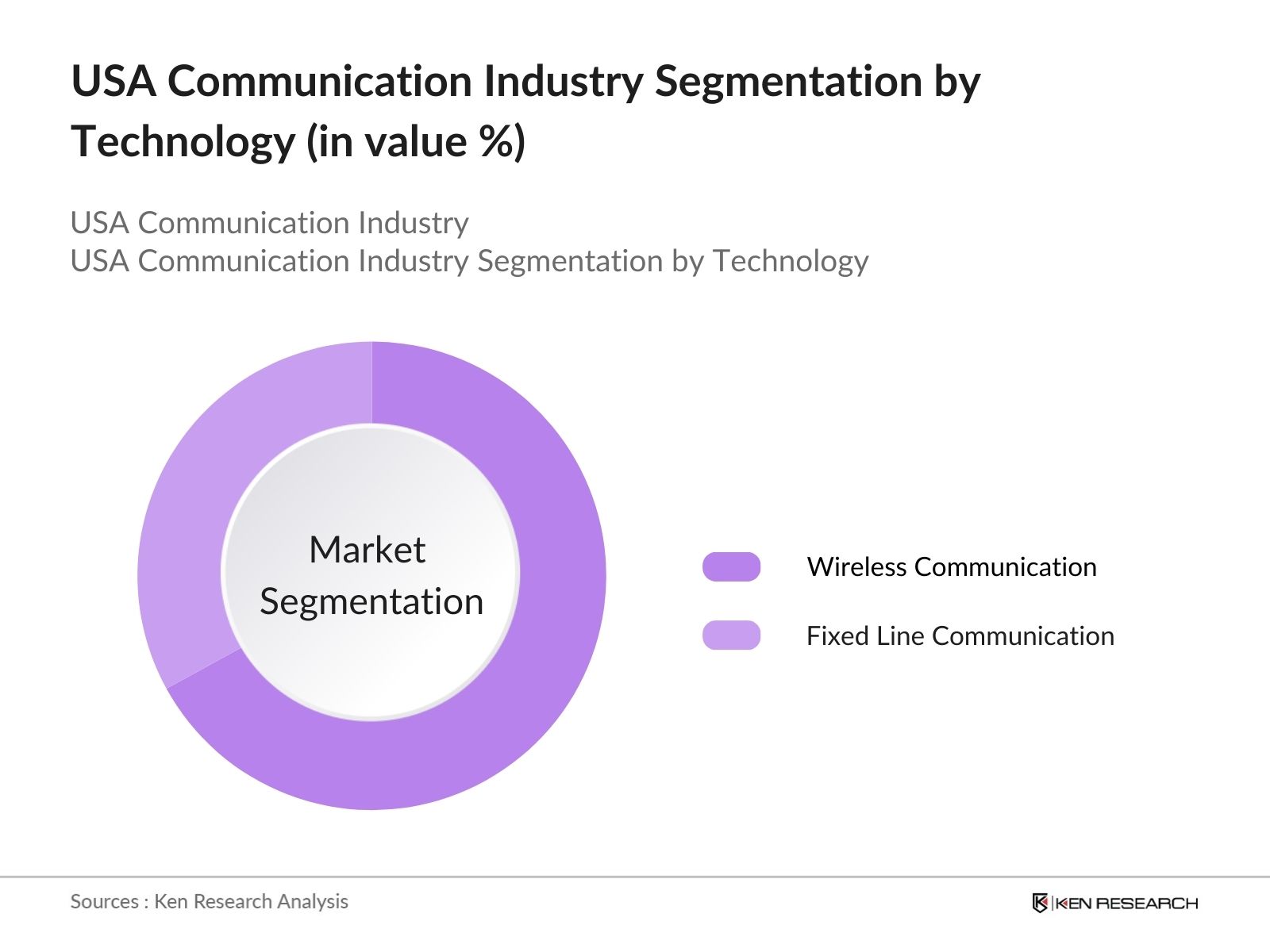
By Technology: The USA Communication market is segmented by technology into wireless communication and fixed-line communication. Wireless communication holds a dominant share due to the rapid growth in mobile device usage and the ongoing expansion of 5G technology. With major telecom operators prioritizing the rollout of 5G services, wireless communication has become indispensable for supporting higher data transfer speeds and improved network efficiency. Furthermore, consumers increasing preference for mobile broadband services and the need for real-time communication drives wireless communications dominance in the industry.
By Application: The USA Communication market is segmented by application into residential, commercial, and industrial. The commercial sector leads the market in terms of share due to the rising demand for high-speed internet and advanced telecommunication services in corporate environments. The increasing need for seamless communication within enterprises, coupled with the rise in cloud-based solutions and teleconferencing, has contributed to the commercial segments growth. Furthermore, businesses are leveraging advanced communication tools to enhance efficiency, leading to continued investment in communication infrastructure within this segment.

The USA Communication market is highly competitive, with several dominant players operating within the sector. The markets structure reflects the presence of both local and global telecommunication companies, driving competition through continuous innovation and large-scale investments in technology.
|
Company |
Establishment Year |
Headquarters |
Revenue (USD Bn) |
No. of Employees |
Global Presence |
Network Coverage |
Subscriber Base |
R&D Investments |
|---|---|---|---|---|---|---|---|---|
|
AT&T Inc. |
1983 |
Dallas, USA |
||||||
|
Verizon Communications Inc. |
2000 |
New York, USA |
||||||
|
T-Mobile US, Inc. |
1994 |
Bellevue, USA |
||||||
|
Comcast Corporation |
1963 |
Philadelphia, USA |
||||||
|
Charter Communications, Inc. |
1993 |
Stamford, USA |
Growth Drivers
Challenges
The USA Communication Industry is expected to witness sustained growth, driven by continuous technological advancements and increased investment in infrastructure. The adoption of 5G technology will play a pivotal role, enabling faster data transmission, reduced latency, and enhanced network capabilities. The rise of IoT devices and the growing trend toward edge computing will further fuel demand for advanced communication services
Market Opportunities
|
Segment |
Sub-segment |
|---|---|
|
By Technology |
Wireless Communication |
|
Fixed-Line Communication |
|
|
By Application |
Residential |
|
Commercial |
|
|
Industrial |
|
|
By Deployment Type |
On-Premise |
|
Cloud-Based |
|
|
By End-User |
Telecommunications Providers |
|
Media and Entertainment |
|
|
IT & Telecom Enterprises |
|
|
By Region |
North-East USA |
|
Midwest USA |
|
|
South USA |
|
|
West USA |
1.1. Definition and Scope
1.2. Market Taxonomy
1.3. Market Structure
1.4. Market Segmentation Overview
2.1. Historical Market Size
2.2. Year-on-Year Growth Analysis
2.3. Key Market Milestones and Developments
3.1. Growth Drivers
3.1.1. 5G Network Expansion
3.1.2. Rising Demand for High-Speed Internet (Broadband Penetration, Digital Consumption Patterns)
3.1.3. Increased IoT Adoption (IoT Devices in Telecom, Machine-to-Machine Communication)
3.2. Market Challenges
3.2.1. Infrastructure Costs (Network Infrastructure Investment)
3.2.2. Regulatory Barriers (Federal Communications Commission Regulations)
3.2.3. Spectrum Availability
3.3. Opportunities
3.3.1. Virtualization and Cloud-Based Solutions (Network Virtualization, Cloud Services)
3.3.2. Expansion of Fiber Networks (Fiber Optic Penetration)
3.3.3. Partnerships and Acquisitions (Strategic Collaborations)
3.4. Trends
3.4.1. Edge Computing Integration (Edge Devices, Low Latency Communication)
3.4.2. Software-Defined Networks (SDN Implementation)
3.4.3. Growth in Unified Communications as a Service (UCaaS)
3.5. Government Regulations
3.5.1. Net Neutrality Policies
3.5.2. Data Privacy and Protection Laws
3.5.3. FCC Regulatory Guidelines
3.6. SWOT Analysis
3.7. Stakeholder Ecosystem
3.8. Porters Five Forces
3.9. Competition Ecosystem
4.1. By Technology (In Value %)
4.1.1. Wireless Communication
4.1.2. Fixed-Line Communication
4.2. By Application (In Value %)
4.2.1. Residential
4.2.2. Commercial
4.2.3. Industrial
4.3. By Deployment Type (In Value %)
4.3.1. On-Premise
4.3.2. Cloud-Based
4.4. By End-User (In Value %)
4.4.1. Telecommunications Providers
4.4.2. Media and Entertainment
4.4.3. IT & Telecom Enterprises
4.5. By Region (In Value %)
4.5.1. North-East USA
4.5.2. Midwest USA
4.5.3. South USA
4.5.4. West USA
5.1. Detailed Profiles of Major Companies
5.1.1. AT&T Inc.
5.1.2. Verizon Communications Inc.
5.1.3. T-Mobile US, Inc.
5.1.4. Comcast Corporation
5.1.5. Charter Communications, Inc.
5.1.6. CenturyLink, Inc.
5.1.7. Cox Communications, Inc.
5.1.8. Sprint Corporation
5.1.9. DISH Network Corporation
5.1.10. Altice USA, Inc.
5.1.11. Frontier Communications Corporation
5.1.12. Windstream Holdings, Inc.
5.1.13. Cable One, Inc.
5.1.14. Level 3 Communications, Inc.
5.1.15. Hughes Network Systems, LLC
5.2. Cross Comparison Parameters (Revenue, Service Portfolio, Market Share, Subscriber Base, Network Coverage, No. of Data Centers, No. of Employees, Global Reach)
5.3. Market Share Analysis
5.4. Strategic Initiatives
5.5. Mergers and Acquisitions
5.6. Investment Analysis
5.7. Venture Capital Funding
5.8. Government Grants
5.9. Private Equity Investments
6.1. FCC Licensing Policies
6.2. Spectrum Allocation Requirements
6.3. Compliance Standards (Data Privacy, Security)
6.4. Certification Requirements for Operators
7.1. Future Market Size Projections
7.2. Key Factors Driving Future Market Growth
8.1. By Technology (In Value %)
8.2. By Application (In Value %)
8.3. By Deployment Type (In Value %)
8.4. By End-User (In Value %)
8.5. By Region (In Value %)
9.1. TAM/SAM/SOM Analysis
9.2. Customer Cohort Analysis
9.3. Marketing Strategies
9.4. White Space Opportunities
This step involves identifying the key players and stakeholders in the USA Communication Industry through comprehensive desk research. Secondary sources such as FCC data, market reports, and industry publications are used to gather insights into market trends, consumer behavior, and technological developments.
Historical data for the USA Communication market is compiled and analyzed to assess growth trends and evaluate key market segments. This includes analyzing market revenue, the impact of technology shifts, and the role of regulatory policies. The goal is to construct a thorough analysis of market dynamics.
Through industry consultations with telecom experts, key market hypotheses are tested and validated. These interviews provide operational and strategic insights from leading players in the communication industry, enhancing the accuracy of our market projections.
In this phase, data collected from various sources is synthesized to produce a comprehensive market report. This includes input from telecom operators, infrastructure providers, and regulators, ensuring that the final report reflects a holistic view of the USA Communication market.
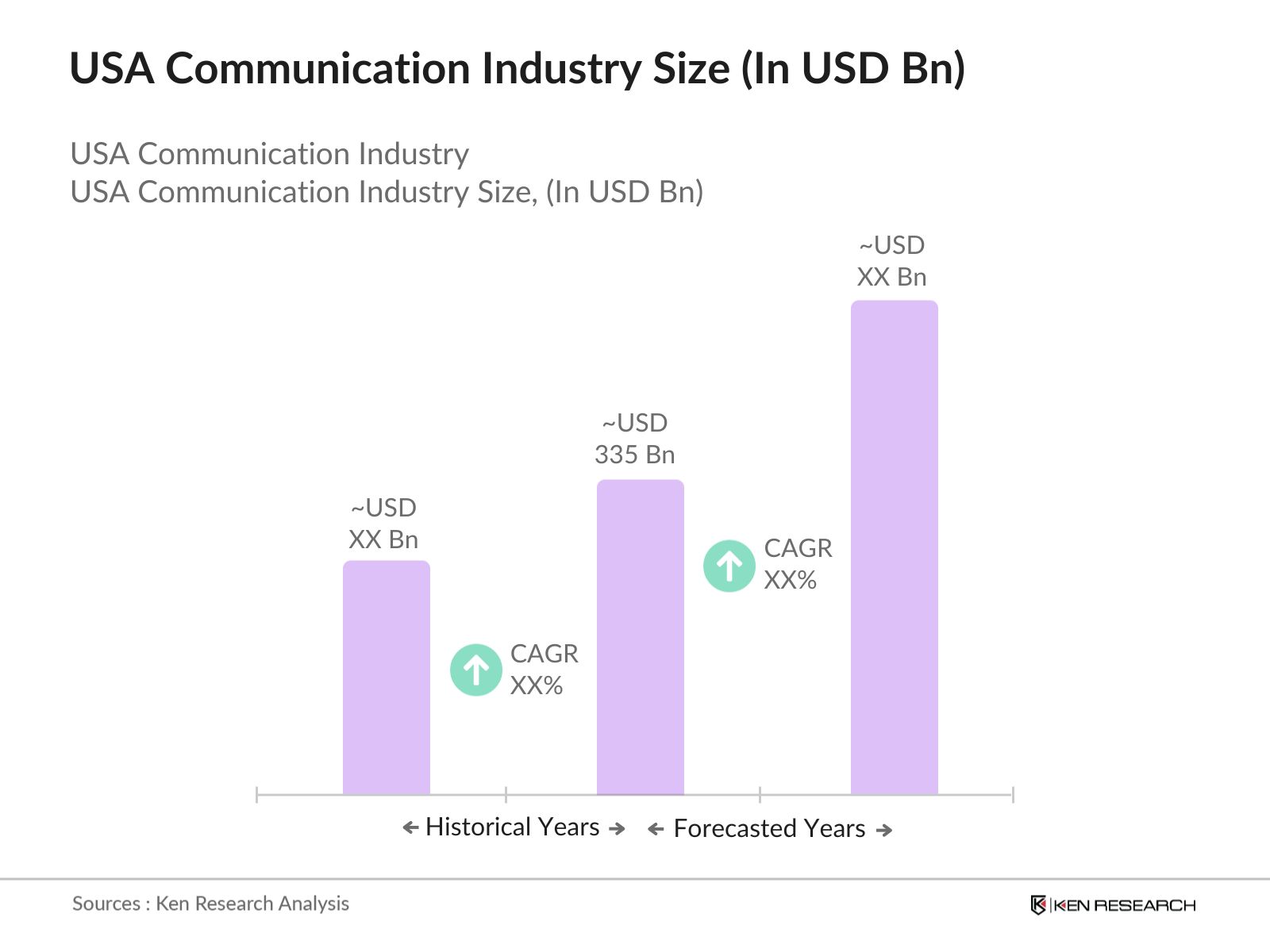
The USA Communication Industry market is valued at USD 335 billion supported by significant investments in 5G infrastructure and increasing demand for broadband services.
Key challenges include the high cost of infrastructure deployment, spectrum allocation issues, and regulatory barriers. Companies also face rising competition as new technologies like cloud communications and edge computing emerge.
Key players in the market include AT&T Inc., Verizon Communications Inc., T-Mobile US, Inc., Comcast Corporation, and Charter Communications, Inc., all of which are driving innovation through strategic investments and partnerships.
The industry's growth is propelled by the expansion of 5G networks, increased demand for IoT connectivity, and the rise of remote working and cloud-based communication solutions.

What makes us stand out is that our consultants follows Robust, Refine and Result (RRR) methodology. i.e. Robust for clear definitions, approaches and sanity checking, Refine for differentiating respondents facts and opinions and Result for presenting data with story

We have set a benchmark in the industry by offering our clients with syndicated and customized market research reports featuring coverage of entire market as well as meticulous research and analyst insights.

While we don't replace traditional research, we flip the method upside down. Our dual approach of Top Bottom & Bottom Top ensures quality deliverable by not just verifying company fundamentals but also looking at the sector and macroeconomic factors.

With one step in the future, our research team constantly tries to show you the bigger picture. We help with some of the tough questions you may encounter along the way: How is the industry positioned? Best marketing channel? KPI's of competitors? By aligning every element, we help maximize success.

Our report gives you instant access to the answers and sources that other companies might choose to hide. We elaborate each steps of research methodology we have used and showcase you the sample size to earn your trust.

If you need any support, we are here! We pride ourselves on universe strength, data quality, and quick, friendly, and professional service.