















USA CRRT Market Outlook to 2030
Region:North America
Author(s):Yogita Sahu
Product Code:KROD6129
November 2024
87
About the Report
USA CRRT Market Overview
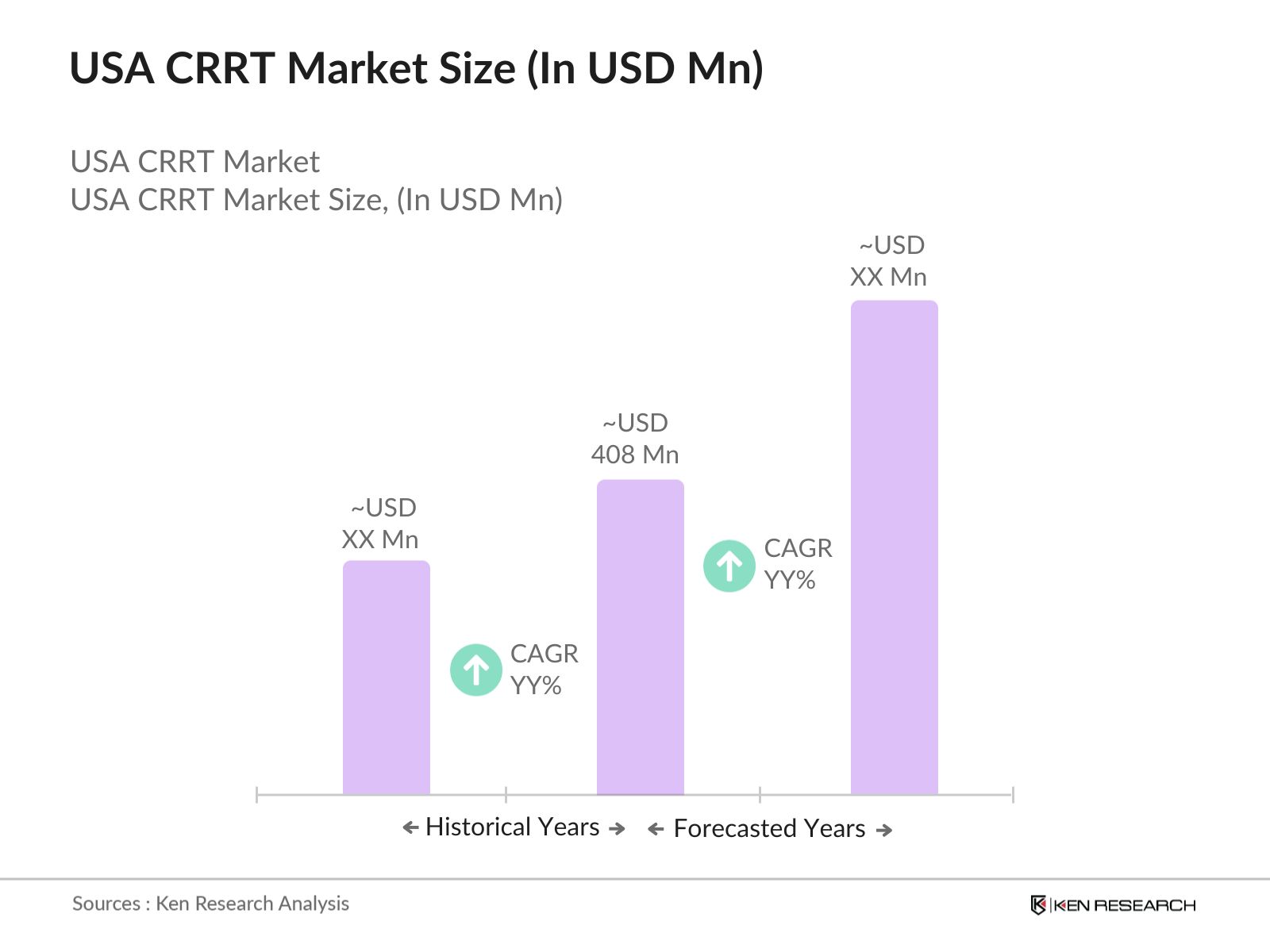
- The USA CRRT market is valued at USD 408 million, based on a five-year historical analysis. The growth of the market is primarily driven by the increasing incidence of acute kidney injury (AKI), especially among critically ill patients. Technological advancements in CRRT machines, such as improved fluid management systems and theintegration of artificial intelligence, have further driven the adoption of CRRT in critical care settings.
- In the USA, cities such as New York, Los Angeles, and Houston dominate the CRRT market due to their well-established healthcare infrastructure and large patient pools. These cities have some of the largest tertiary hospitals and specialized nephrology centers, contributing to the increased demand for CRRT machines.
- The U.S. Department of Health and Human Services (HHS) allocated $15 million in 2023 to the KidneyX program, promoting the development of innovative therapies like CRRT to treat kidney diseases. This funding aims to improve the availability and efficiency of renal replacement technologies nationwide.
USA CRRT Market Segmentation
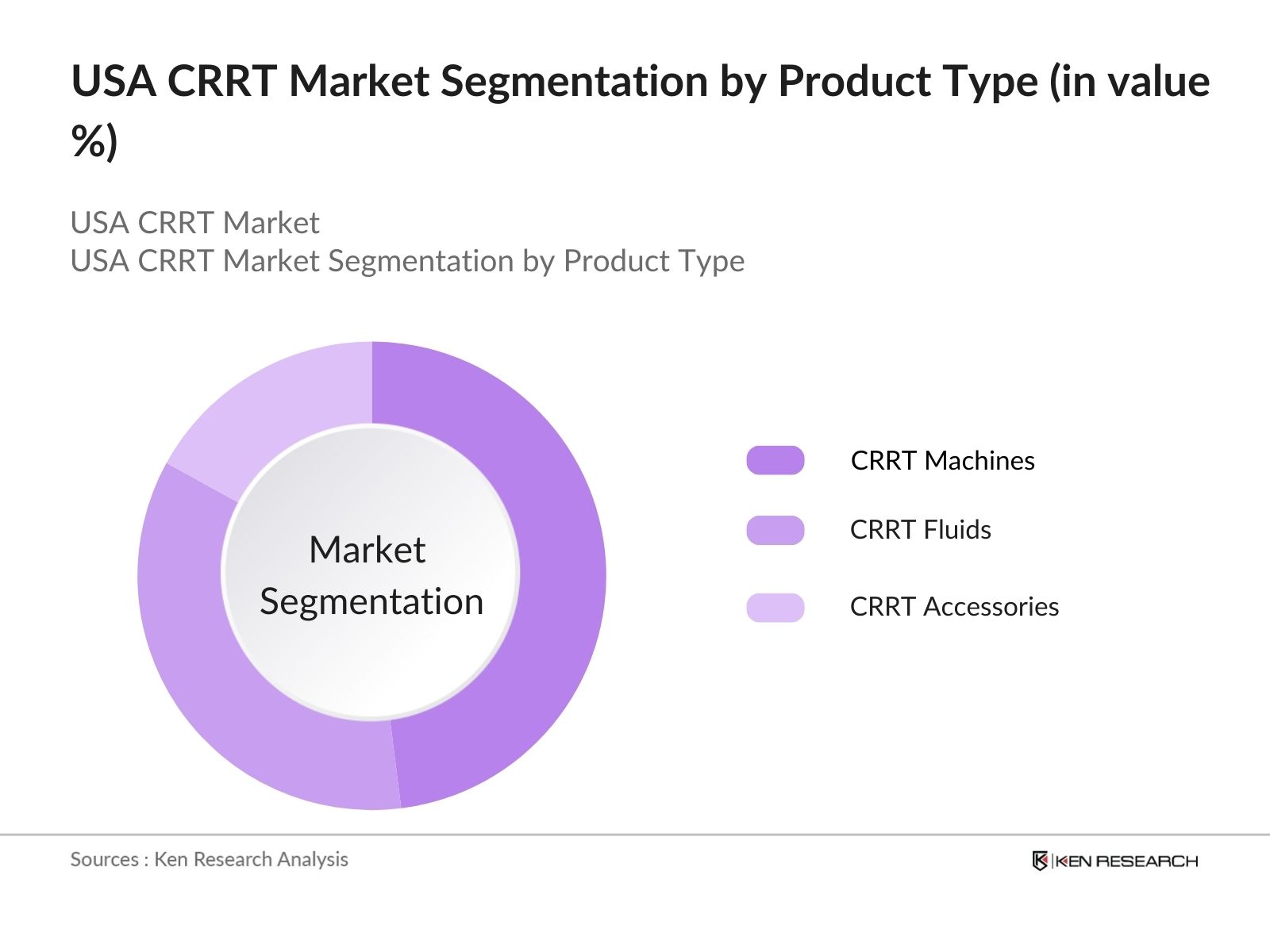
By Product Type: The market is segmented by product type into CRRT machines, CRRT fluids, and CRRT accessories. CRRT machines hold a dominant market share due to the continuous demand for technologically advanced equipment in hospitals. These machines are crucial for handling acute kidney failure in critical patients. Companies like Baxter International and Fresenius Medical Care have introduced machines with enhanced automation, improving the precision of treatments.
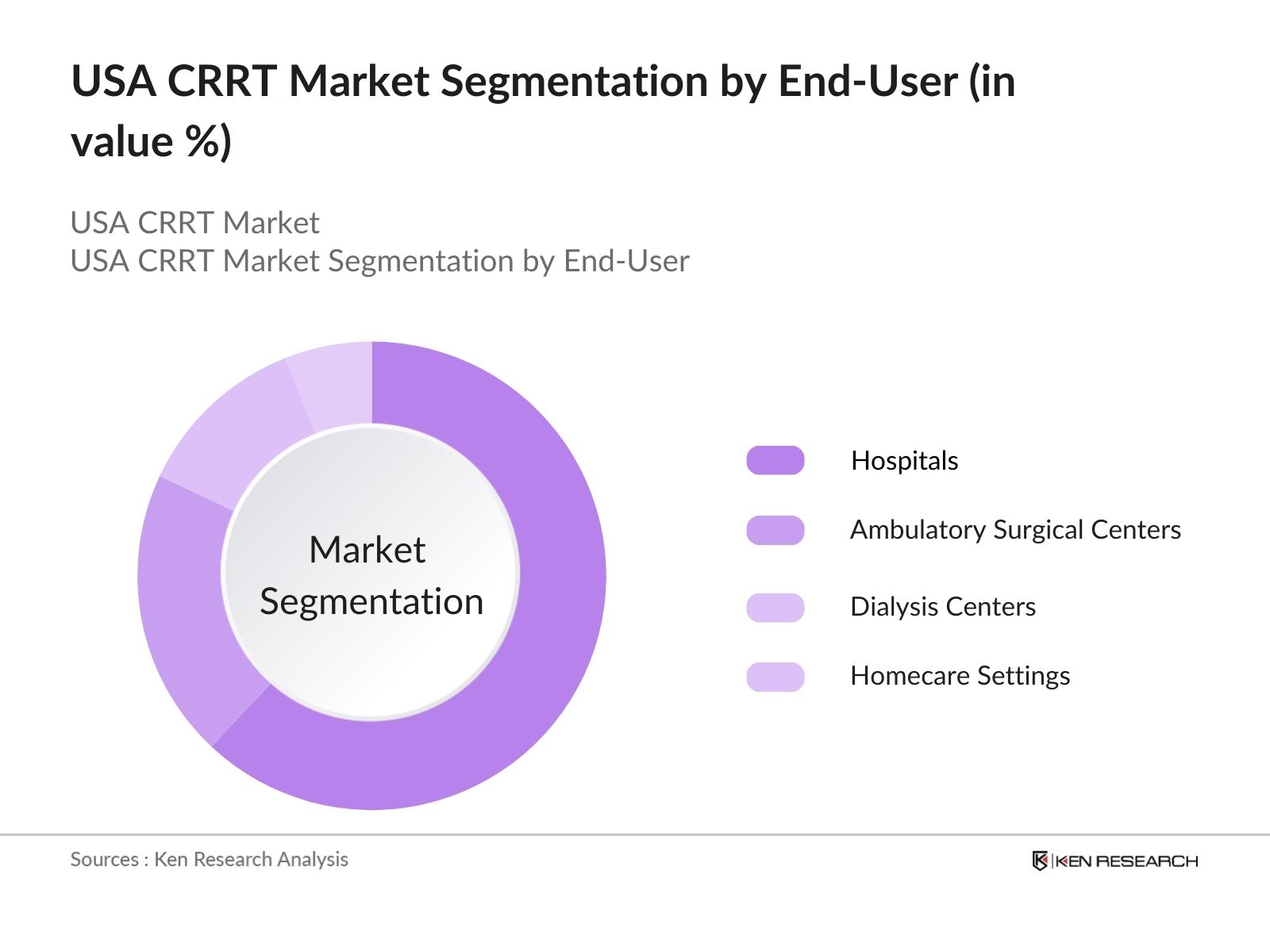
By End-User: The market is segmented by end-user into hospitals, ambulatory surgical centers, dialysis centers, and homecare settings. Hospitals, particularly those with intensive care units, dominate the market with a significant market share. This is due to the high frequency of acute kidney injury cases that require critical care, and hospitals are well-equipped with ICU facilities and trained healthcare professionals to administer CRRT.
USA CRRT Market Competitive Landscape
The market is dominated by a few major players with strong product portfolios and global distribution networks. This market consolidation is characterized by the presence of well-established multinational companies alongside smaller specialized manufacturers.
|
Company Name |
Establishment Year |
Headquarters |
Revenue (USD) |
Market Share (%) |
Patents Held |
R&D Expenditure |
Global Presence |
Number of Employees |
Strategic Partnerships |
|
Baxter International Inc. |
1931 |
Deerfield, IL |
|||||||
|
Fresenius Medical Care AG |
1996 |
Bad Homburg, Germany |
|||||||
|
B. Braun Melsungen AG |
1839 |
Melsungen, Germany |
|||||||
|
Nikkiso Co., Ltd. |
1953 |
Tokyo, Japan |
|||||||
|
Medtronic PLC |
1949 |
Dublin, Ireland |
USA CRRT Market Analysis
Market Growth Drivers
- Increasing Incidence of Acute Kidney Injury (AKI): In 2024, the number of patients diagnosed with acute kidney injury (AKI) in the USA exceeded 1.4 million annually, contributing to the demand for CRRT. With nearly 60% of ICU patients suffering from some form of kidney impairment, CRRT becomes a vital therapy in critical care settings to manage fluid overload and remove waste from the bloodstream. According to clinical data from healthcare institutions, around 300,000 ICU patients require CRRT annually.
- Aging Population Requiring Intensive Care: The USAs aging population, with over 57 million individuals aged 65 or older in 2024, is expected to drive the CRRT market as elderly patients are more prone to severe illnesses like heart failure, sepsis, and kidney dysfunction. Hospital reports suggest that older patients undergoing CRRT are increasing by 3% annually, with over 100,000 seniors receiving this therapy in 2023 alone.
- Advances in Critical Care and ICU Capabilities: In 2024, the U.S. healthcare system reported an increase in ICU capacity, reaching over 85,000 ICU beds nationwide. The demand for CRRT machines and services rises in parallel, as more advanced ICUs are equipped to provide continuous dialysis for critically ill patients. Medical device manufacturers report annual sales of over 8,000 CRRT machines to U.S. hospitals, showcasing the growing investment in critical care technologies.
Market Challenges
- Shortage of Trained Medical Staff: CRRT requires specialized skills for setup, monitoring, and maintenance. In 2024, the U.S. reported a shortage of nearly 30,000 nephrology-trained nurses and ICU specialists, leading to constraints in administering the therapy. Hospitals with understaffed ICU units may face difficulties in managing high patient volumes that require continuous renal care.
- Risk of Complications in Patients: According to clinical studies from 2023, approximately 25% of patients undergoing CRRT in the USA develop complications such as electrolyte imbalances and infections. These adverse events raise concerns among healthcare providers and patients, potentially limiting CRRT usage, particularly in high-risk populations.
USA CRRT Market Future Outlook
Over the next five years, the USA CRRT industry is expected to witness growth driven by several factors, including technological advancements in CRRT machines, increasing awareness among healthcare professionals, and rising patient admissions in critical care.
Future Market Opportunities
- Increased Adoption of Artificial Intelligence in CRRT Systems: Over the next five years, AI-integrated CRRT machines are expected to become a standard in U.S. hospitals. These systems will enable precise monitoring of fluid removal and electrolyte balance, improving patient outcomes. By 2028, AI-based CRRT solutions are projected to manage over 50,000 ICU patients annually, reducing human error and enhancing treatment efficiency.
- Expansion of Telemedicine Support for CRRT Treatments: Telemedicine platforms are expected to expand their role in CRRT administration over the next five years. By 2028, around 25% of U.S. hospitals are projected to offer remote monitoring for CRRT patients, allowing healthcare providers to manage treatments from off-site locations, ensuring continuous care even in under-resourced areas.
Scope of the Report
|
Product Type |
CRRT Machines CRRT Accessories CRRT Fluids |
|
Modality |
CVVH CVVHDF CVVHD SCUF |
|
End-User |
Hospitals Ambulatory Surgical Centers Dialysis Centers Homecare Settings |
|
Patient Type |
Adults Pediatrics Neonates |
|
Region |
North South East West |
Products
Key Target Audience Organizations and Entities Who Can Benefit by Subscribing This Report:
Banks and Financial Institution
Government and Regulatory Bodies (FDA, CMS)
Investors and Venture Capitalist Firms
Private Equity Firms
Medical Instrument Manufactures
Companies
Players Mentioned in the Report:
Baxter International Inc.
Fresenius Medical Care AG & Co. KGaA
Nikkiso Co., Ltd.
B. Braun Melsungen AG
Medtronic PLC
NxStage Medical, Inc.
Asahi Kasei Medical Co., Ltd.
Toray Medical Co., Ltd.
Biolight Meditech
Infomed SA
Terumo Corporation
CytoSorbents Corporation
Medica S.p.A.
Adoratec GmbH
Toray Industries
Table of Contents
USA CRRT Market Overview
1.1. Definition and Scope
1.2. Market Taxonomy
1.3. Market Growth Rate (Units Installed, Revenue in USD, Patient Cases)
1.4. Market Segmentation Overview
USA CRRT Market Size (In USD Mn)
2.1. Historical Market Size (Units Sold, Units in Operation, Revenue)
2.2. Year-On-Year Growth Analysis (By Units and USD)
2.3. Key Market Developments and Milestones (New CRRT Technologies, FDA Approvals, Product Launches)
USA CRRT Market Analysis
3.1. Growth Drivers
3.1.1. Increasing Incidence of Acute Kidney Injury (AKI)
3.1.2. Growing Geriatric Population (By Number)
3.1.3. Technological Advancements in CRRT Machines
3.1.4. Increasing Hospital Admissions for Critical Care (Critical Care Beds, Patient Data)
3.2. Market Challenges
3.2.1. High Costs of CRRT Equipment
3.2.2. Limited Skilled Healthcare Professionals for CRRT Operations
3.2.3. Regulatory Approval Delays (FDA, CE Marking)
3.2.4. Competition from Intermittent Hemodialysis (Comparison by Cost and Efficiency)
3.3. Opportunities
3.3.1. Expansion of CRRT in Homecare Settings (Homecare Setup Statistics)
3.3.2. Increasing Adoption in Medium-Sized Hospitals
3.3.3. Technological Integration (Remote Monitoring, AI-assisted CRRT)
3.3.4. Partnership Opportunities with Research Institutes
3.4. Trends
3.4.1. Integration of Artificial Intelligence in CRRT Machines
3.4.2. Rise in CRRT Procedures in Ambulatory Surgical Centers
3.4.3. Adoption of Portable CRRT Devices for Emergency Use
3.4.4. Increasing Investment in R&D for CRRT Innovations
3.5. Government Regulation
3.5.1. FDA Guidelines for CRRT Equipment
3.5.2. Reimbursement Policies and Medicare Coverage
3.5.3. Government Funding for Kidney Care Programs
3.5.4. National Health Policy Guidelines for Acute Kidney Treatment
3.6. SWOT Analysis
3.7. Stake Ecosystem (Suppliers, Distributors, Hospitals, Clinics)
3.8. Porters Five Forces
3.9. Competition Ecosystem (Market Share Distribution by Company, Revenue Data)
USA CRRT Market Segmentation
4.1. By Product Type (In Value USD and Units Sold)
4.1.1. CRRT Machines
4.1.2. CRRT Accessories (Filters, Catheters, Tubing Sets)
4.1.3. CRRT Fluids
4.2. By Modality (In Value USD and Patient Usage Data)
4.2.1. Continuous Venovenous Hemofiltration (CVVH)
4.2.2. Continuous Venovenous Hemodiafiltration (CVVHDF)
4.2.3. Continuous Venovenous Hemodialysis (CVVHD)
4.2.4. Slow Continuous Ultrafiltration (SCUF)
4.3. By End-User (In Value USD and Installed Machines)
4.3.1. Hospitals (Tertiary Care, Secondary Care)
4.3.2. Ambulatory Surgical Centers
4.3.3. Dialysis Centers
4.3.4. Homecare Settings
4.4. By Patient Type (In Value USD and Procedure Count)
4.4.1. Adults
4.4.2. Pediatrics
4.4.3. Neonates
4.5. By Region (In Value USD and Procedure Count)
4.5.1. North-East USA
4.5.2. South USA
4.5.3. Midwest USA
4.5.4. Western USA
USA CRRT Market Competitive Analysis
5.1. Detailed Profiles of Major Companies (In USD Revenue, Market Share, Installed Base)
5.1.1. Baxter International Inc.
5.1.2. Fresenius Medical Care AG & Co. KGaA
5.1.3. Nikkiso Co., Ltd.
5.1.4. Medtronic PLC
5.1.5. B. Braun Melsungen AG
5.1.6. Toray Medical Co., Ltd.
5.1.7. NxStage Medical, Inc.
5.1.8. Asahi Kasei Medical Co., Ltd.
5.1.9. Terumo Corporation
5.1.10. Biolight Meditech
5.1.11. CytoSorbents Corporation
5.1.12. Infomed SA
5.1.13. Medica S.p.A.
5.1.14. Adoratec GmbH
5.1.15. Toray Industries
5.2. Cross Comparison Parameters (Revenue, Installed Base, Global Presence, R&D Investments, Patent Count, Strategic Collaborations, Number of Employees, Market Share %)
5.3. Market Share Analysis (By Company, Region, Product Type)
5.4. Strategic Initiatives (Mergers, Product Launches, Collaborations)
5.5. Mergers And Acquisitions (Major M&A Activities)
5.6. Investment Analysis (Venture Capital and Private Equity Investments)
5.7. Government Grants (Key Funding Programs)
USA CRRT Market Regulatory Framework
6.1. FDA Standards and Approvals for CRRT Equipment
6.2. Certification and Compliance Requirements
6.3. Environmental Standards for Medical Equipment Manufacturing
USA CRRT Future Market Size (In USD Mn)
7.1. Future Market Size Projections (Forecast by USD and Units)
7.2. Key Factors Driving Future Market Growth (New Technologies, Increasing Patient Admissions)
USA CRRT Future Market Segmentation
8.1. By Product Type
8.2. By Modality
8.3. By End-User
8.4. By Patient Type
8.5. By Region
USA CRRT Market Analysts Recommendations
9.1. TAM/SAM/SOM Analysis
9.2. Customer Cohort Analysis (By Hospital Size, ICU Admissions)
9.3. White Space Opportunity Analysis
9.4. Strategic Market Expansion Recommendations
Research Methodology
Step 1: Identification of Key Variables
The research begins with identifying the major stakeholders within the USA CRRT market. This involves comprehensive desk research using both secondary sources and proprietary databases. The key variables analyzed include patient demographics, healthcare infrastructure, and CRRT machine distribution.
Step 2: Market Analysis and Construction
This stage involves gathering historical data on the CRRT market, including penetration rates, the number of hospitals with ICU facilities, and the overall sales of CRRT machines. The data is analyzed to estimate market revenue and market share distribution across different product categories and end-users.
Step 3: Hypothesis Validation and Expert Consultation
To validate our market assumptions, consultations with healthcare professionals, equipment manufacturers, and other industry experts are conducted. These experts provide insights into the operational challenges, adoption rates, and upcoming innovations in CRRT technologies.
Step 4: Research Synthesis and Final Output
Finally, we synthesize the data from both primary and secondary research, cross-referencing it with market insights from industry participants. The result is a validated and comprehensive analysis of the USA CRRT market, with an accurate depiction of market dynamics and forecasts.
Frequently Asked Questions
01. How big is the USA CRRT Market?
The USA CRRT market is valued at USD 408 million, driven by an increasing number of critically ill patients and the growing adoption of CRRT machines in hospitals.
02. What are the challenges in the USA CRRT Market?
The primary challenges in the USA CRRT market include the high cost of CRRT machines, limited availability of skilled healthcare professionals, and regulatory hurdles in getting new CRRT devices approved for use.
03. Who are the major players in the USA CRRT Market?
Key players in the USA CRRT market include Baxter International, Fresenius Medical Care, Nikkiso Co., Ltd., B. Braun Melsungen, and Medtronic PLC. These companies dominate due to their extensive product portfolios and strong R&D investments.
04. What are the growth drivers of the USA CRRT Market?
The USA CRRT market is driven by the rising incidence of acute kidney injury, advancements in CRRT machine technologies, and an increase in the number of critical care units in hospitals.
05. What is the future outlook for the USA CRRT Market?
The USA CRRT market is expected to see strong growth over the next five years, fueled by continuous technological innovation, increased hospital infrastructure investment, and collaborations between hospitals and research institutes.
Why Buy From Us?

What makes us stand out is that our consultants follows Robust, Refine and Result (RRR) methodology. i.e. Robust for clear definitions, approaches and sanity checking, Refine for differentiating respondents facts and opinions and Result for presenting data with story

We have set a benchmark in the industry by offering our clients with syndicated and customized market research reports featuring coverage of entire market as well as meticulous research and analyst insights.

While we don't replace traditional research, we flip the method upside down. Our dual approach of Top Bottom & Bottom Top ensures quality deliverable by not just verifying company fundamentals but also looking at the sector and macroeconomic factors.

With one step in the future, our research team constantly tries to show you the bigger picture. We help with some of the tough questions you may encounter along the way: How is the industry positioned? Best marketing channel? KPI's of competitors? By aligning every element, we help maximize success.

Our report gives you instant access to the answers and sources that other companies might choose to hide. We elaborate each steps of research methodology we have used and showcase you the sample size to earn your trust.

If you need any support, we are here! We pride ourselves on universe strength, data quality, and quick, friendly, and professional service.