
USA Data Center Cooling Market Outlook to 2030
Region:North America
Author(s):Shubham Kashyap
Product Code:KROD2581
November 2024
98
About the Report
USA Data Center Cooling Market Overview
- The USA Data Center Cooling market is valued at USD 4.40 billion, based on a five-year historical analysis. This market is primarily driven by the growing number of hyperscale data centers, increasing rack power density, and the rising demand for energy-efficient cooling solutions. As data centers are integral to cloud computing, AI, and other advanced technologies, the need for effective cooling systems to manage heat dissipation in these facilities is becoming increasingly critical.

- The demand for cooling solutions is highly concentrated in regions with dense data center hubs such as Northern Virginia, Dallas, and Silicon Valley. These areas host a number of large-scale data centers due to favorable business climates, availability of power, and technological infrastructure. Additionally, the rising number of data center investments by tech giants like Amazon, Google, and Microsoft in these regions is further propelling the need for efficient cooling systems.
- In 2023, the Environmental Protection Agency (EPA) introduced new regulations aimed at reducing carbon emissions from data centers, particularly targeting cooling systems that consume large amounts of energy. These regulations require data center operators to adopt energy-efficient cooling technologies and reduce their overall carbon footprints, making compliance a critical aspect for market players.
USA Data Center Cooling Market Segmentation
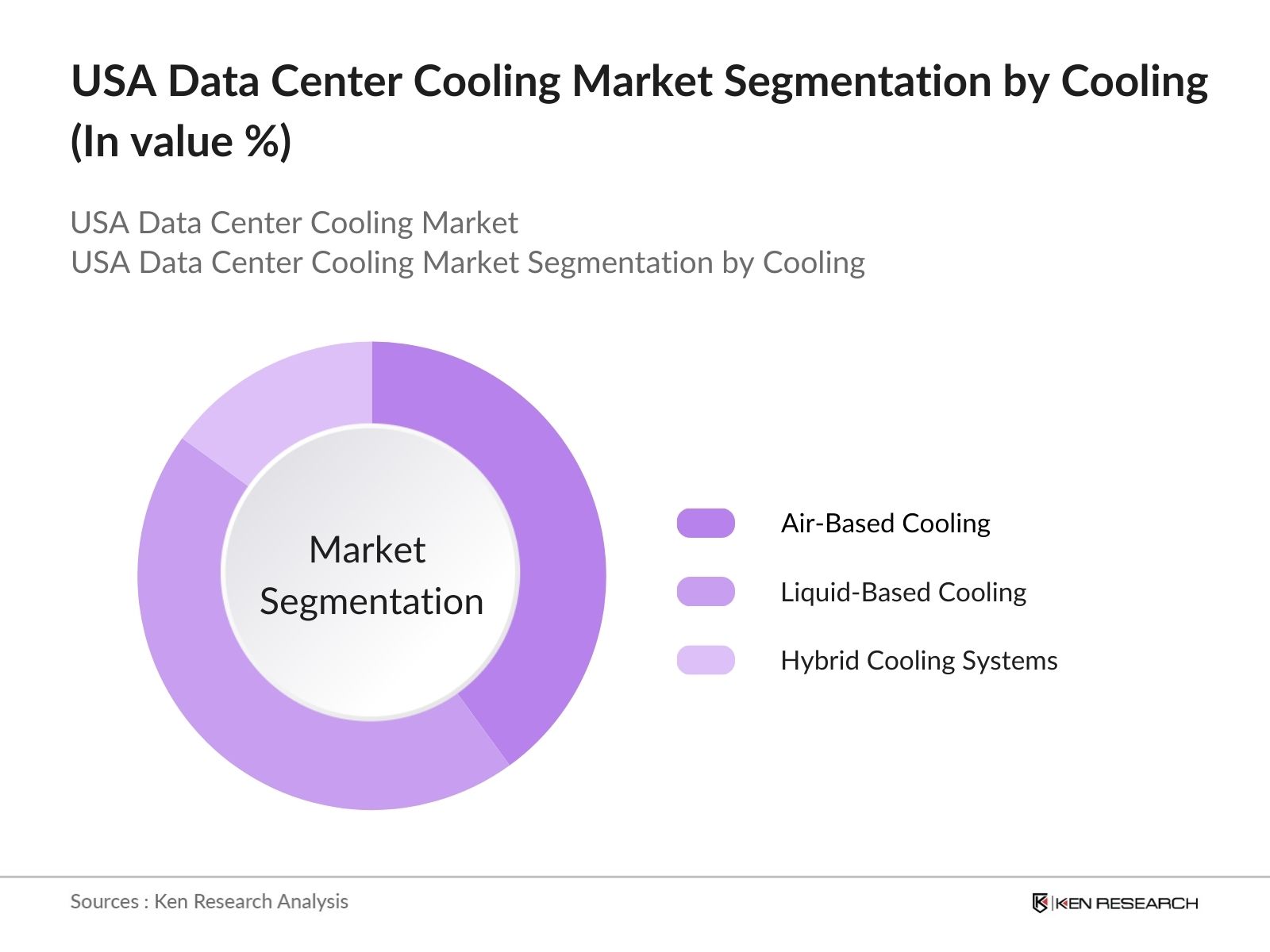
- By Cooling Type: The market is segmented by cooling type into air-based cooling, liquid-based cooling, and hybrid systems. Liquid-based cooling currently holds a significant market share due to its superior heat dissipation capabilities, particularly in high-density data centers. Companies like Vertiv and Schneider Electric are leading the liquid cooling segment, as it provides better energy efficiency and operational reliability, especially for hyperscale data centers.

- By Data Center Size: The market is also segmented by data center size into small and medium-sized data centers, large data centers, and hyperscale data centers. Hyperscale data centers dominate the market due to their higher power densities and increased cooling requirements. The rise in cloud computing and AI services has led to an increase in hyperscale data centers, which often require more advanced cooling systems to prevent overheating. This demand is expected to grow as companies like Amazon and Google continue to expand their operations in the U.S.
USA Data Center Cooling Market Competitive Landscape
The USA Data Center Cooling market is highly competitive, with several key players focusing on innovation, R&D, and strategic partnerships to strengthen their market positions. Leading companies like Vertiv, Schneider Electric, and Stulz dominate the market with their advanced cooling solutions tailored for hyperscale data centers and energy efficiency.
|
Company Name |
Establishment Year |
Headquarters |
Key Product |
R&D Investment |
Revenue (2023) |
No. of Employees |
Market Presence |
Patents |
Strategic Partnerships |
|
Vertiv |
2000 |
Ohio, USA |
|||||||
|
Schneider Electric |
1836 |
Massachusetts, USA |
|||||||
|
Stulz |
1947 |
Hamburg, Germany |
|||||||
|
CoolIT Systems |
2001 |
Alberta, Canada |
|||||||
|
Rittal GmbH |
1961 |
Herborn, Germany |
USA Data Center Cooling Industry Analysis
Growth Drivers
- Rising Power Densities in Data Centers: Data centers in the USA are experiencing increased power densities, leading to higher heat output and cooling demands. The average power density in modern data centers reached 7 kW per rack in 2023, with some hyperscale centers reaching up to 20 kW per rack. This increase results in significant cooling requirements to prevent overheating and maintain operational efficiency. The U.S. Energy Information Administration (EIA) reported that data centers consumed 2% of the nation's electricity in 2023, emphasizing the need for efficient cooling solutions.
- Increase in Hyperscale Data Center Construction: Hyperscale data centers are rapidly growing in the USA, driven by the expansion of cloud services, AI, and big data. In 2023, there were over 600 hyperscale data centers globally, with the USA accounting for nearly 40% of the total. Each facility typically requires cooling systems capable of managing upwards of 100 MW of power, necessitating advanced cooling technologies. According to the U.S. Department of Energy, hyperscale centers alone accounted for more than 10% of the total energy consumption by data centers, highlighting the critical need for efficient cooling solutions.
- Edge Computing Expansion (Cooling for Edge Data Centers): With the rise of edge computing, localized data centers are becoming more prevalent across the USA, each requiring specialized cooling solutions. Edge data centers typically operate in smaller, decentralized locations, with power densities between 5 to 10 kW per rack. According to the Federal Communications Commission (FCC), the expansion of 5G and IoT will lead to the installation of over 10,000 edge data centers by the end of 2024, each demanding compact and energy-efficient cooling technologies.
Market Challenges
- High Capital Expenditure (CAPEX): Advanced cooling systems, such as liquid cooling and hybrid cooling solutions, require significant upfront investment, which is a key barrier to adoption, particularly for small and medium-sized data centers. The average cost of deploying a liquid cooling system in a hyperscale data center can exceed USD 1 million, making it a less viable option for smaller operators.
- Technical Complexity of Liquid Cooling Systems: Although liquid cooling is more energy-efficient, it comes with higher technical complexity. Implementing and maintaining liquid cooling systems requires specialized knowledge and infrastructure, which is not always readily available in smaller or remote data centers. This adds to operational challenges and limits widespread adoption.
USA Data Center Cooling Market Future Outlook
Over the next five years, the USA Data Center Cooling market is expected to experience significant growth, driven by continued advancements in cooling technologies, increasing data center power densities, and stricter environmental regulations. The adoption of AI-driven cooling systems is anticipated to improve energy efficiency further, allowing data center operators to optimize their cooling processes in real time.
Market Opportunities
- AI and Automation in Data Center Cooling: Artificial intelligence (AI) and automation are emerging as game changers for cooling management in data centers. AI-driven systems can analyze temperature and humidity data in real-time to optimize cooling operations, leading to energy savings. In 2023, data centers implementing AI for cooling management reduced energy consumption by an average of 15%, according to a study by the U.S. Department of Energy. As energy costs continue to rise, AI-based cooling offers a promising opportunity to reduce operational expenses while enhancing efficiency.
- Increasing Demand for Liquid Cooling Solutions: Liquid cooling is gaining traction due to its ability to efficiently manage high heat loads in data centers. In 2023, liquid cooling systems were installed in nearly 15% of U.S. data centers, and this figure is expected to grow as power densities increase. According to the U.S. Environmental Protection Agency, liquid cooling can reduce cooling energy consumption by up to 50% in certain facilities, making it an attractive option for high-performance computing environments.
Scope of the Report
|
Cooling Type |
Air-Based Cooling Liquid-Based Cooling Hybrid Cooling Systems |
|
Component |
Cooling Hardware (Chillers, Air Conditioners, CRAC Units) Cooling Services |
|
Data Center Size |
Small and Medium Data Centers Large Data Centers Hyperscale Data Centers |
|
Industry Vertical |
IT & Telecom BFSI Healthcare Government Others |
|
Geography |
North-East Midwest West Coast Southern States |
Major Players of the Market
- Vertiv
- Schneider Electric
- Stulz
- CoolIT Systems
- Rittal GmbH
- Nortek Air Solutions
- Airedale International
- Trane Technologies
- Munters Group AB
- Fujitsu General
- Mitsubishi Electric
- Hitachi Cooling & Heating
- Daikin Industries
- Green Revolution Cooling (GRC)
- LiquidStack
Products
Key Target Audience
Data Center Operators
Cooling Equipment Manufacturers
Energy Management Companies
Investments and Venture Capital Firms
Banks and financial institutes
Government and Regulatory Bodies (EPA, Department of Energy)
Data Center Design and Engineering Firms
IT & Telecom Companies
Cloud Service Providers
Companies
Major Players Mentioned in the Market
Vertiv
Schneider Electric
Stulz
CoolIT Systems
Rittal GmbH
Nortek Air Solutions
Airedale International
Trane Technologies
Munters Group AB
Fujitsu General
Mitsubishi Electric
Hitachi Cooling & Heating
Daikin Industries
Green Revolution Cooling (GRC)
LiquidStack
Table of Contents
1. USA Data Center Cooling Market Overview
1.1. Definition and Scope
1.2. Market Taxonomy
1.3. Market Growth Rate (Rack Density Growth, Data Center Investments, Regulatory Drivers)
1.4. Market Segmentation Overview (By Cooling Type, Component, Data Center Size, Industry Vertical, Geography)
2. USA Data Center Cooling Market Size (In USD Bn)
2.1. Historical Market Size (Cooling System Investments, Energy Consumption Trends)
2.2. Year-On-Year Growth Analysis (YoY Growth Rate, Cooling Capacity Expansion)
2.3. Key Market Developments and Milestones (Hyperscale Data Centers, Technology Integrations)
3. USA Data Center Cooling Market Analysis
3.1. Growth Drivers
3.1.1. Rising Power Densities in Data Centers
3.1.2. Increase in Hyperscale Data Center Construction
3.1.3. Demand for Energy Efficiency (Green Cooling Technologies, Energy Star Ratings)
3.1.4. Edge Computing Expansion (Cooling for Edge Data Centers)
3.1.5. Regulatory Compliance (EPA Regulations, Carbon Emission Standards)
3.2. Market Challenges
3.2.1. High Capital Costs of Advanced Cooling Solutions (Liquid Cooling, Immersion Cooling)
3.2.2. Technical Complexity of Liquid Cooling Systems
3.2.3. Energy Consumption Constraints (Heat Management, High-Energy Cost)
3.3. Opportunities
3.3.1. AI and Automation in Data Center Cooling
3.3.2. Increasing Demand for Liquid Cooling Solutions
3.3.3. Adoption of Modular Data Center Cooling Solutions
3.3.4. Renewable Energy-Powered Cooling Systems
3.4. Trends
3.4.1. Adoption of Liquid Immersion Cooling
3.4.2. Shift Toward Sustainable Cooling Technologies
3.4.3. Integration of AI for Optimized Cooling Management
3.4.4. Micro-Data Centers and Their Cooling Needs
3.5. Government Regulation
3.5.1. EPA Carbon Reduction Mandates
3.5.2. State-Level Energy Efficiency Incentives (California, Texas)
3.5.3. ASHRAE Guidelines for Data Center Temperature Control
3.6. SWOT Analysis
3.7. Stake Ecosystem (Cooling Equipment Manufacturers, Data Center Operators, Service Providers)
3.8. Porters Five Forces
3.9. Competitive Landscape and Key Competitor Strategies
4. USA Data Center Cooling Market Segmentation
4.1. By Cooling Type (In Value %)
4.1.1. Air-Based Cooling
4.1.2. Liquid-Based Cooling
4.1.3. Hybrid Cooling Systems
4.2. By Component (In Value %)
4.2.1. Cooling Hardware (Chillers, Air Conditioners, CRAC Units)
4.2.2. Cooling Services (Installation, Maintenance, Monitoring)
4.3. By Data Center Size (In Value %)
4.3.1. Small and Medium Data Centers
4.3.2. Large Data Centers
4.3.3. Hyperscale Data Centers
4.4. By Industry Vertical (In Value %)
4.4.1. IT & Telecom
4.4.2. BFSI
4.4.3. Healthcare
4.4.4. Government
4.4.5. Others
4.5. By Geography (In Value %)
4.5.1. Northern Virginia
4.5.2. Dallas
4.5.3. Silicon Valley
4.5.4. Other Regions
5. USA Data Center Cooling Market Competitive Analysis
5.1. Detailed Profiles of Major Companies
5.1.1. Vertiv
5.1.2. Schneider Electric
5.1.3. Stulz
5.1.4. Rittal GmbH & Co. KG
5.1.5. Airedale International
5.1.6. Nortek Air Solutions
5.1.7. Trane Technologies
5.1.8. Munters Group AB
5.1.9. Fujitsu General
5.1.10. Mitsubishi Electric
5.1.11. Hitachi Cooling & Heating
5.1.12. Daikin Industries
5.1.13. CoolIT Systems
5.1.14. Green Revolution Cooling (GRC)
5.1.15. LiquidStack
5.2. Cross Comparison Parameters (Revenue, Cooling Technologies, Partnerships, Patents, No. of Employees, Inception Year, Data Center Partnerships, R&D Investment)
5.3. Market Share Analysis
5.4. Strategic Initiatives (Mergers and Acquisitions, New Product Launches)
5.5. Venture Capital Funding (Investment Trends in Cooling Tech)
5.6. Private Equity Investments in the Cooling Sector
5.7. Strategic Alliances and Joint Ventures
6. USA Data Center Cooling Market Regulatory Framework
6.1. Environmental Standards (EPA, ASHRAE)
6.2. Compliance Requirements (Energy Efficiency Standards, Data Center Certifications)
6.3. Certification Processes (Energy Star, LEED Certifications)
7. USA Data Center Cooling Market Future Size (In USD Bn)
7.1. Future Market Size Projections
7.2. Key Factors Driving Future Market Growth (Expansion of Hyperscale Facilities, Emerging Technologies)
8. USA Data Center Cooling Future Market Segmentation
8.1. By Cooling Type (In Value %)
8.2. By Component (In Value %)
8.3. By Data Center Size (In Value %)
8.4. By Industry Vertical (In Value %)
8.5. By Geography (In Value %)
9. USA Data Center Cooling Market Analysts Recommendations
9.1. TAM/SAM/SOM Analysis
9.2. Customer Segmentation Strategies
9.3. Key Differentiators in Product Offerings
9.4. Market Expansion Opportunities (White Space Analysis)
Research Methodology
Step 1: Identification of Key Variables
The initial phase involves mapping the USA Data Center Cooling Market by identifying all major stakeholders. This step relies on a combination of proprietary and secondary data sources to define the critical variables that influence market dynamics.
Step 2: Market Analysis and Construction
This phase includes compiling historical data on the USA Data Center Cooling Market, assessing cooling technologies, and analyzing trends in power consumption. The analysis focuses on revenue generation, industry trends, and competitive strategies.
Step 3: Hypothesis Validation and Expert Consultation
Hypotheses will be validated through expert consultations using computer-assisted telephone interviews (CATI) with key industry professionals. Insights gathered will help refine the analysis and market projections.
Step 4: Research Synthesis and Final Output
The final phase involves engaging with data center operators to gather detailed insights into cooling system performance, product preferences, and market trends. This data is integrated with secondary research to produce a validated market report.
Frequently Asked Questions
01. How big is the USA Data Center Cooling Market?
The USA Data Center Cooling market is valued at USD 4.40 billion, driven by the increasing number of hyperscale data centers and the demand for energy-efficient cooling systems.
02. What are the key challenges in the USA Data Center Cooling Market?
Key challenges include the high initial cost of implementing advanced cooling systems like liquid cooling and the technical complexity involved in maintaining these systems.
03. Who are the major players in the USA Data Center Cooling Market?
The market is dominated by companies such as Vertiv, Schneider Electric, Stulz, CoolIT Systems, and Rittal GmbH, which are known for their innovative cooling solutions and extensive market presence.
04. What are the growth drivers of the USA Data Center Cooling Market?
Growth drivers include the rising power density in data centers, increased demand for energy efficiency, and advancements in AI-driven cooling systems.
05. What is the competitive landscape of the USA Data Center Cooling Market?
The market is highly competitive, with major players focusing on R&D, strategic partnerships, and mergers to strengthen their market positions and meet the growing demand for advanced cooling solutions.
Why Buy From Us?

What makes us stand out is that our consultants follows Robust, Refine and Result (RRR) methodology. i.e. Robust for clear definitions, approaches and sanity checking, Refine for differentiating respondents facts and opinions and Result for presenting data with story

We have set a benchmark in the industry by offering our clients with syndicated and customized market research reports featuring coverage of entire market as well as meticulous research and analyst insights.

While we don't replace traditional research, we flip the method upside down. Our dual approach of Top Bottom & Bottom Top ensures quality deliverable by not just verifying company fundamentals but also looking at the sector and macroeconomic factors.

With one step in the future, our research team constantly tries to show you the bigger picture. We help with some of the tough questions you may encounter along the way: How is the industry positioned? Best marketing channel? KPI's of competitors? By aligning every element, we help maximize success.

Our report gives you instant access to the answers and sources that other companies might choose to hide. We elaborate each steps of research methodology we have used and showcase you the sample size to earn your trust.

If you need any support, we are here! We pride ourselves on universe strength, data quality, and quick, friendly, and professional service.