
USA Digital Signage Market Outlook to 2030
Region:United States
Author(s):Meenakshi
Product Code:KROD4978
Region:United States
Author(s):Meenakshi
Product Code:KROD4978
October 2024
83
Listen to the audio summary
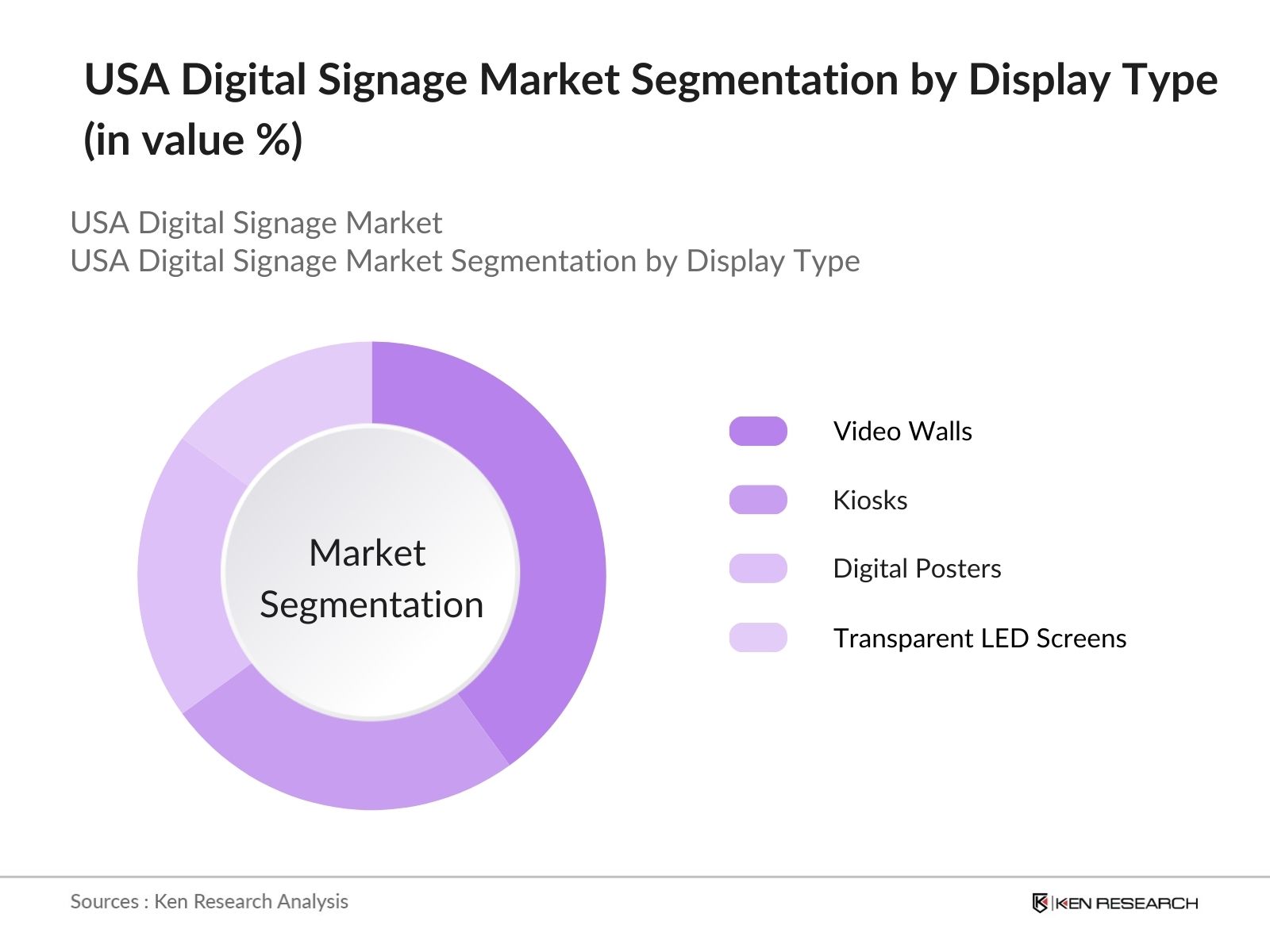
By Display Type: The USA Digital Signage market is segmented by display type into video walls, kiosks, digital posters, and transparent LED screens. Video walls currently hold the dominant market share within this segmentation due to their extensive use in large public spaces such as airports, malls, and stadiums. The ability of video walls to display high-definition visuals in large formats makes them an appealing choice for advertisers seeking to create impactful brand messaging. Furthermore, advancements in display resolution and flexibility in customization contribute to their popularity in various sectors.
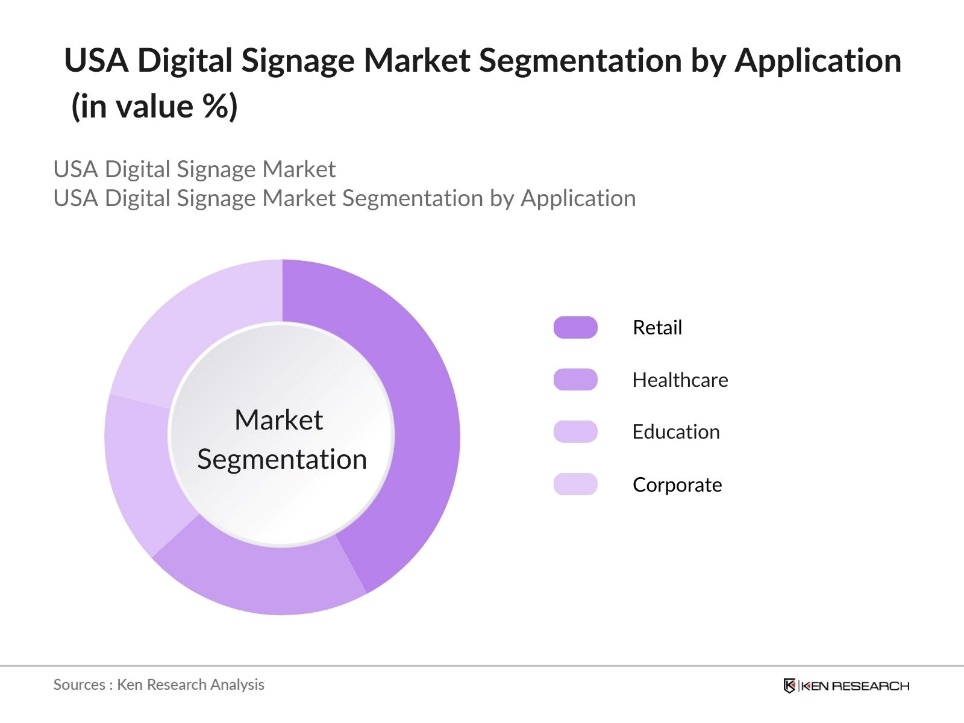
By Application: The USA Digital Signage market is segmented by application segment, the market is categorized into retail, healthcare, education, and corporate environments. Retail is currently the leading application, dominating the market due to the growing demand for digital advertising solutions within physical stores. Retailers use digital signage to enhance customer experience, promote offers, and showcase new products. The integration of touchscreen displays for interactive shopping, combined with proximity sensors and data analytics, has made digital signage indispensable for modern retail strategies, further solidifying its dominance in this segment.
The market is dominated by several key players, each with unique strengths in technological innovation and market presence. The market is highly competitive, with companies investing heavily in research and development to integrate new technologies such as AI, IoT, and cloud-based content management systems. The competitive environment encourages continuous product innovation, ensuring that businesses can cater to evolving consumer preferences and technological advancements.
|
Company |
Establishment Year |
Headquarters |
Revenue (2023) |
Employees |
Product Offerings |
Technology Innovations |
Customer Base |
R&D Investment |
|
Samsung Electronics Co. |
1969 |
South Korea |
||||||
|
NEC Display Solutions |
1980 |
Japan |
||||||
|
LG Electronics |
1958 |
South Korea |
||||||
|
Cisco Systems Inc. |
1984 |
USA |
||||||
|
BrightSign LLC |
2002 |
USA |
Over the next five years, the USA Digital Signage market is expected to experience robust growth, driven by continued technological advancements and rising demand for interactive and immersive advertising solutions. The adoption of AI-powered content personalization, combined with the expansion of smart cities and connected environments, will further propel the market. Additionally, the integration of cloud-based content management solutions will reduce operational costs, making digital signage more accessible to a broader range of businesses.
|
Display Type |
Video Walls Kiosks Digital Posters Transparent LED Screens |
|
Component |
Hardware Software Services |
|
Application |
Retail Healthcare Education Corporate |
|
Technology |
LCD LED Projection OLED |
|
Region |
Northeast Midwest West South |
1.1. Definition and Scope
1.2. Market Taxonomy
1.3. Market Growth Rate
1.4. Market Segmentation Overview
2.1. Historical Market Size
2.2. Year-on-Year Growth Analysis
2.3. Key Market Developments and Milestones
3.1. Growth Drivers
3.1.1. Adoption of 4K and 8K Display Technology
3.1.2. Increasing Demand for Interactive Displays
3.1.3. Expansion in Retail and Hospitality Sectors
3.1.4. Increasing Penetration of Digital Out-of-Home (DOOH) Advertising
3.2. Market Challenges
3.2.1. High Initial Installation Costs
3.2.2. Technological Obsolescence
3.2.3. Bandwidth and Connectivity Issues
3.3. Opportunities
3.3.1. Integration of Artificial Intelligence and Machine Learning
3.3.2. Growth in Smart Cities and Smart Buildings
3.3.3. Partnerships with Content Providers and Ad Networks
3.4. Trends
3.4.1. Rise of Cloud-Based Digital Signage Solutions
3.4.2. Increasing Use of Touchscreen and Interactive Displays
3.4.3. Integration with Internet of Things (IoT)
3.5. Government Regulation
3.5.1. Federal Advertising Guidelines
3.5.2. Energy Efficiency Standards for Display Technologies
3.5.3. Data Privacy Regulations (GDPR, CCPA)
3.5.4. Zoning and Permitting Regulations for Outdoor Signage
3.6. SWOT Analysis
3.7. Stakeholder Ecosystem
3.8. Porters Five Forces Analysis
3.9. Competition Ecosystem
4.1. By Display Type (In Value %)
4.1.1. Video Walls
4.1.2. Kiosks
4.1.3. Digital Posters
4.1.4. Transparent LED Screens
4.2. By Component (In Value %)
4.2.1. Hardware (Displays, Media Players)
4.2.2. Software (Content Management, Cloud Solutions)
4.2.3. Services (Installation, Maintenance)
4.3. By Application (In Value %)
4.3.1. Retail
4.3.2. Healthcare
4.3.3. Education
4.3.4. Corporate
4.4. By Technology (In Value %)
4.4.1. LCD
4.4.2. LED
4.4.3. Projection
4.4.4. OLED
4.5. By Region (In Value %)
4.5.1. Northeast
4.5.2. Midwest
4.5.3. West
4.5.4. South
5.1. Detailed Profiles of Major Companies
5.1.1. Samsung Electronics Co. Ltd.
5.1.2. NEC Display Solutions
5.1.3. LG Electronics
5.1.4. Sony Corporation
5.1.5. Panasonic Corporation
5.1.6. Cisco Systems Inc.
5.1.7. Sharp Corporation
5.1.8. Planar Systems
5.1.9. Leyard Optoelectronic Co.
5.1.10. Intel Corporation
5.1.11. BrightSign LLC
5.1.12. Stratacache
5.1.13. Scala Inc.
5.1.14. Four Winds Interactive
5.1.15. Mvix
5.2. Cross Comparison Parameters (Revenue, Headquarters, Inception Year, Market Presence, Product Portfolio, Technological Innovation, R&D Spending, Customer Base)
5.3. Market Share Analysis
5.4. Strategic Initiatives
5.5. Mergers and Acquisitions
5.6. Investment Analysis
5.7. Venture Capital Funding
5.8. Government Grants
5.9. Private Equity Investments
6.1. Environmental Standards for Digital Displays
6.2. Compliance with Energy Efficiency Certifications
6.3. Certification Processes (UL, CE, FCC)
7.1. Future Market Size Projections
7.2. Key Factors Driving Future Market Growth
8.1. By Display Type (In Value %)
8.2. By Component (In Value %)
8.3. By Application (In Value %)
8.4. By Technology (In Value %)
8.5. By Region (In Value %)
9.1. TAM/SAM/SOM Analysis
9.2. Customer Cohort Analysis
9.3. Marketing Initiatives
9.4. White Space Opportunity Analysis
The initial phase involves constructing an ecosystem map for the USA Digital Signage market. We conducted extensive desk research, using secondary sources such as industry reports and proprietary databases, to identify key variables influencing market dynamics. These variables include technological advancements, regional market adoption, and regulatory frameworks.
In this phase, we analyzed historical market data for digital signage in the USA. We assessed factors such as display type penetration, revenue generation by application, and the number of service providers. This data formed the foundation for market growth projections and future segment developments.
Market hypotheses were developed through interviews with industry experts, including digital signage manufacturers, advertising agencies, and technology providers. These consultations provided operational and financial insights, further validating the data collected in earlier phases.
The final stage involved synthesizing research data and insights into a comprehensive report. Engagements with display manufacturers and media companies helped verify revenue estimates and market segmentation accuracy, ensuring the analysis aligns with current market trends.
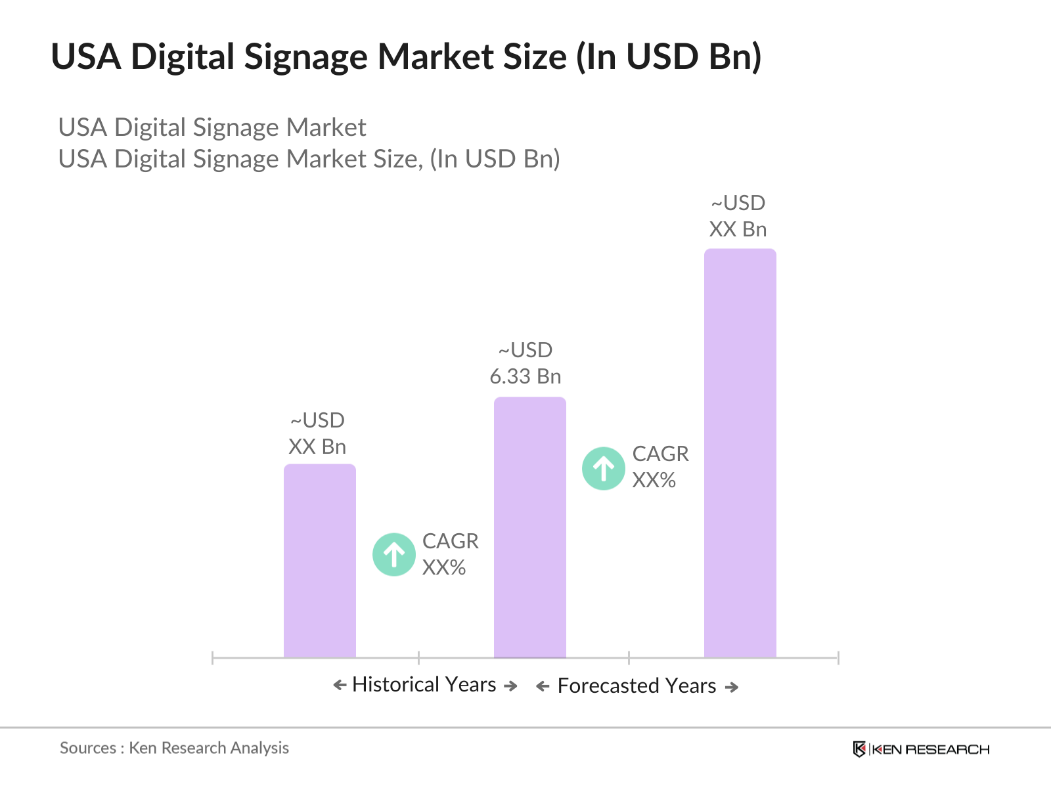
The USA Digital Signage Market is valued at USD 6.33 billion, driven by the increasing adoption of interactive displays and digital advertising solutions across retail and corporate sectors.
Challenges in USA Digital Signage market include high installation costs, technological obsolescence, and connectivity issues. The rapid pace of technology innovation also poses a challenge for companies trying to keep their systems updated.
Key players in USA Digital Signage market include Samsung Electronics, NEC Display Solutions, LG Electronics, Cisco Systems, and BrightSign. These companies dominate due to their technological innovations, extensive product offerings, and global reach.
The USA Digital Signage market is driven by the increasing demand for high-definition video walls and interactive displays, as well as the growing integration of AI and IoT technologies into digital signage solutions.

What makes us stand out is that our consultants follows Robust, Refine and Result (RRR) methodology. i.e. Robust for clear definitions, approaches and sanity checking, Refine for differentiating respondents facts and opinions and Result for presenting data with story

We have set a benchmark in the industry by offering our clients with syndicated and customized market research reports featuring coverage of entire market as well as meticulous research and analyst insights.

While we don't replace traditional research, we flip the method upside down. Our dual approach of Top Bottom & Bottom Top ensures quality deliverable by not just verifying company fundamentals but also looking at the sector and macroeconomic factors.

With one step in the future, our research team constantly tries to show you the bigger picture. We help with some of the tough questions you may encounter along the way: How is the industry positioned? Best marketing channel? KPI's of competitors? By aligning every element, we help maximize success.

Our report gives you instant access to the answers and sources that other companies might choose to hide. We elaborate each steps of research methodology we have used and showcase you the sample size to earn your trust.

If you need any support, we are here! We pride ourselves on universe strength, data quality, and quick, friendly, and professional service.