
USA Forklift Market Outlook to 2030
Region:United States
Author(s):Abhinav kumar
Product Code:KROD6668
Region:United States
Author(s):Abhinav kumar
Product Code:KROD6668
December 2024
88
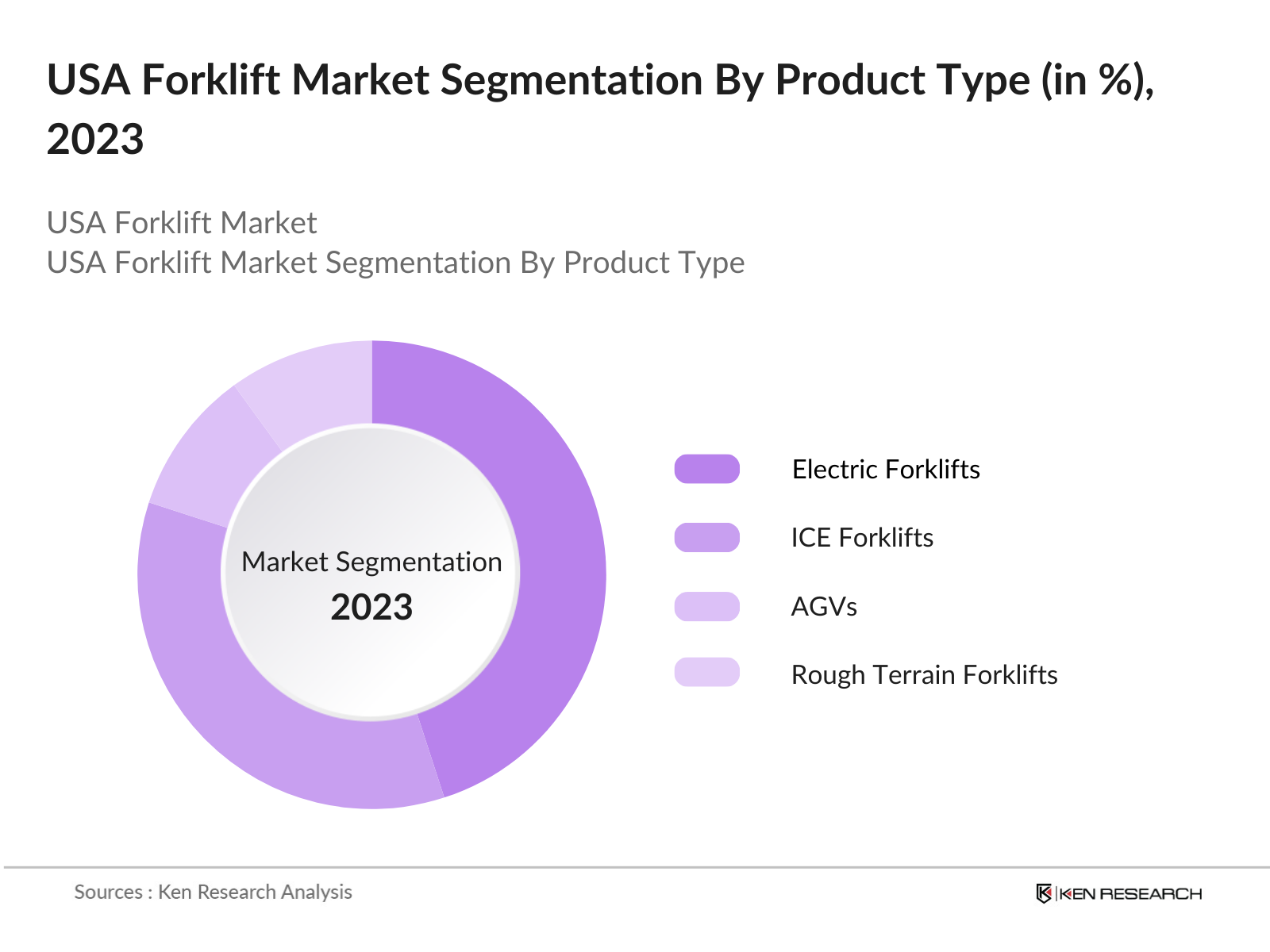
By Product Type: The USA forklift market is segmented by product type into electric forklifts, internal combustion engine (ICE) forklifts, automated guided vehicles (AGVs), and rough terrain forklifts. Recently, electric forklifts have been dominating the product type segment due to their growing demand in industries that prioritize environmental sustainability. The push for lower carbon emissions and government regulations regarding workplace safety and emissions have prompted businesses to adopt electric forklifts over traditional ICE forklifts. Moreover, advancements in battery technology have further enhanced their efficiency, making them a preferred choice for many industries.
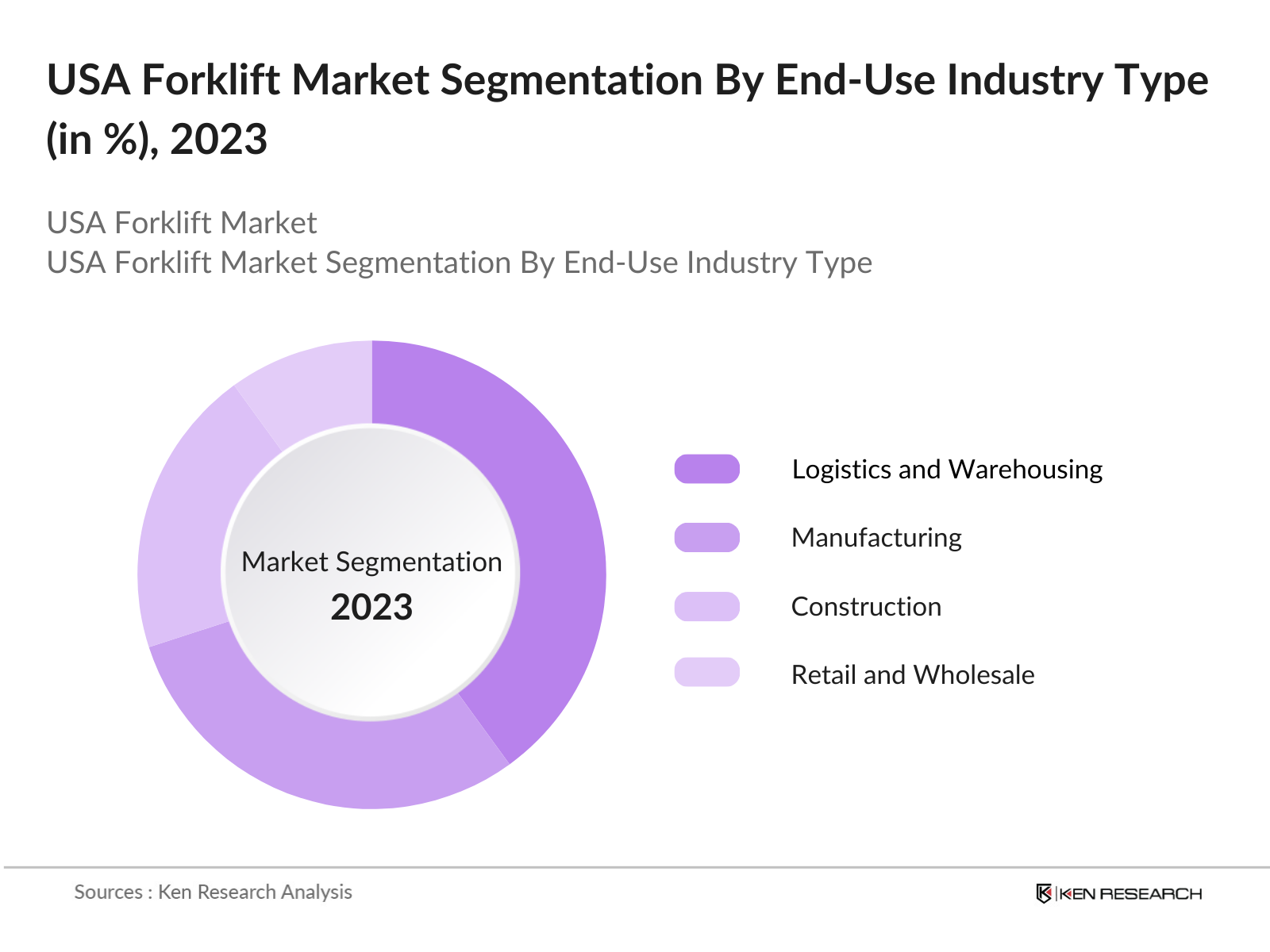
By End-Use Industry: The market is segmented by end-use industry into manufacturing, construction, retail and wholesale, and logistics and warehousing. Logistics and warehousing dominate this segmentation due to the significant expansion of e-commerce and the increasing need for efficient material handling systems. Companies like Amazon, Walmart, and other major logistics players have expanded their warehousing capabilities, necessitating a robust material handling infrastructure. The adoption of advanced forklift technologies in logistics hubs and distribution centers is further driving this segment’s growth.
The USA forklift market is dominated by a mix of global and local players, with key companies leveraging their expertise and technological innovations to maintain a strong presence. The competitive landscape is characterized by technological advancements, investments in electric forklift production, and increasing partnerships with logistics companies to enhance distribution capabilities. The introduction of autonomous forklifts by major companies is creating a shift in the competitive dynamics, making automation a key differentiator for many players.
|
Company Name |
Establishment Year |
Headquarters |
Product Range |
Technological Advancements |
Electric Forklift Portfolio |
Global Reach |
Revenue (USD Bn) |
Market Innovations |
Strategic Partnerships |
|
Toyota Industries Corporation |
1926 |
Kariya, Japan |
_ |
_ |
_ |
_ |
_ |
_ |
_ |
|
Crown Equipment Corporation |
1945 |
Ohio, USA |
_ |
_ |
_ |
_ |
_ |
_ |
_ |
|
Hyster-Yale Materials Handling |
1985 |
Ohio, USA |
_ |
_ |
_ |
_ |
_ |
_ |
_ |
|
Mitsubishi Logisnext Co., Ltd. |
1937 |
Tokyo, Japan |
_ |
_ |
_ |
_ |
_ |
_ |
_ |
|
Jungheinrich AG |
1953 |
Hamburg, Germany |
_ |
_ |
_ |
_ |
_ |
_ |
_ |
The USA forklift market is poised to grow significantly over the coming years, driven by increasing demand for automation in warehousing and material handling processes. As industries continue to prioritize efficiency and sustainability, the adoption of electric and autonomous forklifts is expected to rise. Additionally, government regulations favoring the use of eco-friendly machinery will further stimulate the market. Companies that continue to invest in research and development to enhance battery technologies and automation capabilities will likely lead the market in the future.
|
By Product Type |
Electric Forklifts ICE Forklifts AGVs Rough Terrain Forklifts |
|
By End-Use Industry |
Manufacturing, Construction Retail and Wholesale Logistics and Warehousing |
|
By Technology |
Manual Semi-Automated Fully Automated |
|
By Fuel Type |
Electric Diesel Gasoline/LP Gas |
|
By Region |
North East Midwest South West |
1.1. Definition and Scope
1.2. Market Taxonomy
1.3. Market Growth Rate
1.4. Market Segmentation Overview
2.1. Historical Market Size
2.2. Year-On-Year Growth Analysis
2.3. Key Market Developments and Milestones
3.1. Growth Drivers
3.1.1. E-commerce Boom
3.1.2. Manufacturing Sector Growth
3.1.3. Adoption of Automation in Warehousing
3.1.4. Infrastructure Developments
3.2. Market Challenges
3.2.1. High Equipment Costs
3.2.2. Lack of Skilled Operators
3.2.3. Stringent Emission Norms
3.3. Opportunities
3.3.1. Electrification of Forklifts
3.3.2. Government Subsidies for Clean Energy Equipment
3.3.3. Growth in Retail Distribution Networks
3.4. Trends
3.4.1. Increasing Demand for Autonomous Forklifts
3.4.2. Shift Toward Lithium-Ion Batteries
3.4.3. Focus on Compact and High-Capacity Forklifts
3.5. Government Regulations
3.5.1. OSHA Safety Standards
3.5.2. EPA Emission Guidelines for Diesel Forklifts
3.5.3. Federal Tax Incentives for Green Energy Forklifts
3.5.4. U.S. Infrastructure Modernization Act
3.6. SWOT Analysis
3.7. Stake Ecosystem (Suppliers, Distributors, OEMs)
3.8. Porter’s Five Forces
3.9. Competition Ecosystem
4.1. By Power Source (In Value %)
4.1.1. Electric Forklifts
4.1.2. Internal Combustion Forklifts
4.2. By Class Type (In Value %)
4.2.1. Class I - Electric Motor Rider Trucks
4.2.2. Class II - Electric Motor Narrow Aisle Trucks
4.2.3. Class III - Electric Hand Trucks
4.2.4. Class IV - Internal Combustion Engine Trucks (Cushion Tires)
4.2.5. Class V - Internal Combustion Engine Trucks (Pneumatic Tires)
4.3. By End-Use Industry (In Value %)
4.3.1. Warehousing & Logistics
4.3.2. Manufacturing
4.3.3. Retail & Wholesale Distribution
4.3.4. Construction
4.3.5. Food & Beverage
4.4. By Load Capacity (In Value %)
4.4.1. Below 5 Tons
4.4.2. 5 to 10 Tons
4.4.3. Above 10 Tons
4.5. By Region (In Value %)
4.5.1. North East
4.5.2. South
4.5.3. Mid-West
4.5.4. West
5.1. Detailed Profiles of Major Companies
5.1.1. Toyota Industries Corporation
5.1.2. KION Group AG
5.1.3. Mitsubishi Logisnext Co., Ltd.
5.1.4. Crown Equipment Corporation
5.1.5. Hyster-Yale Materials Handling, Inc.
5.1.6. Jungheinrich AG
5.1.7. Doosan Industrial Vehicle Co., Ltd.
5.1.8. CLARK Material Handling Company
5.1.9. Komatsu Ltd.
5.1.10. Hyundai Heavy Industries Co., Ltd.
5.1.11. Lonking Holdings Limited
5.1.12. Manitou BF
5.1.13. Hangcha Group Co., Ltd.
5.1.14. UniCarriers Americas Corporation
5.1.15. EP Equipment Co., Ltd.
5.2. Cross Comparison Parameters (No. of Employees, Headquarters, Inception Year, Revenue, Sales Volume, Forklift Production Capacity, Distribution Network Size, R&D Expenditure)
5.3. Market Share Analysis
5.4. Strategic Initiatives
5.5. Mergers And Acquisitions
5.6. Investment Analysis
5.6.1. Venture Capital Funding
5.6.2. Government Grants
5.6.3. Private Equity Investments
6.1. Safety and Emission Standards
6.2. Certification Processes
6.3. Environmental Regulations
7.1. Future Market Size Projections
7.2. Key Factors Driving Future Market Growth
8.1. By Power Source (In Value %)
8.2. By Class Type (In Value %)
8.3. By End-Use Industry (In Value %)
8.4. By Load Capacity (In Value %)
8.5. By Region (In Value %)
9.1. TAM/SAM/SOM Analysis
9.2. Customer Cohort Analysis
9.3. Marketing Initiatives
9.4. White Space Opportunity Analysis
In the initial phase, we conducted a comprehensive mapping of the key stakeholders in the USA Forklift Market. Our research was based on secondary data sources like industry reports, government publications, and proprietary databases. This step enabled us to identify the major factors influencing market growth, including technological advancements and regulatory changes.
This phase involved collecting historical market data on forklift adoption, market penetration, and revenue generation in various segments. We analyzed the impact of logistics expansion and e-commerce growth on the market's development. The historical data were validated using reliable secondary sources to ensure accurate market insights.
We formulated hypotheses regarding market growth and dynamics, which were subsequently validated through interviews with industry experts. These consultations provided us with real-time operational insights and helped refine our understanding of market trends and challenges.
Finally, we synthesized all data collected from industry players, market analysts, and secondary sources. This synthesis was conducted using a bottom-up approach, with a focus on validating market size and segmentation. Our research output provides a detailed and accurate assessment of the USA forklift market.
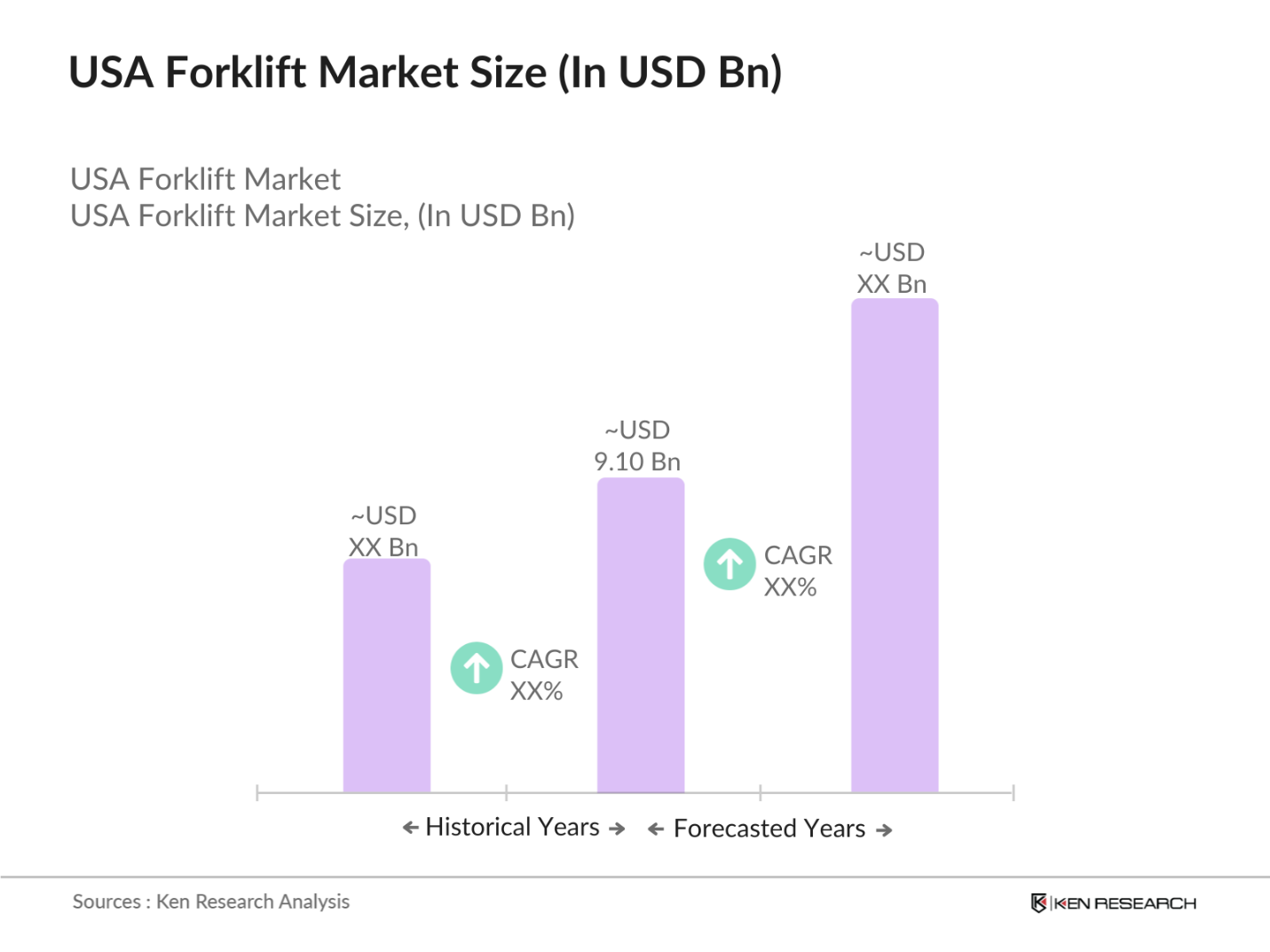
The USA forklift market is valued at USD 9.10 billion, driven by the expansion of logistics, e-commerce, and manufacturing sectors.
Challenges include high initial capital investments, safety regulations, and the shortage of skilled operators. Additionally, evolving environmental standards require companies to shift to electric forklifts.
Key players include Toyota Industries Corporation, Crown Equipment Corporation, Jungheinrich AG, Hyster-Yale Materials Handling, and Mitsubishi Logisnext Co., Ltd.
The market is propelled by the increasing need for automation in warehouses, the rise of e-commerce, and the adoption of eco-friendly electric forklifts.
Key trends include the growing adoption of electric forklifts, the development of autonomous forklifts, and the integration of IoT and fleet management systems.
TABLES

What makes us stand out is that our consultants follows Robust, Refine and Result (RRR) methodology. i.e. Robust for clear definitions, approaches and sanity checking, Refine for differentiating respondents facts and opinions and Result for presenting data with story

We have set a benchmark in the industry by offering our clients with syndicated and customized market research reports featuring coverage of entire market as well as meticulous research and analyst insights.

While we don't replace traditional research, we flip the method upside down. Our dual approach of Top Bottom & Bottom Top ensures quality deliverable by not just verifying company fundamentals but also looking at the sector and macroeconomic factors.

With one step in the future, our research team constantly tries to show you the bigger picture. We help with some of the tough questions you may encounter along the way: How is the industry positioned? Best marketing channel? KPI's of competitors? By aligning every element, we help maximize success.

Our report gives you instant access to the answers and sources that other companies might choose to hide. We elaborate each steps of research methodology we have used and showcase you the sample size to earn your trust.

If you need any support, we are here! We pride ourselves on universe strength, data quality, and quick, friendly, and professional service.