
USA Gesture Recognition Market Outlook to 2030
Region:North America
Author(s):Vijay Kumar
Product Code:KROD10236
November 2024
83
About the Report
USA Gesture Recognition Market Overview
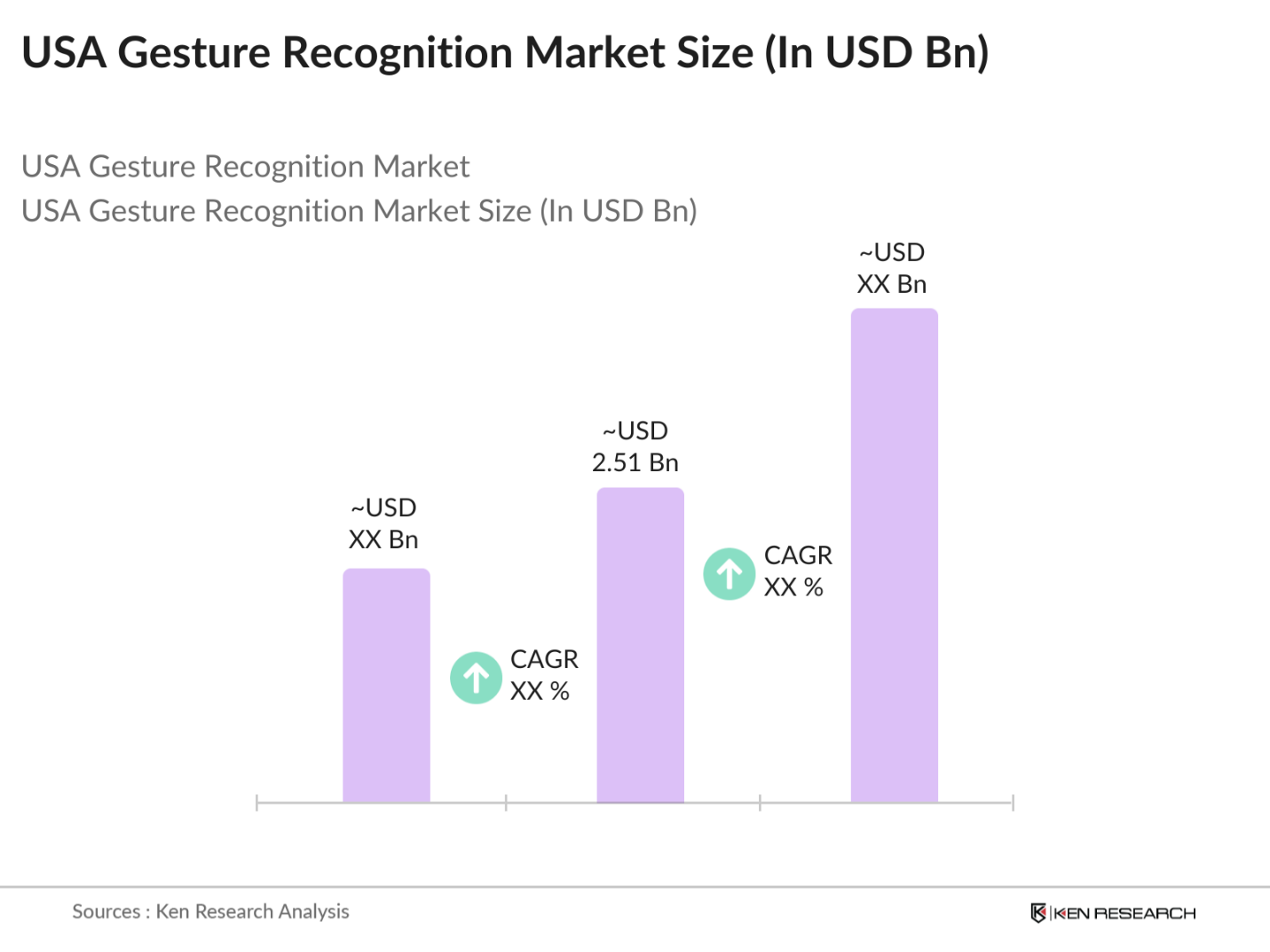
- The USA Gesture Recognition market is valued at USD 2.51 billion, based on a five-year historical analysis. This market's expansion is driven by the rise of touchless interfaces, AI integration, and advancements in sensor technologies, particularly benefiting healthcare, consumer electronics, and automotive industries. Gesture recognitions ability to provide seamless interaction and enhanced user experiences, especially in applications such as patient monitoring and automotive infotainment systems, is accelerating its adoption in both personal and industrial devices
- The market is primarily dominated by metropolitan hubs and tech-driven states like California and New York. California's dominance can be attributed to its thriving tech ecosystem, which includes major industry players, high R&D investment, and proximity to Silicon Valleys innovations. New York, as a commercial and financial center, has witnessed adoption across retail and healthcare, while regions like Texas are seeing increased interest in automotive applications due to local manufacturing capabilities and demand for advanced driver-assistance systems (ADAS).
- Strict USA regulations govern technology trade and compliance, affecting the export and development of gesture-based technologies. Compliance with these regulations is critical, as they influence the feasibility and cost of deployment in international markets, impacting both product development and export strategies.
USA Gesture Recognition Market Segmentation
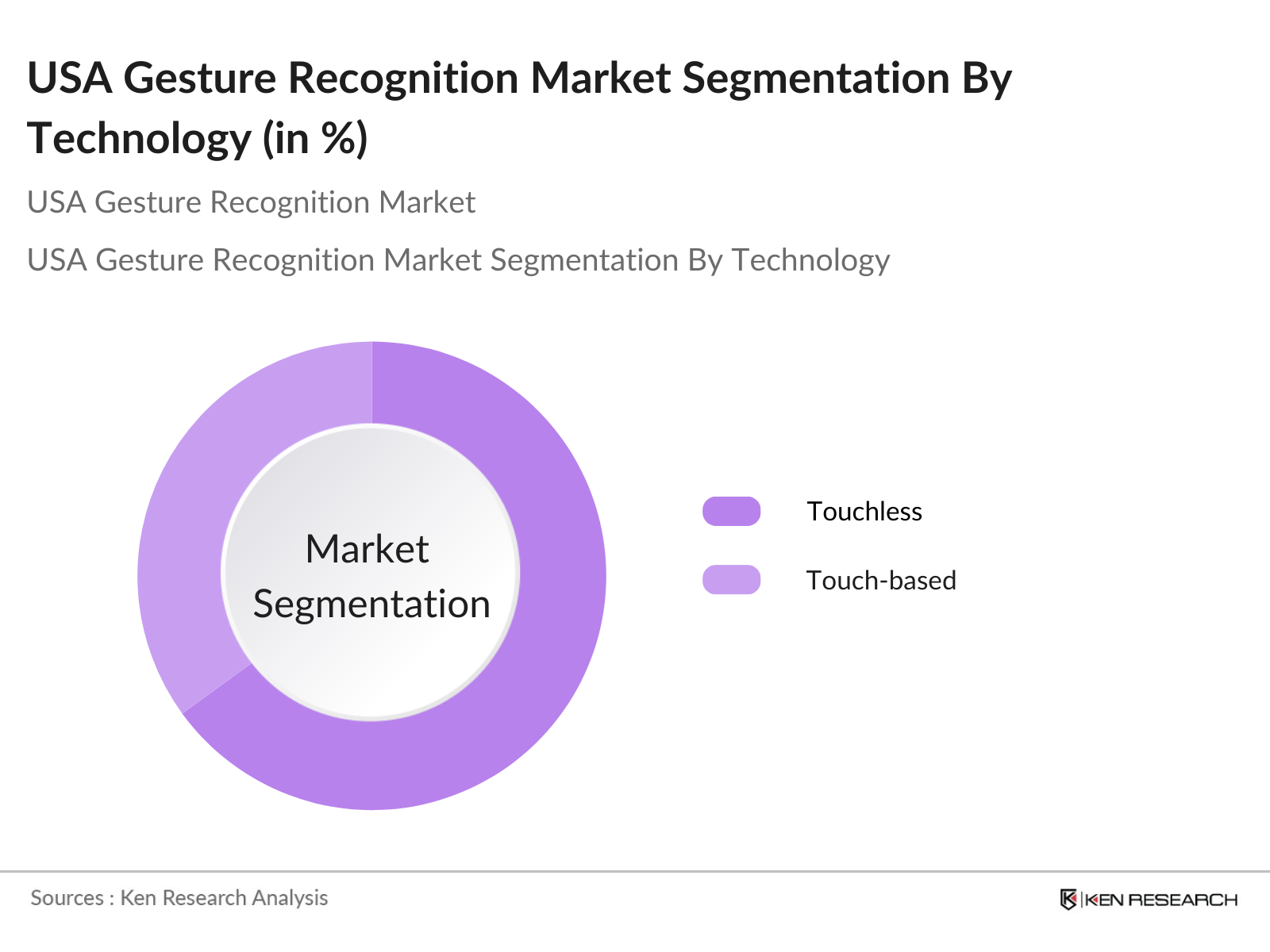
By Technology: The market is segmented by technology into touch-based and touchless systems. Touchless systems dominate due to their ability to provide a hygienic, hands-free experience, crucial in the healthcare and automotive sectors. Hospitals increasingly prefer touchless interfaces for patient care, while automotive companies integrate these systems for safer, distraction-free navigation controls. Touchless interfaces use infrared, capacitive, and ultrasonic sensors, making them ideal for environments prioritizing sanitation and user convenience.
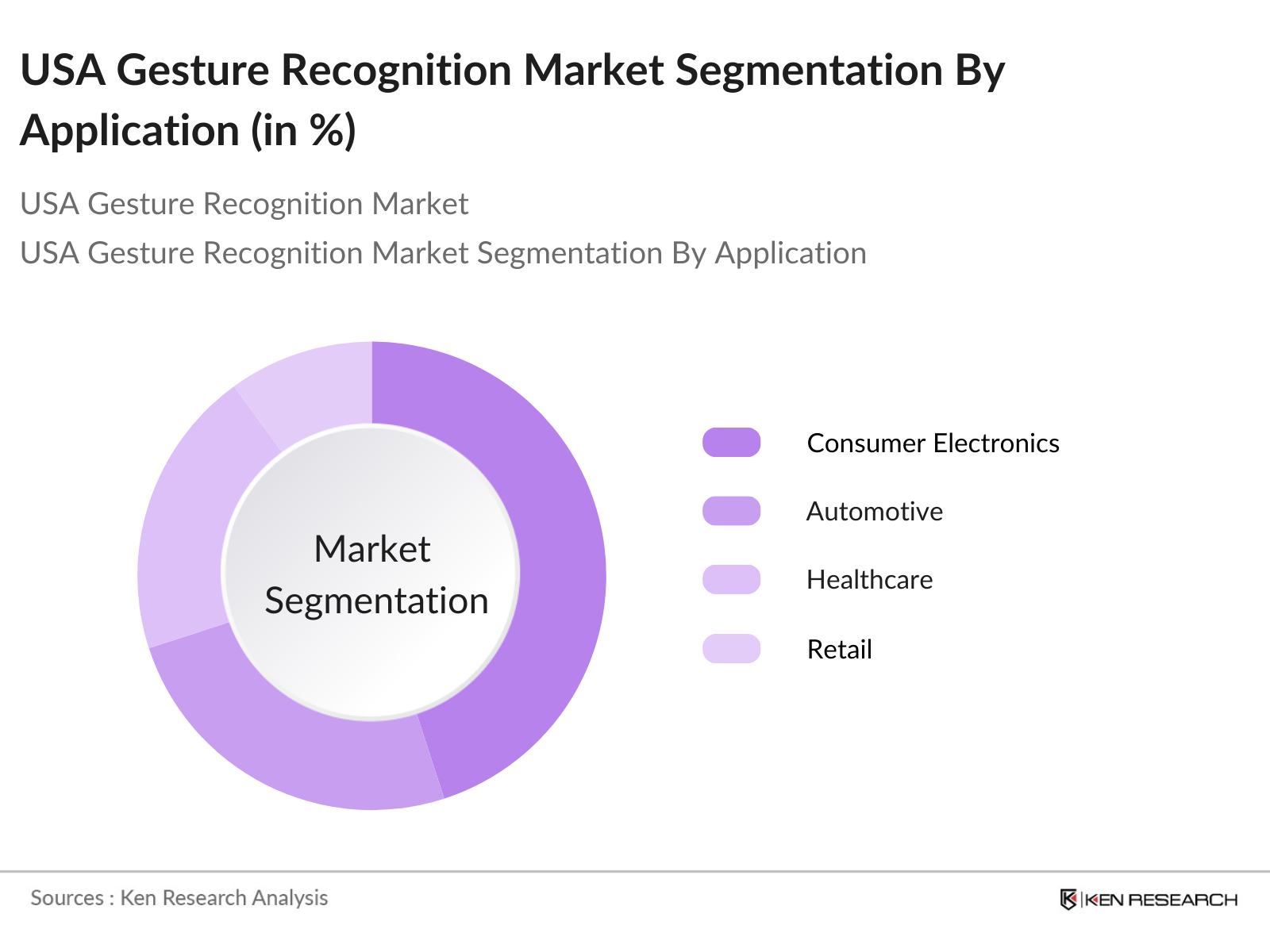
By Application: The market divides by application into automotive, healthcare, consumer electronics, retail, and IT/telecom. Consumer electronics is the most prominent segment due to high demand for smart devices with touchless interaction. Smartphones, laptops, and gaming consoles increasingly feature gesture recognition for an immersive experience. For instance, facial and gesture recognition in smartphones have become commonplace, enhancing security and functionality while meeting consumer preferences for touchless interactions.
USA Gesture Recognition Market Competitive Landscape
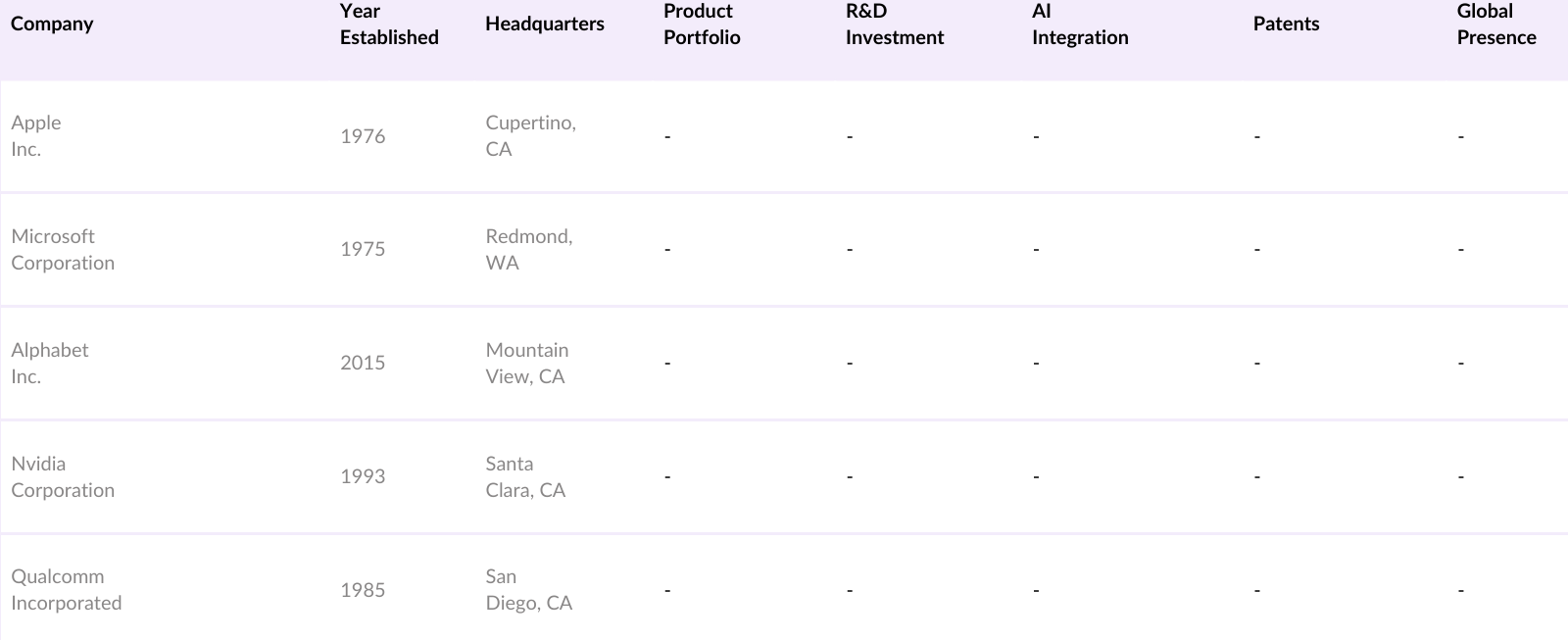
The USA gesture recognition market is dominated by major technology companies, each advancing proprietary gesture control systems. Apple, Microsoft, and Google have all integrated gesture recognition into their products, capitalizing on their vast user bases and R&D resources. This consolidation underscores the influence of these key companies, particularly as they expand into augmented reality (AR) and virtual reality (VR) applications.
USA Gesture Recognition Industry Analysis
Growth Drivers
- Technological Advancements in Sensor & Imaging: Technological improvements in sensor and imaging have accelerated globally, driven by increased investment in digital infrastructure. By 2023, the top six economies accounted for 70% of global IT value, and digital services job growth was six times the rate of overall economic growth, highlighting the demand for advanced sensor technology in sectors from healthcare to smart devices. Furthermore, East Asia led in business digitalization, with 54% of firms using digital solutions, up from 13% in 2020, illustrating the essential role of imaging and sensor technology to bridge efficiency gaps in various sectors.
- Increasing Demand for Touchless Interaction: Touchless technology adoption surged post-2020 due to hygiene and convenience preferences. WHO highlighted that infection control awareness is now embedded in health and public service sectors globally, leading to a steady rise in contactless interaction technologies across markets. An estimated 80% of firms in emerging economies expanded digital solutions from 2021 to 2023, reflecting the focus on convenience and hygiene, especially in high-contact areas like transportation and retail, where touchless payment and interaction became the norm.
- Integration with AI and Machine Learning: With AI-driven capabilities improving gesture interpretation, AI integration in user interfaces has surged. In 2024, AI technologies accounted for 22% of total automation, driven largely by machine learning advancements. For instance, AI-enabled applications in healthcare improved gesture-based diagnosis accuracy in low-resource settings, creating robust demand for these technologies. AI investment in digital health alone rose by over $500 million since 2020, emphasizing the importance of AI in gesture-driven fields.
Market Challenges
- High Implementation Costs: Implementing gesture-based technology remains capital-intensive, particularly in developing economies, where digital infrastructure costs can be prohibitive. For example, the World Bank reports that digital investments often comprise up to 15% of total ICT budgets in low-income countries, constraining potential adoption. High costs are a barrier to entry, especially in public sector projects where budget constraints are significant.
- Technical Barriers in Gesture Accuracy: Gesture-based technologies face accuracy limitations, especially in diverse or non-standardized environments. Studies reveal that gesture calibration issues reduce reliability, which impedes broader application in sectors requiring high precision, such as healthcare. This limitation is critical, as WHO and World Bank data suggest digital errors in health technologies can impact user adoption due to safety concerns.
USA Gesture Recognition Market Future Outlook
Over the next five years, the USA gesture recognition market is expected to experience significant growth as new applications emerge across various industries. Consumer demand for touchless technology, especially within healthcare and automotive sectors, combined with continuous AI integration, will drive advancements. In the consumer electronics sector, innovations in AR and VR will further fuel demand for gesture-based controls, setting the stage for widespread adoption across devices.
Market Opportunities
- Growth in Automotive and Healthcare Applications: Healthcare and automotive sectors are rapidly adopting gesture technology, especially for patient management and in-car interfaces. According to the WHO, digital health solutions increased twofold since 2020, highlighting demand in interactive care management. Automotive systems integrating gesture control are also on the rise, with several high-end vehicle models now including hands-free interfaces.
- Potential in Smart Home and Consumer Electronics: Consumer electronics and smart home markets represent significant opportunities for gesture-based technology. Smart homes alone saw 25% of consumer electronics investments in 2023, indicating a strong alignment with user demand for touchless interaction within these environments. Integration in home automation has streamlined control for users, creating opportunities for product expansion.
Scope of the Report
|
Technology |
Touch-based Touchless AI & Deep Learning |
|
Application |
Automotive Healthcare Consumer Electronics Retail IT/Telecom |
|
Authentication Type |
Single-Factor Multi-Factor |
|
End-User |
Government & Defense Commercial Residential |
|
Region |
North America (USA focus) |
Products
Key Target Audience
Consumer Electronics Manufacturers
Automotive OEMs
Healthcare Device Manufacturers
Smart Home Device Developers
Investments and Venture Capitalist Firms
Government and Regulatory Bodies (FDA, FCC)
Retailers and In-Store Display Innovators
Defense and Security Technology Developers
Companies
Players Mentioned in the Report
Apple Inc.
Alphabet Inc.
Microsoft Corporation
Intel Corporation
Nvidia Corporation
Qualcomm Incorporated
Microchip Technology Incorporated
OmniVision Technologies
Sony Corporation
eyeSight Technologies Ltd.
Table of Contents
1. Market Overview
1.1 Definition and Scope
1.2 Market Taxonomy
1.3 Market Growth Rate
1.4 Market Segmentation Overview
2. USA Gesture Recognition Market Size (In USD Billion)
2.1 Historical Market Size
2.2 Year-on-Year Growth Analysis
2.3 Key Market Milestones
3. Market Analysis
3.1 Growth Drivers
3.1.1 Technological Advancements in Sensor & Imaging (sensors, image recognition)
3.1.2 Increasing Demand for Touchless Interaction (hygiene and convenience)
3.1.3 Integration with AI and Machine Learning (AI-driven gesture interpretation)
3.1.4 Expansion of AR/VR and Smart Devices (real-time response requirements)
3.2 Market Challenges
3.2.1 High Implementation Costs (cost implications)
3.2.2 Technical Barriers in Gesture Accuracy (gesture calibration)
3.2.3 Privacy and Security Concerns (data security and consent)
3.2.4 Compatibility with Existing Systems (infrastructure compatibility)
3.3 Opportunities
3.3.1 Growth in Automotive and Healthcare Applications
3.3.2 Potential in Smart Home and Consumer Electronics
3.3.3 Rise of Multi-modal Interaction (gesture, voice, haptics)
3.4 Key Trends
3.4.1 Increasing Use of Biometric-based Recognition (face, iris)
3.4.2 AR/VR Gesture Integration in Gaming and Wearables
3.4.3 Gesture-based User Interfaces in Smart Infrastructure
3.5 Regulatory Landscape
3.5.1 USA Technology Trade and Compliance Regulations
3.5.2 Cybersecurity Guidelines for Gesture Devices
3.5.3 Data Privacy Standards and Impact on Gesture Recognition
3.6 SWOT Analysis
3.7 Stakeholder Ecosystem
3.8 Porters Five Forces Analysis
3.9 Competitive Landscape Analysis
4. Market Segmentation
4.1 By Technology
4.1.1 Touch-based Gesture Recognition
4.1.2 Touchless Gesture Recognition (IR, capacitive sensing, ultrasonic)
4.1.3 AI and Deep Learning-Enabled Gesture Systems
4.2 By Application
4.2.1 Automotive (driver monitoring, infotainment control)
4.2.2 Healthcare (patient monitoring, diagnostics)
4.2.3 Consumer Electronics (smartphones, gaming consoles)
4.2.4 Retail (interactive displays, virtual fitting rooms)
4.2.5 IT/Telecom (access control, authentication)
4.3 By Authentication Type
4.3.1 Single-Factor Authentication
4.3.2 Multi-Factor Authentication
4.4 By End-User
4.4.1 Government & Defense
4.4.2 Commercial Enterprises
4.4.3 Residential Consumers
4.5 By Region
4.5.1 North America (regional market concentration)
5. Competitive Analysis
5.1 Major Companies in the Market
5.1.1 Apple Inc.
5.1.2 Alphabet Inc.
5.1.3 Intel Corporation
5.1.4 Microsoft Corporation
5.1.5 Qualcomm Incorporated
5.1.6 Nvidia Corporation
5.1.7 Microchip Technology Incorporated
5.1.8 OmniVision Technologies
5.1.9 eyeSight Technologies Ltd.
5.1.10 Infineon Technologies AG
5.1.11 Sony Corporation
5.1.12 Elliptic Labs ASA
5.1.13 GestureTek Technologies
5.1.14 Cognitec Systems GmbH
5.1.15 Ultraleap
5.2 Cross-Comparison Parameters (Employee Count, Product Portfolio, Market Share, Revenue, Geographical Presence, Technology Adoption, Innovation Quotient, Market Entry Timing)
5.3 Market Share Analysis
5.4 Strategic Initiatives and Partnerships
5.5 Mergers & Acquisitions
5.6 R&D and Investment Analysis
5.7 Venture Capital and Private Equity Impact
6. Regulatory Framework
6.1 Standards for Biometric Data Security
6.2 Privacy Compliance and Gesture Recognition
6.3 Compliance with Federal & State Technology Laws
7. Future Market Size (USD Billion)
7.1 Growth Drivers and Projections
8. Future Market Segmentation
8.1 By Technology (growth analysis per segment)
8.2 By Application (future market trends)
8.3 By Authentication Type
8.4 By End-User
8.5 By Region (regional growth predictions)
9. Market Analyst Recommendations
9.1 TAM/SAM/SOM Analysis
9.2 Consumer Behavior Insights
9.3 Suggested Investment Areas
9.4 Unexplored Niche Markets
Disclaimer Contact UsResearch Methodology
Step 1: Identification of Key Variables
This step involves building an ecosystem map of all stakeholders in the USA gesture recognition market. Utilizing secondary databases and extensive desk research, critical variables influencing market dynamics are identified and defined.
Step 2: Market Analysis and Construction
Here, historical data is collected and analyzed to assess market penetration and the impact of consumer and industrial demand on revenue generation. Service quality statistics are evaluated to ensure reliability in revenue estimates.
Step 3: Hypothesis Validation and Expert Consultation
Hypotheses are developed and validated through structured interviews with industry experts across various companies. These consultations provide essential insights to refine the data and strengthen the accuracy of market estimates.
Step 4: Research Synthesis and Final Output
The final step entails direct engagement with manufacturers to obtain detailed insights into product segments, consumer trends, and market dynamics. This information verifies and complements statistics, ensuring an accurate and comprehensive market analysis.
Frequently Asked Questions
1. How big is the USA Gesture Recognition Market?
The USA Gesture Recognition market is valued at USD 2.51 billion, based on a five-year historical analysis. This market's expansion is driven by the rise of touchless interfaces, AI integration, and advancements in sensor technologies, particularly benefiting healthcare, consumer electronics, and automotive industries.
2. What are the main challenges in the USA Gesture Recognition Market?
The market faces challenges including high implementation costs, technical difficulties in achieving accuracy, and privacy concerns related to data security.
3. Who are the major players in the USA Gesture Recognition Market?
Key players include Apple Inc., Microsoft Corporation, Alphabet Inc., Nvidia Corporation, and Qualcomm Incorporated, who leverage strong R&D capabilities and extensive product portfolios.
4. What drives the USA Gesture Recognition Market?
Growth is driven by advancements in AI, rising consumer demand for touchless interfaces, and applications across diverse industries, including automotive and healthcare.
Why Buy From Us?

What makes us stand out is that our consultants follows Robust, Refine and Result (RRR) methodology. i.e. Robust for clear definitions, approaches and sanity checking, Refine for differentiating respondents facts and opinions and Result for presenting data with story

We have set a benchmark in the industry by offering our clients with syndicated and customized market research reports featuring coverage of entire market as well as meticulous research and analyst insights.

While we don't replace traditional research, we flip the method upside down. Our dual approach of Top Bottom & Bottom Top ensures quality deliverable by not just verifying company fundamentals but also looking at the sector and macroeconomic factors.

With one step in the future, our research team constantly tries to show you the bigger picture. We help with some of the tough questions you may encounter along the way: How is the industry positioned? Best marketing channel? KPI's of competitors? By aligning every element, we help maximize success.

Our report gives you instant access to the answers and sources that other companies might choose to hide. We elaborate each steps of research methodology we have used and showcase you the sample size to earn your trust.

If you need any support, we are here! We pride ourselves on universe strength, data quality, and quick, friendly, and professional service.