















USA Healthcare Companion Robot Market Outlook to 2030
Region:North America
Author(s):Shreya Garg
Product Code:KROD9904
December 2024
90
About the Report
USA Healthcare Companion Robot Market Overview
- The USA healthcare companion robot market is valued at USD 302 million, driven by a combination of factors including the growing elderly population, technological advancements in robotics, and increasing demand for home healthcare solutions. Healthcare robotics offer companionship and assistance to patients, helping reduce the strain on caregivers and improving patient outcomes. This has contributed significantly to the growth of the market, especially in areas where healthcare labor shortages persist.
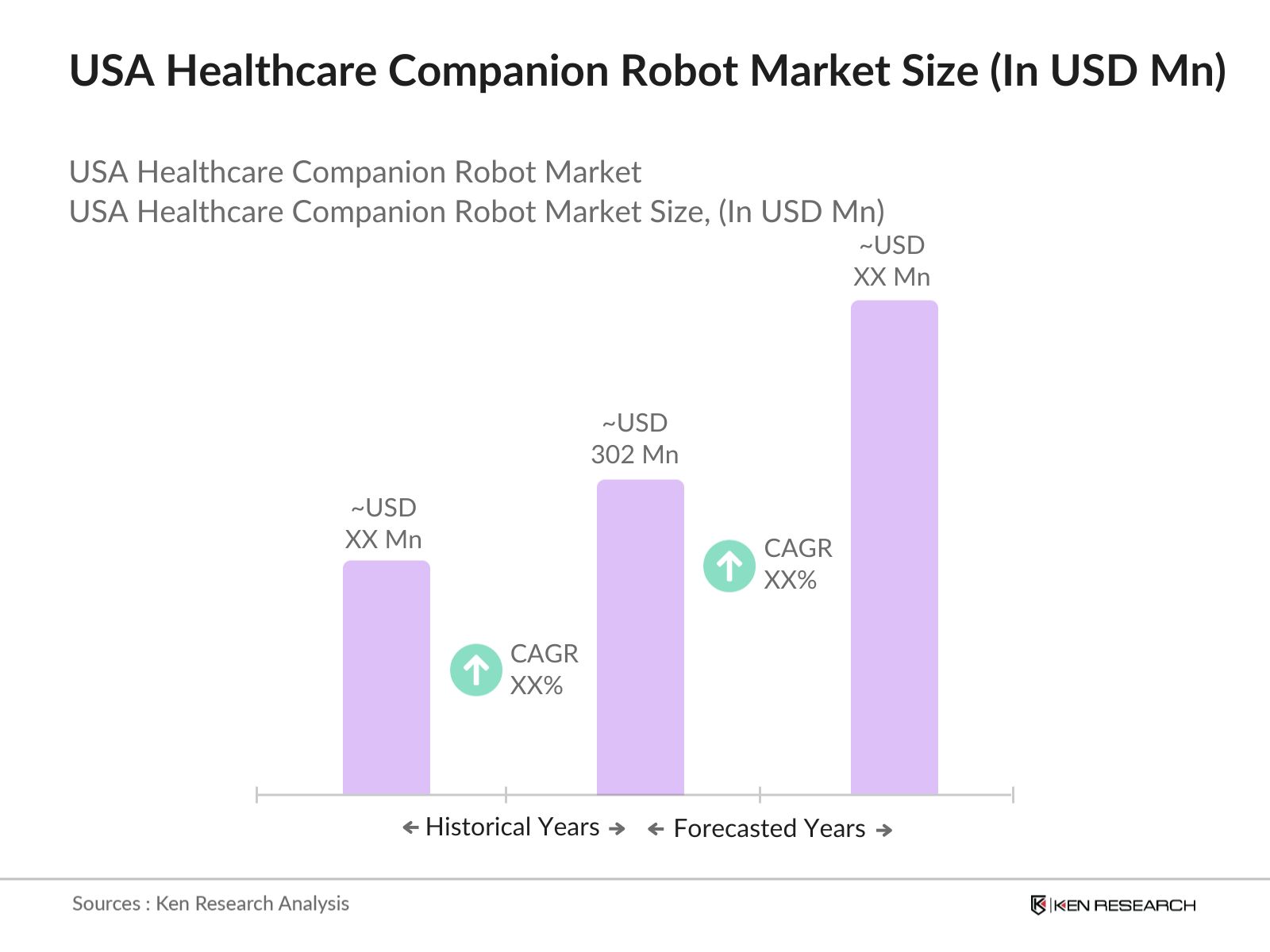
- Dominant regions in the USA, such as California and New York, lead in the adoption of healthcare companion robots due to their advanced healthcare infrastructure and concentration of high-tech companies. These states have the resources, facilities, and technological ecosystems to support the integration of robotics in healthcare settings. Additionally, regions like Texas and Florida also dominate, driven by their large elderly populations and focus on home healthcare services.
- As of 2023, the U.S. Food and Drug Administration (FDA) had approved several AI-driven healthcare devices, setting a precedent for the approval of healthcare companion robots. The FDA's regulatory framework ensures that these robots meet safety and efficacy standards before being deployed in healthcare settings. As more healthcare robots enter the market, FDA approvals will play a crucial role in ensuring their safe integration into hospitals and homes. In 2024, regulations are expected to focus on ensuring that AI and robotics used in healthcare comply with data privacy, safety, and patient care standards.
USA Healthcare Companion Robot Market Segmentation
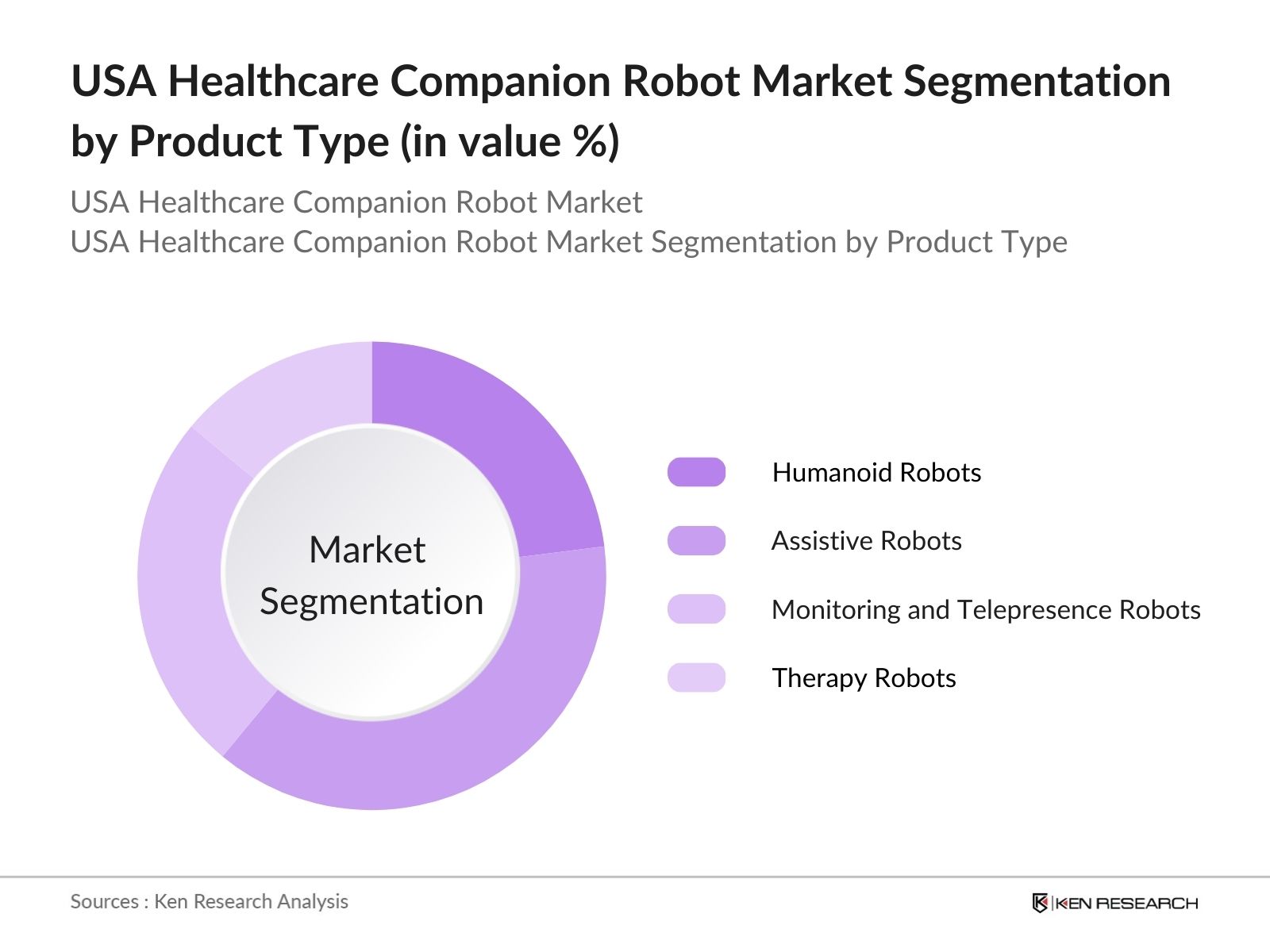
By Product Type: The market is segmented by product type into humanoid robots, assistive robots, monitoring and telepresence robots, and therapy robots. Among these, assistive robots hold a dominant market share. The reason for this dominance lies in their widespread use in home care and assisted living facilities. These robots assist in tasks like medication management, mobility assistance, and monitoring, which are crucial for the growing elderly population. They help reduce caregiver burnout and improve patient autonomy, making them an attractive option for healthcare providers.
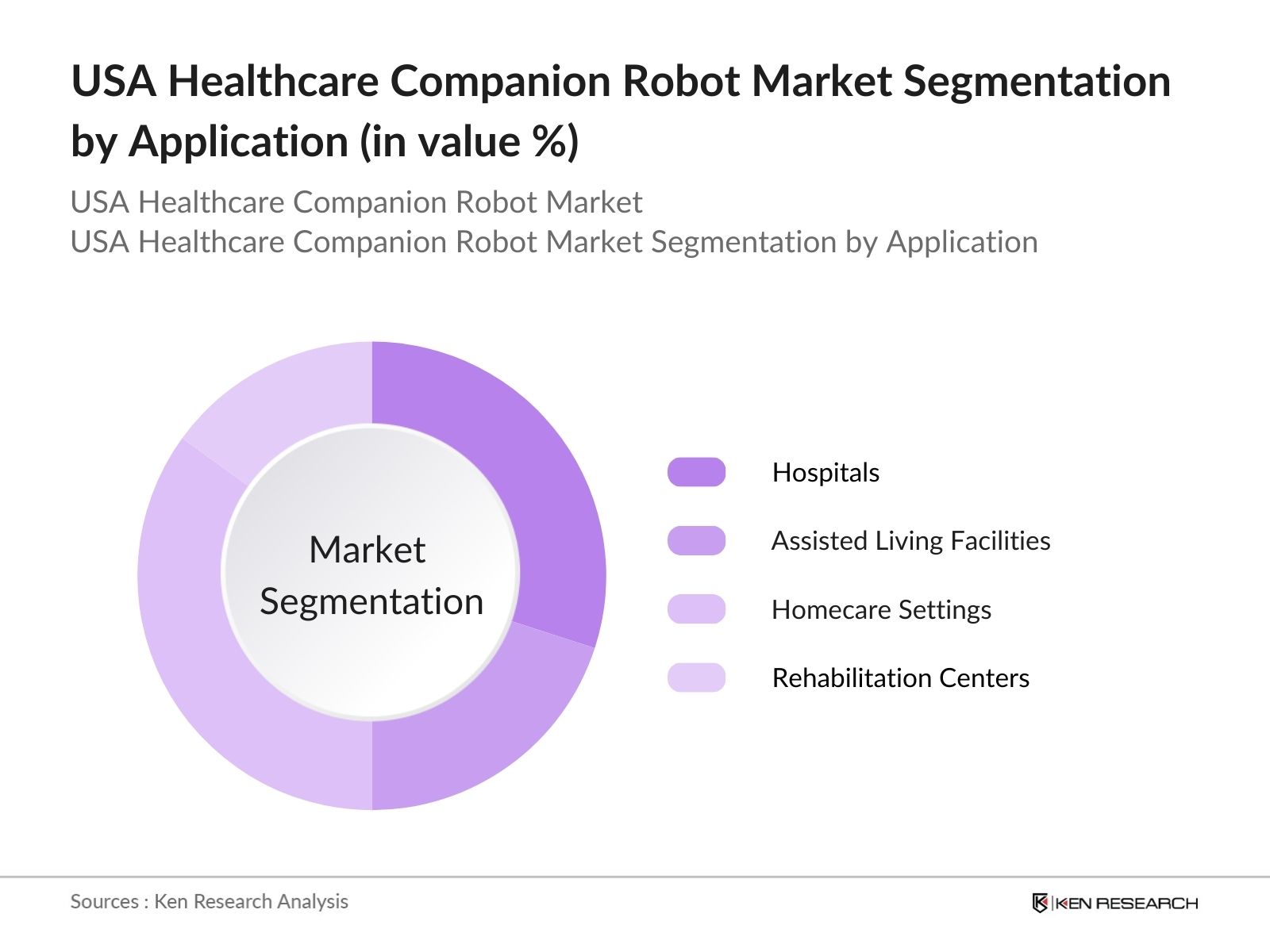
By Application: The market is further segmented by application into hospitals, assisted living facilities, homecare settings, and rehabilitation centers. The homecare settings segment dominates this category. This is primarily driven by the growing preference for in-home care solutions, especially for elderly patients who require continuous monitoring and assistance. Healthcare companion robots have made homecare more accessible and affordable, reducing the need for constant human caregiving and enabling patients to live independently.
USA Healthcare Companion Robot Market Competitive Landscape
The USA healthcare companion robot market is characterized by the presence of both established multinational corporations and innovative startups. Major players focus on developing AI-integrated robots that offer advanced functionalities such as voice recognition, facial recognition, and personalized patient care. Strategic collaborations between healthcare providers and tech companies are prevalent, allowing for the integration of robotic systems into existing healthcare infrastructure.
|
Company |
Establishment Year |
Headquarters |
Number of Patents |
Key Product |
Revenue (USD Mn) |
R&D Investment |
Geographical Reach |
Strategic Partnerships |
Product Innovations |
|
Intuition Robotics |
2016 |
Ramat Gan, Israel |
|||||||
|
SoftBank Robotics |
2014 |
Tokyo, Japan |
|||||||
|
Hanson Robotics |
2013 |
Hong Kong, China |
|||||||
|
Diligent Robotics |
2017 |
Austin, Texas, USA |
|||||||
|
Toyota Motor Corporation |
1937 |
Aichi, Japan |
USA Healthcare Companion Robot Industry Analysis
Growth Drivers
- Aging Population: The United States is experiencing a rapidly aging population, with over 56 million people aged 65 and older in 2023. This demographic shift increases healthcare demand, particularly in areas like home care and assisted living, which are crucial for elderly individuals who require constant monitoring and support. As life expectancy continues to rise, projected at 79 years in 2024, healthcare companion robots offer an effective solution for addressing the needs of aging individuals by providing assistance, monitoring, and companionship in home settings.
- Increasing Adoption of AI and Robotics in Healthcare: The integration of AI and robotics in healthcare is growing, driven by their potential to improve efficiency in patient care. By 2023, nearly 3 million healthcare robots were deployed globally, automating tasks like monitoring, data collection, and physical assistance. In the U.S., the demand for AI-driven healthcare solutions has increased due to the shortage of healthcare professionals. AI-enabled healthcare companion robots can operate continuously, providing round-the-clock assistance and reducing the workload on human caregivers. As AI capabilities advance, such robots are becoming essential in hospitals and home care environments.
- Rising Need for Home Healthcare Solutions: The U.S. home healthcare market is expanding, with over 12 million people receiving home care services annually. Rising healthcare costs and the preference for home-based care have driven demand for solutions that enhance patient monitoring and support in home settings. By 2024, it is estimated that the number of households using remote patient monitoring technologies will exceed 50 million. Healthcare companion robots, which can assist with tasks such as medication reminders and mobility support, play a pivotal role in addressing the needs of patients who prefer receiving care in their homes.
Market Challenges
- High Initial Costs: The development and deployment of healthcare companion robots require substantial investment. In 2023, the average cost of developing advanced robotic systems for healthcare was around $100,000 per unit, reflecting the high price of AI integration, sensor technology, and robotics hardware. This has posed a challenge for widespread adoption, particularly for smaller healthcare providers and home care users. Additionally, the cost of maintenance and software updates adds to the long-term expenses, making healthcare companion robots a costly solution, particularly in the absence of standardized reimbursement mechanisms.
- Lack of Standardization in Healthcare Robotics: The healthcare robotics industry faces a lack of standardized regulations and certification processes, particularly in the U.S., where different states may have varying guidelines. As of 2023, the U.S. did not have comprehensive federal standards governing the use of AI and robotics in healthcare, creating inconsistencies in their adoption and implementation across the country. This lack of standardization hinders the widespread deployment of healthcare robots, as healthcare providers and manufacturers navigate varying regulatory requirements and certification issues, leading to delayed integration into mainstream healthcare systems.
USA Healthcare Companion Robot Market Future Outlook
The USA healthcare companion robot market is expected to witness significant growth in the coming years, driven by a surge in demand for home healthcare, particularly for the elderly and disabled populations. Innovations in AI and machine learning will further enhance the capabilities of companion robots, enabling them to offer more personalized care and interact naturally with patients. The integration of these robots in telehealth services and virtual care platforms will play a crucial role in expanding their market presence, especially as healthcare providers continue to adopt technology-driven solutions to meet patient demands.
Future Market Opportunities
- Expansion into Telehealth and Virtual Care: The U.S. telehealth market saw a substantial rise in adoption, with over 52 million virtual visits recorded in 2023. Healthcare companion robots, equipped with telemedicine functionalities, can act as intermediaries between patients and healthcare professionals, enabling real-time communication and monitoring. This presents a lucrative opportunity for the expansion of robotic care into virtual healthcare settings, particularly as demand for telehealth solutions continues to grow. By integrating with telemedicine platforms, these robots can enhance patient access to healthcare services, especially in remote or underserved areas.
- Collaborations with Hospitals and Care Facilities: In 2023, over 7,000 hospitals in the U.S. were actively exploring partnerships with AI and robotics companies to enhance their patient care services. Healthcare companion robots provide hospitals and care facilities with an innovative solution for improving patient care, reducing the strain on human staff, and lowering operational costs. Collaborations between hospitals and robotics companies are paving the way for greater integration of robotic assistants into clinical settings, offering potential growth opportunities for robot manufacturers as they expand their presence in healthcare institutions.
Scope of the Report
|
By Product Type |
Humanoid Robots Assistive Robots Monitoring and Telepresence Robots Therapy Robots |
|
By Application |
Hospitals Assisted Living Facilities Homecare Setting Rehabilitation Centers |
|
By Technology |
AI and Machine Learning Computer Vision and Speech Recognition Sensor Technologies |
|
By End User |
Elderly Care Disabled Care Post-Operative Care |
|
By Region |
Northeast Midwest South West |
Products
Key Target Audience
Investors and Venture Capitalist Firms
Government and Regulatory Bodies (FDA, Medicare)
Elderly Care Facilities
Assisted Living Facility Operators
Home Healthcare Providers
Robotics Technology Providers
Hospitals and Rehabilitation Centers
Telehealth and Virtual Care Providers
Companies
Major Players
Intuition Robotics
SoftBank Robotics
Hanson Robotics
Diligent Robotics
Toyota Motor Corporation
ReWalk Robotics
UBTECH Robotics
Cyberdyne Inc.
Aethon Inc.
OhmniLabs
Blue Frog Robotics
Ekso Bionics
Fraunhofer IPA
ABB Ltd
InTouch Health
Table of Contents
1. USA Healthcare Companion Robot Market Overview
1.1 Definition and Scope
1.2 Market Taxonomy
1.3 Market Growth Rate
1.4 Market Segmentation Overview
2. USA Healthcare Companion Robot Market Size (In USD Bn)
2.1 Historical Market Size
2.2 Year-On-Year Growth Analysis
2.3 Key Market Developments and Milestones
3. USA Healthcare Companion Robot Market Analysis
3.1 Growth Drivers
- 3.1.1 Aging Population (Population Demographics, Healthcare Demand)
- 3.1.2 Increasing Adoption of AI and Robotics in Healthcare (AI Integration, Robotic Process Efficiency)
- 3.1.3 Rising Need for Home Healthcare Solutions (Homecare Trends, Remote Patient Monitoring)
3.2 Market Challenges - 3.2.1 High Initial Costs (Cost of Development, Technology Investment)
- 3.2.2 Lack of Standardization in Healthcare Robotics (Standards and Certification Issues)
- 3.2.3 Ethical and Privacy Concerns (Data Security, Patient Privacy)
3.3 Opportunities - 3.3.1 Expansion into Telehealth and Virtual Care (Telemedicine Growth, Patient Support)
- 3.3.2 Collaborations with Hospitals and Care Facilities (Partnerships, Integration with Healthcare Systems)
- 3.3.3 Growth of Robotics in Assisted Living (Assisted Living Facilities, Elder Care Technology)
3.4 Trends - 3.4.1 AI and Machine Learning Integration (AI Innovations, Learning Algorithms)
- 3.4.2 Personalized Care through Data Analytics (Big Data in Healthcare, Personalized Treatment)
- 3.4.3 Robot-Human Interaction Advancements (Natural Language Processing, Human Interaction Features)
3.5 Government Regulation - 3.5.1 FDA Approvals for Healthcare Robotics (Regulatory Requirements, Product Approvals)
- 3.5.2 Medicare and Insurance Reimbursement (Healthcare Coverage, Reimbursement Models)
- 3.5.3 Healthcare Robotics Compliance Standards (Safety Standards, Legal Compliance)
3.6 SWOT Analysis
3.7 Stakeholder Ecosystem
3.8 Porters Five Forces Analysis
3.9 Competition Ecosystem
4. USA Healthcare Companion Robot Market Segmentation
4.1 By Product Type (In Value %)
- 4.1.1 Humanoid Robots
- 4.1.2 Assistive Robots
- 4.1.3 Monitoring and Telepresence Robots
- 4.1.4 Therapy Robots
4.2 By Application (In Value %) - 4.2.1 Hospitals
- 4.2.2 Assisted Living Facilities
- 4.2.3 Homecare Settings
- 4.2.4 Rehabilitation Centers
4.3 By Technology (In Value %) - 4.3.1 AI and Machine Learning
- 4.3.2 Computer Vision and Speech Recognition
- 4.3.3 Sensor Technologies
4.4 By End User (In Value %) - 4.4.1 Elderly Care
- 4.4.2 Disabled Care
- 4.4.3 Post-Operative Care
4.5 By Region (In Value %) - 4.5.1 Northeast
- 4.5.2 Midwest
- 4.5.3 South
- 4.5.4 West
5. USA Healthcare Companion Robot Market Competitive Analysis
5.1 Detailed Profiles of Major Competitors
- 5.1.1 Intuition Robotics
- 5.1.2 Blue Frog Robotics
- 5.1.3 Toyota Motor Corporation
- 5.1.4 SoftBank Robotics
- 5.1.5 Hanson Robotics
- 5.1.6 Aethon Inc.
- 5.1.7 Cyberdyne Inc.
- 5.1.8 Diligent Robotics
- 5.1.9 Fraunhofer IPA
- 5.1.10 OhmniLabs
- 5.1.11 ABB Ltd
- 5.1.12 ReWalk Robotics
- 5.1.13 Ekso Bionics
- 5.1.14 InTouch Health
- 5.1.15 UBTECH Robotics
5.2 Cross Comparison Parameters
- 5.2.1 Company Size (Number of Employees, Market Reach)
- 5.2.2 Inception Year
- 5.2.3 Revenue (Annual Sales)
- 5.2.4 Key Products and Services
- 5.2.5 Patents and Innovations
- 5.2.6 Geographical Presence
- 5.2.7 Strategic Partnerships
- 5.2.8 R&D Investment
5.3 Market Share Analysis
5.4 Strategic Initiatives
5.5 Mergers and Acquisitions
5.6 Investment Analysis
5.7 Venture Capital Funding
5.8 Government Grants
5.9 Private Equity Investments
6. USA Healthcare Companion Robot Market Regulatory Framework
6.1 FDA Standards for Medical Robotics
6.2 Medicare Reimbursement Policies
6.3 HIPAA Compliance and Data Privacy
6.4 Robotics Safety Standards
6.5 Medical Device Certification Processes
7. USA Healthcare Companion Robot Market Future Size (In USD Bn)
7.1 Future Market Size Projections
7.2 Key Factors Driving Future Market Growth
8. USA Healthcare Companion Robot Market Future Segmentation
8.1 By Product Type (In Value %)
8.2 By Application (In Value %)
8.3 By Technology (In Value %)
8.4 By End User (In Value %)
8.5 By Region (In Value %)
9. Market Analysts Recommendations
9.1 TAM/SAM/SOM Analysis
9.2 Customer Cohort Analysis
9.3 Marketing Initiatives
9.4 White Space Opportunity Analysis
Research Methodology
Step 1: Identification of Key Variables
The initial phase involves identifying all relevant variables influencing the USA Healthcare Companion Robot Market. Extensive secondary research, including desk research, is carried out to define the key variables that shape the market dynamics, such as technology adoption rates, patient demographics, and healthcare industry needs.
Step 2: Market Analysis and Construction
This step involves gathering and analyzing historical data related to healthcare robotics. The analysis includes market penetration, segment-specific growth, and revenue generation from key stakeholders. Additionally, the ratio of robots deployed in various healthcare settings is evaluated to ensure the accuracy of market estimates.
Step 3: Hypothesis Validation and Expert Consultation
Market hypotheses, formed based on the gathered data, are validated through consultations with industry experts, including healthcare providers and robotics developers. Computer-assisted telephone interviews (CATIs) are used to collect direct feedback on the operational efficiency, sales performance, and financial impact of healthcare companion robots.
Step 4: Research Synthesis and Final Output
The final phase involves synthesizing the research findings and engaging with healthcare robotics manufacturers to obtain detailed insights into their product offerings. These interactions are crucial for validating the market size estimates and ensuring that the report presents a complete and accurate analysis of the market.
Frequently Asked Questions
01. How big is the USA Healthcare Companion Robot Market?
The USA healthcare companion robot market is valued at USD 302 million, driven by advancements in robotics technology and the increasing demand for elder care and home healthcare solutions.
02. What are the challenges in the USA Healthcare Companion Robot Market?
Challenges in the USA healthcare companion robot market include high initial costs, the need for standardized regulations, and ethical concerns related to data privacy and patient safety. These factors slow down the widespread adoption of companion robots in healthcare.
03. Who are the major players in the USA Healthcare Companion Robot Market?
Key players in the USA healthcare companion robot market include Intuition Robotics, SoftBank Robotics, Hanson Robotics, Diligent Robotics, and Toyota Motor Corporation. These companies have a strong focus on AI integration and partnerships with healthcare providers.
04. What drives growth in the USA Healthcare Companion Robot Market?
The USA healthcare companion robot market is propelled by the increasing elderly population, advancements in AI and robotics, and growing investments in home healthcare solutions. Healthcare providers are turning to companion robots to reduce caregiver strain and enhance patient care.
05. How is AI integrated into healthcare companion robots?
AI in healthcare companion robots enables features like voice recognition, personalized care plans, and interaction through natural language processing. This makes them more intuitive and effective in patient care settings in the USA healthcare companion robot market.
Why Buy From Us?

What makes us stand out is that our consultants follows Robust, Refine and Result (RRR) methodology. i.e. Robust for clear definitions, approaches and sanity checking, Refine for differentiating respondents facts and opinions and Result for presenting data with story

We have set a benchmark in the industry by offering our clients with syndicated and customized market research reports featuring coverage of entire market as well as meticulous research and analyst insights.

While we don't replace traditional research, we flip the method upside down. Our dual approach of Top Bottom & Bottom Top ensures quality deliverable by not just verifying company fundamentals but also looking at the sector and macroeconomic factors.

With one step in the future, our research team constantly tries to show you the bigger picture. We help with some of the tough questions you may encounter along the way: How is the industry positioned? Best marketing channel? KPI's of competitors? By aligning every element, we help maximize success.

Our report gives you instant access to the answers and sources that other companies might choose to hide. We elaborate each steps of research methodology we have used and showcase you the sample size to earn your trust.

If you need any support, we are here! We pride ourselves on universe strength, data quality, and quick, friendly, and professional service.