
USA Heat Exchanger Market Outlook to 2030
Region:United States
Author(s):Yogita Sahu
Product Code:KROD6407
Region:United States
Author(s):Yogita Sahu
Product Code:KROD6407
December 2024
90
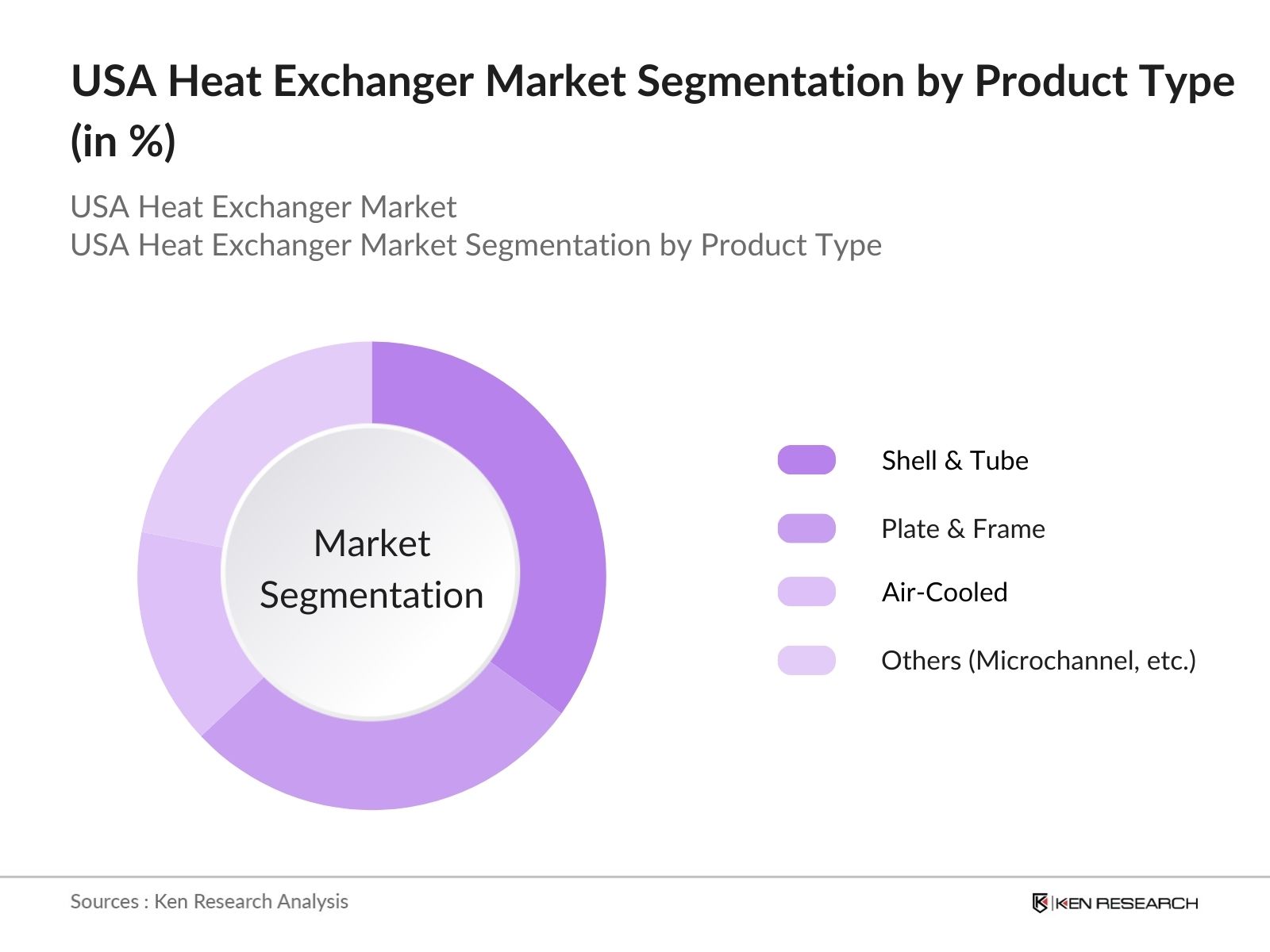
By Product Type: The market is segmented by product type into shell & tube, plate & frame, and air-cooled heat exchangers. Shell & tube heat exchangers hold a dominant market share due to their versatile application across industries like oil & gas, power generation, and chemical processing. Their ability to handle high-pressure and high-temperature applications makes them indispensable. The dominance of this sub-segment is also attributed to their widespread use in environments requiring efficient heat transfer.
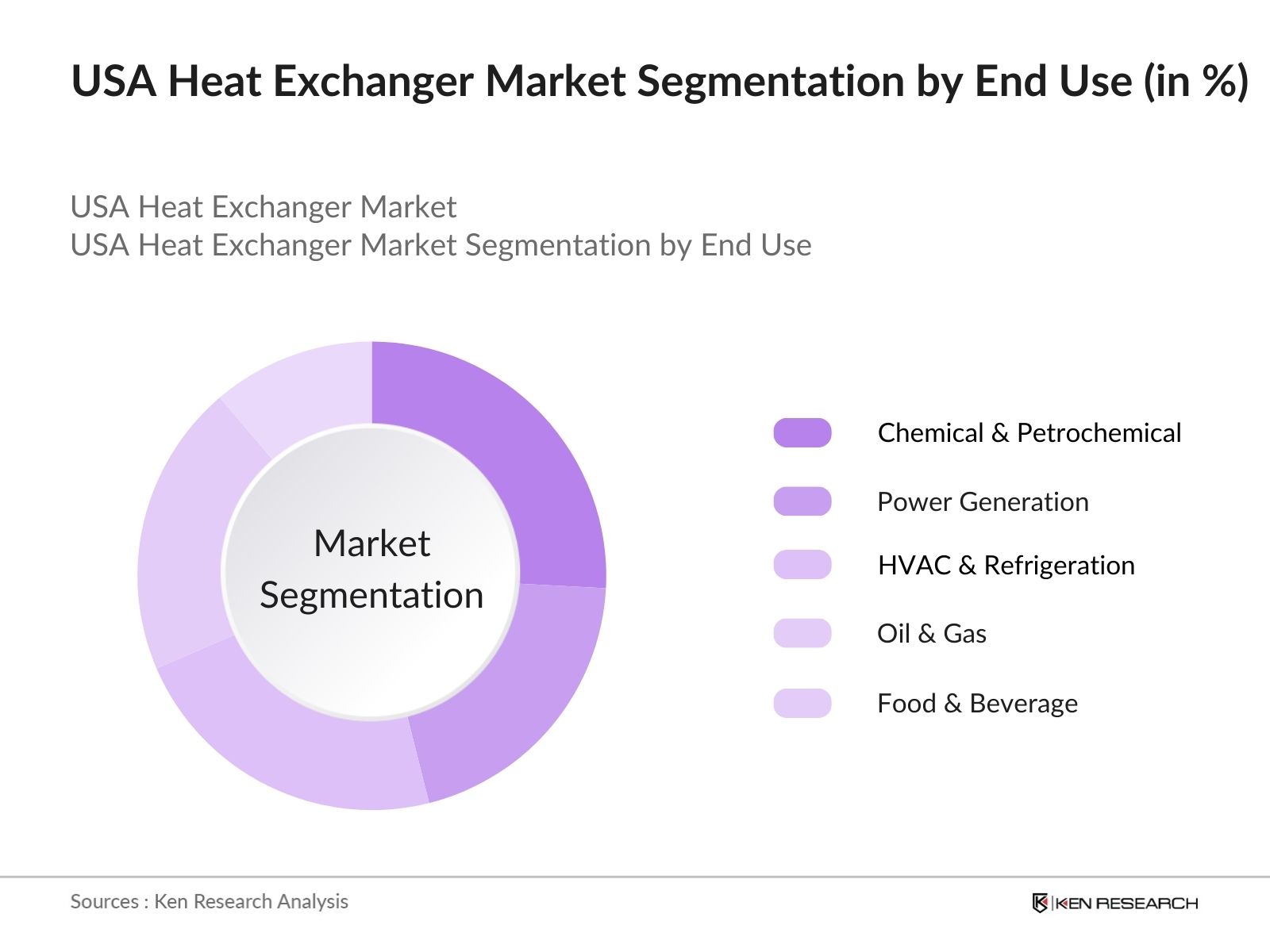
By End Use: The market is further segmented by end use into chemical & petrochemical, power generation, HVAC & refrigeration, oil & gas, and food & beverage processing. The chemical & petrochemical industry holds the largest market share due to the high demand for heat exchangers in chemical processing and refinery operations. The growth of this segment is driven by the need for heat exchangers to maintain optimal temperatures in critical processes, and the increasing demand for petrochemical products.
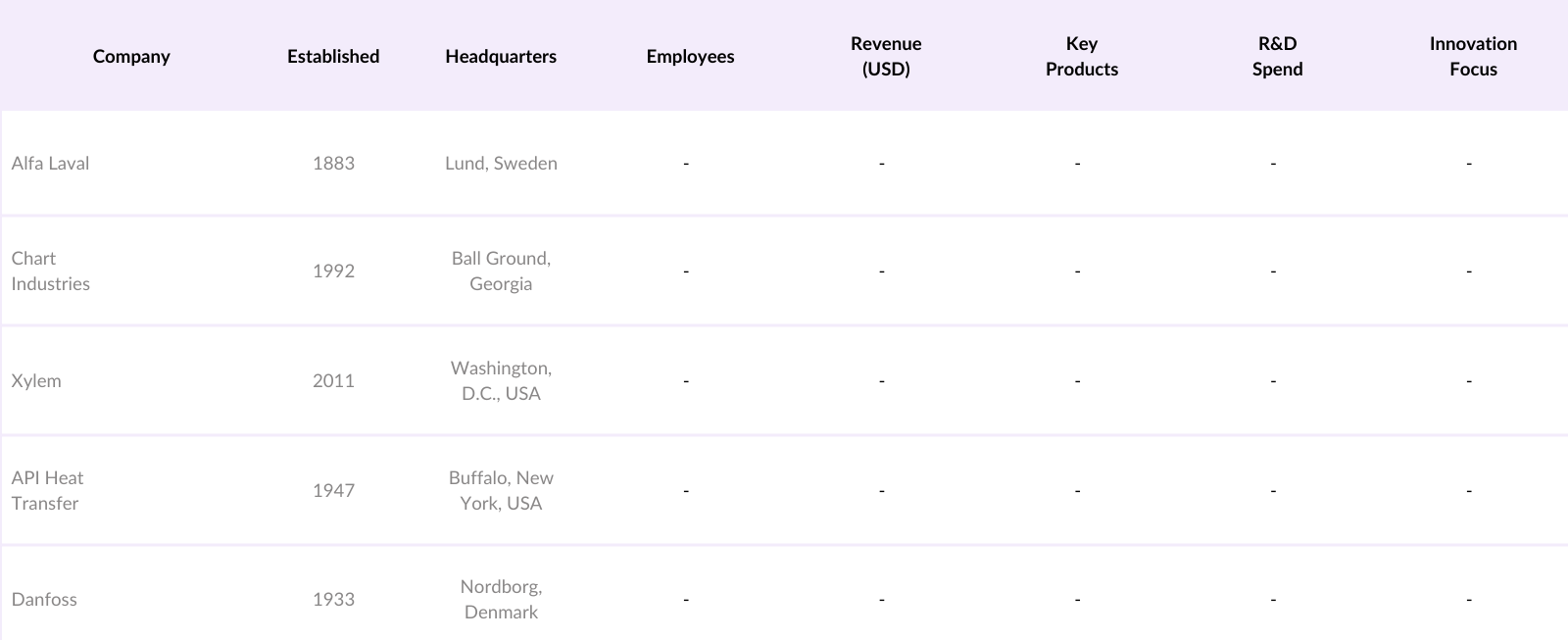
The market is highly competitive, dominated by a mix of global and local players. Companies focus on R&D, mergers, and strategic collaborations to gain market share. Major players include Alfa Laval, Chart Industries, and Xylem, which invest heavily in innovative heat exchanger technologies and the integration of digitalization into their systems.
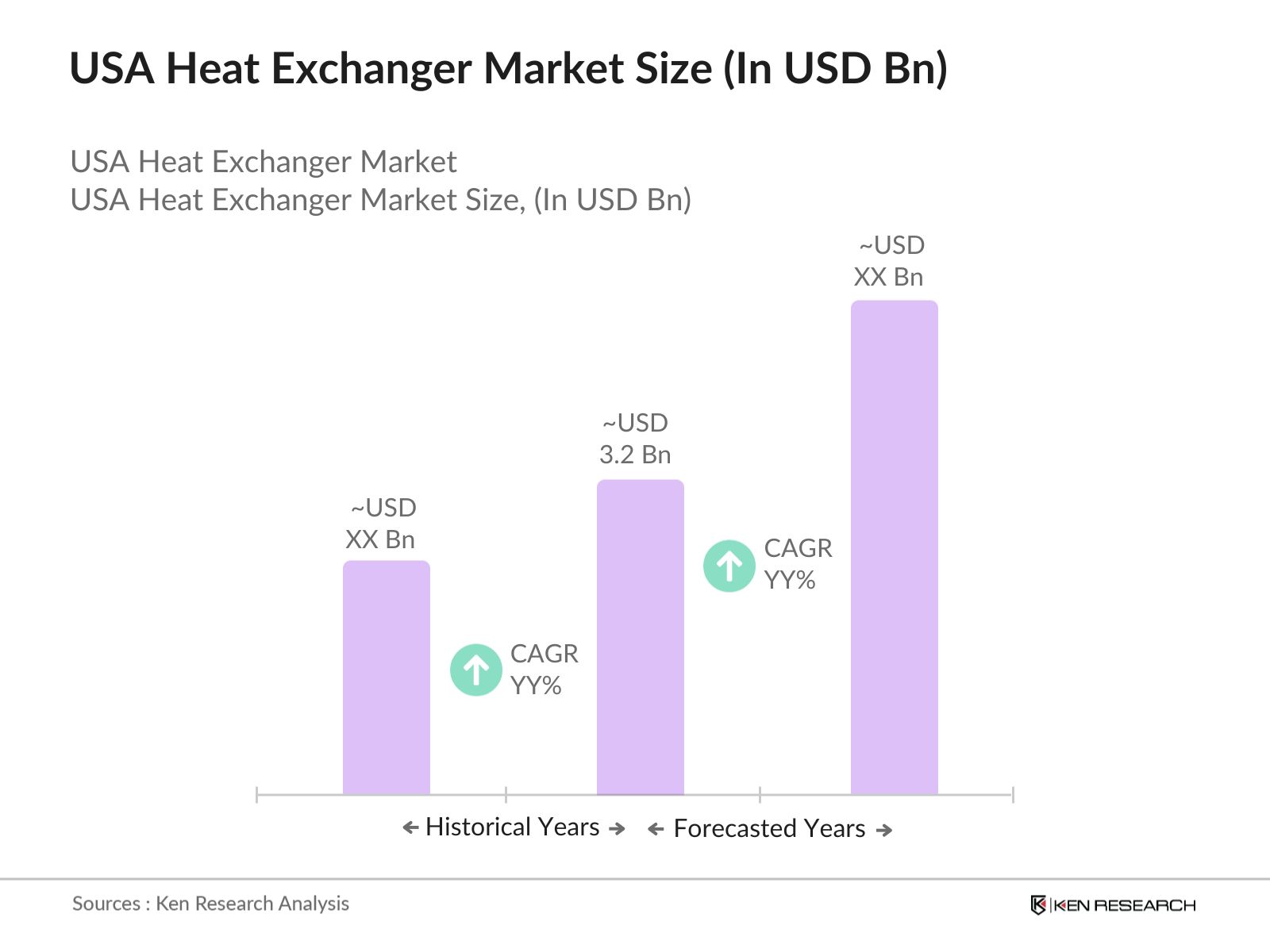
Over the next five years, the USA heat exchanger industry is projected to grow steadily, driven by ongoing demand for energy-efficient technologies, particularly in industrial applications like power generation, oil & gas, and HVAC systems.
|
Product Type |
Shell & Tube Plate & Frame Air-Cooled Others |
|
End Use |
Chemical & Petrochemical Power Generation HVAC & Refrigeration Oil & Gas Food & Beverage Processing |
|
Material Type |
Stainless Steel Nickel Alloys Aluminum Titanium |
|
Region |
North East West |
1.1 Definition and Scope
1.2 Market Taxonomy
1.3 Market Growth Rate
1.4 Market Segmentation Overview
2.1 Historical Market Size
2.2 Year-On-Year Growth Analysis
2.3 Key Market Developments and Milestones
3.1 Growth Drivers (Energy Efficiency, Industrialization, Digitalization, etc.)
3.2 Market Challenges (High Initial Costs, Maintenance Challenges)
3.3 Opportunities (Waste Heat Recovery, Customization Trends, Modularity)
3.4 Market Trends (IoT Integration, Additive Manufacturing, Material Innovations)
3.5 Government Regulations (Environmental Standards, Energy Efficiency Initiatives)
3.6 SWOT Analysis
3.7 Stakeholder Ecosystem
3.8 Porters Five Forces Analysis
3.9 Competition Ecosystem
4.1 By Product Type (In Value %)
4.1.1 Shell & Tube Heat Exchangers
4.1.2 Plate & Frame Heat Exchangers
4.1.3 Air-Cooled Heat Exchangers
4.1.4 Others (Microchannel, Compact, etc.)
4.2 By End Use (In Value %)
4.2.1 Chemical & Petrochemical
4.2.2 Power Generation
4.2.3 HVAC & Refrigeration
4.2.4 Oil & Gas
4.2.5 Food & Beverage Processing
4.3 By Material Type (In Value %)
4.3.1 Stainless Steel
4.3.2 Nickel Alloys
4.3.3 Aluminum
4.3.4 Titanium
4.4 By Region (In Value %)
4.4.1 North
4.4.2 East
4.4.3 West
4.4.4 South
5.1 Detailed Profiles of Major Companies
5.1.1 ALFA LAVAL
5.1.2 Xylem
5.1.3 Chart Industries
5.1.4 Koch Heat Transfer
5.1.5 API Heat Transfer
5.1.6 Danfoss
5.1.7 Kelvion
5.1.8 SWEP International AB
5.1.9 Mersen Group
5.1.10 SHECO Industries
5.1.11 Enerquip Thermal Solutions
5.1.12 FUNKE Wrmeaustauscher Apparatebau GmbH
5.1.13 CALORPLAST USA
5.1.14 Mason Manufacturing LLC
5.1.15 HRS Heat Exchangers
5.2 Cross Comparison Parameters (Inception Year, Revenue, Employee Size, Headquarters, Product Portfolio, R&D Initiatives, Key End-User Focus, Technological Advancements)
5.3 Market Share Analysis
5.4 Strategic Initiatives (Mergers, Acquisitions, Joint Ventures)
5.5 Investment Analysis (Venture Capital, Private Equity)
5.6 Government Grants and Subsidies
5.7 Technological Collaborations
6.1 Energy Efficiency Standards
6.2 Environmental Compliance and Certifications
6.3 Material Use and Safety Regulations
7.1 Future Market Size Projections
7.2 Key Factors Driving Future Market Growth
8.1 By Product Type (In Value %)
8.2 By End Use (In Value %)
8.3 By Region (In Value %)
9.1 TAM/SAM/SOM Analysis
9.2 White Space Opportunity Analysis
9.3 Marketing Initiatives
9.4 Customer Cohort Analysis
Disclaimer Contact UsThe research process begins with identifying the major stakeholders within the USA Heat Exchanger Market, including manufacturers, end-users, and regulatory bodies. We employ proprietary databases and extensive desk research to map the ecosystem and define critical market variables.
In this phase, we compile historical data and trends to assess the penetration of various heat exchanger technologies and their impact on revenue generation. Industry reports are cross-referenced with third-party data to ensure accuracy.
Market assumptions are tested through interviews with industry professionals, focusing on operational insights and financial data. This process helps validate the collected data and aligns market forecasts with industry expectations.
The final step involves direct engagement with manufacturers to obtain detailed insights on product segments, sales performance, and consumer behavior. This engagement helps corroborate data from the bottom-up approach, providing a robust, validated market analysis.
The USA heat exchanger market is valued at USD 3.2 billion, driven by demand across power generation, chemical processing, and HVAC industries.
Key drivers in the USA heat exchanger market include increasing energy efficiency initiatives, adoption of renewable energy, and the rise of IoT-enabled smart heat exchangers that enhance performance monitoring and maintenance.
Regions such as the Midwest and Gulf Coast dominate the USA heat exchanger market due to their high concentration of chemical processing plants and refineries, while the Southwests booming petrochemical sector also drives significant demand.
Key players in the USA heat exchanger market include Alfa Laval, Xylem, Chart Industries, API Heat Transfer, and Danfoss, all of which maintain strong market positions through technological innovations and strategic partnerships.
The USA heat exchanger market is expected to see increased adoption of energy-efficient solutions, IoT integration, and waste heat recovery systems, contributing to long-term growth and environmental sustainability.

What makes us stand out is that our consultants follows Robust, Refine and Result (RRR) methodology. i.e. Robust for clear definitions, approaches and sanity checking, Refine for differentiating respondents facts and opinions and Result for presenting data with story

We have set a benchmark in the industry by offering our clients with syndicated and customized market research reports featuring coverage of entire market as well as meticulous research and analyst insights.

While we don't replace traditional research, we flip the method upside down. Our dual approach of Top Bottom & Bottom Top ensures quality deliverable by not just verifying company fundamentals but also looking at the sector and macroeconomic factors.

With one step in the future, our research team constantly tries to show you the bigger picture. We help with some of the tough questions you may encounter along the way: How is the industry positioned? Best marketing channel? KPI's of competitors? By aligning every element, we help maximize success.

Our report gives you instant access to the answers and sources that other companies might choose to hide. We elaborate each steps of research methodology we have used and showcase you the sample size to earn your trust.

If you need any support, we are here! We pride ourselves on universe strength, data quality, and quick, friendly, and professional service.