















USA Heat Pump Market Outlook to 2030
Region:North America
Author(s):Shubham
Product Code:KROD4381
October 2024
85
About the Report
USA Heat Pump Market Overview
- The USA heat pump market is an integral part of the energy-efficient solutions sector, currently valued at USD 11.8 Mn, driven by growing demand for renewable energy sources and the governments push towards reducing carbon emissions. In 2024, the market saw significant adoption due to its ability to provide both heating and cooling, particularly in residential and commercial buildings. Heat pumps are a preferred alternative to conventional HVAC systems, offering energy savings of up to 50% compared to electric resistance heaters or furnaces.

- Key cities like New York, Los Angeles, and Chicago dominate the USA heat pump market, driven by high urbanization rates, strict environmental regulations, and state-level incentives for energy-efficient home improvements. The dominance in these regions is also due to the increasing demand for sustainable residential and commercial infrastructure. These metropolitan areas lead the way in both new installations and retrofit projects, further solidifying their influence in the heat pump sector.
- Federal policies such as the Inflation Reduction Act (IRA) of 2022 have also spurred market growth, offering tax credits for homeowners and businesses that install high-efficiency heat pumps. This, along with the push for electrification, is shifting market dynamics, making heat pumps a key player in the HVAC sectors decarbonization efforts. Additionally, the U.S. Department of Energy (DOE) has established new federal efficiency standards for heat pumps, effective from 2023. These regulations require heat pumps to meet a minimum Seasonal Energy Efficiency Ratio (SEER) of 15.
USA Heat Pump Market Segmentation
- By Type of Heat Pump: The market is segmented into air-source heat pumps (ASHP), hybrid heat pump, ground-source heat pumps (GSHP), and water-source heat pumps (WSHP). Air-source heat pumps dominate the market due to their cost-effectiveness and ease of installation. They are widely used in residential applications where moderate climates prevail. Ground-source heat pumps, though more expensive to install, are growing in popularity for large-scale commercial buildings due to their superior efficiency. Water-source heat pumps, primarily utilized in multi-unit residential and commercial buildings, are favored for their ability to leverage water bodies as heat exchangers, making them ideal in specific geographies.

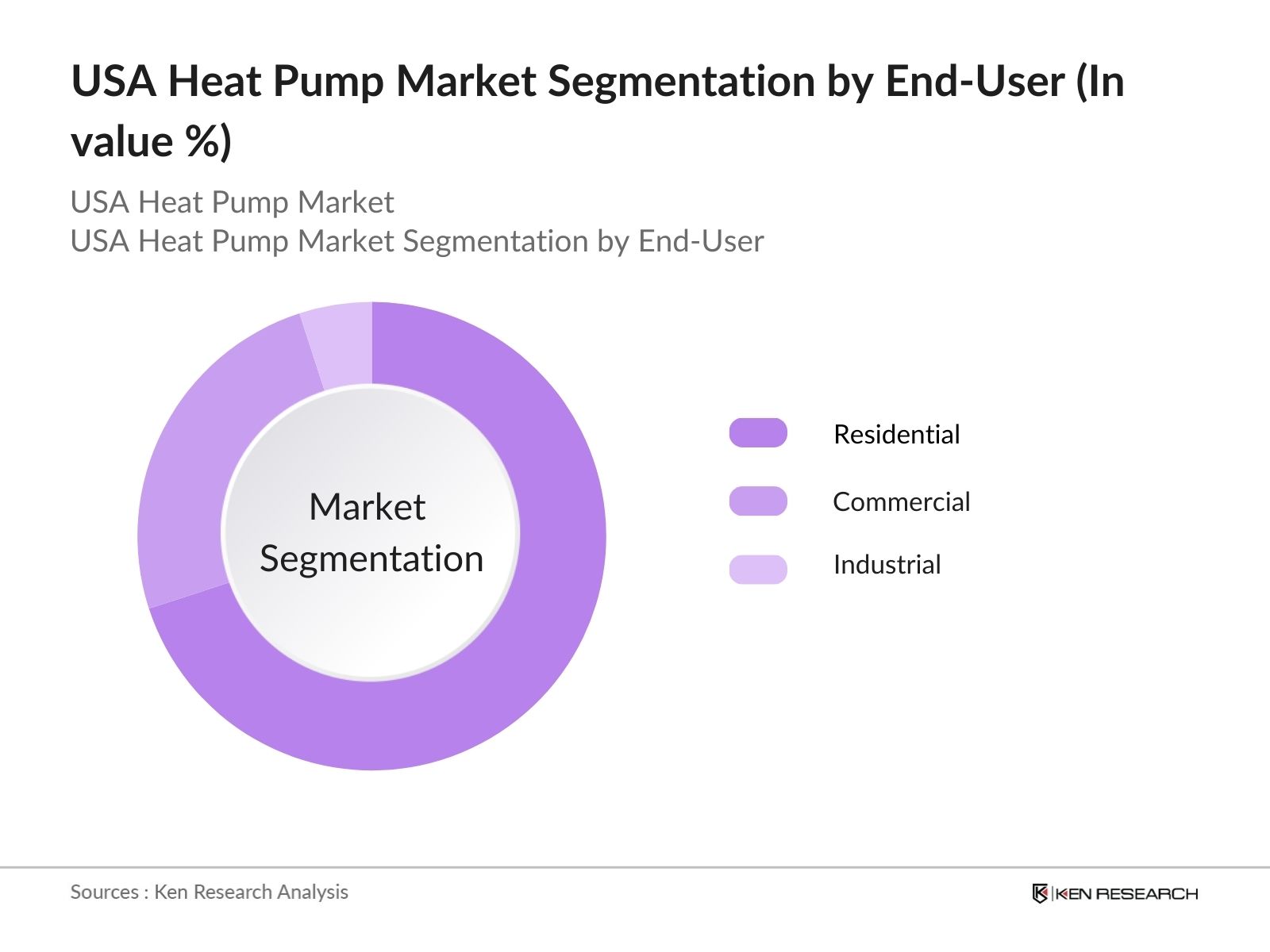
- By End-User: The market is segmented by application into residential, commercial, and industrial sectors. The residential sector holds the largest share, driven by increasing awareness of energy savings and the availability of government subsidies. Commercial applications are growing steadily as businesses seek to meet energy efficiency targets, while industrial applications are emerging, especially in sectors requiring precise climate control for production processes.
USA Heat Pump Market Competitive Landscape
The USA heat pump market is highly competitive, with several domestic and international players competing for market share. Leading companies are focusing on innovation, expanding production capacity, and enhancing product performance to stay ahead in the market.
|
Company Name |
Establishment Year |
Headquarters |
No. of Employees |
Revenue (USD Billion) |
Key Products |
Sustainability Initiatives |
Technology Investments |
|
Carrier |
1915 |
Palm Beach, FL |
|||||
|
Trane Technologies |
1885 |
Davidson, NC |
|||||
|
Daikin |
1924 |
Houston, TX |
|||||
|
Lennox International |
1895 |
Richardson, TX |
|||||
|
Mitsubishi Electric |
1921 |
Suwanee, GA |
USA Heat Pump Industry Analysis
Growth Drivers
- Increasing Adoption in Residential and Commercial Sectors: The U.S. residential sector saw a rise in heat pump adoption, with installations reaching 2.2 million units in 2023, a significant increase from 1.7 million in 2022, according to data from the U.S. Energy Information Administration (EIA). Commercial sector adoption is similarly growing, with installations rising substantially in key markets such as California and Texas, driven by stringent energy efficiency mandates for new commercial buildings.
- Government Subsidies and Incentives: The Inflation Reduction Act (IRA) introduced in 2022 allocates over USD 8.6 billion in tax credits and rebates for residential heat pump installations, with federal initiatives promoting energy-efficient technologies through Energy Star programs. In 2024, the U.S. Department of Energy reported that over thousands of heat pumps were installed in residential sectors due to these incentives, particularly in regions like California and New York, where energy efficiency programs are prevalent. Such incentives have contributed to a major portion of heat pump installations in new buildings in 2023.
- Decarbonization and Electrification Trends: Decarbonization policies in the U.S., such as the Zero-Emission Buildings Act, have accelerated the electrification of heating systems. Heat pumps, which contribute to reducing CO2 emissions, were installed in themajority of new homes in the Pacific Northwest by 2023, with similar trends across other states like Massachusetts. The shift towards electrification is projected to save an estimated million metric tons of CO2 emissions annually by 2025, according to the U.S. Environmental Protection Agency (EPA)
Market Challenges
- High Initial Installation Costs: The initial cost of installing heat pumps is a notable obstacle for many homeowners and businesses, as these systems typically require a significant upfront investment. Despite the availability of rebates and government incentives aimed at offsetting costs, the expenses associated with heat pump installation, including labor, equipment, and system modifications, often remain higher compared to traditional heating, ventilation, and air conditioning (HVAC) systems. This disparity in cost can be a deterrent, particularly for middle-income households, who may struggle to justify the additional expense over less energy-efficient alternatives, despite the long-term savings on energy bills.
- Climate-Specific Performance Limitations: Heat pumps often face challenges in maintaining efficiency in colder climates, where temperatures drop significantly during winter months. This issue is particularly evident in northern regions of the U.S., where severe winters can compromise the performance of standard air-source heat pumps. In such conditions, heat pumps may need to rely on supplemental heating systems to provide adequate warmth, which increases energy consumption. This limitation has slowed the adoption of heat pumps in colder states, where alternative heating methods like natural gas furnaces or oil heating systems are often preferred for their reliability in extreme weather.
USA Heat Pump Market Future Outlook
The USA heat pump market is projected to witness steady growth, driven by supportive government policies, technological innovations, and growing consumer demand for energy-efficient solutions. The market is expected to benefit from the continuous transition towards electrification and decarbonization of the heating sector. With advancements in smart home integrations and cold-climate adaptations, heat pumps will likely become the preferred choice for both new constructions and retrofits.
Future Market Opportunities
- Cold Climate Heat Pump Development: Cold climate heat pumps (CCHPs) are gaining traction, particularly in northern U.S. regions. In 2023, the U.S. Department of Energy announced a substantial investment in CCHP research, aiming to improve efficiency in temperatures as low as -15F. The development of these systems is expected to address inefficiencies in states like Alaska and Montana, potentially expanding the market by thousands of units per year by 2025.
- Integration with Renewable Energy Systems: The integration of heat pumps with renewable energy sources like solar power is creating new market opportunities. Data from the National Renewable Energy Laboratory (NREL) shows that in 2023, majority of new residential heat pump installations were paired with solar panels, particularly in states like California and Arizona. This integration helps to further reduce energy costs and carbon emissions, supporting decarbonization goals
Scope of the Report
|
By Type of Heat Pump |
Air-Source Heat Pumps Ground-Source Heat Pumps Water-Source Heat Pumps Hybrid Heat Pumps |
|
By End-User |
Residential Commercial Industrial |
|
By Installation Type |
New Installations Retrofit Installations |
|
By Technology |
Split-System Heat Pumps Packaged Heat Pumps Ductless Heat Pumps |
|
By Region |
North-East South Midwest West |
Products
Key Target Audience
Heat Pump Manufacturers
Energy Efficiency Consultants
Residential and Commercial Builders
Government and Regulatory Bodies (U.S. Department of Energy, EPA)
Investors and Venture Capitalist Firms
Utilities and Power Companies
Renewable Energy Solution Providers
State Energy Commissions
Banks and Financial Institutions
Companies
Players Mentioned in the Report
Carrier
Trane Technologies
Lennox International
Daikin
Bosch Thermotechnology
Mitsubishi Electric
Rheem Manufacturing
Fujitsu General
LG Electronics
Panasonic Corporation
Nortek Global HVAC
Emerson Electric Co.
Sanden International
Aermec
Johnson Controls
Table of Contents
1. USA Heat Pump Market Overview
1.1. Definition and Scope
1.2. Market Taxonomy
1.3. Market Growth Rate
1.4. Market Segmentation Overview
2. USA Heat Pump Market Size (In USD Mn)
2.1. Historical Market Size
2.2. Year-On-Year Growth Analysis
2.3. Key Market Developments and Milestones
3. USA Heat Pump Market Analysis
3.1. Growth Drivers
3.1.1. Government Subsidies and Incentives (IRA, Energy Star programs)
3.1.2. Increasing Adoption in Residential and Commercial Sectors
3.1.3. Advancements in Heat Pump Technology (Variable-speed compressors, Smart thermostats)
3.1.4. Decarbonization and Electrification Trends
3.2. Market Challenges
3.2.1. High Initial Installation Costs
3.2.2. Climate-Specific Performance Limitations (Cold-climate inefficiency)
3.2.3. Supply Chain and Component Shortages
3.2.4. Regulatory Compliance (EPA standards on refrigerants)
3.3. Opportunities
3.3.1. Cold Climate Heat Pump Development
3.3.2. Integration with Renewable Energy Systems
3.3.3. Heat Pumps for Industrial Applications (Process heating and cooling)
3.3.4. Growth in Heat Pump Retrofit Market
3.4. Trends
3.4.1. Growth in Dual-Function Heat Pumps (Heating and Cooling)
3.4.2. IoT Integration and Smart Home Applications
3.4.3. Expansion of Ground-Source Heat Pumps in Commercial Sector
3.4.4. Rise in Solar-Powered Heat Pump Systems
3.5. Government Regulation
3.5.1. Federal Efficiency Standards (DOE regulations)
3.5.2. Energy Star Certification Programs
3.5.3. Local Building Code Requirements (State-level mandates)
3.5.4. Low GWP Refrigerant Policies (EPA phase-out programs)
3.6. SWOT Analysis
3.7. Stake Ecosystem
3.8. Porters Five Forces
3.9. Competition Ecosystem
4. USA Heat Pump Market Segmentation
4.1. By Type of Heat Pump (In Value %)
4.1.1. Air-Source Heat Pumps
4.1.2. Ground-Source Heat Pumps
4.1.3. Water-Source Heat Pumps
4.1.4. Hybrid Heat Pumps
4.2. By End-Use Application (In Value %)
4.2.1. Residential
4.2.2. Commercial
4.2.3. Industrial
4.3. By Region (In Value %)
4.3.1. North-East
4.3.2. South
4.3.3. Midwest
4.3.4. West
4.4. By Installation Type (In Value %)
4.4.1. New Installations
4.4.2. Retrofit Installations
4.5. By Technology (In Value %)
4.5.1. Split-System Heat Pumps
4.5.2. Packaged Heat Pumps
4.5.3. Ductless Heat Pumps
5. USA Heat Pump Market Competitive Analysis
5.1. Detailed Profiles of Major Companies
5.1.1. Carrier
5.1.2. Trane Technologies
5.1.3. Lennox International
5.1.4. Daikin
5.1.5. Mitsubishi Electric
5.1.6. Bosch Thermotechnology
5.1.7. Rheem Manufacturing
5.1.8. LG Electronics
5.1.9. Nortek Global HVAC
5.1.10. Panasonic Corporation
5.1.11. Fujitsu General
5.1.12. Emerson Electric Co.
5.1.13. Sanden International
5.1.14. Aermec
5.1.15. Johnson Controls
5.2. Cross Comparison Parameters (Headquarters, Inception Year, Revenue, No. of Employees, Technology Focus, Sustainability Initiatives, Smart System Integration, Production Capacity)
5.3. Market Share Analysis
5.4. Strategic Initiatives
5.5. Mergers and Acquisitions
5.6. Investment Analysis
5.7. Venture Capital Funding
5.8. Government Grants
5.9. Private Equity Investments
6. USA Heat Pump Market Regulatory Framework
6.1. Federal Efficiency Standards (DOE)
6.2. State-Level Energy Codes
6.3. EPA Refrigerant Regulations
6.4. Certification Processes (Energy Star)
7. USA Heat Pump Future Market Size (In USD Mn)
7.1. Future Market Size Projections
7.2. Key Factors Driving Future Market Growth
8. USA Heat Pump Future Market Segmentation
8.1. By Type of Heat Pump (In Value %)
8.2. By End-Use Application (In Value %)
8.3. By Region (In Value %)
8.4. By Installation Type (In Value %)
8.5. By Technology (In Value %)
9. USA Heat Pump Market Analysts Recommendations
9.1. TAM/SAM/SOM Analysis
9.2. Customer Cohort Analysis
9.3. White Space Opportunity Analysis
9.4. Marketing Initiatives
Disclaimer Contact UsResearch Methodology
Step 1: Identification of Key Variables
The initial step involved mapping the ecosystem of the USA heat pump market, identifying all major stakeholders. Through extensive desk research, we sourced data from government bodies like the U.S. Department of Energy and reputable databases to identify the critical variables that influence the market.
Step 2: Market Analysis and Construction
Historical data on the market size and penetration of heat pumps in different regions of the U.S. was compiled. We analyzed the trends in consumer preferences, government incentives, and market developments to provide an accurate estimation of revenue generation and growth drivers.
Step 3: Hypothesis Validation and Expert Consultation
We conducted interviews with industry experts, including representatives from leading heat pump manufacturers and HVAC professionals, to validate the market hypotheses. This step helped refine our market projections and ensure data accuracy.
Step 4: Research Synthesis and Final Output
We synthesized the findings by correlating the data gathered through both desk research and expert consultations. The final output was validated through consultations with multiple market players to ensure the robustness and reliability of our analysis for the USA heat pump market.
Frequently Asked Questions
01. How big is the USA heat pump market?
The USA heat pump market was valued at USD 11.8 billion, driven by the growing demand for energy-efficient solutions and supportive government incentives.
02. What are the challenges in the USA heat pump market?
The key challenges in the USA heat pump market include high upfront installation costs, climate-specific performance limitations, and supply chain disruptions for critical components.
03. Who are the major players in the USA heat pump market?
Major players in the USA heat pump market include Carrier, Trane Technologies, Lennox International, Daikin, and Bosch Thermotechnology, among others.
04. What are the growth drivers of the USA heat pump market?
The growth of the USA heat pump market is driven by government policies promoting energy efficiency, advancements in heat pump technology, and the increasing adoption of renewable energy systems.
Why Buy From Us?

What makes us stand out is that our consultants follows Robust, Refine and Result (RRR) methodology. i.e. Robust for clear definitions, approaches and sanity checking, Refine for differentiating respondents facts and opinions and Result for presenting data with story

We have set a benchmark in the industry by offering our clients with syndicated and customized market research reports featuring coverage of entire market as well as meticulous research and analyst insights.

While we don't replace traditional research, we flip the method upside down. Our dual approach of Top Bottom & Bottom Top ensures quality deliverable by not just verifying company fundamentals but also looking at the sector and macroeconomic factors.

With one step in the future, our research team constantly tries to show you the bigger picture. We help with some of the tough questions you may encounter along the way: How is the industry positioned? Best marketing channel? KPI's of competitors? By aligning every element, we help maximize success.

Our report gives you instant access to the answers and sources that other companies might choose to hide. We elaborate each steps of research methodology we have used and showcase you the sample size to earn your trust.

If you need any support, we are here! We pride ourselves on universe strength, data quality, and quick, friendly, and professional service.