















USA Humanoid Robot Market Outlook to 2030
Region:North America
Author(s):Shreya Garg
Product Code:KROD4172
November 2024
83
About the Report
USA Humanoid Robot Market Overview
- The USA humanoid robot market is valued at USD 580 million, driven by increasing demand for automation in healthcare, service industries, and education. Key factors fueling market growth include advancements in AI, machine learning, and robotics. The rapid rise in the development of human-like robots for use in customer service, rehabilitation, and as personal assistants is a key driver. The service sector's growing need for intelligent robotics to assist with repetitive or hazardous tasks is also a major contributor to the markets expansion.
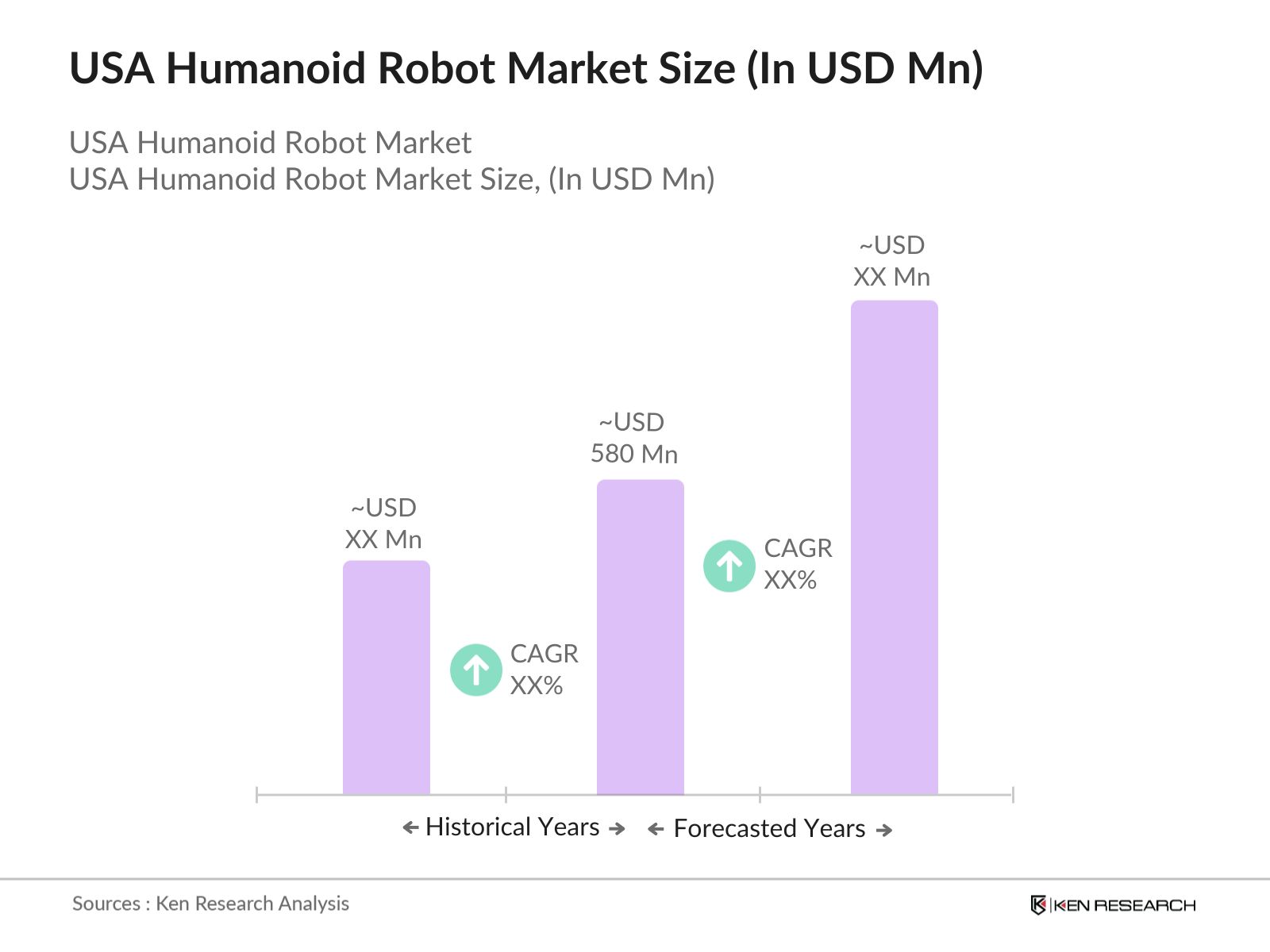
- Major cities and regions such as Silicon Valley, Boston, and New York are dominant in the USA humanoid robot market due to the presence of key robotics companies, tech startups, and leading research institutions. Silicon Valley, with its innovation-driven ecosystem, fosters collaboration between AI specialists and hardware developers, making it a hotbed for robotics innovation. Boston, home to renowned universities and research labs, is another leader due to its focus on cutting-edge robotic research.
- The U.S. government has been heavily investing in robotics research to maintain its leadership in the global robotics market. In 2024, the U.S. National Science Foundation (NSF) allocated $500 million to robotics research, with a portion dedicated to humanoid robot development. These investments are aimed at improving AI capabilities, human-robot interaction, and safety features, which are critical for the widespread adoption of humanoid robots in various sectors.
USA Humanoid Robot Market Segmentation
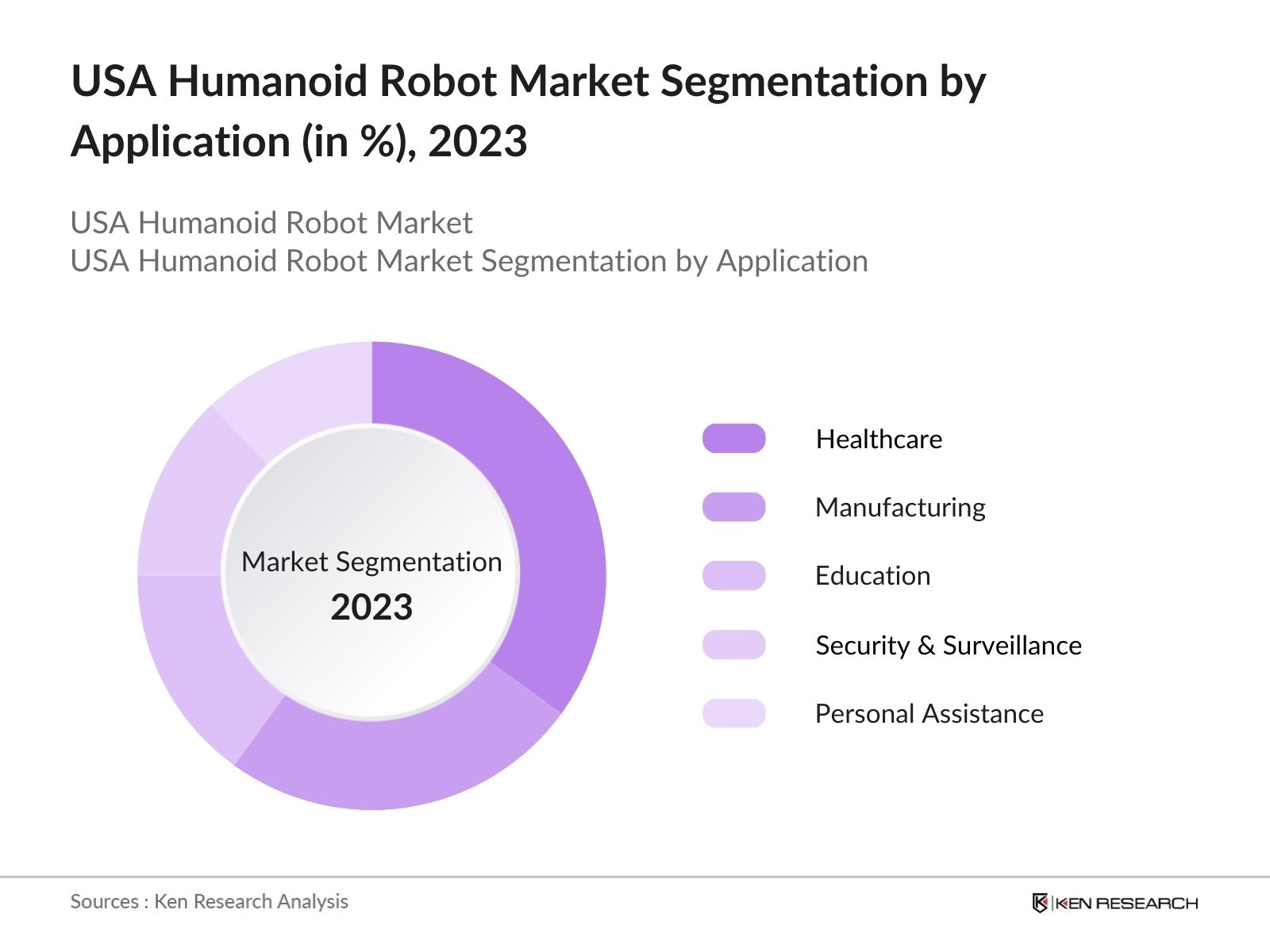
By Application: The market is segmented by application into healthcare, manufacturing, education, security and surveillance, and personal assistance. The healthcare sector has a dominant market share in the humanoid robot market due to its increasing use of robots for elderly care, rehabilitation, and patient assistance. The rising aging population in the USA has created a demand for robotic solutions that can help elderly patients with daily activities and healthcare needs, further boosting the adoption of humanoid robots in this segment.
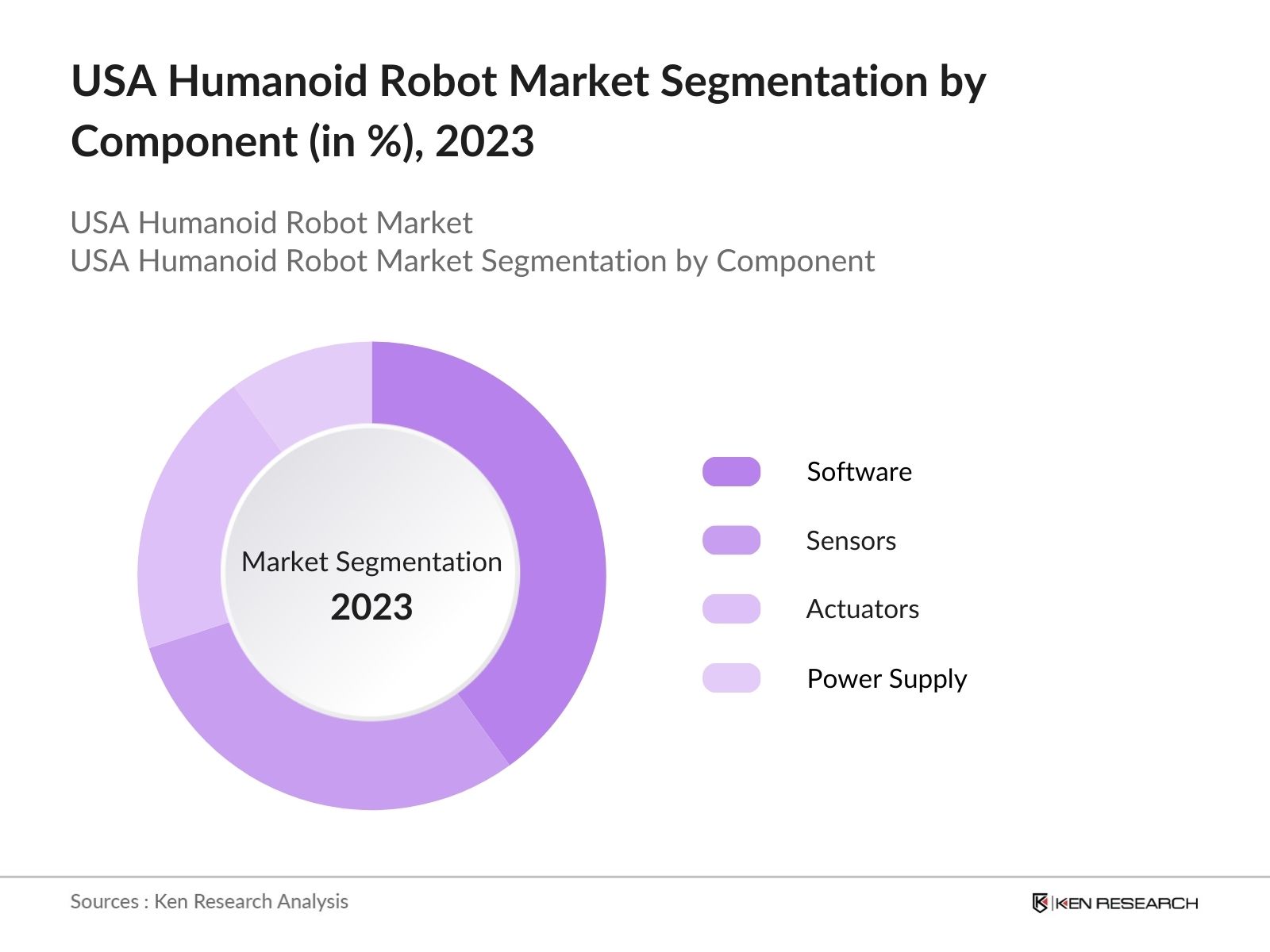
By Component: The market is segmented by component into sensors, actuators, power supply, and software. Software holds the largest market share within this segmentation due to the crucial role AI and machine learning algorithms play in driving the decision-making, movement, and interaction capabilities of humanoid robots. The advancement in AI-driven robotics is creating a high demand for robust software solutions that can continuously improve the autonomy and adaptability of humanoid robots.
USA Humanoid Robot Market Competitive Landscape
The USA humanoid robot market is dominated by a mix of well-established companies and innovative startups. The competitive landscape highlights the concentrated efforts of both tech giants and specialized robotics firms in developing advanced humanoid robots for various industries. With Silicon Valley and Boston leading the way in robotics research and development, several companies have emerged as key players in the market. These companies are increasingly focusing on improving AI capabilities, software development, and hardware integration to enhance the performance of humanoid robots.
|
Company Name |
Year Established |
Headquarters |
Key Product Focus |
R&D Investments |
AI Integration |
Robotics Capabilities |
Partnerships |
Revenue (USD Mn) |
Market Penetration |
|---|---|---|---|---|---|---|---|---|---|
|
SoftBank Robotics |
1987 |
Tokyo, Japan |
|||||||
|
Honda Motor Co., Ltd. |
1948 |
Tokyo, Japan |
|||||||
|
Boston Dynamics |
1992 |
Waltham, MA, USA |
|||||||
|
Toyota Motor Corporation |
1937 |
Toyota City, Japan |
|||||||
|
Hanson Robotics |
2005 |
Hong Kong |
USA Humanoid Robot Industry Analysis
Growth Drivers
- Increased Adoption in Service Sector: The service sector in the U.S. has seen a notable increase in the adoption of humanoid robots, particularly for customer interaction and assistance in retail, hospitality, and healthcare. The retail industry alone accounted for 1.9 million humanoid service robots deployed in 2023 across various customer service roles. The U.S. Department of Labor highlights that automation is critical in mitigating labor shortages across multiple service industries, where humanoid robots help maintain operational efficiency.
- Technological Advancements in AI and Robotics: Technological advancements in artificial intelligence (AI) and robotics are enhancing the capabilities of humanoid robots in the U.S. market. In 2024, the U.S. invested over $7.8 billion in AI research, with a portion directed towards improving human-machine interaction and machine learning algorithms. These investments are driving the development of more intelligent robots capable of performing complex tasks in real-time, contributing to a growing demand for healthcare and industrial applications.
- Aging Population Driving Demand in Healthcare: The aging U.S. population, with over 56 million people aged 65 or older in 2023, has increased the demand for humanoid robots in healthcare settings. These robots are increasingly used in elderly care, providing support for daily activities, medication management, and companionship. The U.S. Department of Health and Human Services notes that healthcare systems face staff shortages, and robots have helped address this gap by handling repetitive and assistive tasks in hospitals.
Market Challenges
- Limitations in Artificial Intelligence and Human-Machine Interaction: Despite significant advancements, artificial intelligence (AI) in humanoid robots still faces limitations, particularly in natural language processing and complex decision-making tasks. The National Science Foundation (NSF) has reported that while 82% of humanoid robots can execute pre-programmed tasks, only 46% can adapt to unexpected human behavior. These limitations reduce the robots' effectiveness in dynamic environments, posing a challenge for widespread adoption in customer-facing industries.
- Regulatory and Safety Concerns: Regulatory concerns regarding the deployment of humanoid robots are prominent in the U.S., particularly in industries like healthcare and public services. The U.S. Food and Drug Administration (FDA) and Occupational Safety and Health Administration (OSHA) are increasingly involved in setting safety standards for robots interacting with humans. In 2023, the U.S. government implemented over 14 new regulations concerning human-robot interaction in medical environments, primarily focused on minimizing potential injuries and ensuring operational safety.
USA Humanoid Robot Market Future Outlook
Over the next five years, the USA humanoid robot market is expected to witness substantial growth driven by rapid advancements in AI and robotics, increasing adoption across healthcare and service industries, and a strong focus on automation. The integration of 5G networks, enhancing the capabilities of robots in real-time communication, will also be a critical factor driving growth. Moreover, the rise in demand for personal assistance robots due to the aging population is expected to continue expanding the market.
Future Market Opportunities
- Growth in Education and Research Sector: The U.S. education and research sector are increasingly integrating humanoid robots into learning environments. In 2023, over 500 universities and research institutions across the U.S. were involved in robotics research, using humanoid robots for teaching STEM subjects and conducting human-robot interaction studies. The U.S. National Robotics Initiative, with an annual budget of $180 million, has also been instrumental in promoting the development of humanoid robots tailored to educational needs.
- Customization for Specialized Use-Cases: The customization of humanoid robots for specific industries offers significant growth opportunities in the U.S. In 2024, over 40% of all humanoid robots sold in the U.S. were customized to meet the unique requirements of industries like healthcare, retail, and defense. These customizations include task-specific programming and hardware modifications, allowing robots to perform highly specialized functions. The U.S. military has developed robots with advanced mobility features for search-and-rescue operations.
Scope of the Report
|
Application |
Healthcare Manufacturing Education Security and Surveillance Personal Assistance |
|
Component |
Sensors Actuators Power Supply Software |
|
Motion Type |
Bipedal Quadrupedal Wheeled Robots |
|
End-User Industry |
Healthcare Retail Defense Entertainment |
|
Region |
North-East West South Midwest |
Products
Key Target Audience
Government and Regulatory Bodies (U.S. Department of Commerce, U.S. Department of Defense)
Humanoid Robot Manufacturers
Venture Capital and Investment Firms
Healthcare Service Providers
Robotics Software Developers
Banks and Financial Institutes
Defense and Security Contractors
Personal Assistance Service Providers
R&D Institutions Focused on Robotics
Companies
Major Players
SoftBank Robotics
Honda Motor Co., Ltd.
Boston Dynamics
Toyota Motor Corporation
Hanson Robotics
Ubtech Robotics
Agility Robotics
PAL Robotics
Shadow Robot Company
Robotics Evolved Inc.
Blue Ocean Robotics
Kawada Robotics Corporation
iRobot Corporation
ABB Robotics
Hyundai Robotics
Table of Contents
1. USA Humanoid Robot Market Overview
1.1. Definition and Scope
1.2. Market Taxonomy
1.3. Market Growth Rate
1.4. Market Segmentation Overview
2. USA Humanoid Robot Market Size (In USD Bn)
2.1. Historical Market Size
2.2. Year-On-Year Growth Analysis
2.3. Key Market Developments and Milestones
3. USA Humanoid Robot Market Analysis
3.1. Growth Drivers (Automation, Healthcare, Education, Service Sector, Defense, and Security)
3.1.1. Increased Adoption in Service Sector
3.1.2. Technological Advancements in AI and Robotics
3.1.3. Aging Population Driving Demand in Healthcare
3.1.4. Demand for Automation in Manufacturing
3.2. Market Challenges (High Development Costs, Battery Life, AI Limitations, Safety Concerns)
3.2.1. High Costs of Development and Maintenance
3.2.2. Limitations in Artificial Intelligence and Human-Machine Interaction
3.2.3. Regulatory and Safety Concerns
3.2.4. Battery Life and Power Management Issues
3.3. Opportunities (Technological Integration, Education and Research, Customization)
3.3.1. Growth in Education and Research Sector
3.3.2. Customization for Specialized Use-Cases
3.3.3. Integration with Virtual Assistants and IoT
3.4. Trends (AI Integration, 5G Connectivity, Modular Robotics, Human-Robot Collaboration)
3.4.1. Growing Integration of AI and Machine Learning
3.4.2. Use of 5G Networks for Enhanced Connectivity
3.4.3. Modular Robotics for Enhanced Flexibility
3.4.4. Increasing Human-Robot Collaboration in Service Sectors
3.5. Government Regulation (Robotics Standards, AI Regulation, Privacy and Data Security)
3.5.1. U.S. Government Initiatives in Robotics Research
3.5.2. Regulatory Framework on AI Development
3.5.3. Policies on Privacy and Data Protection for Robots in Public Spaces
3.5.4. Safety Standards for Human-Robot Interaction
3.6. SWOT Analysis
3.7. Stake Ecosystem (Manufacturers, Suppliers, Technology Providers, End-Users)
3.8. Porters Five Forces (Buyer Power, Supplier Power, Competitive Rivalry, Threat of Substitutes, Threat of New Entrants)
3.9. Competition Ecosystem (Competitor Positioning, Industry Partnerships, Market Penetration)
4. USA Humanoid Robot Market Segmentation
4.1. By Application (In Value %)
4.1.1. Healthcare
4.1.2. Manufacturing
4.1.3. Education
4.1.4. Security and Surveillance
4.1.5. Personal Assistance
4.2. By Component (In Value %)
4.2.1. Sensors
4.2.2. Actuators
4.2.3. Power Supply
4.2.4. Software
4.3. By Motion Type (In Value %)
4.3.1. Bipedal
4.3.2. Quadrupedal
4.3.3. Wheeled Robots
4.4. By End-User Industry (In Value %)
4.4.1. Healthcare and Assistive Technologies
4.4.2. Retail and Service Sector
4.4.3. Defense and Security
4.4.4. Entertainment and Media
4.5. By Region (In Value %)
4.5.1. North-East
4.5.2. West
4.5.3. South
4.5.4. Midwest
5. USA Humanoid Robot Market Competitive Analysis
5.1 Detailed Profiles of Major Companies
5.1.1. SoftBank Robotics
5.1.2. Honda Motor Co., Ltd.
5.1.3. Hanson Robotics
5.1.4. Ubtech Robotics
5.1.5. Boston Dynamics
5.1.6. Toyota Motor Corporation
5.1.7. Agility Robotics
5.1.8. PAL Robotics
5.1.9. Shadow Robot Company
5.1.10. Robotics Evolved Inc.
5.1.11. Blue Ocean Robotics
5.1.12. Kawada Robotics Corporation
5.1.13. iRobot Corporation
5.1.14. ABB Robotics
5.1.15. Hyundai Robotics
5.2 Cross Comparison Parameters (No. of Employees, Revenue, R&D Investments, Market Presence, Robotics Capabilities, AI Integration, Patents Held, Operational Sectors)
5.3 Market Share Analysis
5.4 Strategic Initiatives (R&D Initiatives, Innovation Centers, Industry Collaborations)
5.5 Mergers And Acquisitions
5.6 Investment Analysis
5.7 Venture Capital Funding
5.8 Government Grants
5.9 Private Equity Investments
6. USA Humanoid Robot Market Regulatory Framework
6.1. Robotics Standards in the USA
6.2. Compliance Requirements for Humanoid Robotics
6.3. Certification Processes for Humanoid Robots
6.4. Ethical Guidelines for Human-Robot Interaction
7. USA Humanoid Robot Future Market Size (In USD Bn)
7.1. Future Market Size Projections
7.2. Key Factors Driving Future Market Growth
8. USA Humanoid Robot Future Market Segmentation
8.1. By Application (In Value %)
8.2. By Component (In Value %)
8.3. By Motion Type (In Value %)
8.4. By End-User Industry (In Value %)
8.5. By Region (In Value %)
9. USA Humanoid Robot Market Analysts Recommendations
9.1. TAM/SAM/SOM Analysis
9.2. Customer Cohort Analysis
9.3. Marketing Initiatives
9.4. White Space Opportunity Analysis
Research Methodology
Step 1: Identification of Key Variables
The research begins by mapping the entire humanoid robotics ecosystem in the USA, identifying the key stakeholders and market influencers, including manufacturers, suppliers, and end-users. This process is supported by extensive desk research utilizing credible databases and proprietary sources to gather comprehensive market information.
Step 2: Market Analysis and Construction
In this phase, historical data on market performance is compiled and analyzed, focusing on market adoption across sectors such as healthcare and manufacturing. Revenue generation and service quality metrics are thoroughly assessed to ensure accurate market estimations.
Step 3: Hypothesis Validation and Expert Consultation
Market hypotheses are formulated and validated through interviews with industry experts, ensuring that insights are based on operational knowledge and market-specific financial performance. These expert consultations provide deeper insight into emerging trends and challenges in the market.
Step 4: Research Synthesis and Final Output
Finally, data from key humanoid robot manufacturers is synthesized, providing detailed insights into product segmentation, performance, and consumer behavior. This stage ensures that all findings are validated through cross-referencing with market insights and trends, resulting in a comprehensive report.
Frequently Asked Questions
01. How big is the USA Humanoid Robot Market?
The USA humanoid robot market is valued at USD 580 million, driven by advancements in AI technology and the demand for service-oriented robots in sectors such as healthcare and retail.
02. What are the key challenges in the USA Humanoid Robot Market?
Key challenges in the USA humanoid robot market include the high costs of development and maintenance, AI limitations, safety concerns, and the need for more advanced power supply technologies.
03. Who are the major players in the USA Humanoid Robot Market?
Major players in the USA humanoid robot market include SoftBank Robotics, Boston Dynamics, Honda Motor Co., Ltd., Hanson Robotics, and Toyota Motor Corporation, each excelling in different aspects of robotics development and AI integration.
04. What are the growth drivers of the USA Humanoid Robot Market?
Growth drivers in the USA humanoid robot market include the increasing demand for automation in healthcare and service industries, the need for personal assistance robots due to the aging population, and continuous technological advancements in AI and robotics.
05. What future trends can be expected in the USA Humanoid Robot Market?
Future trends include the integration of humanoid robots with IoT and smart city infrastructure, the use of robots for real-time communication and service delivery via 5G networks, and advancements in human-robot interaction technologies in the USA humanoid robot market.
Why Buy From Us?

What makes us stand out is that our consultants follows Robust, Refine and Result (RRR) methodology. i.e. Robust for clear definitions, approaches and sanity checking, Refine for differentiating respondents facts and opinions and Result for presenting data with story

We have set a benchmark in the industry by offering our clients with syndicated and customized market research reports featuring coverage of entire market as well as meticulous research and analyst insights.

While we don't replace traditional research, we flip the method upside down. Our dual approach of Top Bottom & Bottom Top ensures quality deliverable by not just verifying company fundamentals but also looking at the sector and macroeconomic factors.

With one step in the future, our research team constantly tries to show you the bigger picture. We help with some of the tough questions you may encounter along the way: How is the industry positioned? Best marketing channel? KPI's of competitors? By aligning every element, we help maximize success.

Our report gives you instant access to the answers and sources that other companies might choose to hide. We elaborate each steps of research methodology we have used and showcase you the sample size to earn your trust.

If you need any support, we are here! We pride ourselves on universe strength, data quality, and quick, friendly, and professional service.