















USA Hydrogen Generation Market Outlook to 2030
Region:North America
Author(s):Vijay Kumar
Product Code:KROD3399
December 2024
82
About the Report
USA Hydrogen Generation Market Overview
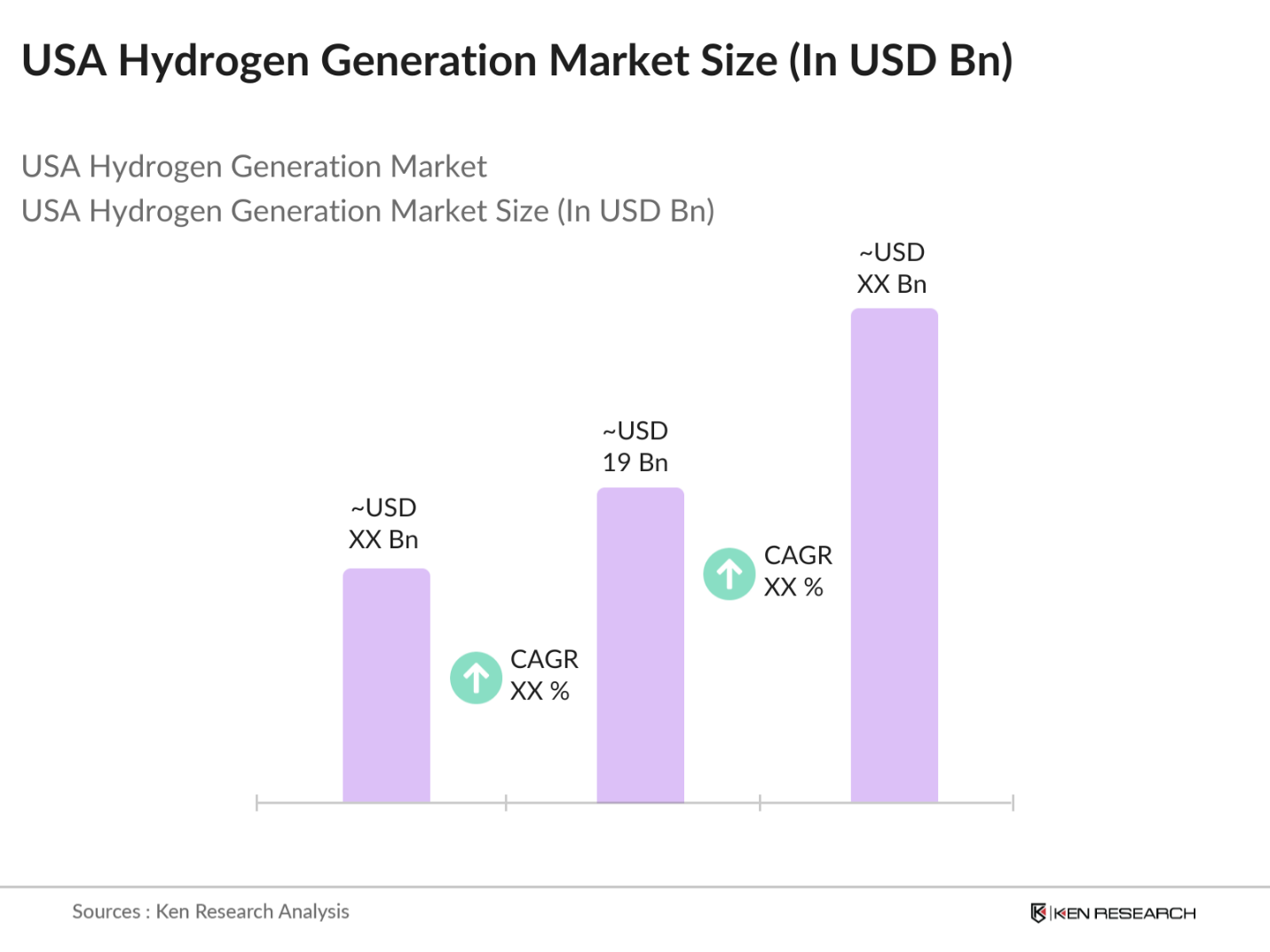
- The USA Hydrogen Generation market, valued at USD 19 billion in 2023, has shown consistent growth driven by increasing investments in clean energy initiatives and government policies favoring the decarbonization of various sectors. Hydrogens potential as a key energy source is increasingly recognized, particularly for its versatility across industries such as transportation, power generation, and heavy industry. The market is largely driven by the demand for green hydrogen (produced using renewable energy sources like solar and wind) and blue hydrogen (produced using natural gas with carbon capture technologies).
- Key regions dominating the USA hydrogen generation market include California, Texas, and the Midwest. California leads due to its stringent environmental policies and substantial investments in hydrogen refueling infrastructure, while Texas benefits from its established oil and gas infrastructure, which is repurposed for blue hydrogen production. The Midwest is emerging as a significant hub due to a mix of renewable energy resources and existing industrial hydrogen demand, particularly from the chemicals and manufacturing sectors.
- The U.S. government has outlined a comprehensive hydrogen strategy through the DOEs Hydrogen Program. Launched in 2022, this roadmap emphasizes the development of hydrogen hubs across the country, with a target to produce 10 million metric tons of clean hydrogen annually by 2030. The DOE has invested $8 billion to support regional hydrogen hubs, which will focus on production, storage, and distribution.
USA Hydrogen Generation Market Segmentation
By Production Technology: The market is segmented by production technology into Electrolysis, Steam Methane Reforming (SMR), and Biomass Gasification. Recently, Electrolysis has taken a dominant share in the hydrogen generation market, largely due to the rising focus on green hydrogen. Electrolysis, which uses renewable energy to split water into hydrogen and oxygen, aligns perfectly with the increasing demand for zero-emission hydrogen production methods.

By Application: The market is segmented by application into Industrial, Transportation, Power Generation, and Residential/Commercial uses. Among these, the Industrial sector, particularly in chemicals and petrochemicals, holds the largest share due to its heavy reliance on hydrogen as a raw material for ammonia production and oil refining. The transportation segment is rapidly gaining ground, driven by investments in hydrogen-powered vehicles and refueling infrastructure, but the established nature of industrial hydrogen use has ensured its dominance.

USA Hydrogen Generation Market Competitive Landscape
The USA Hydrogen Generation market is led by a combination of global energy companies and specialized hydrogen producers. This consolidation indicates the significant influence of major companies in shaping the markets future, particularly those involved in both hydrogen production and the development of related infrastructure.

USA Hydrogen Generation Industry Analysis
Growth Drivers
- Demand for Clean Energy Solutions: The demand for hydrogen generation is rapidly increasing due to the transition toward cleaner energy solutions. As of 2023, the U.S. Department of Energy (DOE) allocated $9.5 billion for clean hydrogen projects under the Infrastructure Investment and Jobs Act. This investment supports the goal of producing 10 million metric tons of clean hydrogen annually by 2030.
- Decarbonization Initiatives (Federal/State Incentives): Decarbonization has gained traction with federal and state-level incentives promoting hydrogen adoption. The 2022 Inflation Reduction Act includes a production tax credit of $3 per kilogram for clean hydrogen, a significant financial incentive for the industry. Additionally, the California Public Utilities Commission has committed $1.5 billion in hydrogen production grants to support statewide decarbonization.
- Expansion of Renewable Energy Sources (Solar, Wind Integration): Hydrogen generation through electrolysis, powered by renewable energy sources like solar and wind, is becoming more feasible as the U.S. expands its renewable energy capacity. In 2023, the U.S. Energy Information Administration (EIA) reported an addition of over 40 gigawatts of solar and wind capacity. States such as Texas and California, which contribute more than 60% of the nations renewable energy, are also leaders in hydrogen production initiatives.
Market Challenges
- High Production Costs (Electrolysis, SMR with CCS): Hydrogen production, particularly through electrolysis and Steam Methane Reforming (SMR) with Carbon Capture and Storage (CCS), remains cost-prohibitive. The DOE estimates that the cost of producing green hydrogen via electrolysis is currently between $4 to $6 per kilogram, compared to $1.50 for conventional hydrogen produced from natural gas. While federal subsidies and technological advancements aim to lower these costs, they remain a significant challenge.
- Infrastructure Limitations (Hydrogen Storage, Pipelines): The U.S. hydrogen infrastructure, particularly for storage and pipelines, is underdeveloped. In 2023, the U.S. had approximately 1,600 miles of hydrogen pipelines, a fraction of the 300,000 miles used for natural gas, limiting the transportation of hydrogen across the country. Additionally, hydrogen storage solutions face technological and economic barriers, with DOE targeting a storage cost of $15 per kilogram by 2030, down from the current $30.
USA Hydrogen Generation Market Future Outlook
Over the next five years, the USA Hydrogen Generation market is expected to experience substantial growth, driven by the acceleration of government support for hydrogen technologies, rapid advancements in electrolysis, and the expansion of the hydrogen refueling infrastructure for transportation. The industrial sector will continue to be a significant user of hydrogen, while the transportation sector, especially in heavy-duty vehicles and aviation, is poised for faster growth due to sustainability goals and new innovations in hydrogen fuel cells.
Market Opportunities
- Green Hydrogen Expansion (Electrolysis from Renewables): Green hydrogen production via electrolysis from renewable energy sources is becoming more viable with increased investments in renewable energy capacity. In 2022, the U.S. installed 30 gigawatts of solar and wind capacity, much of which is targeted for hydrogen production projects. These developments make it possible for the U.S. to meet its goal of 10 million metric tons of clean hydrogen by 2030.
- International Collaborations (US-EU Hydrogen Partnership): International collaborations are fostering opportunities for the U.S. hydrogen market. The U.S.-EU Hydrogen Partnership, established in 2022, aims to enhance hydrogen production and trade between the two regions. This partnership focuses on developing supply chains for green hydrogen and sharing technological advancements. In 2023, the U.S. exported 1.2 million metric tons of hydrogen to Europe, which is expected to increase as infrastructure improves.
Scope of the Report
|
Production Technology |
Electrolysis SMR with CCS Biomass Gasification etc. |
|
Application |
Industrial Transportation Power Generation etc. |
|
End-Use Sector |
Energy Transportation Industrial Commercial |
|
Distribution Channel |
Pipeline Liquid Transportation On-Site Production |
|
Region |
Northeast Midwest West Coast Southern U.S. Mountain |
Products
Key Target Audience
Hydrogen Production Companies
Energy and Power Generation Companies
Heavy-Duty Vehicle Manufacturers
Government and Regulatory Bodies (U.S. Department of Energy, California Air Resources Board)
Oil & Gas Companies Transitioning to Hydrogen
Industrial and Manufacturing Companies (Chemicals, Steel Production)
Venture Capital and Investment Firms
Hydrogen Storage and Distribution Service Providers
Companies
Players Mentioned in the Report
Air Liquide
Linde plc
Plug Power Inc.
Air Products and Chemicals, Inc.
Nel ASA
Bloom Energy
ITM Power
Cummins Inc.
Ballard Power Systems
Engie
Table of Contents
1. USA Hydrogen Generation Market Overview
1.1. Definition and Scope
1.2. Market Taxonomy
1.3. Market Growth Rate
1.4. Market Segmentation Overview
2. USA Hydrogen Generation Market Size (In USD Bn)
2.1. Historical Market Size
2.2. Year-On-Year Growth Analysis
2.3. Key Market Developments and Milestones
3. USA Hydrogen Generation Market Analysis
3.1. Growth Drivers
3.1.1. Demand for Clean Energy Solutions
3.1.2. Decarbonization Initiatives (Federal/State Incentives)
3.1.3. Expansion of Renewable Energy Sources (Solar, Wind Integration)
3.1.4. Increasing Hydrogen Demand in Industrial Applications (Energy, Chemicals)
3.2. Market Challenges
3.2.1. High Production Costs (Electrolysis, SMR with CCS)
3.2.2. Infrastructure Limitations (Hydrogen Storage, Pipelines)
3.2.3. Lack of Hydrogen Refueling Infrastructure (Transportation, Logistics)
3.2.4. Technological Barriers (Efficiency, Scale)
3.3. Opportunities
3.3.1. Government Grants for R&D (DOE, State-level Funding)
3.3.2. Green Hydrogen Expansion (Electrolysis from Renewables)
3.3.3. International Collaborations (US-EU Hydrogen Partnership)
3.3.4. Integration with Carbon Capture Technologies (SMR-CCUS)
3.4. Trends
3.4.1. Blue Hydrogen vs. Green Hydrogen Adoption Rates
3.4.2. Increasing Investments in Hydrogen Refueling Infrastructure
3.4.3. Strategic Collaborations Between Hydrogen Producers and End-Users
3.4.4. Partnerships with Automotive OEMs for Hydrogen Vehicles
3.5. Government Regulation
3.5.1. U.S. Hydrogen Strategy and Roadmap
3.5.2. Federal Tax Incentives and Subsidies for Hydrogen Projects
3.5.3. State-Level Clean Energy Mandates
3.5.4. Hydrogen Production and Distribution Standards
3.6. SWOT Analysis
3.7. Stakeholder Ecosystem (End-Users, Suppliers, Policy Makers)
3.8. Porters Five Forces (Threats of New Entrants, Substitutes, Buyer Power, etc.)
3.9. Competition Ecosystem
4. USA Hydrogen Generation Market Segmentation
4.1. By Production Technology (In Value %)
4.1.1. Electrolysis
4.1.2. Steam Methane Reforming (With Carbon Capture)
4.1.3. Biomass Gasification
4.1.4. Thermochemical Water Splitting
4.2. By Application (In Value %)
4.2.1. Industrial (Petrochemicals, Steel Production, Ammonia)
4.2.2. Transportation (Hydrogen Vehicles, Fuel Cells)
4.2.3. Power Generation (Grid Support, Renewable Energy Storage)
4.2.4. Residential/Commercial (Heating, Cooling)
4.3. By End-Use Sector (In Value %)
4.3.1. Energy Sector (Electric Utilities, Oil & Gas)
4.3.2. Transportation (Heavy-Duty Vehicles, Aviation, Marine)
4.3.3. Industrial (Chemicals, Manufacturing)
4.3.4. Commercial (Warehousing, Logistics)
4.4. By Distribution Channel (In Value %)
4.4.1. Pipeline Distribution
4.4.2. Liquid Hydrogen Transportation
4.4.3. On-Site Hydrogen Production (Captive Use)
4.5. By Region (In Value %)
4.5.1. Northeast
4.5.2. Midwest
4.5.3. West Coast
4.5.4. Southern U.S.
4.5.5. Mountain Region
5. USA Hydrogen Generation Market Competitive Analysis
5.1. Detailed Profiles of Major Companies
5.1.1. Air Liquide
5.1.2. Linde plc
5.1.3. Plug Power Inc.
5.1.4. Air Products and Chemicals, Inc.
5.1.5. Nel ASA
5.1.6. Bloom Energy
5.1.7. ITM Power
5.1.8. Cummins Inc.
5.1.9. Ballard Power Systems
5.1.10. Engie
5.1.11. BP
5.1.12. Chevron
5.1.13. ExxonMobil
5.1.14. Siemens Energy
5.1.15. Shell Hydrogen
5.2. Cross Comparison Parameters (Revenue, Market Share, Technology Portfolio, Hydrogen Production Capacity, R&D Investments, Strategic Partnerships, Global Presence, No. of Patents)
5.3. Market Share Analysis
5.4. Strategic Initiatives
5.5. Mergers And Acquisitions
5.6. Investment Analysis
5.7. Venture Capital Funding
5.8. Government Grants
5.9. Private Equity Investments
6. USA Hydrogen Generation Market Regulatory Framework
6.1. U.S. Federal Hydrogen Strategy and Policies
6.2. Environmental and Safety Regulations for Hydrogen Production and Distribution
6.3. Compliance Requirements
6.4. Certification Processes
7. USA Hydrogen Generation Future Market Size (In USD Bn)
7.1. Future Market Size Projections
7.2. Key Factors Driving Future Market Growth
8. USA Hydrogen Generation Future Market Segmentation
8.1. By Production Technology (In Value %)
8.2. By Application (In Value %)
8.3. By End-Use Sector (In Value %)
8.4. By Distribution Channel (In Value %)
8.5. By Region (In Value %)
9. USA Hydrogen Generation Market Analysts Recommendations
9.1. TAM/SAM/SOM Analysis
9.2. Customer Cohort Analysis
9.3. White Space Opportunity Analysis
9.4. Go-To-Market Strategy for Hydrogen Adoption
Disclaimer Contact UsResearch Methodology
Step 1: Identification of Key Variables
In the initial stage, we mapped all critical stakeholders within the USA Hydrogen Generation Market. This step involved extensive desk research, utilizing secondary sources, government databases, and industry publications to identify the main variables influencing the market, such as production capacity, government incentives, and technological advancements.
Step 2: Market Analysis and Construction
We gathered and analyzed historical market data to understand trends in hydrogen production, application areas, and infrastructure development. This included a thorough examination of hydrogen production costs, technological efficiencies, and market penetration across different sectors, leading to accurate revenue projections.
Step 3: Hypothesis Validation and Expert Consultation
Through consultations with industry experts and companies involved in hydrogen technology, we validated our findings. These interviews provided insights into ongoing projects, new technologies, and key challenges, helping refine our data and hypotheses on market dynamics.
Step 4: Research Synthesis and Final Output
Finally, direct engagement with hydrogen producers and end-users helped us verify data accuracy. This included validating technology adoption rates, investment trends, and future market drivers, resulting in a well-rounded, comprehensive analysis of the USA Hydrogen Generation Market.
Frequently Asked Questions
1. How big is the USA Hydrogen Generation Market?
The USA Hydrogen Generation Market was valued at USD 19 billion in 2023, driven by increasing investments in green hydrogen production and government-backed decarbonization efforts.
2. What are the challenges in the USA Hydrogen Generation Market?
The USA Hydrogen Generation Market Key challenges include high production costs for green hydrogen, limited refueling infrastructure, and the need for significant technological advancements in hydrogen storage and transportation.
3. Who are the major players in the USA Hydrogen Generation Market?
USA Hydrogen Generation Market Major players include Air Liquide, Linde plc, Plug Power Inc., Air Products and Chemicals, Inc., and Nel ASA. These companies lead due to their expansive technology portfolios and global presence.
4. What is driving the growth of the USA Hydrogen Generation Market?
The USA Hydrogen Generation market is propelled by factors such as government incentives, rising demand for clean energy solutions, and advancements in hydrogen production technologies like electrolysis.
Why Buy From Us?

What makes us stand out is that our consultants follows Robust, Refine and Result (RRR) methodology. i.e. Robust for clear definitions, approaches and sanity checking, Refine for differentiating respondents facts and opinions and Result for presenting data with story

We have set a benchmark in the industry by offering our clients with syndicated and customized market research reports featuring coverage of entire market as well as meticulous research and analyst insights.

While we don't replace traditional research, we flip the method upside down. Our dual approach of Top Bottom & Bottom Top ensures quality deliverable by not just verifying company fundamentals but also looking at the sector and macroeconomic factors.

With one step in the future, our research team constantly tries to show you the bigger picture. We help with some of the tough questions you may encounter along the way: How is the industry positioned? Best marketing channel? KPI's of competitors? By aligning every element, we help maximize success.

Our report gives you instant access to the answers and sources that other companies might choose to hide. We elaborate each steps of research methodology we have used and showcase you the sample size to earn your trust.

If you need any support, we are here! We pride ourselves on universe strength, data quality, and quick, friendly, and professional service.