















USA Innerduct Market Outlook to 2030
Region:North America
Author(s):Meenakshi Bisht
Product Code:KROD8197
December 2024
98
About the Report
USA Innerduct Market Overview
- The USA Innerduct Market is valued at USD 185 million based on a five-year historical analysis. This market is driven by the rising demand for fiber-optic networks, which require innerducts to protect and house cables in underground installations. With the rapid expansion of broadband and 5G networks, the demand for robust conduit solutions has seen significant growth. Additionally, the growing utility of innerducts in industries like telecommunications, power, and water distribution has played a pivotal role in its sustained demand.
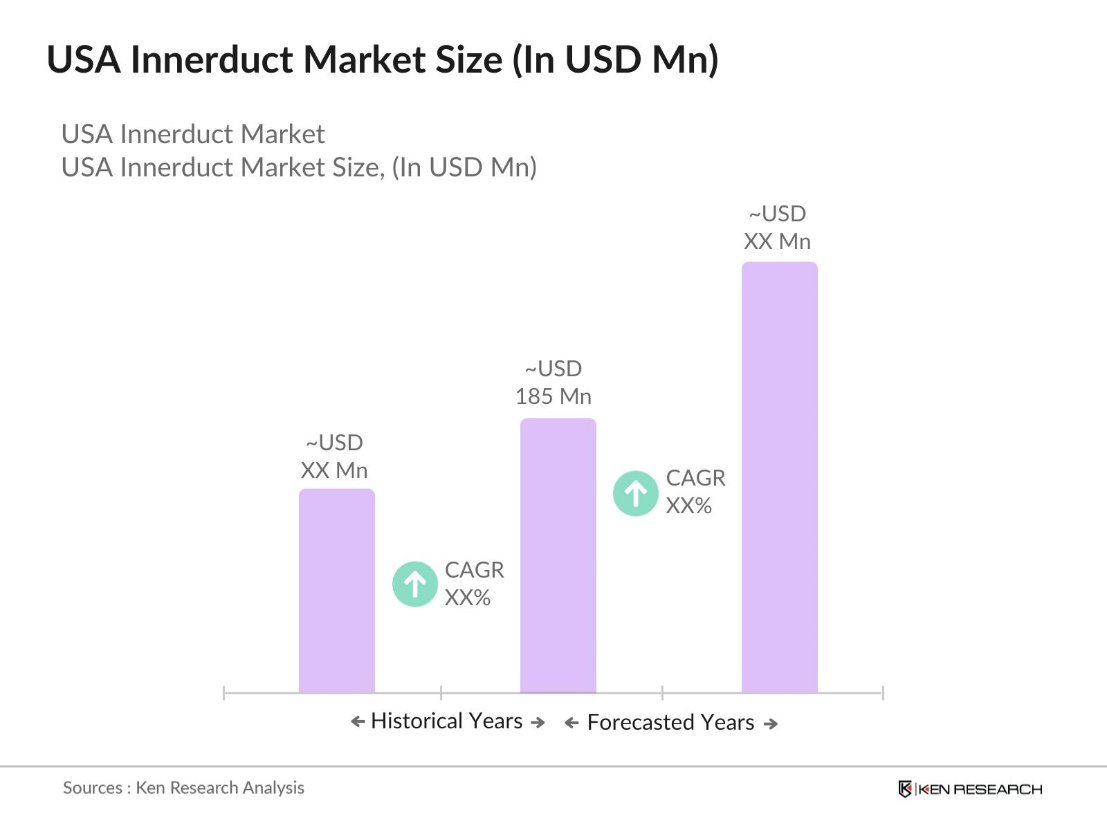
- Key cities like New York, Chicago, and Los Angeles dominate the market due to their advanced telecommunication infrastructure and high demand for underground utilities. These cities have seen significant investments in fiber-optic network expansions and urban infrastructure modernization, which requires durable innerduct solutions to house and protect these installations. Furthermore, these cities dense populations and ongoing urbanization make them central to the demand for such infrastructure products.
- Environmental regulations governing the construction of underground utilities have become more stringent, requiring compliance with federal and state guidelines. In 2023, the Environmental Protection Agency (EPA) updated its standards for underground utility installations, mandating the use of environmentally friendly materials and methods that minimize soil disruption and habitat destruction.
USA Innerduct Market Segmentation
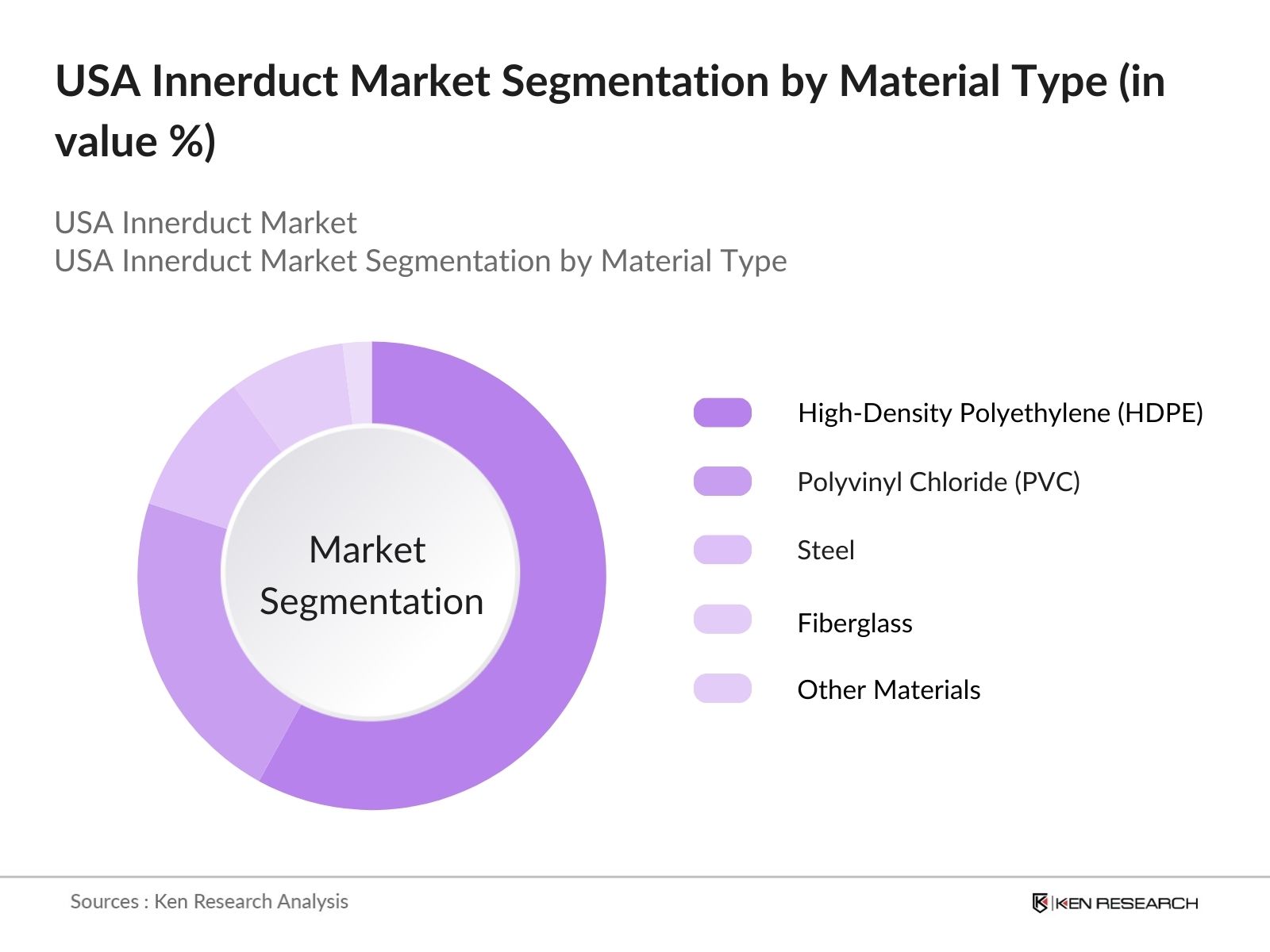
By Material Type: The USA Innerduct market is segmented by material type into High-Density Polyethylene (HDPE), Polyvinyl Chloride (PVC), Steel, Fiberglass, and Other Materials. Recently, HDPE innerducts have dominated the market due to their flexibility, low cost, and ease of installation. The materials resistance to moisture, chemicals, and abrasion makes it ideal for long-term underground applications, particularly in telecommunications and power distribution. The growth in the fiber-optic and broadband industry further propels the use of HDPE in various infrastructure projects.
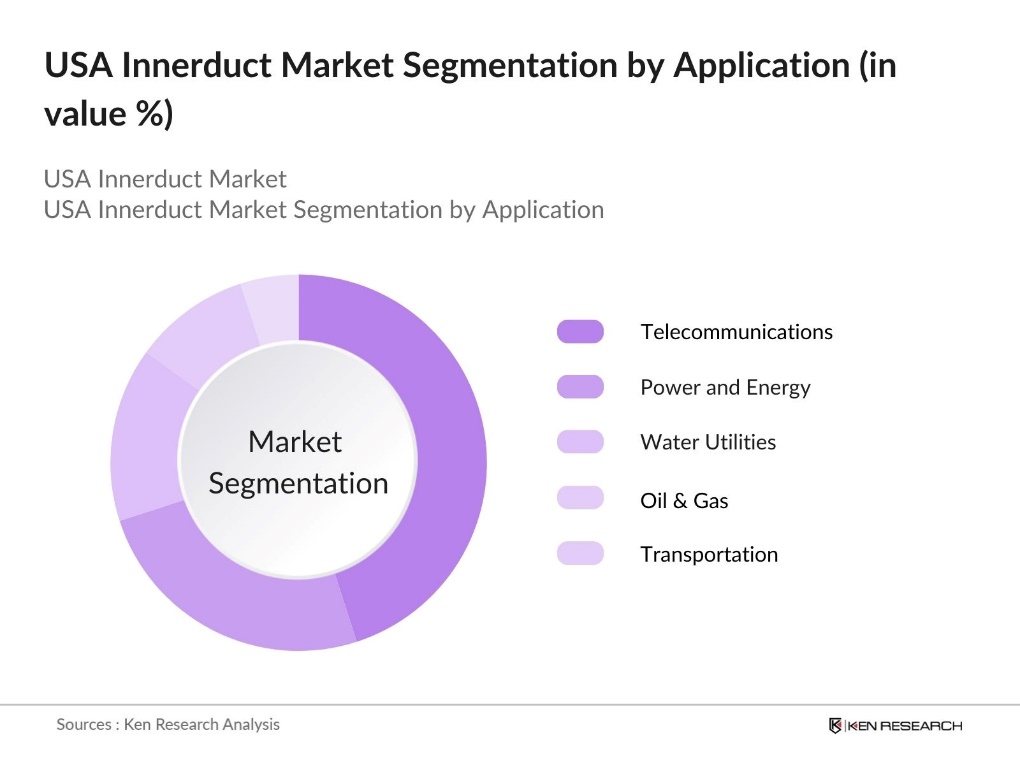
By Application: The USA Innerduct market is also segmented by application into Telecommunications, Power and Energy, Water Utilities, Oil & Gas, and Transportation. The Telecommunications sector holds the largest market share due to the ongoing expansion of fiber-optic networks and the rollout of 5G infrastructure. This growth is fueled by both government incentives and private sector investments in digital infrastructure, which are crucial for achieving faster and more reliable internet access across the country.
USA Innerduct Market Competitive Landscape
The USA Innerduct market is dominated by several key players, each of which has played a significant role in shaping the competitive dynamics. These companies leverage their market expertise, manufacturing capacity, and geographic presence to maintain dominance in the market. Additionally, partnerships with key industries such as telecommunications and power utilities further consolidate their leadership positions.
|
Company |
Establishment Year |
Headquarters |
No. of Employees |
Revenue |
R&D Expenditure |
Market Share (%) |
Key Product Lines |
Geographic Presence |
|
Dura-Line Corporation |
1971 |
Knoxville, Tennessee |
||||||
|
Prime Conduit |
1999 |
Houston, Texas |
||||||
|
ABB (Thomas & Betts) |
1891 |
Zurich, Switzerland |
||||||
|
United Poly Systems |
2011 |
Springfield, Missouri |
||||||
|
Endot Industries Inc. |
1986 |
Rockaway, New Jersey |
USA Innerduct Industry Analysis
Growth Drivers
- Increased Demand for Fiber Optics: The growing demand for high-speed internet and reliable telecommunications is driving the need for fiber optic networks in the USA. The FCC has reported significant growth in fiber optic connections, particularly noting an increase from 16.3 million to 24.2 million residential fiber connections between 2020 and 2022, which represents a 49% increase. This growth is particularly evident in urban and suburban regions as network providers push to enhance internet speeds and bandwidth, supporting a digital economy. This demand has created significant pressure on infrastructure, leading to the expansion of innerduct installations to house and protect these critical networks.
- Infrastructure Modernization: The U.S. government is investing heavily in infrastructure modernization through the Infrastructure Investment and Jobs Act (IIJA) of 2021, which provides $1.2 trillion, including $550 billion in new spending. This funding supports improvements in transportation, clean water, and broadband, driving demand for innerduct systems. These projects are essential for ensuring modern utilities like fiber optic networks function efficiently, especially in densely populated urban areas.
- Focus on Underground Utilities for Safety: To reduce the risk of damage from natural disasters and accidents, there is a growing emphasis on installing utilities underground, driving the innerduct market. Many new utility projects are opting for underground installations, particularly in disaster-prone regions. These installations play a crucial role in protecting and maintaining essential infrastructure, ensuring the durability and safety of utilities in areas where above-ground systems are more vulnerable to disruption.
Market Challenges
- High Installation Costs: The installation of innerduct systems involves significant expenses due to the high costs of materials, labor, and advanced technology. The specialized nature of the work requires skilled labor, adding to the overall cost. Additionally, fluctuations in material prices, such as those for high-density polyethylene (HDPE), further increase installation expenses. These challenges can be particularly burdensome for smaller utility companies and rural areas, where budget constraints are more pronounced.
- Regulatory Constraints on Construction: The regulatory framework for construction in the U.S. adds complexity to innerduct installations. Federal and state regulations related to environmental compliance and land use can lead to delays in project approvals. These regulatory hurdles often extend the timeline for underground utility projects, making it more difficult to deploy innerduct systems in a timely manner.
USA Innerduct Market Future Outlook
Over the next five years, the USA Innerduct market is expected to witness steady growth driven by increasing investments in telecommunications infrastructure, particularly fiber-optic networks, and the expansion of 5G. The demand for innerduct solutions will also rise in the energy and transportation sectors due to ongoing modernization efforts. Innovations in materials, such as more durable and flexible HDPE variants, are anticipated to support this market growth.
Market Opportunities
- Expansion in Rural Areas: Efforts to improve broadband access in rural areas are creating new opportunities for innerduct installations. Government initiatives focused on expanding high-speed internet in underserved communities are driving demand for underground conduit systems. These systems are crucial for safely housing fiber optic cables, ensuring reliable internet connections in remote areas. As more rural projects move forward, the need for innerduct solutions is expected to grow, supporting the broader push for enhanced rural connectivity.
- Technological Advancements in Materials: Advancements in innerduct materials, particularly the use of high-density polyethylene (HDPE) and other advanced polymers, are opening new opportunities in the market. HDPE is valued for its flexibility, durability, and resistance to environmental stress, making it an ideal choice for modern installations. Ongoing research into biodegradable materials could also reduce the environmental impact of future innerduct projects, promoting more sustainable infrastructure development in the years ahead.
Scope of the Report
|
Material Type |
HDPE PVC Steel Fiberglass |
|
Application |
Telecom Power & Energy Water Oil & Gas Transportation |
|
Installation Method |
Direct Bury Aerial Trenching Subducting |
|
Diameter |
<1 Inch 1-2 Inches 2-4 Inches >4 Inches |
|
Region |
Northeast Midwest South West |
Products
Key Target Audience
Telecommunications Companies
Construction and Infrastructure Development Firms
Engineering, Procurement, and Construction (EPC) Contractors
Manufacturing Companies (Materials and Conduits)
Investors and venture capital Firms
Banks and Financial Institutions
Government and Regulatory Bodies (FCC, Department of Energy)
Companies
Players Mentioned in the Report
Dura-Line Corporation
Prime Conduit
ABB (Thomas & Betts)
United Poly Systems
Endot Industries Inc.
Blue Diamond Industries
Pipelife International
Alpha Wire
FiberTel
Arnco Corporation
Table of Contents
1. USA Innerduct Market Overview
1.1 Definition and Scope
1.2 Market Taxonomy
1.3 Market Growth Rate (Fiber-optic infrastructure expansion, demand for underground conduits)
1.4 Market Segmentation Overview
2. USA Innerduct Market Size (In USD Mn)
2.1 Historical Market Size
2.2 Year-On-Year Growth Analysis
2.3 Key Market Developments and Milestones
3. USA Innerduct Market Analysis
3.1 Growth Drivers
3.1.1 Increased Demand for Fiber Optics
3.1.2 Infrastructure Modernization
3.1.3 Energy and Telecom Sector Growth
3.1.4 Focus on Underground Utilities for Safety
3.2 Market Challenges
3.2.1 High Installation Costs
3.2.2 Regulatory Constraints on Construction
3.2.3 Complexities in Retrofitting Existing Systems
3.3 Opportunities
3.3.1 Smart City Initiatives
3.3.2 Expansion in Rural Areas
3.3.3 Technological Advancements in Materials
3.4 Trends
3.4.1 Use of HDPE Materials
3.4.2 Prefabricated Solutions
3.4.3 Microduct Innovations
3.5 Government Regulations
3.5.1 FCC Regulations on Underground Conduit Installation
3.5.2 Infrastructure Bills and Funding
3.5.3 Environmental Compliance in Construction
3.5.4 Public-Private Partnerships
3.6 SWOT Analysis
3.7 Stakeholder Ecosystem
3.8 Porters Five Forces
3.9 Competition Ecosystem
4. USA Innerduct Market Segmentation
4.1 By Material Type (In Value %)
4.1.1 High-Density Polyethylene (HDPE)
4.1.2 Polyvinyl Chloride (PVC)
4.1.3 Steel
4.1.4 Fiberglass
4.1.5 Other Materials
4.2 By Application (In Value %)
4.2.1 Telecom
4.2.2 Power and Energy
4.2.3 Water Utilities
4.2.4 Oil & Gas
4.2.5 Transportation
4.3 By Installation Method (In Value %)
4.3.1 Direct Bury
4.3.2 Aerial
4.3.3 Trenching
4.3.4 Subducting
4.4 By Diameter (In Value %)
4.4.1 <1 Inch
4.4.2 1-2 Inches
4.4.3 2-4 Inches
4.4.4 >4 Inches
4.5 By Region (In Value %)
4.5.1 Northeast
4.5.2 Midwest
4.5.3 South
4.5.4 West
5. USA Innerduct Market Competitive Analysis
5.1 Detailed Profiles of Major Companies
5.1.1 Dura-Line Corporation
5.1.2 Prime Conduit
5.1.3 ABB (Thomas & Betts)
5.1.4 Atkore International
5.1.5 Blue Diamond Industries
5.1.6 Endot Industries Inc.
5.1.7 United Poly Systems
5.1.8 Pipelife International
5.1.9 Alpha Wire
5.1.10 FiberTel
5.1.11 Arnco Corporation
5.1.12 Kraloy Fittings
5.1.13 IPEX Inc.
5.1.14 Milliken Infrastructure Solutions
5.1.15 Condux International
5.2 Cross Comparison Parameters (Revenue, Production Capacity, Market Share, Technology Adoption, Number of Patents, Geographic Presence, R&D Expenditure, Sustainability Initiatives)
5.3 Market Share Analysis
5.4 Strategic Initiatives
5.5 Mergers and Acquisitions
5.6 Investment Analysis
5.7 Venture Capital Funding
5.8 Government Grants
5.9 Private Equity Investments
6. USA Innerduct Market Regulatory Framework
6.1 Construction Standards (ASTM, UL, NEMA)
6.2 Compliance Requirements (Environmental, Zoning, Utility Access)
6.3 Certification Processes (Material Safety, Fire Resistance)
7. USA Innerduct Future Market Size (In USD Mn)
7.1 Future Market Size Projections
7.2 Key Factors Driving Future Market Growth
8. USA Innerduct Future Market Segmentation
8.1 By Material Type (In Value %)
8.2 By Application (In Value %)
8.3 By Installation Method (In Value %)
8.4 By Diameter (In Value %)
8.5 By Region (In Value %)
9. USA Innerduct Market Analysts Recommendations
9.1 TAM/SAM/SOM Analysis
9.2 Customer Cohort Analysis
9.3 Marketing Initiatives
9.4 White Space Opportunity Analysis
Research Methodology
Step 1: Identification of Key Variables
The initial phase of research focuses on mapping all significant stakeholders within the USA Innerduct Market. Comprehensive desk research is conducted using a combination of secondary databases and proprietary sources to collect industry-level data. This allows us to identify and outline the key variables that influence market growth.
Step 2: Market Analysis and Construction
In this step, historical data pertaining to the market's growth trajectory and infrastructure development are compiled. This includes assessing the penetration of fiber-optic networks and conduit installations across key sectors. The data is analyzed to ensure accuracy in revenue estimates and market sizing.
Step 3: Hypothesis Validation and Expert Consultation
Hypotheses developed during the market analysis are validated through direct consultations with industry experts and professionals. These consultations provide insights into key operational and financial aspects of the market, enabling us to refine and corroborate the gathered data.
Step 4: Research Synthesis and Final Output
The final phase synthesizes all the research findings, validating the data through bottom-up approaches. The report concludes with an in-depth analysis of market segments, trends, and strategic initiatives undertaken by major players in the USA Innerduct market.
Frequently Asked Questions
01. How big is the USA Innerduct Market?
The USA Innerduct Market is valued at USD 185 million, driven by rising demand in fiber-optic networks and underground utility applications across various industries.
02. What are the challenges in the USA Innerduct Market?
The key challenges in USA Innerduct Market include high installation costs, regulatory hurdles, and difficulties in retrofitting existing infrastructure with new innerduct solutions.
03. Who are the major players in the USA Innerduct Market?
Key players in the USA Innerduct Market include Dura-Line Corporation, Prime Conduit, ABB (Thomas & Betts), United Poly Systems, and Endot Industries Inc.
04. What are the growth drivers of the USA Innerduct Market?
The USA Innerduct Market is propelled by the expansion of fiber-optic networks, the rollout of 5G infrastructure, and increasing investments in modernizing energy and utility sectors.
Why Buy From Us?

What makes us stand out is that our consultants follows Robust, Refine and Result (RRR) methodology. i.e. Robust for clear definitions, approaches and sanity checking, Refine for differentiating respondents facts and opinions and Result for presenting data with story

We have set a benchmark in the industry by offering our clients with syndicated and customized market research reports featuring coverage of entire market as well as meticulous research and analyst insights.

While we don't replace traditional research, we flip the method upside down. Our dual approach of Top Bottom & Bottom Top ensures quality deliverable by not just verifying company fundamentals but also looking at the sector and macroeconomic factors.

With one step in the future, our research team constantly tries to show you the bigger picture. We help with some of the tough questions you may encounter along the way: How is the industry positioned? Best marketing channel? KPI's of competitors? By aligning every element, we help maximize success.

Our report gives you instant access to the answers and sources that other companies might choose to hide. We elaborate each steps of research methodology we have used and showcase you the sample size to earn your trust.

If you need any support, we are here! We pride ourselves on universe strength, data quality, and quick, friendly, and professional service.