















USA Jet Aviation Market Outlook to 2030
Region:North America
Author(s):Shubham
Product Code:KROD6133
November 2024
91
About the Report
USA Jet Aviation Market Overview
- The USA Jet Aviation Market is valued at USD 15 billion, primarily driven by the rising demand for corporate travel and luxury air services. The market's growth is propelled by a surge in high-net-worth individuals, corporations, and the need for quick, efficient travel solutions. Technological advancements in jet design, enhanced fuel efficiency, and service personalization further drive market expansion, positioning jet aviation as an essential component in the premium travel and transport sector.
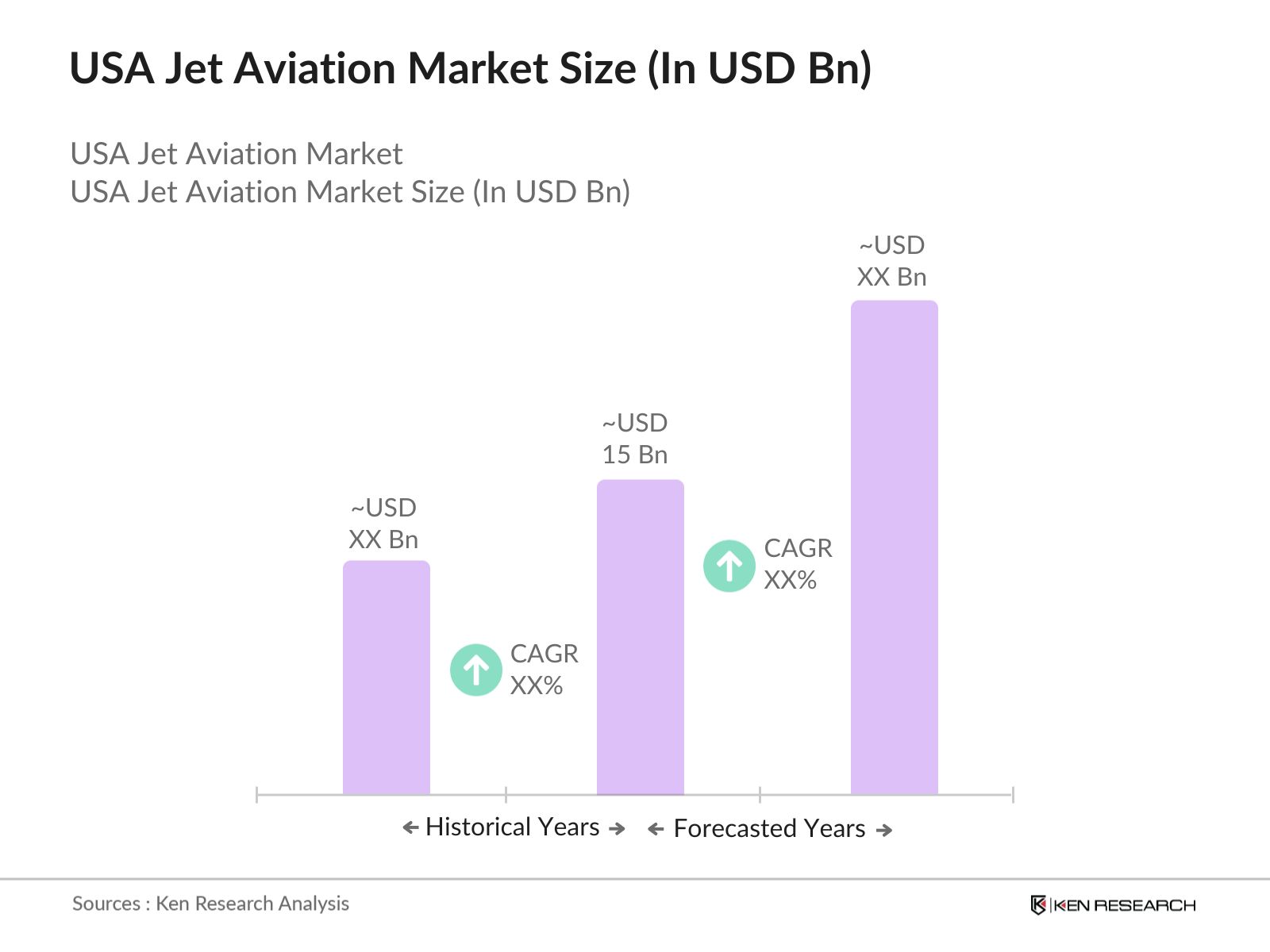
- Dominant regions in the USA Jet Aviation Market include New York, California, and Texas. These states stand out due to high concentrations of affluent individuals, corporate hubs, and advanced aviation infrastructure, all of which contribute to increased demand for private and business jet services. New York leads with its dense corporate landscape, California excels in innovation-driven aviation services, and Texas benefits from its strong industrial base, making these states critical to market growth.
- The U.S. jet aviation market operates under stringent FAA regulations, covering pilot certification, aircraft maintenance, and operational standards. In 2024, the FAA introduced additional compliance requirements focused on enhanced aircraft safety protocols, impacting nearly 1,500 jet operators. These regulations are essential to maintaining high operational standards but require significant adherence costs for operators.
USA Jet Aviation Market Segmentation
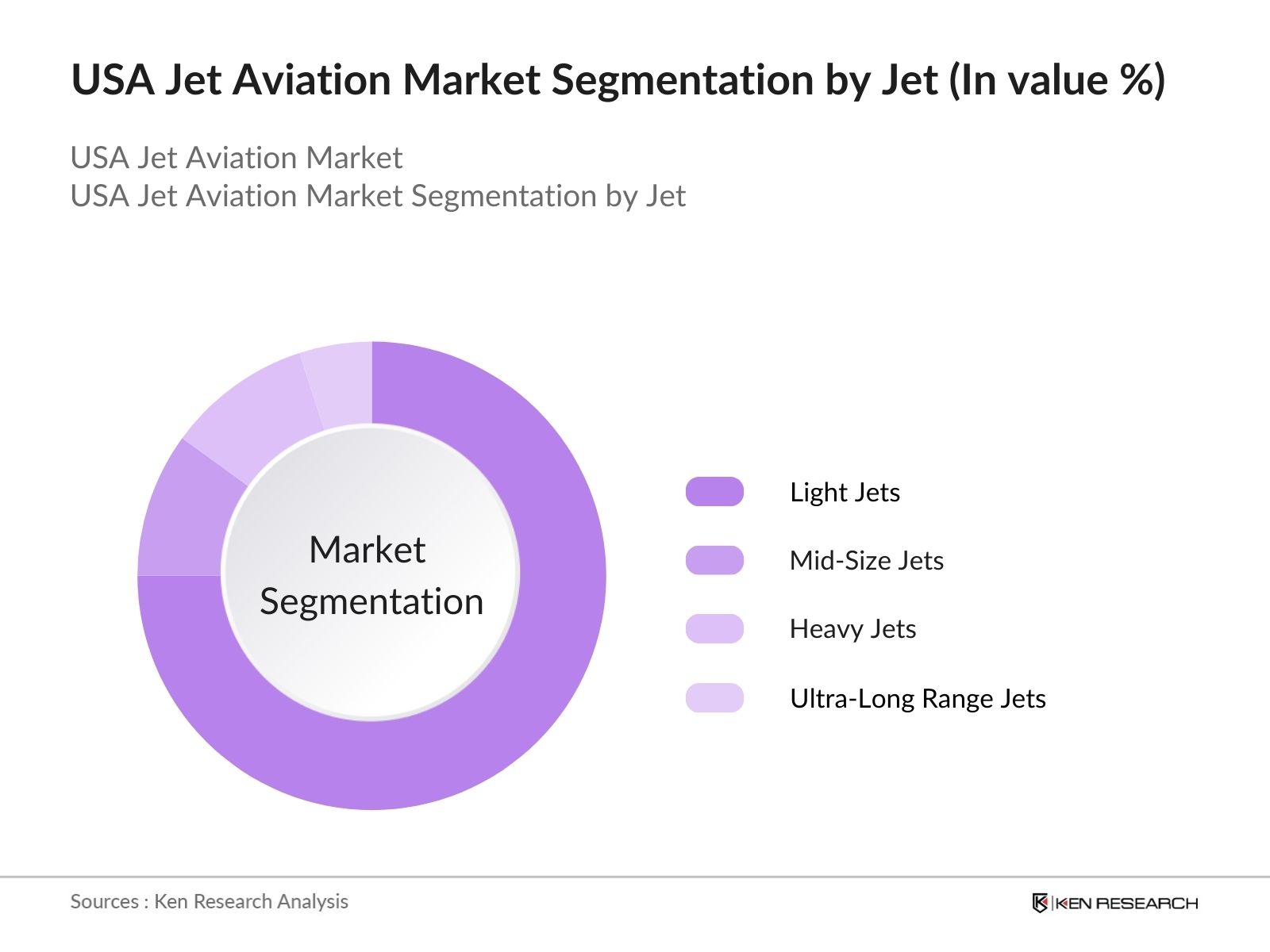
- By Jet Type: The Market is segmented by jet type into Light Jets, Mid-Size Jets, Heavy Jets, and Ultra-Long-Range Jets. Heavy Jets command a dominant market share due to their capability to cover long distances with larger passenger capacities, catering to corporate clients who prioritize luxury and efficiency. Leading business executives and high-net-worth individuals prefer heavy jets for long-haul flights, as these aircraft offer advanced features, luxurious interiors, and superior performance.
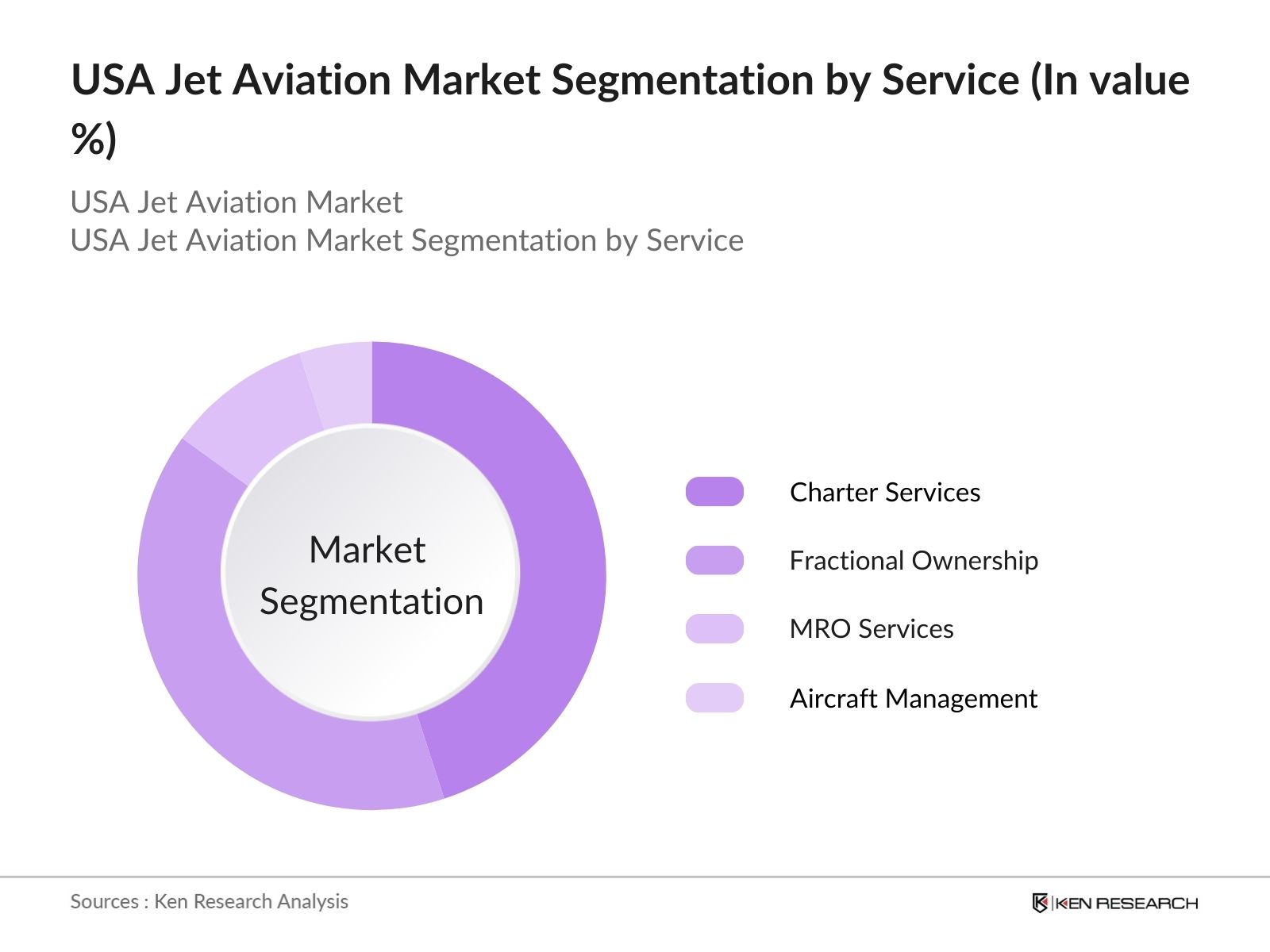
- By Service Type: The Market is further segmented by service type into Charter Services, Fractional Ownership, MRO Services, and Aircraft Management. Charter Services lead the market, supported by the flexibility and convenience they provide to individuals and corporate clients seeking on-demand air travel without long-term ownership commitments. This segment caters primarily to high-net-worth individuals and businesses looking for customizable travel options that align with their specific schedules and preferences.
USA Jet Aviation Market Competitive Landscape
The USA Jet Aviation Market is highly competitive, with established players leading through innovation in jet design, efficiency, and customer service. These companies focus on expanding fleet capabilities, increasing service personalization, and ensuring regulatory compliance to maintain their market positions. Strategic partnerships, high R&D investment, and exclusive services have become crucial for these players to secure loyal clientele and government contracts.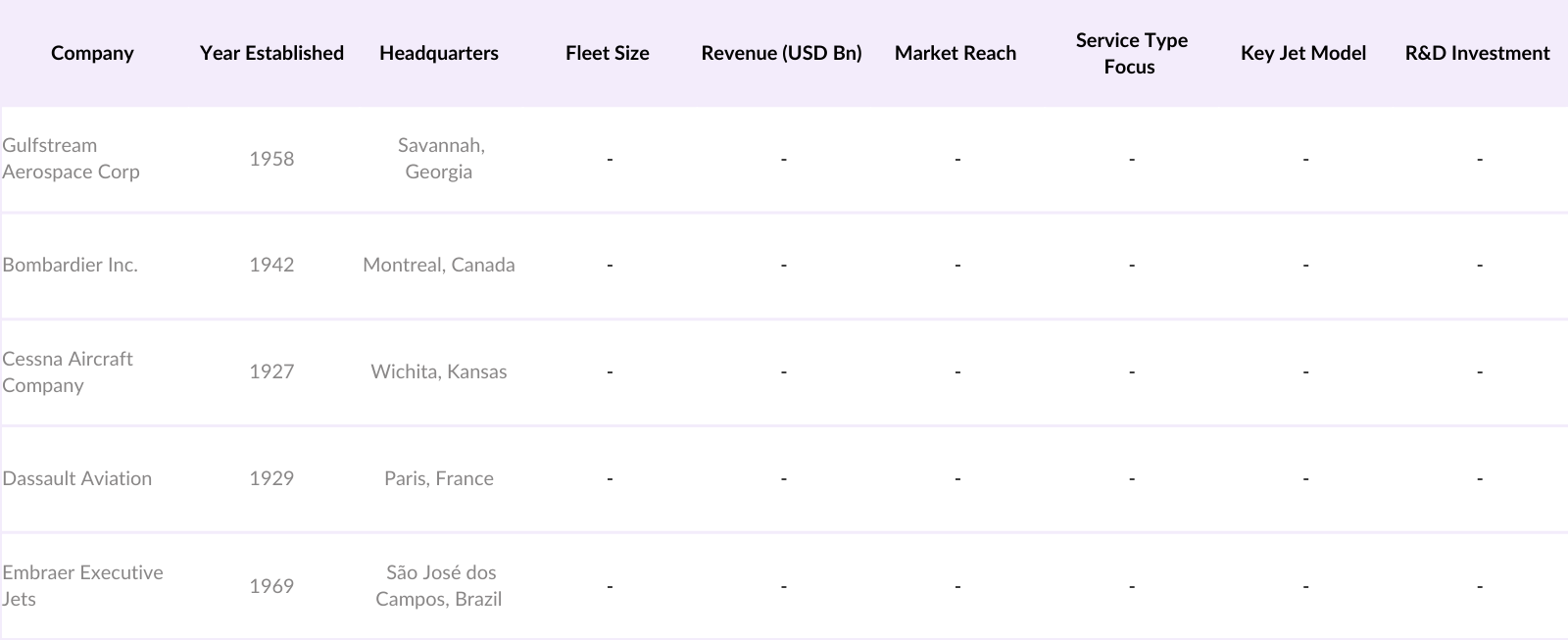
USA Jet Aviation Market Analysis
Growth Drivers
- Rising Demand for Corporate Travel: In 2024, the demand for business jets in the USA has surged, largely due to increased corporate travel needs and a shift towards private aviation amid public health concerns. Data from the Federal Aviation Administration (FAA) indicates that sales of preowned private aircraft increased by 5.9% year-over-year in early 2024. Business executives and high-net-worth individuals increasingly opt for private travel, a trend that has bolstered this segment, showing substantial preference for newer jets equipped with high-efficiency engines and advanced avionics.
- Technological Advancements in Jet Manufacturing: Advancements in jet propulsion technology, especially in fuel efficiency, continue to drive growth. The FAA has reported that new-generation engines, which reduce fuel consumption by up to 20%, are now equipped in thousands of jets within the U.S., significantly impacting operational costs and environmental footprint. This adoption of efficient propulsion systems, supported by continuous R&D investments, has been instrumental in promoting market growth and enhancing operational efficiency.
- Expansion of Charter Services: The U.S. charter services segment has seen accelerated growth, with a rise in consumer interest in flexible travel options and frequent short-haul trips. The FAA recorded nearly 5 million private flight hours in 2023, growing consistently into 2024 due to high demand from business and leisure travelers. Charter service providers have expanded their fleets to meet this demand, particularly with midsize and light jets, making this segment a notable growth driver for the jet aviation industry in the United States.
Challenges
- High Operating and Maintenance Costs: Operating and maintenance costs remain a significant barrier in the U.S. jet aviation market. The upkeep of a midsize jet involves extensive maintenance protocols, covering everything from routine inspections to comprehensive engine overhauls. Fuel expenses also add to the cost burden, often fluctuating in response to global oil prices, which directly impacts operational budgets. This high cost structure associated with jet maintenance creates financial constraints, particularly for independent operators and charter companies that lack the economies of scale enjoyed by larger corporations. As a result, maintaining profitability while delivering reliable service is a persistent challenge for industry players.
- Stringent Regulatory Environment: Compliance with FAA regulations, which encompass safety inspections, emission standards, and environmental considerations, represents a costly challenge for operators. Since 2022, the FAA has progressively tightened airworthiness requirements, pushing for advanced safety and emissions benchmarks across the industry. Smaller operators, in particular, face financial strain as they work to meet these evolving standards, which often require frequent and costly fleet upgrades. This regulatory pressure, while crucial for maintaining safety, impacts overall operational scalability and efficiency, with many operators needing to balance compliance costs against operational expansion initiatives.
USA Jet Aviation Market Future Outlook
The USA Jet Aviation Market is anticipated to expand for the next five years, driven by technological advancements, rising demand for luxury travel, and a growing base of corporate clients. Companies are likely to invest in fleet modernization and eco-friendly jets to align with regulatory requirements and meet evolving consumer preferences. The integration of sustainable aviation fuels, digital services for enhanced passenger experiences, and global service expansion are expected to support market growth, fostering long-term resilience.
Future Market Opportunities
- Expansion into Emerging Markets: Emerging markets, particularly in Latin America and the Middle East, present notable expansion opportunities for U.S.-based jet operators. In 2024, the FAA recorded a substantial increase in permits granted for flights to these regions, totaling over two thousand for Latin America alone. This market expansion enables U.S. jet operators to tap into growing demand abroad, fueled by rising economic prosperity and an increasing affinity for private aviation. This trend aligns with broader global market dynamics, allowing U.S. operators to establish a competitive presence in these high-potential areas.
- Integration of Advanced Avionics: Advancements in avionics technology offer significant growth opportunities for the U.S. jet aviation market. The FAA has reported that the majority of new private jets now incorporate advanced avionics suites, enhancing fuel efficiency, safety, and connectivity. These technological upgrades appeal to a market increasingly drawn to state-of-the-art features, supporting both enhanced flight experiences and operational efficiency across fleets. The push towards advanced avionics also aligns with industry goals to modernize fleets, offering competitive advantages in performance and customer satisfaction.
Scope of the Report
|
By Aircraft Type |
Light Jets Mid-Size Jets Heavy Jets Ultra-Long Range Jets |
|
By Service Type |
Charter Services Fractional Ownership MRO Services Aircraft Management |
|
By End User |
Corporates Individuals Government & Defense |
|
By Region |
North East West Coast Southern States Central USA |
|
By Technology |
Hybrid Propulsion Electric Engines Fuel Cell Technology |
Products
Key Target Audience
Jet Charter Companies
Aviation Service Providers
Airports and Private Airfields
Government and Regulatory Bodies (FAA, TSA)
Investors and Venture Capitalist Firms
Banks and Financial Institutions
Luxury Travel Agencies
Corporate Flight Departments
Companies
Players Mentioned in the Report
Gulfstream Aerospace Corporation
Bombardier Inc.
Cessna Aircraft Company
Dassault Aviation
Embraer Executive Jets
Textron Aviation Inc.
Airbus Corporate Jets
Boeing Business Jets
Pilatus Aircraft Ltd.
Honda Aircraft Company
Cirrus Aircraft
Nextant Aerospace
One Aviation
SyberJet Aircraft
Eclipse Aerospace
Table of Contents
1. USA Jet Aviation Market Overview
1.1 Definition and Scope
1.2 Market Taxonomy
1.3 Market Growth Rate
1.4 Market Segmentation Overview
2. USA Jet Aviation Market Size (in USD Mn)
2.1 Historical Market Size
2.2 Year-On-Year Growth Analysis
2.3 Key Market Developments and Milestones
3. USA Jet Aviation Market Analysis
3.1 Growth Drivers [Aircraft Demand, Charter Services, Premium Services, Fleet Modernization]
3.2 Market Challenges [Fuel Costs, Regulatory Compliance, Pilot Shortages, Environmental Concerns]
3.3 Opportunities [New Market Entrants, Luxury and Comfort Innovations, MRO Expansion, Technological Integration]
3.4 Trends [Sustainable Aviation, Electric Jets, Blockchain in Maintenance, Increased Private Ownership]
3.5 Regulatory Framework [FAA Compliance, Emission Standards, Safety Protocols, Environmental Regulations]
3.6 SWOT Analysis
3.7 Stakeholder Ecosystem
3.8 Porters Five Forces Analysis
3.9 Competitive Landscape Overview
4. USA Jet Aviation Market Segmentation
4.1 By Aircraft Type (in Value %)
4.1.1 Light Jets
4.1.2 Mid-Size Jets
4.1.3 Heavy Jets
4.1.4 Ultra-Long Range Jets
4.2 By Service Type (in Value %)
4.2.1 Charter Services
4.2.2 Fractional Ownership
4.2.3 MRO Services
4.2.4 Aircraft Management
4.3 By End User (in Value %)
4.3.1 Corporates
4.3.2 Individuals
4.3.3 Government & Defense
4.4 By Region (in Value %)
4.4.1 North East
4.4.2 West Coast
4.4.3 Southern States
4.4.4 Central USA
4.5 By Technology (in Value %)
4.5.1 Hybrid Propulsion
4.5.2 Electric Engines
4.5.3 Fuel Cell Technology
5. USA Jet Aviation Market Competitive Analysis
5.1 Profiles of Major Companies
5.1.1 Gulfstream Aerospace Corporation
5.1.2 Bombardier Inc.
5.1.3 Cessna Aircraft Company
5.1.4 Dassault Aviation
5.1.5 Embraer Executive Jets
5.1.6 Textron Aviation Inc.
5.1.7 Airbus Corporate Jets
5.1.8 Boeing Business Jets
5.1.9 Pilatus Aircraft Ltd.
5.1.10 Honda Aircraft Company
5.1.11 Cirrus Aircraft
5.1.12 Nextant Aerospace
5.1.13 One Aviation
5.1.14 SyberJet Aircraft
5.1.15 Eclipse Aerospace
5.2 Cross Comparison Parameters [Fleet Size, Manufacturing Locations, Technology Offerings, Year Established, Revenue, Market Share, R&D Investment, Target Market]
5.3 Market Share Analysis
5.4 Strategic Initiatives
5.5 Mergers and Acquisitions
5.6 Investment Analysis
5.7 Venture Capital Funding
5.8 Government Grants
5.9 Private Equity Investments
6. USA Jet Aviation Market Regulatory Framework
6.1 FAA Regulations
6.2 Emission Standards
6.3 Certification Processes
6.4 Compliance Requirements
7. USA Jet Aviation Future Market Size (in USD Mn)
7.1 Market Size Projections
7.2 Key Factors Driving Future Growth
8. USA Jet Aviation Future Market Segmentation
8.1 By Aircraft Type (in Value %)
8.2 By Service Type (in Value %)
8.3 By End User (in Value %)
8.4 By Region (in Value %)
8.5 By Technology (in Value %)
9. USA Jet Aviation Market Analysts Recommendations
9.1 TAM/SAM/SOM Analysis
9.2 Customer Cohort Analysis
9.3 Marketing Initiatives
9.4 White Space Opportunity Analysis
Disclaimer Contact UsResearch Methodology
Step 1: Identification of Key Variables
The initial phase involves constructing an ecosystem map to outline stakeholders within the USA Jet Aviation Market. Extensive desk research, supported by proprietary and secondary data sources, is conducted to identify and define the key variables influencing market dynamics.
Step 2: Market Analysis and Construction
Historical data is analyzed to understand market trends, fleet capacity, and revenue generation in the USA Jet Aviation Market. This phase includes evaluating key metrics related to operational scale, fleet management, and service demand.
Step 3: Hypothesis Validation and Expert Consultation
Market hypotheses are validated through in-depth consultations with industry experts, offering insights into operational challenges, service demand, and financial forecasts. These expert inputs provide a comprehensive perspective on the markets development and growth.
Step 4: Research Synthesis and Final Output
The final phase synthesizes data from interviews and secondary sources, ensuring comprehensive and accurate findings. A bottom-up and top-down approach is employed for data verification, supporting the analysis of market dynamics and competitive positioning.
Frequently Asked Questions
01. How big is the USA Jet Aviation Market?
The USA Jet Aviation Market is valued at USD 15 billion, with growth driven by corporate travel demand and technological advancements in jet efficiency.
02. What are the main challenges in the USA Jet Aviation Market?
Challenges in the USA Jet Aviation Market include high operating costs and stringent environmental regulations, which require significant investment in energy-efficient jets.
03. Who are the major players in the USA Jet Aviation Market?
Key players in the USA Jet Aviation Market include Gulfstream Aerospace, Bombardier, Dassault Aviation, Embraer Executive Jets, and Textron Aviation Inc., each with unique fleet and service offerings.
04. What drives growth in the USA Jet Aviation Market?
The USA Jet Aviation Market is driven by rising demand for luxury travel, corporate jet services, and advancements in jet technology, which enhance passenger experience and efficiency.
Why Buy From Us?

What makes us stand out is that our consultants follows Robust, Refine and Result (RRR) methodology. i.e. Robust for clear definitions, approaches and sanity checking, Refine for differentiating respondents facts and opinions and Result for presenting data with story

We have set a benchmark in the industry by offering our clients with syndicated and customized market research reports featuring coverage of entire market as well as meticulous research and analyst insights.

While we don't replace traditional research, we flip the method upside down. Our dual approach of Top Bottom & Bottom Top ensures quality deliverable by not just verifying company fundamentals but also looking at the sector and macroeconomic factors.

With one step in the future, our research team constantly tries to show you the bigger picture. We help with some of the tough questions you may encounter along the way: How is the industry positioned? Best marketing channel? KPI's of competitors? By aligning every element, we help maximize success.

Our report gives you instant access to the answers and sources that other companies might choose to hide. We elaborate each steps of research methodology we have used and showcase you the sample size to earn your trust.

If you need any support, we are here! We pride ourselves on universe strength, data quality, and quick, friendly, and professional service.