















USA Kosher Beef Market Outlook to 2030
Region:North America
Author(s):Mukul
Product Code:KROD4336
October 2024
86
About the Report
USA Kosher Beef Market Overview
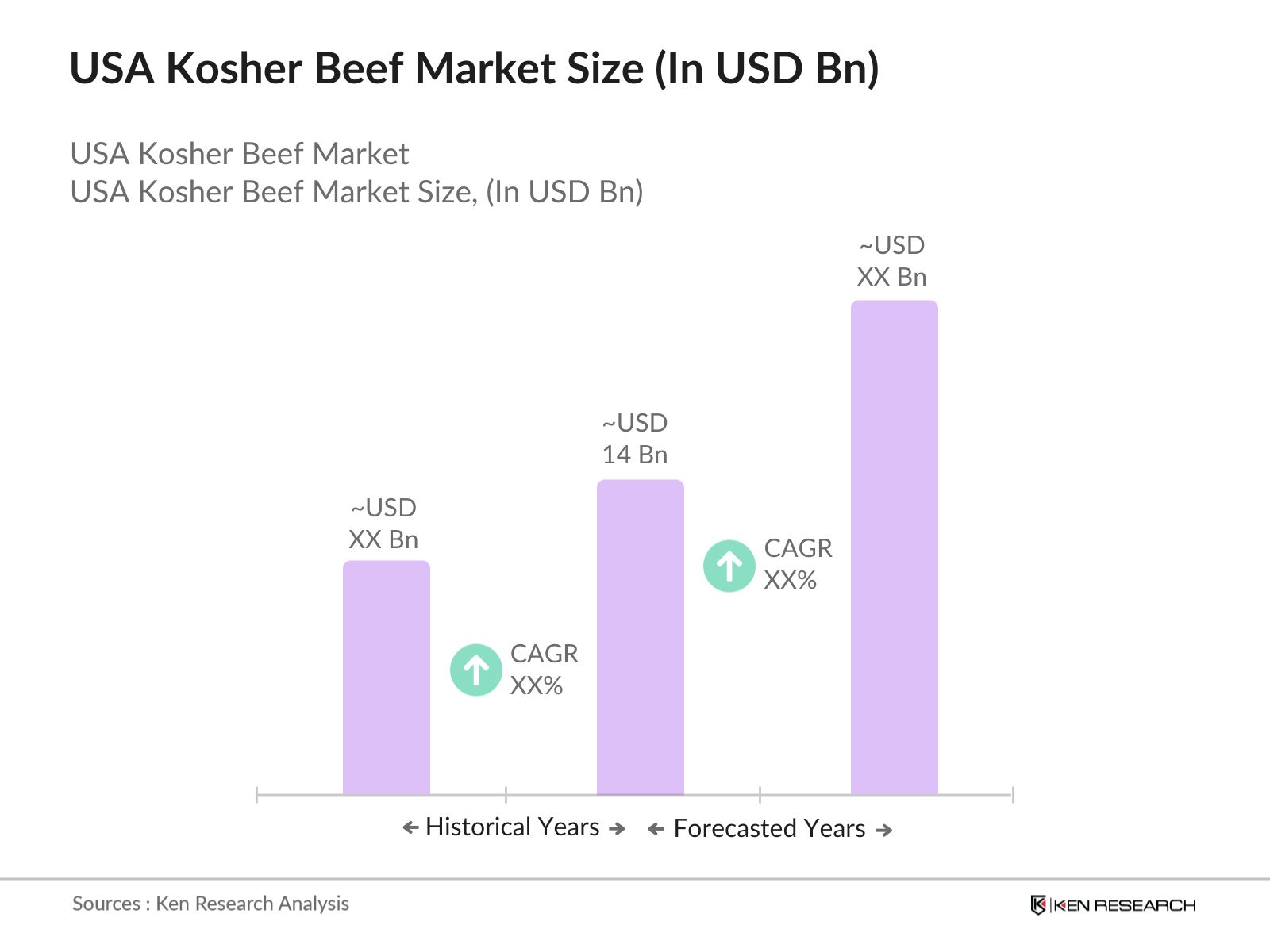
- The USA Kosher Beef market is valued at USD 14 billion, based on a five-year historical analysis. This growth is largely driven by increased demand for ethically sourced and religiously compliant products, especially in metropolitan areas with significant Jewish populations. Furthermore, rising health-conscious consumer behaviors, which perceive kosher products as cleaner and healthier, have contributed to the steady increase in demand for kosher beef. Major retail chains and e-commerce platforms have also expanded their kosher offerings, adding to the market's growth trajectory.
- New York, Los Angeles, and Miami are the leading cities that dominate the kosher beef market. These cities have large Jewish populations and well-established kosher certification bodies, which ensure that products meet stringent kosher standards. The availability of specialized kosher retailers and the integration of kosher offerings in mainstream supermarkets further consolidate these regions as dominant markets for kosher beef. The influence of culturally diverse populations and strong demand for premium cuts also reinforces their leadership in this market.
- The USDA has strict guidelines for the production of kosher meat, ensuring that it meets both federal food safety standards and religious requirements. In 2024, the USDA issued updated regulations to accommodate kosher-specific practices, such as shechita, ensuring compliance with both religious and government standards. These guidelines help maintain the integrity of kosher beef in the market, ensuring that it meets consumer expectations for safety and religious observance.
USA Kosher Beef Market Segmentation
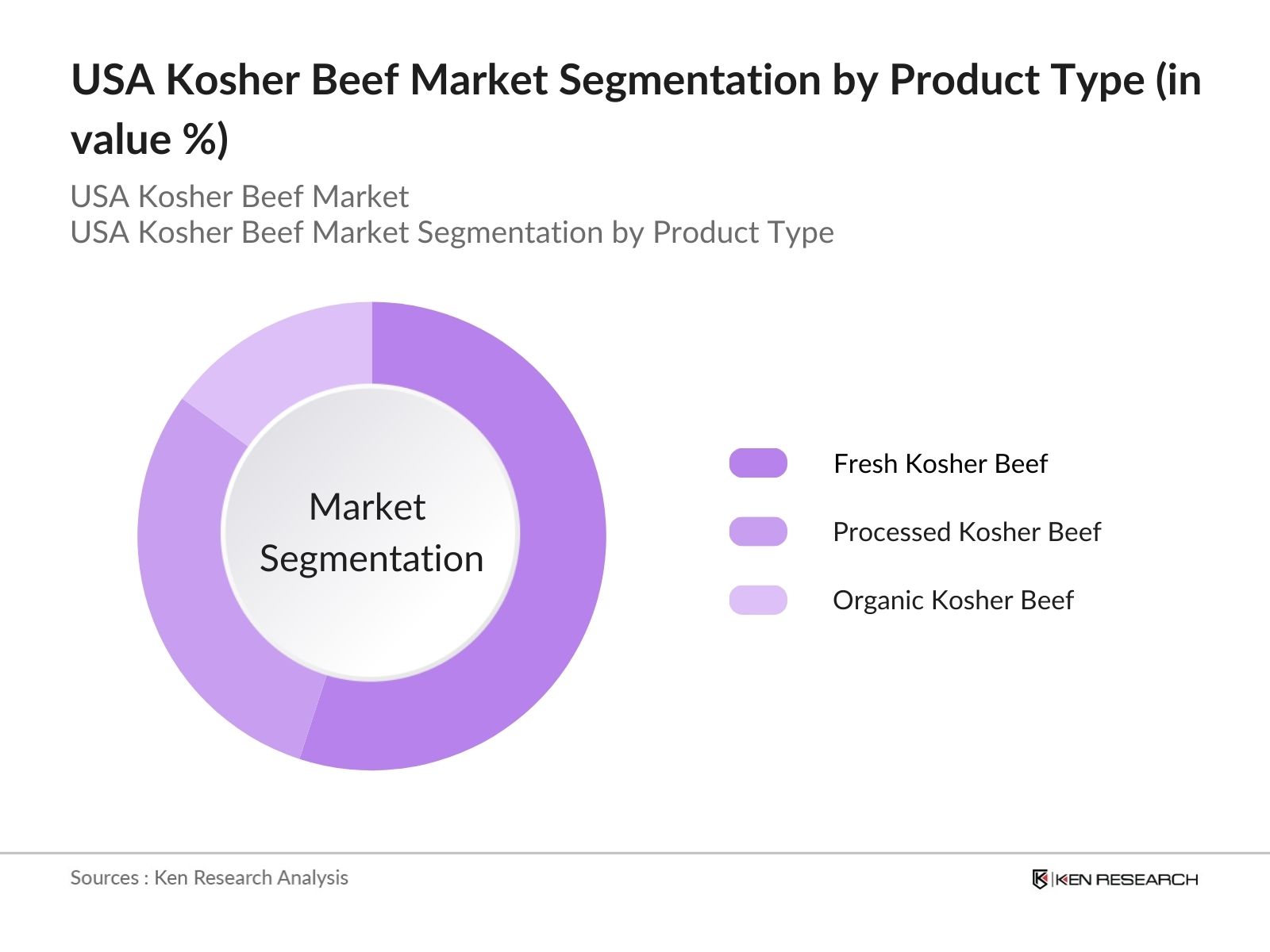
- By Product Type: The USA Kosher Beef market is segmented by product type into fresh kosher beef, processed kosher beef, and organic kosher beef. Among these, fresh kosher beef dominated the market, owing to the traditional preference for freshly slaughtered and prepared beef that complies with kosher laws. Jewish communities, particularly in larger urban centers, often prioritize fresh products for religious observance. Additionally, premium cuts such as brisket and ribeye, commonly used for traditional Jewish meals, further drive the demand for fresh kosher beef.
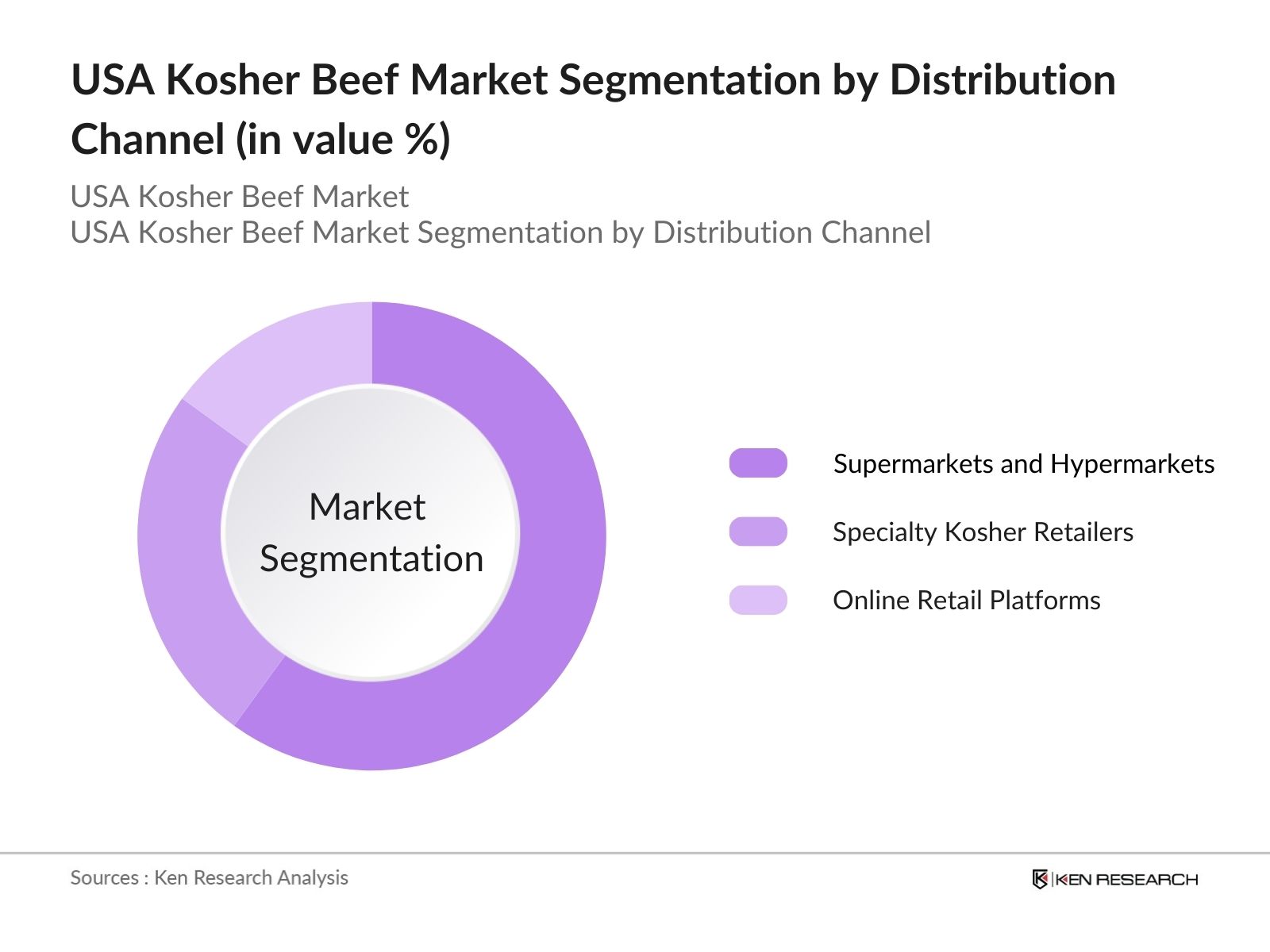
- By Distribution Channel: The USA Kosher Beef market is segmented by distribution channels into supermarkets and hypermarkets, specialty kosher retailers, and online retail platforms. Supermarkets and hypermarkets account for the dominated the market, as many mainstream retailers have incorporated kosher sections within their stores to cater to a growing consumer base. The convenience of these stores, coupled with their ability to stock a wide variety of kosher products, attracts both Jewish and non-Jewish customers seeking ethically sourced meat.
USA Kosher Beef Market Competitive Landscape
The USA Kosher Beef market is dominated by several key players, including both domestic and international companies. The competitive landscape is characterized by companies that have well-established supply chains, kosher certifications, and strong relationships with distributors and retailers. Companies like Empire Kosher and Hebrew National have maintained their leadership due to brand loyalty, high production capacity, and adherence to religious guidelines. The industrys consolidation is further supported by mergers and acquisitions aimed at expanding product lines and geographic reach.
|
Company Name |
Year Established |
Headquarters |
Kosher Certifications |
Distribution Network |
Revenue |
Slaughter Capacity |
Key Retail Partnerships |
Product Range |
|
Empire Kosher |
1938 |
Pennsylvania, USA |
||||||
|
Hebrew National |
1905 |
New York, USA |
||||||
|
Alle Processing |
1977 |
New Jersey, USA |
||||||
|
Solomons Kosher |
1997 |
California, USA |
||||||
|
Agri Star Meat & Poultry |
1996 |
Iowa, USA |
USA Kosher Beef Industry Analysis
Market Growth Drivers
- Rising Jewish Population and Religious Observance: The Jewish population in the United States is 7.6 million, with an increasing number of observant Jews adhering to kosher dietary laws, driving demand for kosher beef. According to the Pew Research Center, nearly 22% of American Jews strictly observe kosher dietary laws, a number that has grown steadily due to rising religious observance. The demand for kosher beef is not limited to religious communities but extends to consumers looking for ethical and traceable food options. This demographic growth directly correlates with increased consumption of kosher-certified beef products.
- Increasing Consumer Awareness of Kosher Standards: Consumers are increasingly aware of the kosher certification process, which emphasizes cleanliness, ethical slaughter practices, and adherence to religious laws. According to the Orthodox Union, over 12 million non-Jewish consumers purchase kosher products annually due to perceptions of higher quality and safety. As more consumers seek transparency in food sourcing, kosher beef has gained traction in mainstream markets for its rigorous certification standards, which align with consumer preferences for food safety and ethical practices. This awareness has led to increased demand for kosher-certified meat products.
- Preference for Ethical and Religious Meat Production (Sustainability Focus): Kosher beef production is seen as more ethical due to its religious slaughter methods (shechita), which require minimal suffering to the animal. The U.S. Department of Agriculture (USDA) reports an increase in demand for sustainably sourced beef, including kosher beef, which aligns with broader consumer trends for environmentally and ethically conscious food choices. In 2024, approximately 9% of U.S. beef consumers sought grass-fed, sustainably produced options, driving interest in kosher beef, particularly in urban markets like New York and Los Angeles.
Market Restraints
- Limited Kosher Slaughter Facilities: The availability of kosher-certified slaughterhouses in the U.S. is limited. As of 2024, there are fewer than 25 kosher slaughter facilities nationwide, compared to over 800 non-kosher facilities, according to the USDA. This scarcity restricts the supply of kosher beef, leading to higher prices and logistical challenges for retailers. Kosher beef producers must transport cattle to certified facilities, increasing transportation costs and reducing supply chain efficiency. The limited number of facilities also affects the availability of kosher beef in certain regions.
- Regulatory Compliance with USDA and Religious Authorities: Compliance with both USDA regulations and religious kosher laws creates additional complexity for kosher beef producers. The USDA mandates food safety standards, while kosher certification bodies require adherence to religious laws, such as shechita. The overlap in regulatory frameworks can lead to delays in production and additional costs. In 2024, regulatory compliance costs for kosher beef producers were estimated to be 15% higher than for non-kosher beef producers due to dual certification requirements. These regulatory challenges impact the operational efficiency of kosher beef production.
USA Kosher Beef Market Future Outlook
The USA Kosher Beef market is expected to experience significant growth driven by increasing consumer awareness regarding religious and ethical food standards, coupled with the expansion of kosher offerings in mainstream retail outlets. Furthermore, advancements in kosher certification processes and rising demand for premium kosher beef cuts, including organic and grass-fed options, will continue to propel the market. The growing interest in health and sustainability, along with the incorporation of kosher beef into various meal delivery services and online retail platforms, will play pivotal roles in the markets expansion.
Market Opportunities
- Expansion in Mainstream Retail Markets (Supermarkets and Online Sales): The kosher beef market has seen significant growth in mainstream supermarkets and online retail platforms. According to a report by the USDA, over 30% of kosher beef sales in 2024 occurred through major retail chains, including Walmart and Kroger, as well as e-commerce platforms like Amazon Fresh. The convenience of online shopping has made kosher products more accessible to a broader audience, expanding the market beyond religious communities. The continued expansion of kosher beef in mainstream retail is expected to enhance the visibility and availability of these products.
- Growing Export Potential in International Markets (Middle East, Europe): The export potential of U.S. kosher beef is growing, particularly in markets such as the Middle East and Europe, where demand for halal and kosher meats is high. According to the International Trade Administration, kosher beef exports to Israel, one of the largest consumers of kosher products, exceeded $100 million in 2024. Additionally, European markets, particularly in France and the UK, are seeing increased demand for kosher products due to growing Jewish and Muslim populations. The rising international demand for kosher beef presents an opportunity for U.S. producers to expand their export footprint.
Scope of the Report
|
By Product Type |
Fresh Kosher Beef, Processed Kosher Beef, Organic Kosher Beef |
|
By Distribution Channel |
Supermarkets and Hypermarkets, Specialty Kosher Retailers, Online Retail Platforms |
|
By Consumer Segment |
Jewish Consumers, Health-Conscious Consumers, General Public with Religious Preferences |
|
By Cut Type |
Premium Cuts, Standard Cuts, Processed Products |
|
By Region |
Northeast, Midwest, West Coast, Southeast |
Products
Key Target Audience
Kosher Beef Processors and Distributors
Kosher Certification Bodies (OU, Kof-K, Star-K)
Supermarkets and Hypermarkets (Walmart, Kroger)
Specialty Kosher Retailers
Online Retail Platforms
Food Service Providers (Restaurants, Catering Services)
Government and Regulatory Bodies (USDA, FDA)
Investments and Venture Capitalist Firms
Time Period Captured in the Report:
Historical Period: 2018-2023
Base Year: 2023
Forecast Period: 2023-2028
Companies
Players Mentioned in the Report:
Empire Kosher
Hebrew National
Alle Processing
Solomons Kosher
Agri Star Meat & Poultry
KJ Poultry
David Elliot Poultry
Grow & Behold Foods
My Kosher Butcher
Millers Kosher Beef
Abeles & Heymann
Jacks Gourmet
Tevyas Ranch
International Glatt
A & L Kosher Meat Market
Table of Contents
1. USA Kosher Beef Market Overview
1.1 Definition and Scope
1.2 Market Taxonomy (Kosher Certification Process, Halal Compliance, Beef Grades)
1.3 Market Growth Rate (Market Demand Shifts, Organic Growth Factors)
1.4 Market Segmentation Overview
2. USA Kosher Beef Market Size (In USD Bn)
2.1 Historical Market Size
2.2 Year-On-Year Growth Analysis (Kosher Beef Consumption, Retail Expansion)
2.3 Key Market Developments and Milestones
3. USA Kosher Beef Market Analysis
3.1 Growth Drivers
3.1.1 Rising Jewish Population and Religious Observance
3.1.2 Increasing Consumer Awareness of Kosher Standards
3.1.3 Preference for Ethical and Religious Meat Production (Sustainability Focus)
3.1.4 Health Perception Associated with Kosher Foods
3.2 Market Challenges
3.2.1 High Cost of Kosher Certification and Slaughter
3.2.2 Limited Kosher Slaughter Facilities
3.2.3 Regulatory Compliance with USDA and Religious Authorities
3.3 Opportunities
3.3.1 Expansion in Mainstream Retail Markets (Supermarkets and Online Sales)
3.3.2 Growing Export Potential in International Markets (Middle East, Europe)
3.3.3 Technological Advancements in Kosher Certification Processes
3.4 Trends
3.4.1 Increasing Availability of Premium Kosher Cuts (Grass-Fed, Organic)
3.4.2 Integration of Kosher Certification with Sustainability Programs
3.4.3 Rise of Alternative Kosher Protein Products (Plant-Based, Lab-Grown)
3.5 Government Regulation
3.5.1 USDA Guidelines for Kosher Meat Production
3.5.2 FDA and Food Safety Standards for Kosher Beef
3.5.3 Kosher Certification Bodies (OU, Kof-K, OK Kosher)
3.5.4 Religious Compliance: Rabbinical Supervision and Shechita Laws
3.6 SWOT Analysis
3.7 Stakeholder Ecosystem (Retailers, Distributors, Religious Bodies, Processors)
3.8 Porters Five Forces
3.9 Competition Ecosystem
4. USA Kosher Beef Market Segmentation
4.1 By Product Type (In Value %)
4.1.1 Fresh Kosher Beef
4.1.2 Processed Kosher Beef (Deli Meats, Ready-to-Eat)
4.1.3 Organic Kosher Beef
4.2 By Distribution Channel (In Value %)
4.2.1 Supermarkets and Hypermarkets
4.2.2 Specialty Kosher Retailers
4.2.3 Online Retail Platforms
4.3 By Consumer Segment (In Value %)
4.3.1 Jewish Consumers
4.3.2 Health-Conscious Consumers
4.3.3 General Public with Religious Preferences
4.4 By Cut Type (In Value %)
4.4.1 Premium Cuts (Ribeye, Brisket)
4.4.2 Standard Cuts (Chuck, Flank)
4.4.3 Processed Products (Ground Beef, Kosher Hot Dogs)
4.5 By Region (In Value %)
4.5.1 Northeast (New York, New Jersey)
4.5.2 Midwest (Illinois, Ohio)
4.5.3 West Coast (California, Arizona)
4.5.4 Southeast (Florida, Georgia)
5. USA Kosher Beef Market Competitive Analysis
5.1 Detailed Profiles of Major Companies
5.1.1 Aarons Best
5.1.2 Empire Kosher
5.1.3 Alle Processing
5.1.4 Hebrew National
5.1.5 Tevyas Ranch
5.1.6 Solomons Kosher
5.1.7 International Glatt
5.1.8 Agri Star Meat and Poultry
5.1.9 KJ Poultry
5.1.10 Grow & Behold Foods
5.1.11 Abeles & Heymann
5.1.12 Jacks Gourmet
5.1.13 David Elliot Poultry
5.1.14 My Kosher Butcher
5.1.15 Millers Kosher Beef
5.2 Cross Comparison Parameters (No. of Kosher Certifications, Retail Presence, Distribution Network, Sales Volume, Processing Facilities, Revenue, Slaughter Capacity, Certification Process)
5.3 Market Share Analysis
5.4 Strategic Initiatives
5.5 Mergers and Acquisitions
5.6 Investment Analysis
5.7 Venture Capital Funding
5.8 Government Grants
5.9 Private Equity Investments
6. USA Kosher Beef Market Regulatory Framework
6.1 Kosher Certification Standards
6.2 USDA Compliance Requirements
6.3 FDA Guidelines and Kosher Meat Handling
6.4 Certification Costs and Processes
7. USA Kosher Beef Future Market Size (In USD Bn)
7.1 Future Market Size Projections
7.2 Key Factors Driving Future Market Growth
8. USA Kosher Beef Future Market Segmentation
8.1 By Product Type (In Value %)
8.2 By Distribution Channel (In Value %)
8.3 By Consumer Segment (In Value %)
8.4 By Cut Type (In Value %)
8.5 By Region (In Value %)
9. USA Kosher Beef Market Analysts Recommendations
9.1 TAM/SAM/SOM Analysis
9.2 Customer Cohort Analysis
9.3 Marketing Initiatives
9.4 White Space Opportunity Analysis
Disclaimer
Contact Us
Research Methodology
Step 1: Identification of Key Variables
The initial phase involves constructing an ecosystem map encompassing all major stakeholders within the USA Kosher Beef Market. This step is underpinned by extensive desk research, utilizing secondary and proprietary databases to gather comprehensive industry-level information. The primary objective is to identify and define the critical variables that influence market dynamics.
Step 2: Market Analysis and Construction
In this phase, we compile and analyze historical data pertaining to the USA Kosher Beef Market. This includes assessing market penetration, distribution channels, and revenue generation. Furthermore, an evaluation of beef quality standards will be conducted to ensure the reliability and accuracy of market estimates.
Step 3: Hypothesis Validation and Expert Consultation
Market hypotheses will be developed and subsequently validated through computer-assisted telephone interviews (CATIs) with industry experts representing various companies. These consultations provide valuable operational insights directly from industry practitioners, which will be instrumental in refining and corroborating market data.
Step 4: Research Synthesis and Final Output
The final phase involves direct engagement with multiple kosher beef producers to acquire detailed insights into product segments, sales performance, and other pertinent factors. This interaction will serve to verify and complement the statistics derived from the bottom-up approach, ensuring a comprehensive, validated analysis of the USA Kosher Beef Market.
Frequently Asked Questions
01. How big is the USA Kosher Beef Market?
The USA Kosher Beef Market, valued at USD 14 billion, is driven by increasing consumer demand for ethically sourced and religiously compliant meat products. The markets steady growth is supported by the expansion of kosher certification programs and retail availability.
02. What are the challenges in the USA Kosher Beef Market?
Challenges include the high costs of kosher certification and slaughter, limited slaughter facilities, and strict regulatory requirements imposed by both USDA and religious bodies. These factors often lead to higher prices for kosher beef compared to non-kosher alternatives.
03. Who are the major players in the USA Kosher Beef Market?
Major players in the market include Empire Kosher, Hebrew National, Alle Processing, Solomons Kosher, and Agri Star Meat & Poultry. These companies have established strong relationships with retailers and adhere to strict kosher standards.
04. What are the growth drivers in the USA Kosher Beef Market?
The market is primarily driven by a rising Jewish population, increased awareness of kosher dietary laws, and consumer preference for ethically sourced and health-conscious meat options. Additionally, kosher beefs perceived health benefits contribute to its growing popularity.
Why Buy From Us?

What makes us stand out is that our consultants follows Robust, Refine and Result (RRR) methodology. i.e. Robust for clear definitions, approaches and sanity checking, Refine for differentiating respondents facts and opinions and Result for presenting data with story

We have set a benchmark in the industry by offering our clients with syndicated and customized market research reports featuring coverage of entire market as well as meticulous research and analyst insights.

While we don't replace traditional research, we flip the method upside down. Our dual approach of Top Bottom & Bottom Top ensures quality deliverable by not just verifying company fundamentals but also looking at the sector and macroeconomic factors.

With one step in the future, our research team constantly tries to show you the bigger picture. We help with some of the tough questions you may encounter along the way: How is the industry positioned? Best marketing channel? KPI's of competitors? By aligning every element, we help maximize success.

Our report gives you instant access to the answers and sources that other companies might choose to hide. We elaborate each steps of research methodology we have used and showcase you the sample size to earn your trust.

If you need any support, we are here! We pride ourselves on universe strength, data quality, and quick, friendly, and professional service.