















USA Linux Operating System Market Outlook to 2030
Region:North America
Author(s):Sanjna
Product Code:KROD4226
November 2024
95
About the Report
USA Linux Operating System Market Overview
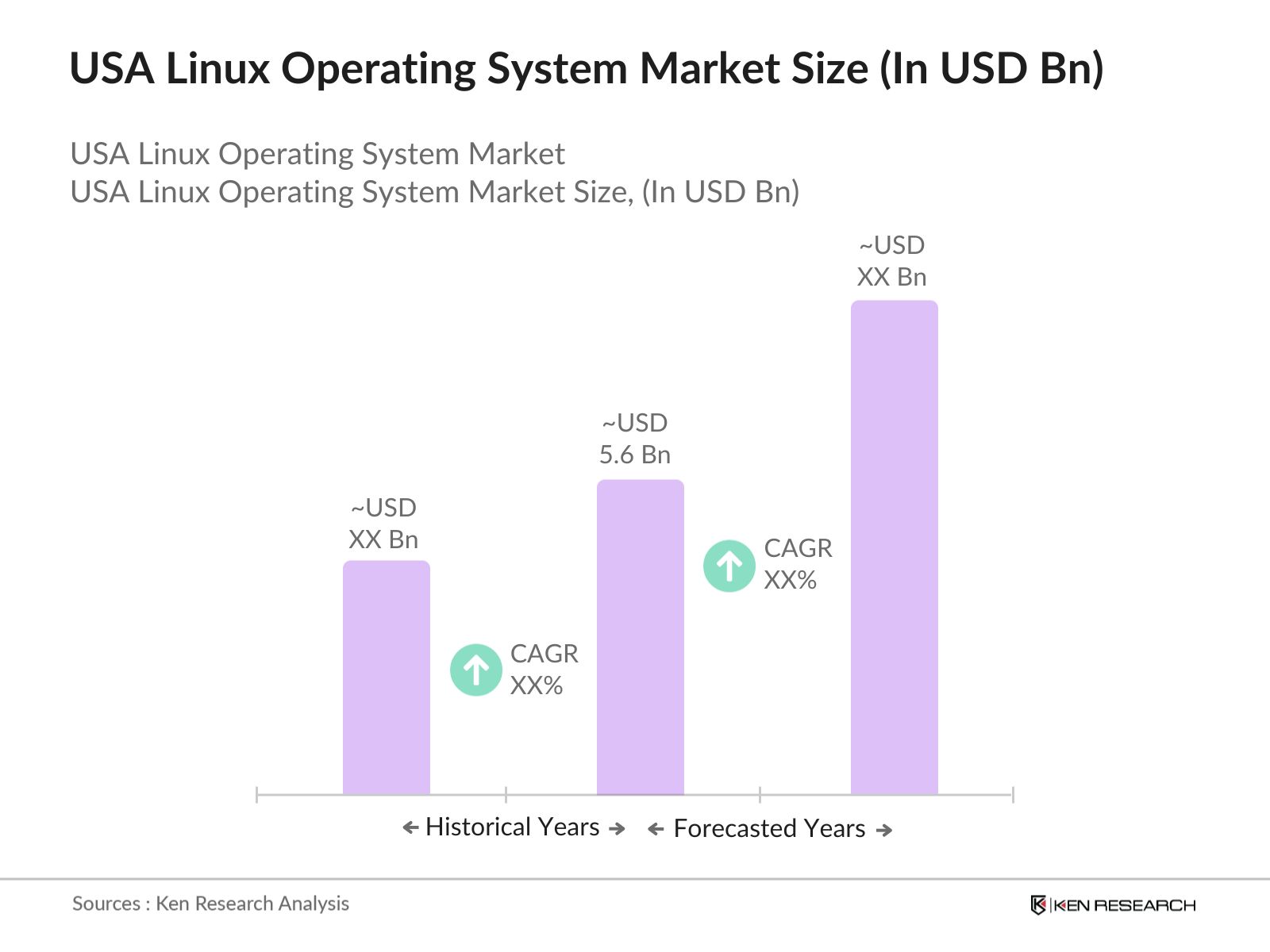
- The USA Linux operating system market is valued at USD 5.6 billion, with significant growth attributed to its cost-effectiveness, scalability, and strong adoption in cloud-based and enterprise data center environments. This robust growth is primarily driven by the increasing reliance on Linux for managing large-scale cloud services, virtualization, and high-performance computing. Additionally, the open-source nature of Linux continues to attract developers and enterprises, enabling them to customize and innovate solutions without licensing constraints.
- North America, especially the United States, dominates the Linux OS market due to the region's well-established IT infrastructure and the presence of major cloud service providers such as Amazon Web Services (AWS), Google, and Microsoft. The widespread deployment of Linux across high-performance computing (HPC) and data centers in cities like Silicon Valley, Seattle, and New York underpins this dominance. These cities are home to many technology-driven enterprises that utilize Linux for its security, flexibility, and ability to handle extensive workloads efficiently.
- The U.S. government has embraced open-source software like Linux as part of its Digital Government Strategy. By 2024, over 40 federal agencies are actively using Linux to reduce costs and enhance system flexibility. The National Institute of Standards and Technology (NIST) supports open-source software by setting guidelines for federal use, ensuring secure integration into critical infrastructures. In the public sector, Linux is vital to managing government clouds, which store over 700 petabytes of data. This adoption supports U.S. government transparency efforts while maintaining security in sensitive areas such as defense and healthcare systems.
USA Linux Operating System Market Segmentation
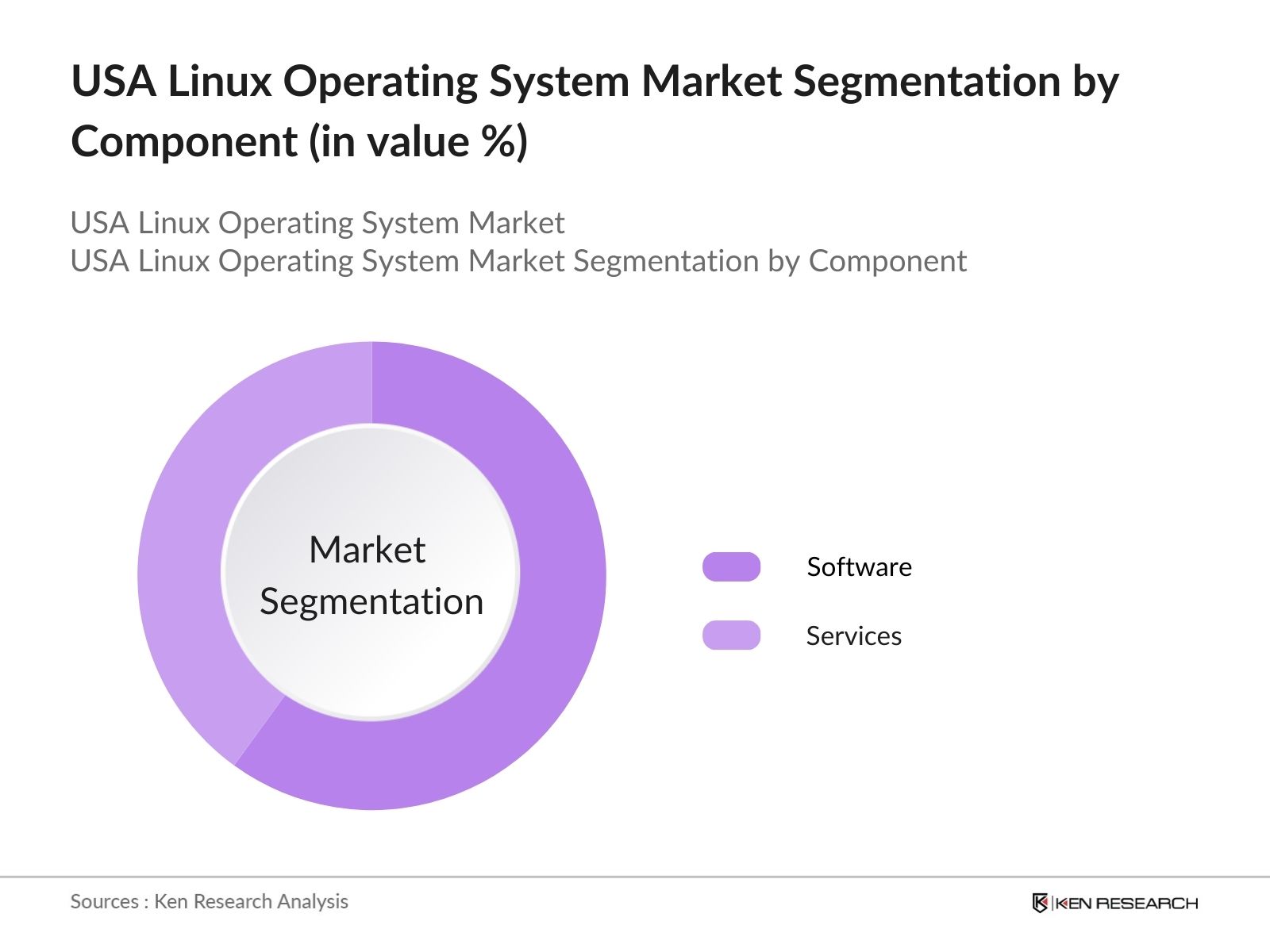
By Component: The Linux operating system market is segmented by components into Software and Services. Currently, the software segment holds a dominant position due to the increasing demand for operating systems in cloud computing, IoT, and edge computing environments. Many large enterprises prefer Linux software for its stability and cost-effectiveness, particularly in managing virtual machines and server applications. The service segment, though smaller in size, is growing steadily as companies require expert support for managing and customizing Linux systems.
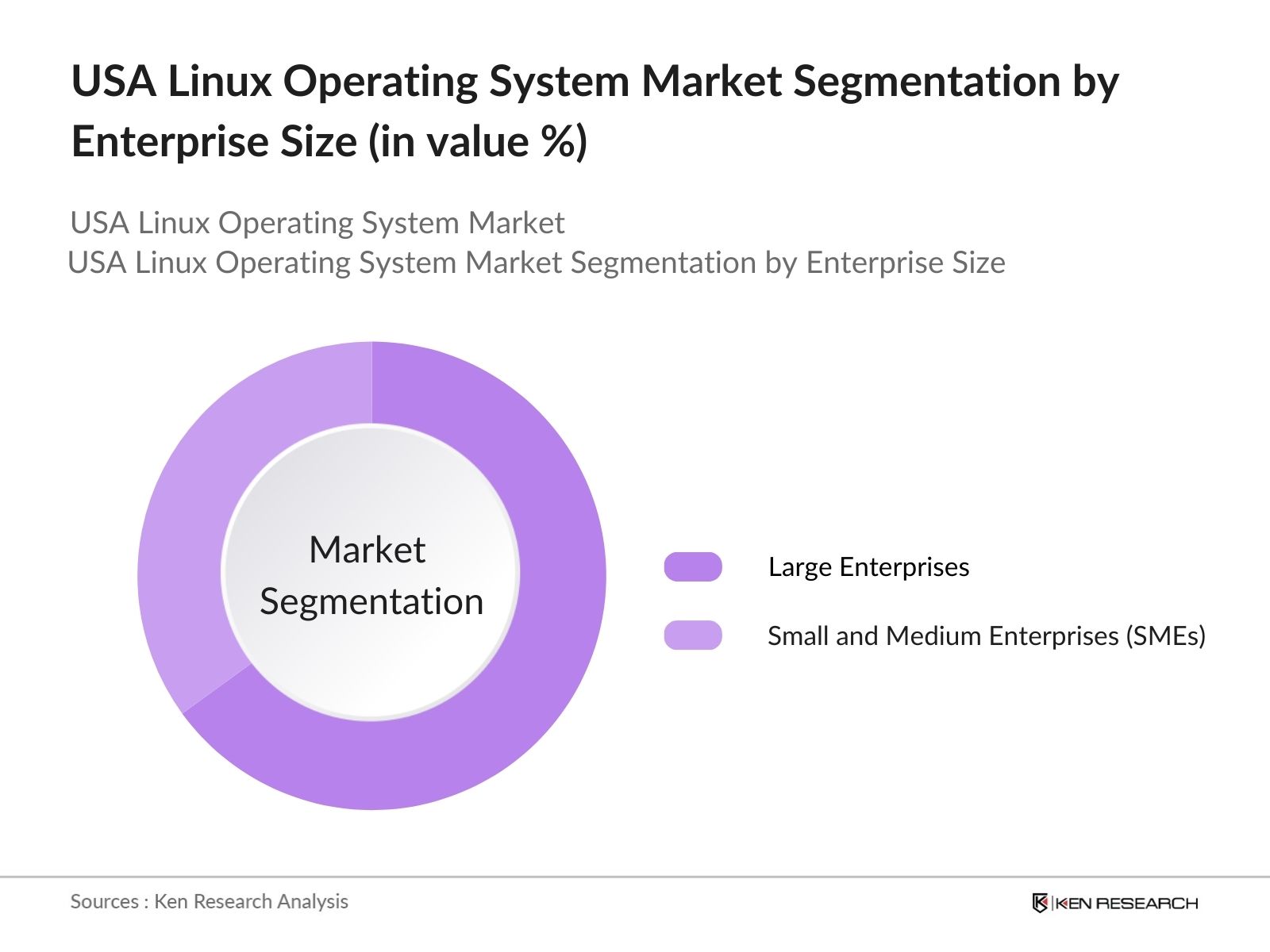
By Enterprise Size: The Linux OS market can also be segmented by enterprise size into Large Enterprises and Small and Medium Enterprises (SMEs). Large enterprises account for a significant market share as they rely on Linux for its ability to scale infrastructure, particularly in cloud and data center applications. These organizations benefit from the low total cost of ownership (TCO) and robust security features of Linux, which is critical in sectors like finance, government, and IT. SMEs are gradually adopting Linux due to its cost savings and flexibility, especially in cloud deployments.
USA Linux Operating System Market Competitive Landscape
The USA Linux operating system market is concentrated with several key players that dominate through partnerships, acquisitions, and product innovation. The market sees active competition between major global corporations and smaller specialized Linux distributors. These companies leverage strategic alliances, innovations in AI and machine learning, and expertise in cloud computing to maintain their competitive edge.
|
Company Name |
Year Established |
Headquarters |
Market Segment Focus |
Notable Product |
Revenue (USD) |
Key Customers |
Technology Partnerships |
No. of Employees |
Certifications |
|
Amazon Web Services |
2006 |
Seattle, USA |
- |
- |
- |
- |
- |
- |
- |
|
IBM Corporation |
1911 |
New York, USA |
- |
- |
- |
- |
- |
- |
- |
|
Canonical Ltd. |
2004 |
London, UK |
- |
- |
- |
- |
- |
- |
- |
|
SUSE S.A. |
1992 |
Nuremberg, Germany |
- |
- |
- |
- |
- |
- |
- |
|
Oracle Corporation |
1977 |
Redwood City, USA |
- |
- |
- |
- |
- |
- |
- |
USA Linux Operating System Market Analysis
Growth Drivers
- Rising Adoption of Cloud Platforms: Cloud adoption in the USA has surged significantly with approximately 35 million U.S. businesses utilizing some form of cloud computing in 2024, driven by the demand for flexible and scalable IT infrastructures. Linux-based systems are pivotal in this trend due to their strong compatibility with cloud platforms like AWS, Google Cloud, and Microsoft Azure, which primarily use Linux distributions for their virtual machines. In fact, Linux accounts for more than 70% of cloud workloads globally, making it a cornerstone in enterprise cloud strategies.
- Expansion of Edge Computing Solutions: Edge computing is expected to see exponential growth with over 15 billion connected devices in the U.S. by 2024. Linux is at the core of many edge computing systems, supporting various applications like IoT and autonomous vehicles due to its lightweight, scalable architecture. The U.S. is a leader in the deployment of edge computing infrastructure, which drives the demand for Linux-based solutions that are essential for managing the vast amounts of data processed at the network's edge. Sources: IMF Economic Outlook.
- Growing Demand in Data Centers: The U.S. data center industry, which houses more than 2,600 data centers, heavily relies on Linux OS due to its robust performance, security, and scalability. The Linux kernels efficient resource management and virtualization support make it the go-to OS for modern data centers. As of 2024, over 85% of the top 500 supercomputers run on Linux, highlighting its dominance in high-performance computing environments that support critical cloud and enterprise operations.
Challenges
- Competition from Proprietary Software Providers: While Linux offers cost advantages, proprietary software like Microsoft Windows continues to hold a significant share in enterprise environments due to its user-friendly interfaces and integration with existing enterprise applications. By 2024, Microsoft retains its foothold in over 60% of U.S. enterprises, challenging Linux adoption in certain sectors where legacy systems and specific software dependencies are dominant.
- Complexity in Software Integration: Many enterprises report challenges in integrating Linux with existing software solutions, particularly in industries reliant on proprietary systems. In 2024, approximately 40% of medium-sized enterprises in the U.S. have encountered difficulties in managing Linuxs complex configurations, which requires specialized knowledge in open-source environments. This adds operational delays and raises training costs, creating a hurdle for widespread Linux adoption across all business sectors.
USA Linux Operating System Market Future Outlook
USA Linux operating system market is poised for continued growth, supported by the expanding adoption of cloud infrastructure, the rise of IoT, and advancements in AI and machine learning technologies. The increasing need for scalable, secure, and cost-effective operating systems in various industriessuch as IT, financial services, and healthcarewill also contribute to market expansion. Moreover, government initiatives to promote open-source adoption in critical sectors, along with collaborations between industry leaders, are expected to fuel growth and innovation in the Linux ecosystem.
Market Opportunities
- Growth in Open-Source Community Contributions: The open-source community supporting Linux has expanded rapidly in recent years. Over 200,000 developers contribute actively to Linux distributions, resulting in improved functionality, security, and performance enhancements. This dynamic and innovative community has become an asset for enterprises, particularly in industries like fintech and healthcare, where custom solutions are vital. Open-source software now powers 80% of emerging technologies, providing a fertile ground for the Linux ecosystem to thrive.
- AI and Machine Learning Integrations: Linux-based systems are playing a crucial role in AI and machine learning advancements. U.S. firms specializing in AI-driven applications, such as autonomous vehicles and predictive analytics, predominantly rely on Linux environments due to their flexibility and superior computational power. In 2024, more than 80% of AI research labs in the U.S. utilize Linux to develop machine learning models. Linuxs lightweight and adaptable nature positions it to be a critical component in the AI technology stack.
Scope of the Report
|
Segments |
Sub-Segments |
|
Component |
Software Services |
|
Distribution Model |
Virtual Machines Servers Desktops Embedded Systems |
|
Enterprise Size |
Large Enterprises SMEs |
|
End-User Industry |
IT & Telecom Financial Services Healthcare Government & Defense |
|
Region |
California Washington New York Texas Massachusetts |
Products
Key Target Audience
Cloud Service Providers
Data Center Operators
Telecom Operators
System Integrators
Enterprise Software Developers
Cybersecurity Firms
Investors and Venture Capitalist Firms
Government and Regulatory Bodies (e.g., Federal Communications Commission (FCC), U.S. Department of Defense)
Companies
Players Mentioned in the Report
Amazon Web Services (AWS)
IBM Corporation
Canonical Ltd. (Ubuntu)
SUSE S.A.
Oracle Corporation
Red Hat Inc.
Arch Linux
Zorin OS Technologies Limited
MontaVista Software
Fedora Linux
Table of Contents
1. USA Linux Operating System Market Overview
1.1. Definition and Scope
1.2. Market Taxonomy
1.3. Market Growth Rate and Key Metrics
1.4. Market Segmentation Overview
2. USA Linux Operating System Market Size (In USD Billion)
2.1. Historical Market Size
2.2. Year-On-Year Growth Analysis
2.3. Key Market Developments and Milestones
3. USA Linux Operating System Market Analysis
3.1. Growth Drivers
3.1.1. Rising Adoption of Cloud Platforms
3.1.2. Increasing Enterprise Integration
3.1.3. Expansion of Edge Computing Solutions
3.1.4. Growing Demand in Data Centers
3.2. Market Challenges
3.2.1. Competition from Proprietary Software Providers
3.2.2. Complexity in Software Integration
3.2.3. Lack of Skilled Linux Professionals
3.2.4. Security and Compliance Issues
3.3. Opportunities
3.3.1. Growth in Open-Source Community Contributions
3.3.2. AI and Machine Learning Integrations
3.3.3. Increasing Mobile and Embedded Systems Adoption
3.3.4. Rising Government Interest in Open-Source Solutions
3.4. Trends
3.4.1. Adoption in Internet of Things (IoT) Solutions
3.4.2. Server Virtualization and Containerization
3.4.3. Increasing Use in Autonomous Systems
3.4.4. Expansion in High-Performance Computing (HPC)
4. USA Linux Operating System Market Segmentation
4.1. By Component (In Value %)
4.1.1. Software
4.1.2. Services
4.2. By Distribution Model (In Value %)
4.2.1. Virtual Machines
4.2.2. Servers
4.2.3. Desktops
4.2.4. Embedded Systems
4.3. By Enterprise Size (In Value %)
4.3.1. Large Enterprises
4.3.2. Small and Medium Enterprises (SMEs)
4.4. By End-User Industry (In Value %)
4.4.1. Information Technology (IT) and Telecom
4.4.2. Financial Services
4.4.3. Healthcare
4.4.4. Government and Defense
4.5. By Region (In Value %)
4.5.1 California
4.5.2 Washington
4.5.3 New York
4.5.4 Texas
4.5.5 Massachusetts
5. USA Linux Operating System Market Competitive Landscape
5.1. Detailed Profiles of Major Companies
5.1.1. Amazon Web Services
5.1.2. IBM Corporation
5.1.3. Canonical Ltd. (Ubuntu)
5.1.4. SUSE S.A.
5.1.5. Oracle Corporation
5.1.6. Red Hat Inc.
5.1.7. Arch Linux
5.1.8. Fedora Linux
5.1.9. MontaVista Software
5.1.10. Zorin OS Technologies Limited
5.2. Cross Comparison Parameters (No. of Employees, Revenue, Key Products, Market Position, Geographical Presence, Key Clients, Security Certifications, Partnerships)
5.3. Market Share Analysis
5.4. Strategic Initiatives
5.5. Mergers and Acquisitions
5.6. Investment Analysis
5.7. Venture Capital Funding
6. USA Linux Operating System Regulatory Framework
6.1. Data Privacy and Compliance Standards
6.2. Open-Source Software Policies
6.3. Certification and Security Compliance
6.4. Government Support for Open-Source Initiatives
7. USA Linux Operating System Future Market Size (In USD Billion)
7.1. Future Market Size Projections
7.2. Key Factors Driving Future Market Growth
8. USA Linux Operating System Market Analysts' Recommendations
8.1. TAM/SAM/SOM Analysis
8.2. Strategic Marketing Initiatives
8.3. Customer Cohort and Segmentation Strategies
8.4. White Space Opportunity Identification
Research Methodology
Step 1: Identification of Key Variables
The initial step in our research involved mapping the ecosystem of the USA Linux operating system market, identifying key stakeholders such as cloud providers, data center operators, and developers. Extensive desk research was carried out using both proprietary databases and public sources to collect data on the key variables driving the market.
Step 2: Market Analysis and Construction
Historical data for the USA Linux OS market was compiled, focusing on market size, competitive analysis, and market penetration. We also assessed pricing trends and market adoption rates in key regions. This data was used to construct a detailed market model, ensuring comprehensive analysis.
Step 3: Hypothesis Validation and Expert Consultation
Hypotheses about market trends and drivers were formulated based on the data and then validated through consultations with industry experts. These included interviews with key personnel from companies active in the Linux OS space, providing deeper insights into operational dynamics.
Step 4: Research Synthesis and Final Output
After gathering and validating the data, we synthesized the research findings to create a final report. This included cross-referencing data from various segments and stakeholders to ensure accuracy, culminating in a validated analysis of the USA Linux OS market.
Frequently Asked Questions
1. How big is the USA Linux Operating System market?
The USA Linux Operating System market was valued at USD 5.6 billion, driven by increasing adoption in cloud computing, data centers, and high-performance computing environments.
2. What are the challenges in the USA Linux OS market?
The key challenges in USA Linux Operating System market include competition from proprietary operating systems, lack of skilled professionals, and the complexity of managing open-source environments, particularly for SMEs.
3. Who are the major players in the USA Linux OS market?
Key players in USA Linux Operating System market include Amazon Web Services, IBM, Canonical (Ubuntu), SUSE, and Oracle, each offering customized Linux solutions for cloud, enterprise, and embedded systems.
4. What drives growth in the USA Linux OS market?
USA Linux Operating System market is primarily driven by the rise of cloud computing, the scalability of Linux for enterprise solutions, and the growing demand for cost-effective and secure open-source operating systems.
Why Buy From Us?

What makes us stand out is that our consultants follows Robust, Refine and Result (RRR) methodology. i.e. Robust for clear definitions, approaches and sanity checking, Refine for differentiating respondents facts and opinions and Result for presenting data with story

We have set a benchmark in the industry by offering our clients with syndicated and customized market research reports featuring coverage of entire market as well as meticulous research and analyst insights.

While we don't replace traditional research, we flip the method upside down. Our dual approach of Top Bottom & Bottom Top ensures quality deliverable by not just verifying company fundamentals but also looking at the sector and macroeconomic factors.

With one step in the future, our research team constantly tries to show you the bigger picture. We help with some of the tough questions you may encounter along the way: How is the industry positioned? Best marketing channel? KPI's of competitors? By aligning every element, we help maximize success.

Our report gives you instant access to the answers and sources that other companies might choose to hide. We elaborate each steps of research methodology we have used and showcase you the sample size to earn your trust.

If you need any support, we are here! We pride ourselves on universe strength, data quality, and quick, friendly, and professional service.