
USA Luxury Hotel Market Outlook to 2030
Region:North America
Author(s):Paribhasha Tiwari
Product Code:KROD10449
December 2024
82
About the Report
USA Luxury Hotel Market Overview
- The USA luxury hotel market is a significant segment of the hospitality industry, valued at USD 78.2 billion. This valuation is driven by a combination of factors, including a robust tourism sector, increasing disposable incomes, and a growing demand for premium accommodations among both domestic and international travelers.
- Major cities such as New York, Los Angeles, and Miami dominate the luxury hotel market in the United States. Their dominance is attributed to their status as key business hubs, cultural centers, and popular tourist destinations, attracting a high volume of affluent travelers seeking upscale lodging options.
- In April 2024, Marriott International announced its strategy to accelerate growth by targeting nearly 100 hotel conversions and adaptive reuse initiatives across Europe by the end of 2026. This move indicates a broader trend within the luxury hotel sector, where established brands are focusing on expanding their portfolios to meet rising demand from affluent travelers.
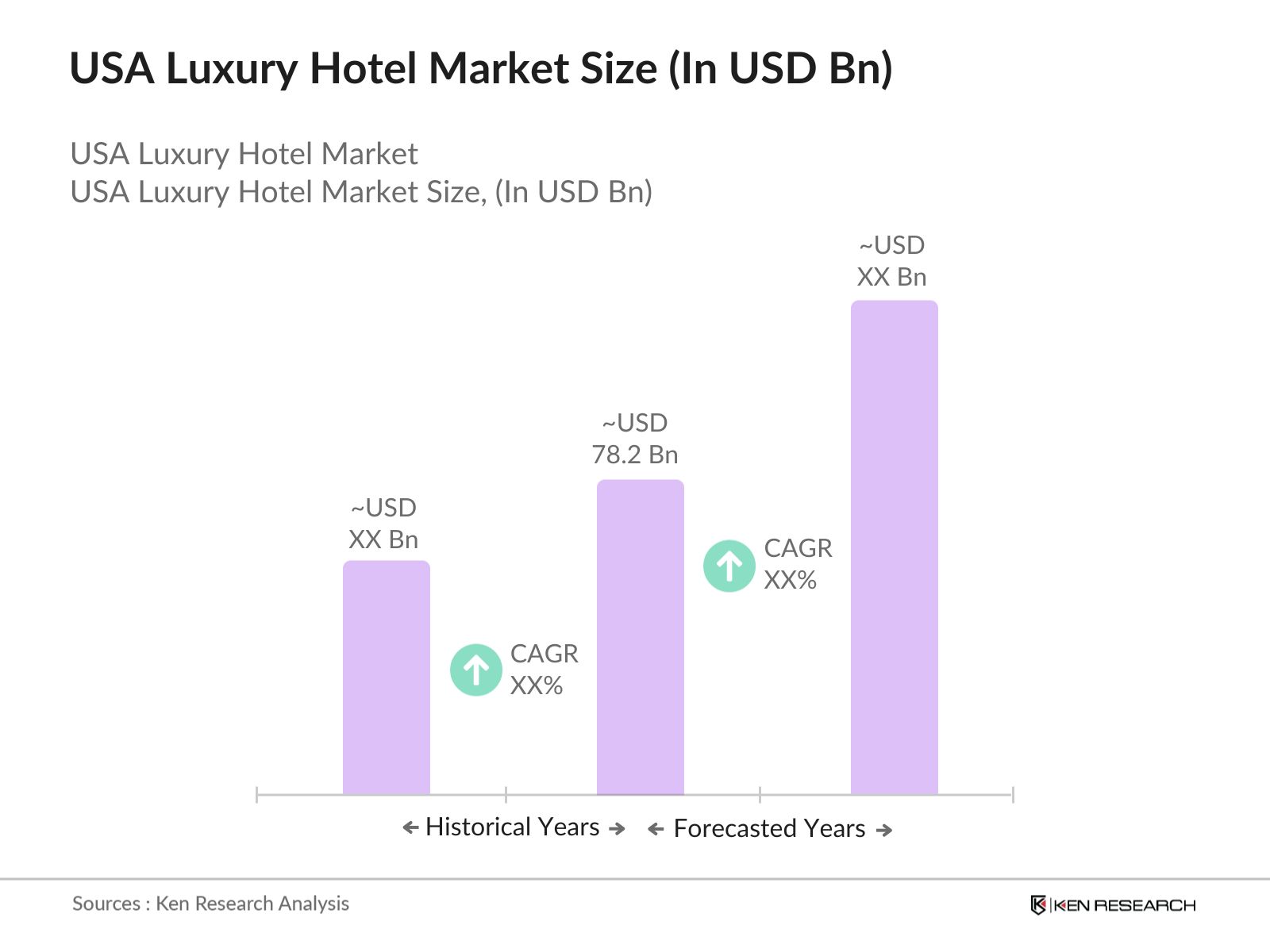
USA Luxury Hotel Market Segmentation
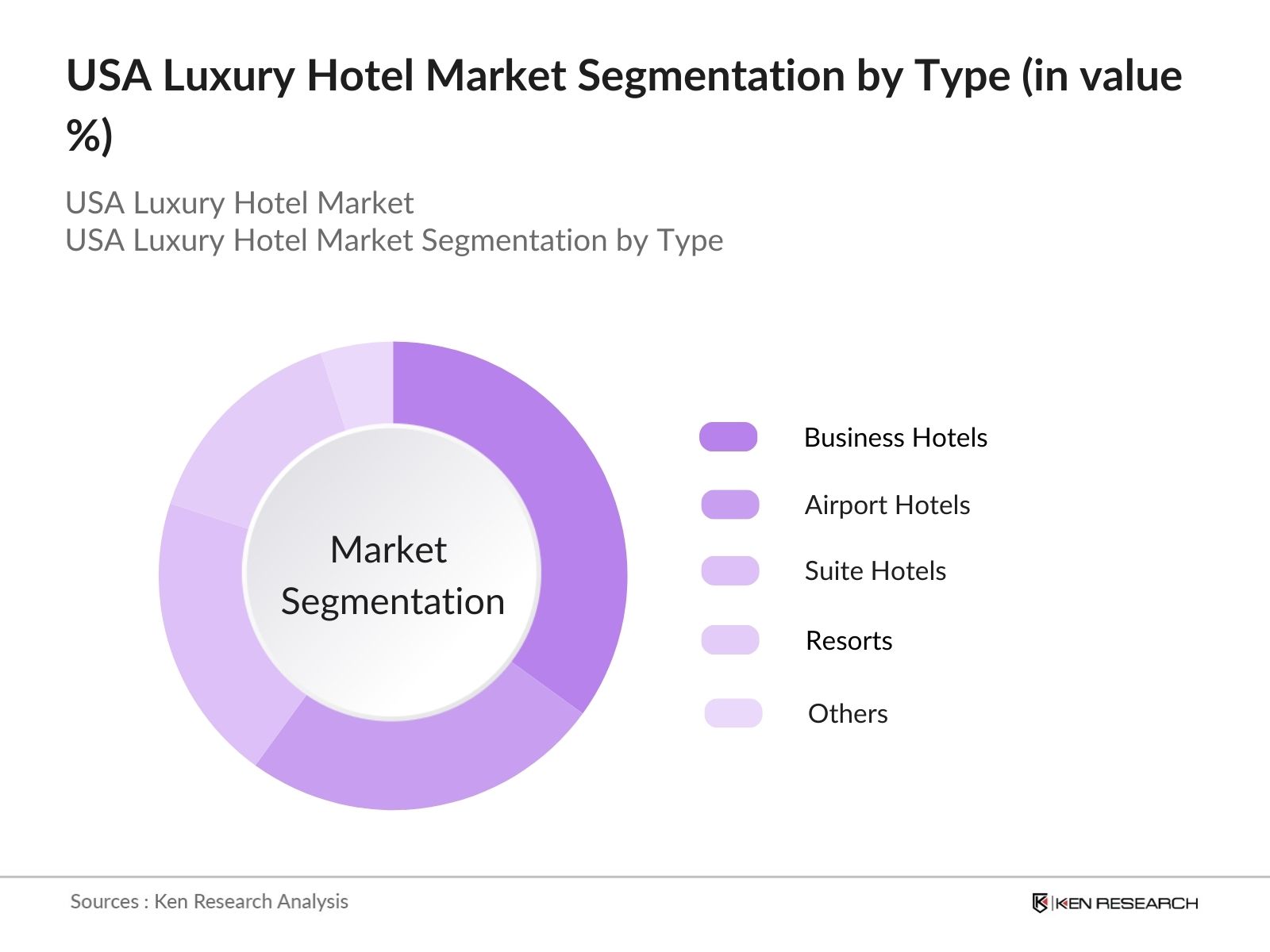
By Type: The USA luxury hotel market is segmented by type into business hotels, airport hotels, suite hotels, resorts, and others. Business hotels hold a dominant market share within this segmentation. This dominance is due to the high demand from corporate travelers who prioritize proximity to business districts, conference facilities, and amenities tailored to professional needs.
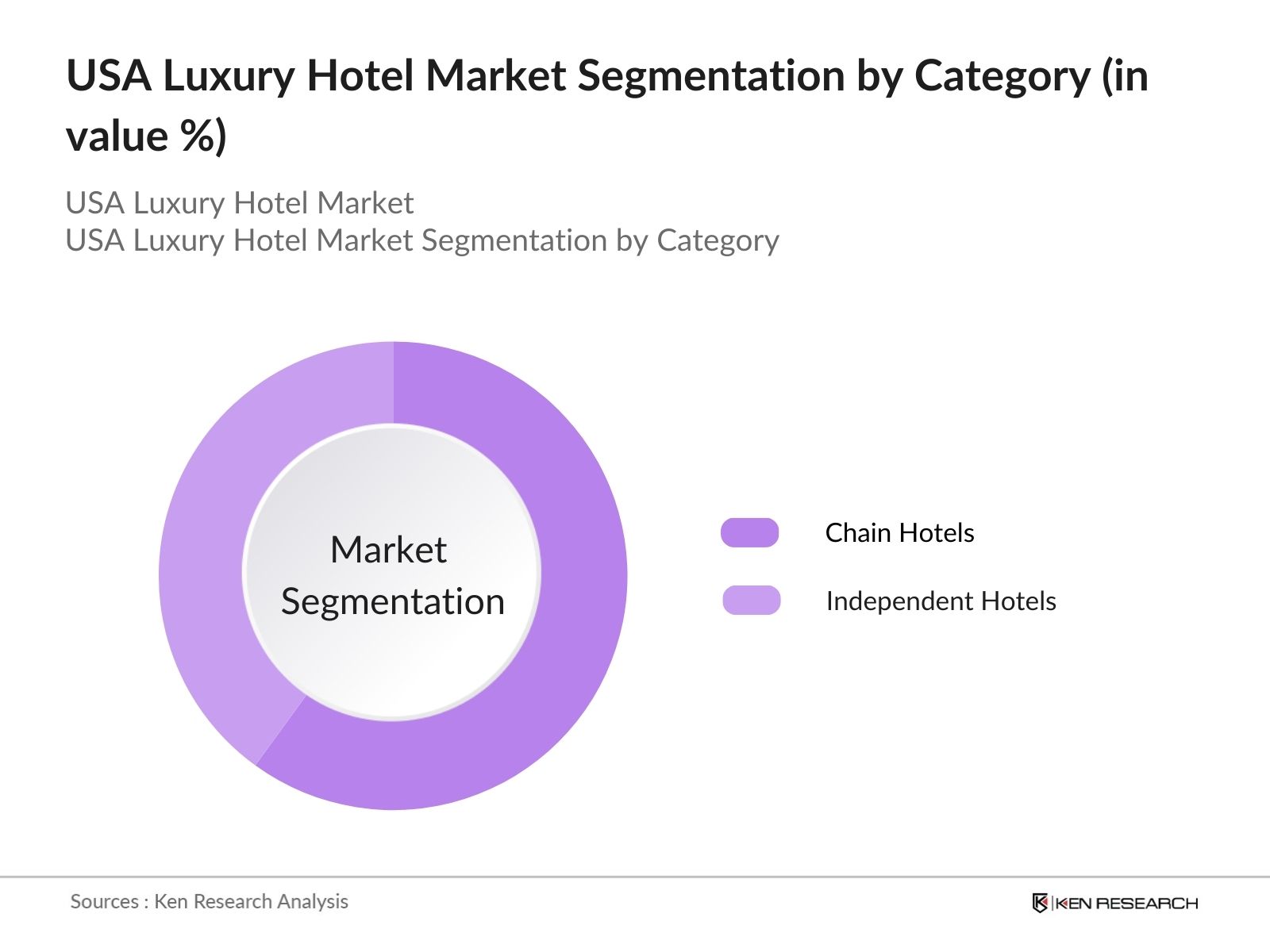
By Category: The market is further segmented by category into chain hotels and independent hotels. Chain hotels lead this segment, benefiting from strong brand recognition, extensive marketing resources, and standardized service quality, which appeal to a broad customer base seeking reliable luxury experiences.
USA Luxury Hotel Market Competitive Landscape
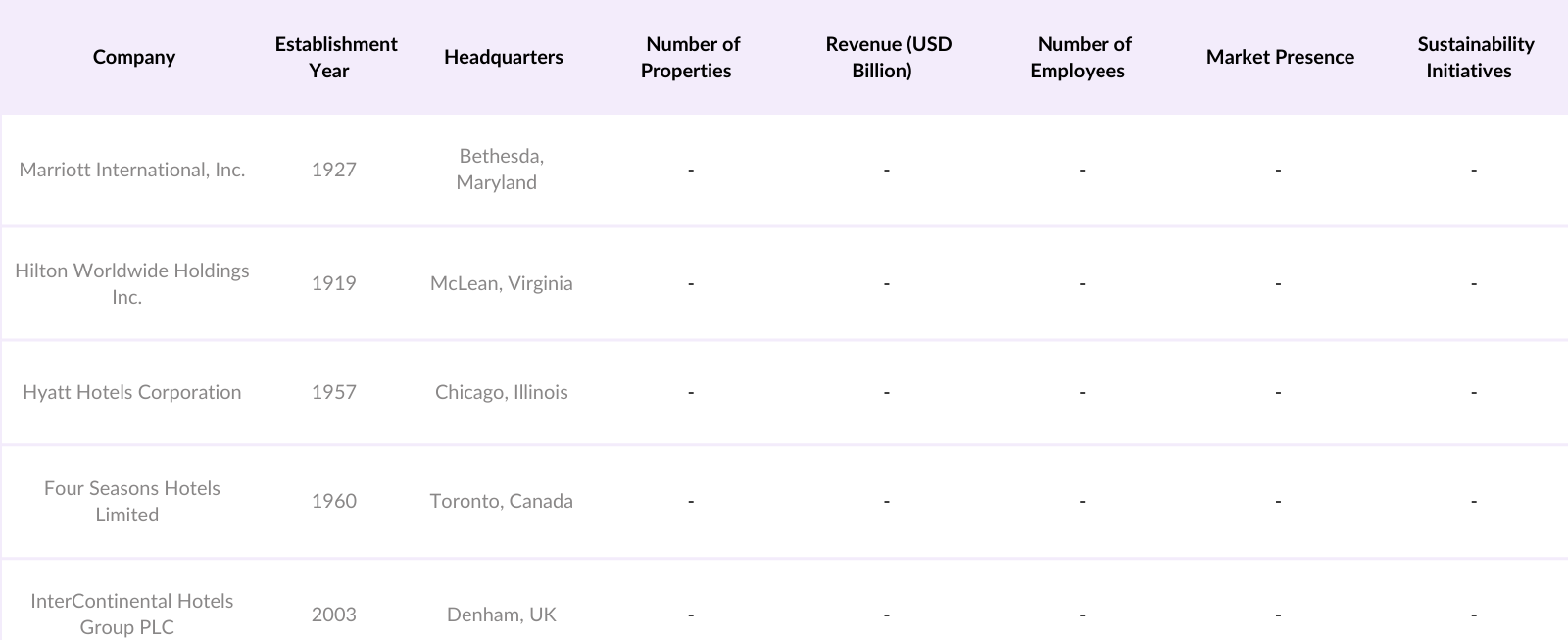
The USA luxury hotel market is characterized by the presence of several key players who have established strong market positions through extensive property portfolios, brand recognition, and consistent service quality. This consolidation underscores the significant influence of these companies in shaping market trends and standards.
USA Luxury Hotel Market Analysis
Growth Drivers
- Expansion of Tourism Industry: The global tourism industry is projected to reach substantial levels by 2024, supported by increased international arrivals and domestic tourism activities. In 2024, over 1.5 billion people traveled internationally, with major markets like Europe and Asia-Pacific driving growth due to robust air connectivity and tourism-friendly policies.
- Increase in Business Travel: Business travel saw an uptick with over 465 million business trips projected by 2024, as companies worldwide resumed corporate travel activities. The United States, China, and Europe lead in business travel expenditure, bolstering demand for quality hospitality and tourism services.
- Demand for Personalized Experiences: Travelers are increasingly seeking personalized services, with an estimated 82 million individuals in 2024 willing to pay a premium for customized itineraries. This trend is observed particularly among millennial and Gen Z consumers, who prioritize unique and tailored travel experiences.
Market Challenges
- High Operational Costs: Operational costs for tourism providers have surged, with labor and energy costs in 2024 reaching all-time highs in many regions. Key tourism hubs reported an average annual cost of over 50,000 per hotel room for maintenance and staffing, impacting profitability and increasing service costs.
- Intense Competition: The industry faces significant competition with over 8 million businesses globally vying for market share in 2024. New entrants, along with established players, are innovating and offering competitive rates, creating a highly fragmented market landscape that pressures existing operators.
USA Luxury Hotel Market Future Outlook
Over the next five years, the USA luxury hotel market is expected to experience significant growth. This expansion will be driven by continuous investments in infrastructure, technological advancements enhancing guest experiences, and a sustained increase in both leisure and business travel. Additionally, a growing emphasis on sustainability and personalized services is anticipated to further propel market growth.
Market Opportunities
- Technological Advancements in Service Delivery: With the implementation of AI-driven concierge services in over 2,500 hotels globally, the sector is embracing technology to enhance customer experience. In 2024, digital innovations, including virtual reality tours and mobile check-in options, offer seamless customer journeys.
- Growth in Wellness Tourism: Wellness tourism saw a marked rise with more than 290 million wellness-specific trips taken in 2024, especially in North America and Asia-Pacific. Wellness services, from spas to mental well-being retreats, present lucrative opportunities in this growing niche sector.
Scope of the Report
|
By Type |
Business Hotels |
|
By Category |
Chain Hotels |
|
By Room Type |
Luxury |
|
By Booking Channel |
Direct Booking |
|
By Region |
Northeast |
Products
Key Target Audience
Hotel Management Companies
Real Estate Developers
Tourism Boards and Agencies
Government and Regulatory Bodies (e.g., U.S. Department of Commerce)
Investors and Venture Capitalist Firms
Travel Agencies and Tour Operators
Corporate Travel Managers
Hospitality Training Institutions
Companies
Players Mentioned in the Report:
Marriott International, Inc.
Hilton Worldwide Holdings Inc.
Hyatt Hotels Corporation
Four Seasons Hotels Limited
InterContinental Hotels Group PLC
Accor SA
Rosewood Hotel Group
The Ritz-Carlton Hotel Company, L.L.C.
Auberge Resorts LLC
Belmond Ltd.
Table of Contents
1. USA Luxury Hotel Market Overview
1.1 Definition and Scope
1.2 Market Taxonomy
1.3 Market Growth Rate
1.4 Market Segmentation Overview
2. USA Luxury Hotel Market Size (USD Billion)
2.1 Historical Market Size
2.2 Year-On-Year Growth Analysis
2.3 Key Market Developments and Milestones
3. USA Luxury Hotel Market Analysis
3.1 Growth Drivers
3.1.1 Expansion of Tourism Industry
3.1.2 Rising Disposable Incomes
3.1.3 Increase in Business Travel
3.1.4 Demand for Personalized Experiences
3.2 Market Challenges
3.2.1 High Operational Costs
3.2.2 Intense Competition
3.2.3 Economic Uncertainties
3.3 Opportunities
3.3.1 Technological Advancements
3.3.2 Growth in Wellness Tourism
3.3.3 Expansion into Emerging Markets
3.4 Trends
3.4.1 Adoption of Sustainable Practices
3.4.2 Integration of Smart Technologies
3.4.3 Emphasis on Health and Wellness Amenities
3.5 Government Regulations
3.5.1 Health and Safety Standards
3.5.2 Environmental Compliance
3.5.3 Labor Laws
3.6 SWOT Analysis
3.7 Stakeholder Ecosystem
3.8 Porters Five Forces Analysis
3.9 Competitive Landscape
4. USA Luxury Hotel Market Segmentation
4.1 By Type (Value %)
4.1.1 Business Hotels
4.1.2 Airport Hotels
4.1.3 Suite Hotels
4.1.4 Resorts
4.1.5 Others
4.2 By Category (Value %)
4.2.1 Chain Hotels
4.2.2 Independent Hotels
4.3 By Room Type (Value %)
4.3.1 Luxury
4.3.2 Upper-Upscale
4.3.3 Upscale
4.4 By Booking Channel (Value %)
4.4.1 Direct Booking
4.4.2 Online Travel Agencies (OTAs)
4.4.3 Other Platforms
4.5 By Region (Value %)
4.5.1 Northeast
4.5.2 Midwest
4.5.3 South
4.5.4 West
5. USA Luxury Hotel Market Competitive Analysis
5.1 Detailed Profiles of Major Companies
5.1.1 Marriott International, Inc.
5.1.2 Hilton Worldwide Holdings Inc.
5.1.3 Hyatt Hotels Corporation
5.1.4 Four Seasons Hotels Limited
5.1.5 InterContinental Hotels Group PLC
5.1.6 Accor SA
5.1.7 Rosewood Hotel Group
5.1.8 The Ritz-Carlton Hotel Company, L.L.C.
5.1.9 Auberge Resorts LLC
5.1.10 Rancho Valencia Resort & Spa
5.1.11 Belmond Ltd.
5.1.12 Mandarin Oriental Hotel Group
5.1.13 Fairmont Hotels & Resorts
5.1.14 Loews Hotels & Co
5.1.15 Omni Hotels & Resorts
5.2 Cross Comparison Parameters
5.2.1 Number of Employees
5.2.2 Headquarters Location
5.2.3 Year of Establishment
5.2.4 Revenue
5.2.5 Number of Properties
5.2.6 Market Share
5.2.7 Average Daily Rate (ADR)
5.2.8 Occupancy Rate
5.3 Market Share Analysis
5.4 Strategic Initiatives
5.5 Mergers and Acquisitions
5.6 Investment Analysis
5.7 Venture Capital Funding
5.8 Government Grants
5.9 Private Equity Investments
6. USA Luxury Hotel Market Regulatory Framework
6.1 Health and Safety Standards
6.2 Environmental Compliance
6.3 Labor Laws
6.4 Licensing and Permits
7. USA Luxury Hotel Future Market Size (USD Billion)
7.1 Future Market Size Projections
7.2 Key Factors Driving Future Market Growth
8. USA Luxury Hotel Future Market Segmentation
8.1 By Type (Value %)
8.2 By Category (Value %)
8.3 By Room Type (Value %)
8.4 By Booking Channel (Value %)
8.5 By Region (Value %)
9. USA Luxury Hotel Market Analysts Recommendations
9.1 Total Addressable Market (TAM) Analysis
9.2 Serviceable Available Market (SAM) Analysis
9.3 Serviceable Obtainable Market (SOM) Analysis
9.4 Customer Cohort Analysis
9.5 Marketing Initiatives
9.6 White Space Opportunity Analysis
Disclaimer Contact UsResearch Methodology
Step 1: Identification of Key Variables
The initial phase involves constructing an ecosystem map encompassing all major stakeholders within the USA luxury hotel market. This step is underpinned by extensive desk research, utilizing a combination of secondary and proprietary databases to gather comprehensive industry-level information. The primary objective is to identify and define the critical variables that influence market dynamics.
Step 2: Market Analysis and Construction
In this phase, we compile and analyze historical data pertaining to the USA luxury hotel market. This includes assessing market penetration, the ratio of marketplaces to service providers, and the resultant revenue generation. Furthermore, an evaluation of service quality statistics is conducted to ensure the reliability and accuracy of the revenue estimates.
Step 3: Hypothesis Validation and Expert Consultation
Market hypotheses are developed and subsequently validated through computer-assisted telephone interviews (CATIs) with industry experts representing a diverse array of companies. These consultations provide valuable operational and financial insights directly from industry practitioners, which are instrumental in refining and corroborating the market data.
Step 4: Research Synthesis and Final Output
The final phase involves direct engagement with multiple luxury hotel operators to acquire detailed insights into product segments, sales performance, consumer preferences, and other pertinent factors. This interaction serves to verify and complement the statistics derived from the bottom-up approach, thereby ensuring a comprehensive, accurate, and validated analysis of the USA luxury hotel market.
Frequently Asked Questions
01. How big is the USA luxury hotel market?
The USA luxury hotel market is valued at USD 78.2 billion.
02. What are the challenges in the USA luxury hotel market?
Challenges in the USA luxury hotel market include high operational costs, intense competition, and economic uncertainties that can affect occupancy rates and profitability.
03. Who are the major players in the USA luxury hotel market?
Key players in the USA luxury hotel market include Marriott International, Hilton Worldwide Holdings, Hyatt Hotels Corporation, Four Seasons Hotels Limited, and InterContinental Hotels Group PLC.
04. What are the growth drivers of the USA luxury hotel market?
The USA luxury hotel market is propelled by factors such as a robust tourism sector, increasing disposable incomes, and a growing demand for premium accommodations among both domestic and international travelers.
Why Buy From Us?

What makes us stand out is that our consultants follows Robust, Refine and Result (RRR) methodology. i.e. Robust for clear definitions, approaches and sanity checking, Refine for differentiating respondents facts and opinions and Result for presenting data with story

We have set a benchmark in the industry by offering our clients with syndicated and customized market research reports featuring coverage of entire market as well as meticulous research and analyst insights.

While we don't replace traditional research, we flip the method upside down. Our dual approach of Top Bottom & Bottom Top ensures quality deliverable by not just verifying company fundamentals but also looking at the sector and macroeconomic factors.

With one step in the future, our research team constantly tries to show you the bigger picture. We help with some of the tough questions you may encounter along the way: How is the industry positioned? Best marketing channel? KPI's of competitors? By aligning every element, we help maximize success.

Our report gives you instant access to the answers and sources that other companies might choose to hide. We elaborate each steps of research methodology we have used and showcase you the sample size to earn your trust.

If you need any support, we are here! We pride ourselves on universe strength, data quality, and quick, friendly, and professional service.