
USA Marketing Digital Transformation Market Outlook to 2030
Region:North America
Author(s):Mukul
Product Code:KROD3426
October 2024
94
About the Report
USA Marketing Digital Transformation Market Overview
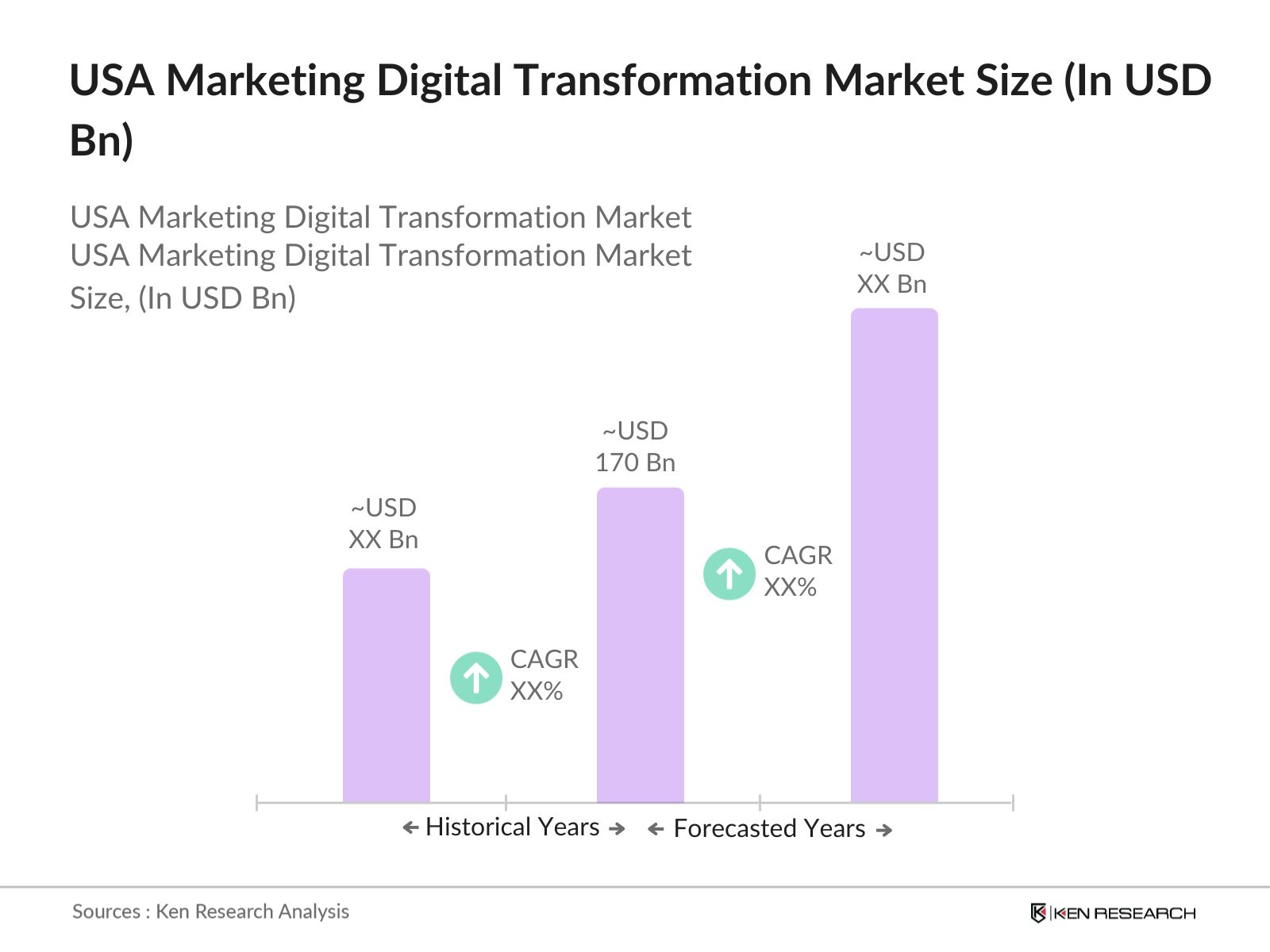
- The USA Marketing Digital Transformation Market is valued at USD 170 billion, according to a five-year historical analysis, driven by the rapid adoption of digital channels, increased reliance on AI-driven marketing tools, and the surge in customer-centric approaches. The demand for personalized experiences and real-time data analysis has led companies to invest heavily in cloud-based marketing solutions, marketing automation, and CRM systems, significantly contributing to the market's expansion in 2023.
- Cities such as New York, San Francisco, and Chicago lead the USA Marketing Digital Transformation Market due to their position as major hubs for technology companies and innovation-driven industries. The presence of global marketing agencies, coupled with strong infrastructure and access to cutting-edge technologies, makes these cities dominant players in driving marketing transformation initiatives across the country. San Francisco, in particular, benefits from its proximity to Silicon Valley, fostering innovation and collaboration with leading tech firms.
- Although GDPR primarily applies to European Union (EU) citizens, U.S. companies marketing to EU customers must comply with these regulations. In 2023, U.S. businesses spent an estimated $9 billion on GDPR compliance, according to the U.S. Chamber of Commerce. Failure to comply can result in significant fines, as seen in recent cases where major U.S. corporations were fined upwards of $2 billion for non-compliance. This regulatory landscape has pushed U.S. companies to adopt stricter data privacy and management practices.
USA Marketing Digital Transformation Market Segmentation
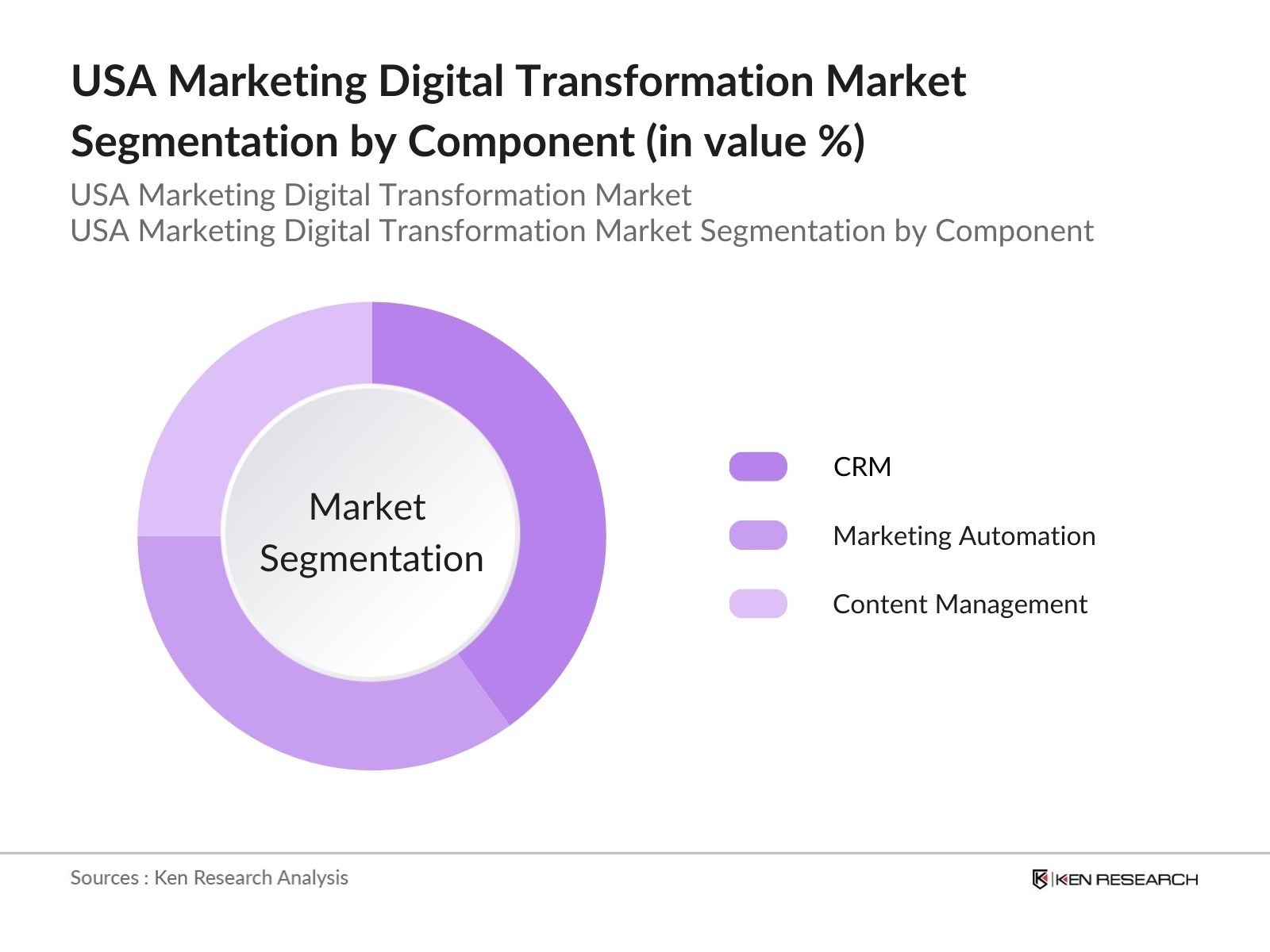
- By Component: The USA Marketing Digital Transformation Market is segmented by component into solutions and services. Sub-segments: CRM, Marketing Automation, Content Management
CRM systems dominate the market under the solutions segment, as companies increasingly focus on enhancing customer experiences and improving relationships through data-driven insights. Marketing automation tools are also gaining traction due to their ability to streamline campaign management and provide scalable marketing efforts. The demand for content management systems continues to grow as brands aim to deliver personalized, consistent content across multiple platforms.
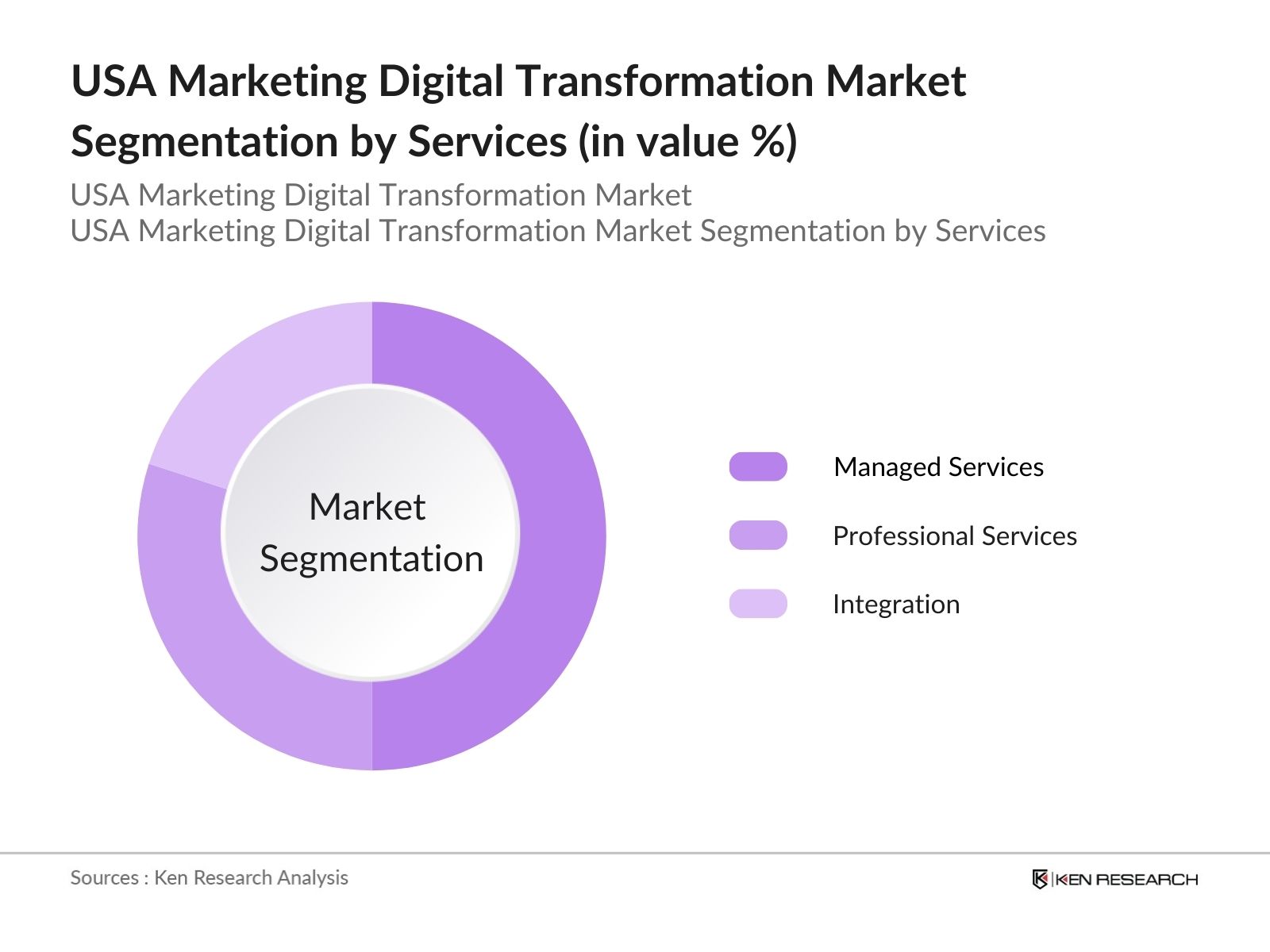
- By Services: Sub-segments: Managed Services, Professional Services, Integration
Managed services hold the largest market share in the services segment, as companies prefer outsourcing their marketing operations to specialized providers to optimize efficiency. Integration services are also in high demand, ensuring seamless connectivity between disparate digital marketing systems, which is crucial for real-time data access and automation.
USA Marketing Digital Transformation Market Competitive Landscape
The USA Marketing Digital Transformation Market is characterized by the presence of both global technology providers and specialized marketing firms. Major players are focusing on AI-driven tools, customer experience enhancement, and omnichannel marketing solutions.
|
Company |
Year Established |
Headquarters |
Revenue (USD Mn) |
APAC Market Presence |
Employees |
Key Services |
Recent Developments |
API Integration |
Cloud-Based Solutions |
|
Adobe Systems Inc. |
1982 |
San Jose, California |
|||||||
|
Salesforce Inc. |
1999 |
San Francisco, California |
|||||||
|
Oracle Corporation |
1977 |
Redwood City, California |
|||||||
|
HubSpot Inc. |
2006 |
Cambridge, Massachusetts |
|||||||
|
IBM Corporation |
1911 |
Armonk, New York |
USA Marketing Digital Transformation Industry Analysis
USA Marketing Digital Transformation Market Growth Drivers
- Customer-Centric Marketing: In the USA, customer-centric marketing is gaining momentum as businesses adopt data-driven strategies to enhance customer engagement. According to the U.S. Bureau of Economic Analysis, consumer spending on goods and services in 2024 is projected to reach $18.2 trillion, highlighting the growing importance of personalized marketing efforts to capture consumer attention. Businesses are increasingly leveraging first-party data and advanced CRM systems to create tailored marketing strategies that align with individual customer preferences, driving higher customer satisfaction and loyalty. Source: U.S. Bureau of Economic Analysis.
- Real-time Data Integration: Real-time data integration is becoming essential in marketing as businesses seek to respond instantly to customer interactions. According to the World Bank, the U.S. tech industry has seen an investment of $1.6 trillion in digital technologies between 2022 and 2024. This surge has enabled companies to integrate real-time data from multiple channels, creating seamless customer experiences. Retailers and service providers, for example, can now offer real-time promotions based on customer behavior, enhancing the effectiveness of marketing campaigns.
- AI-driven Personalization: AI-driven personalization is reshaping the marketing landscape, allowing businesses to offer hyper-targeted content to individual consumers. The U.S. government reported an increase in AI investments, with $130 billion allocated to AI technologies in 2023. AI enables marketers to predict customer behavior and optimize campaigns in real time. This trend is particularly evident in the retail and e-commerce sectors, where AI-driven product recommendations have boosted conversion rates by up to 20%
USA Marketing Digital Transformation Market Restraints
- Data Privacy Regulations: The U.S. marketing sector is facing significant challenges due to stringent data privacy regulations, particularly the enforcement of the California Consumer Privacy Act (CCPA). In 2024, businesses across the U.S. are estimated to spend approximately $55 billion to ensure compliance with CCPA and other privacy laws. This has increased the operational burden on companies, especially those relying on data-driven marketing strategies. The legislation requires companies to safeguard consumer data, leading to higher costs in data management and customer communication. Source: California Legislative Information.
- Integration Complexities: Marketing technology (MarTech) integration is a complex challenge for U.S. businesses, particularly for small and mid-sized enterprises (SMEs). The U.S. Small Business Administration highlights that over 99% of businesses in the U.S. are SMEs, which often struggle with integrating multiple marketing platforms. As of 2023, U.S. businesses spent nearly $90 billion on software solutions to streamline MarTech operations, but integration complexities persist, resulting in inefficiencies and delayed campaign execution.
USA Marketing Digital Transformation Market Future Outlook
Over the next five years, the USA Marketing Digital Transformation Market is poised for significant growth driven by continuous advancements in AI and machine learning technologies, a shift toward personalized marketing strategies, and the growing use of big data analytics. The expanding use of cloud platforms for marketing operations and the increasing integration of real-time customer data analysis will further support market growth, offering marketers the tools they need to create more effective campaigns.
Market Opportunities
- Emerging AI Tools: The rise of AI tools presents a significant opportunity for U.S. marketers to enhance campaign efficiency and accuracy. The U.S. National Institute of Standards and Technology reports that AI adoption in marketing has surged, with over 60% of businesses using AI to automate tasks like content creation and lead scoring in 2024. These tools enable real-time decision-making, improving conversion rates and customer satisfaction without the need for large teams. AI is also helping marketers create dynamic content that adapts to user behavior instantly.
- Expansion of Cloud Marketing: Cloud-based marketing platforms are growing rapidly in the U.S., with over 80% of businesses using cloud marketing solutions in 2023, according to the U.S. Census Bureau. This trend is being driven by the need for scalable, flexible solutions that can handle the growing volumes of data generated by digital campaigns. Cloud-based platforms also reduce IT infrastructure costs, allowing businesses to invest more in customer acquisition strategies. The expansion of cloud marketing is creating new opportunities for companies to manage their marketing efforts efficiently
Scope of the Report
|
Solutions |
CRM Marketing Automation Content Management |
|
Services |
Managed Services Professional Services Integration |
|
By Deployment Mode |
On-Premise, Cloud |
|
By Organization Size |
Small and Medium Enterprises Large Enterprises |
|
By Vertical |
Retail and E-commerce BFSI Media & Entertainment Healthcare Manufacturing |
|
By Region |
Northeast Midwest West South |
Products
Key Target Audience
Digital Marketing Agencies
Large Enterprises (with digital transformation initiatives)
Cloud Service Providers
Marketing Technology Vendors
Retail & E-commerce Companies
Government and Regulatory Bodies (Federal Trade Commission, U.S. Department of Commerce)
BFSI Sector
Investment and Venture Capitalist Firms
Time Period Captured in the Report:
Historical Period: 2018-2023
Base Year: 2023
Forecast Period: 2023-2028
Companies
Players Mentioned in the Report:
Adobe Systems Inc.
Salesforce Inc.
Oracle Corporation
HubSpot Inc.
IBM Corporation
SAP SE
Microsoft Corporation
Marketo Inc.
HCL Technologies
Accenture PLC
Table of Contents
1. USA Marketing Digital Transformation Market Overview
1.1 Definition and Scope
1.2 Market Taxonomy
1.3 Market Growth Rate
1.4 Market Segmentation Overview
2. USA Marketing Digital Transformation Market Size (In USD Bn)
2.1 Historical Market Size
2.2 Year-On-Year Growth Analysis
2.3 Key Market Developments and Milestones
3. USA Marketing Digital Transformation Market Analysis
3.1 Growth Drivers (Customer-Centric Marketing, Real-time Data Integration, AI-driven Personalization)
3.2 Market Challenges (Data Privacy Regulations, Integration Complexities, ROI Justification)
3.3 Opportunities (Emerging AI Tools, Expansion of Cloud Marketing, Rise in Digital Channels)
3.4 Trends (Adoption of Martech Solutions, Automation in CRM, Hyper-Personalization)
3.5 Government Regulations (GDPR Compliance, CCPA Regulations, Federal Trade Commission Guidelines)
3.6 SWOT Analysis
3.7 Ecosystem Analysis (Vendor Ecosystem, Digital Agencies, Martech Providers)
3.8 Porters Five Forces
3.9 Competitive Landscape
4. USA Marketing Digital Transformation Market Segmentation
4.1 By Component (In Value %)
4.1.1 Solutions (CRM, Marketing Automation, Content Management)
4.1.2 Services (Managed Services, Professional Services, Integration)
4.2 By Deployment Mode (In Value %)
4.2.1 On-Premise
4.2.2 Cloud
4.3 By Organization Size (In Value %)
4.3.1 Small and Medium Enterprises
4.3.2 Large Enterprises
4.4 By Vertical (In Value %)
4.4.1 Retail and E-commerce
4.4.2 BFSI
4.4.3 Media & Entertainment
4.4.4 Healthcare
4.4.5 Manufacturing
4.5 By Region (In Value %)
4.5.1 Northeast
4.5.2 Midwest
4.5.3 West
4.5.4 South
5. USA Marketing Digital Transformation Market Competitive Analysis
5.1 Detailed Profiles of Major Competitors
5.1.1. Adobe Systems Inc.
5.1.2. Salesforce Inc.
5.1.3. Oracle Corporation
5.1.4. HubSpot Inc.
5.1.5. IBM Corporation
5.1.6. SAP SE
5.1.7. Microsoft Corporation
5.1.8. Marketo Inc.
5.1.9. HCL Technologies
5.1.10. Accenture PLC
5.1.11. PwC Digital Services
5.1.12. Deloitte Digital
5.1.13. Wipro Digital
5.1.14. Cognizant Technology Solutions
5.1.15. Capgemini SE
5.2 Cross-Comparison Parameters (Revenue, Market Share, Number of Employees, Digital Innovation Index, Client Base, Product Offering Breadth, Marketing Services Revenue, Recent Strategic Initiatives)
5.3 Market Share Analysis
5.4 Strategic Initiatives
5.5 Mergers and Acquisitions
5.6 Investment Analysis
5.7 Government Grants and Incentives
6. USA Marketing Digital Transformation Market Regulatory Framework
6.1 Industry Regulations (Privacy Standards, Data Protection Regulations)
6.2 Certification and Compliance Requirements
6.3 Market Standardization Efforts
7. USA Marketing Digital Transformation Future Market Size (In USD Bn)
7.1 Future Market Size Projections
7.2 Key Factors Driving Future Growth
8. USA Marketing Digital Transformation Future Market Segmentation
8.1 By Component (In Value %)
8.2 By Deployment Mode (In Value %)
8.3 By Organization Size (In Value %)
8.4 By Vertical (In Value %)
8.5 By Region (In Value %)
9. USA Marketing Digital Transformation Market Analysts' Recommendations
9.1 TAM/SAM/SOM Analysis
9.2 White Space Opportunity Analysis
9.3 Marketing Initiatives and Digital Transformation Best Practices
Disclaimer
Contact Us
Research Methodology
Step 1: Identification of Key Variables
The initial phase involves constructing an ecosystem map encompassing all major stakeholders within the USA Marketing Digital Transformation Market. This step is underpinned by extensive desk research, utilizing a combination of secondary and proprietary databases to gather comprehensive industry-level information. The primary objective is to identify and define the critical variables that influence market dynamics.
Step 2: Market Analysis and Construction
In this phase, we will compile and analyze historical data pertaining to the USA Marketing Digital Transformation Market. This includes assessing market penetration, the ratio of solutions and services adoption, and resultant revenue generation. Furthermore, an evaluation of service quality statistics will be conducted to ensure the reliability and accuracy of the revenue estimates.
Step 3: Hypothesis Validation and Expert Consultation
Market hypotheses will be developed and subsequently validated through computer-assisted telephone interviews (CATIs) with industry experts representing a diverse array of companies. These consultations will provide valuable operational and financial insights directly from industry practitioners, which will be instrumental in refining and corroborating the market data.
Step 4: Research Synthesis and Final Output
The final phase involves direct engagement with multiple marketing technology providers to acquire detailed insights into product segments, sales performance, consumer preferences, and other pertinent factors. This interaction will serve to verify and complement the statistics derived from the bottom-up approach, thereby ensuring a comprehensive, accurate, and validated analysis of the USA Marketing Digital Transformation Market.
Frequently Asked Questions
01. How big is the USA Marketing Digital Transformation Market?
The USA Marketing Digital Transformation Market was valued at USD 170 billion in 2023, driven by the increasing use of digital channels and advancements in marketing technologies like AI and machine learning.
02. What are the challenges in the USA Marketing Digital Transformation Market?
Key challenges include data privacy concerns, integration complexities, and the difficulty of justifying return on investment (ROI) for marketing technology implementations.
03. Who are the major players in the USA Marketing Digital Transformation Market?
Major players in the market include Adobe Systems Inc., Salesforce Inc., Oracle Corporation, HubSpot Inc., and IBM Corporation. These companies lead due to their comprehensive digital marketing solutions, cloud platforms, and innovative AI-driven marketing tools.
04. What are the growth drivers of the USA Marketing Digital Transformation Market?
Growth is driven by the increasing demand for real-time data analytics, personalized customer experiences, and the adoption of cloud-based marketing platforms. The rise of omnichannel marketing strategies also fuels market expansion.
Why Buy From Us?

What makes us stand out is that our consultants follows Robust, Refine and Result (RRR) methodology. i.e. Robust for clear definitions, approaches and sanity checking, Refine for differentiating respondents facts and opinions and Result for presenting data with story

We have set a benchmark in the industry by offering our clients with syndicated and customized market research reports featuring coverage of entire market as well as meticulous research and analyst insights.

While we don't replace traditional research, we flip the method upside down. Our dual approach of Top Bottom & Bottom Top ensures quality deliverable by not just verifying company fundamentals but also looking at the sector and macroeconomic factors.

With one step in the future, our research team constantly tries to show you the bigger picture. We help with some of the tough questions you may encounter along the way: How is the industry positioned? Best marketing channel? KPI's of competitors? By aligning every element, we help maximize success.

Our report gives you instant access to the answers and sources that other companies might choose to hide. We elaborate each steps of research methodology we have used and showcase you the sample size to earn your trust.

If you need any support, we are here! We pride ourselves on universe strength, data quality, and quick, friendly, and professional service.