















USA Mechanical Ventilator Market Outlook to 2030
Region:North America
Author(s):Vijay Kumar
Product Code:KROD1949
November 2024
84
About the Report
USA Mechanical Ventilator Market Overview
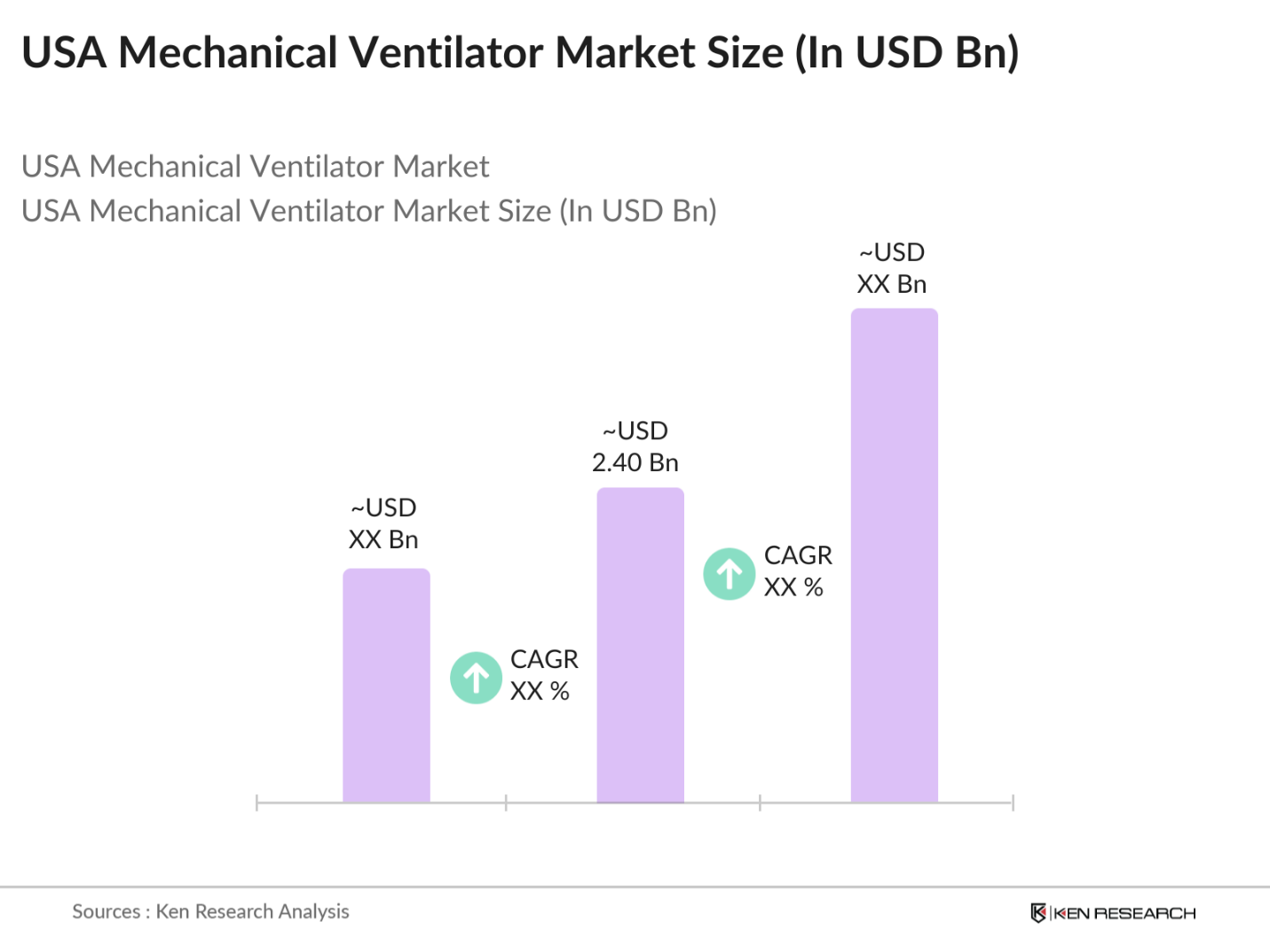
- The USA mechanical ventilator market is valued at USD 2.40 billion, based on a five-year historical analysis. This valuation is driven by the increasing prevalence of chronic respiratory diseases, advancements in ventilator technology, and the aging population requiring critical care support. The COVID-19 pandemic has also significantly influenced market dynamics, leading to heightened demand for ventilatory support systems.
- Major metropolitan areas such as New York, Los Angeles, and Chicago dominate the USA mechanical ventilator market. This dominance is attributed to their large healthcare infrastructures, higher patient populations, and substantial investments in medical technology. These cities have extensive networks of hospitals and critical care facilities, necessitating a higher demand for mechanical ventilators to support patient care.
- The U.S. Food and Drug Administration (FDA) classifies mechanical ventilators as Class II medical devices, necessitating a 510(k) premarket notification for market entry. This process requires manufacturers to demonstrate that their device is substantially equivalent to a legally marketed predicate device in terms of safety and effectiveness. In 2023, the FDA received over 3,000 510(k) submissions across various medical devices, reflecting the rigorous evaluation process for market approval.
USA Mechanical Ventilator Market Segmentation
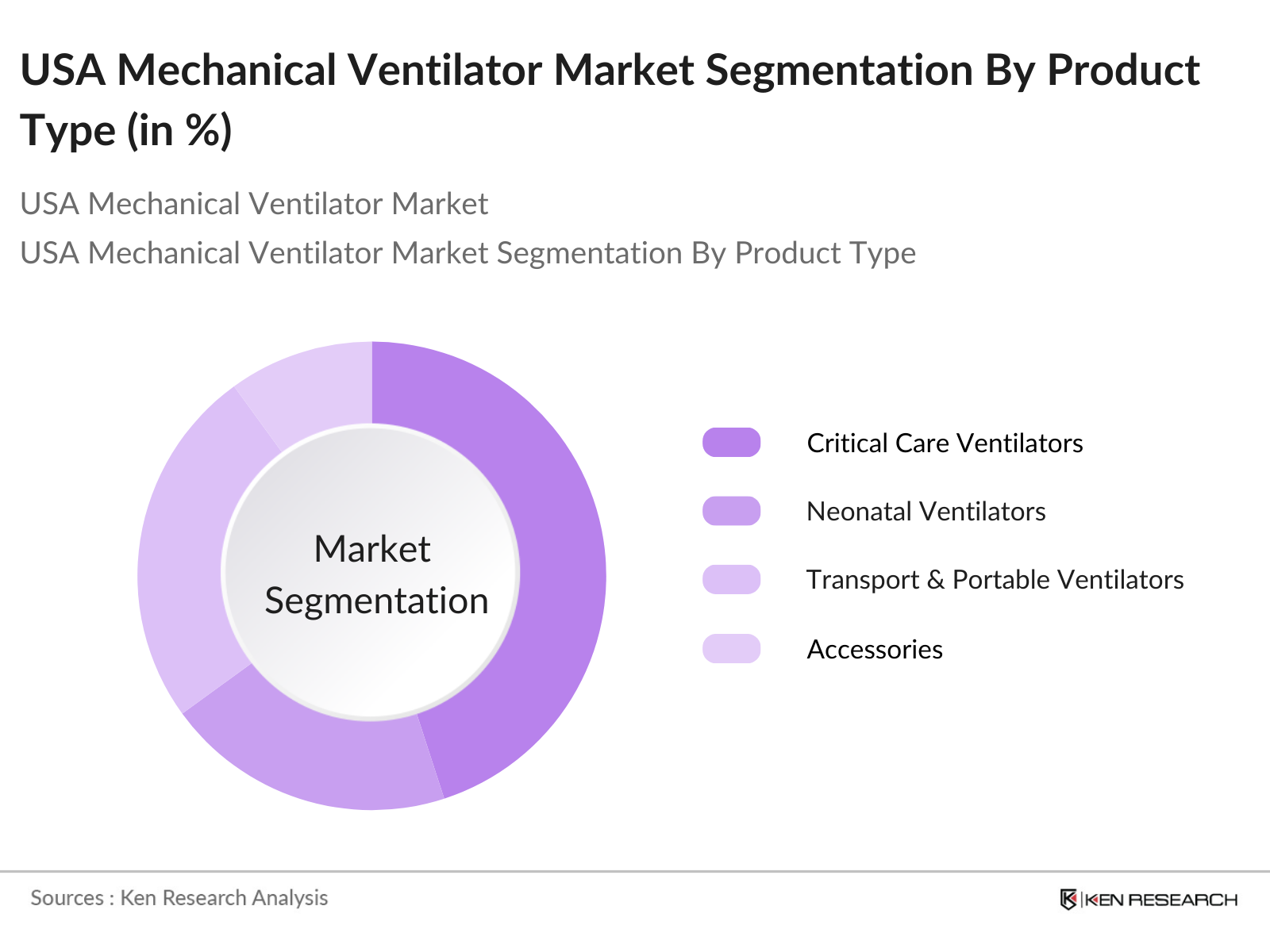
By Product Type: The market is segmented by product type into critical care ventilators, neonatal ventilators, transport & portable ventilators, and accessories. Critical care ventilators hold a dominant market share due to their essential role in intensive care units (ICUs) for patients with severe respiratory conditions. Their advanced features and capabilities make them indispensable in managing critical patients, thereby driving their widespread adoption in hospitals nationwide.
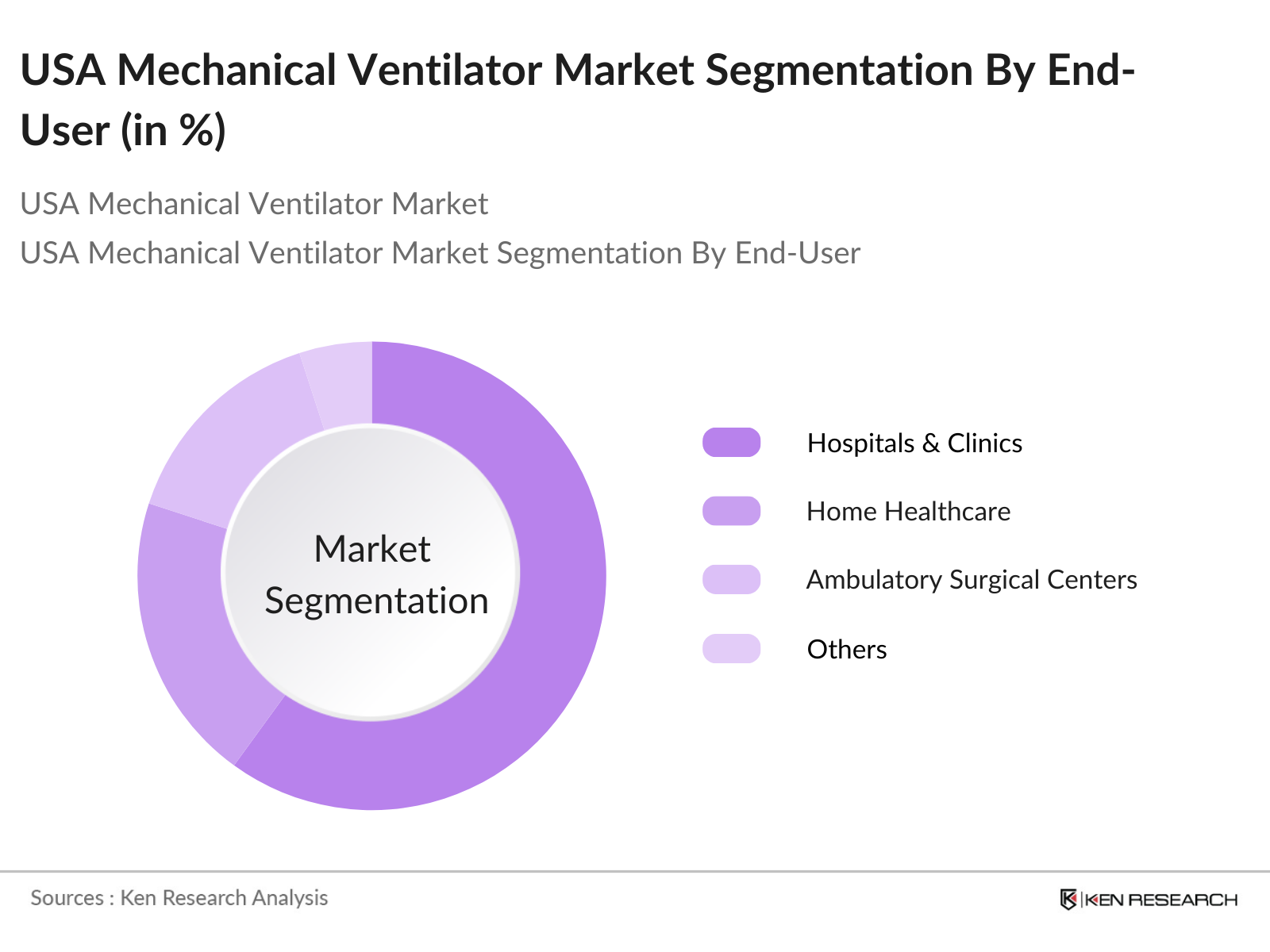
By End-User: The market is also segmented by end-user into hospitals & clinics, home healthcare, ambulatory surgical centers, and others. Hospitals & clinics represent the largest market share, primarily because they are the primary settings for critical care and emergency services. The need for immediate and advanced respiratory support in these facilities underscores the high demand for mechanical ventilators in hospital settings.
USA Mechanical Ventilator Market Competitive Landscape
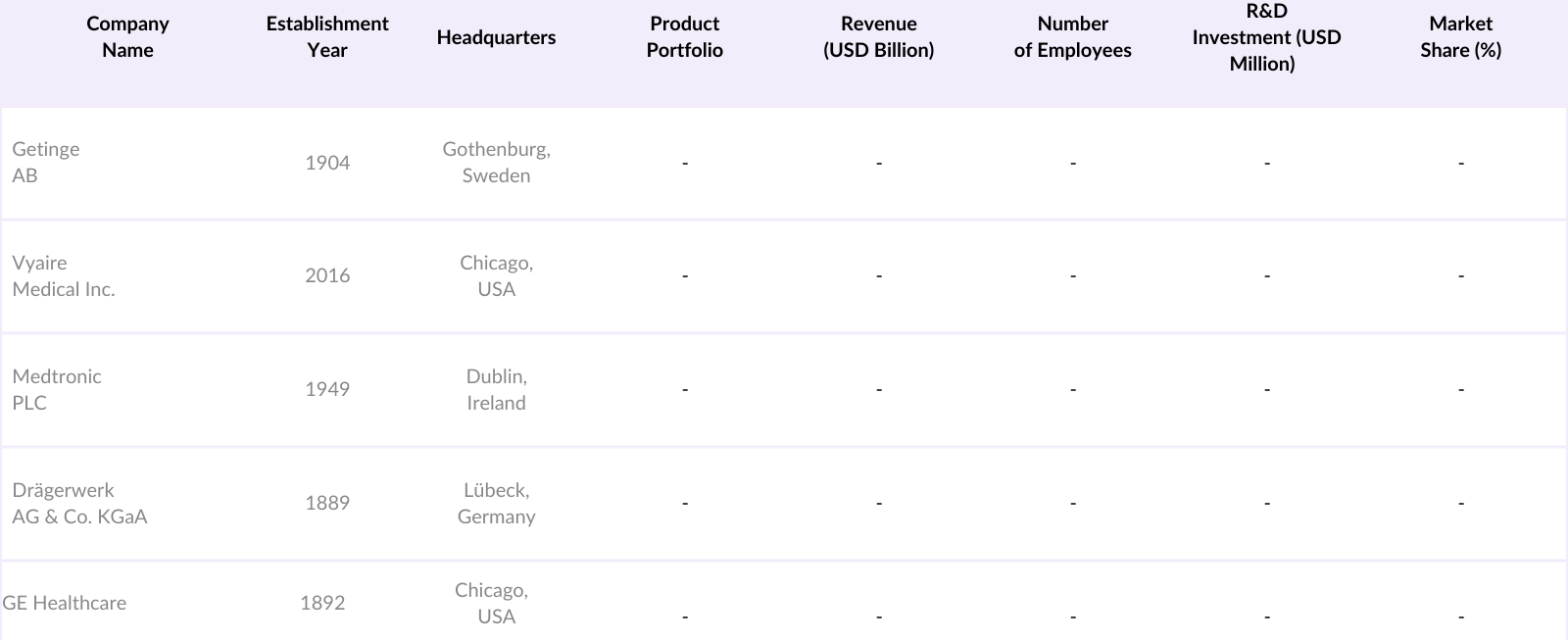
The USA mechanical ventilator market is characterized by the presence of several key players who contribute significantly to market dynamics. These companies are engaged in continuous innovation, strategic partnerships, and expansion to maintain their competitive edge.
USA Mechanical Ventilator Industry Analysis
Growth Drivers
- Increasing Prevalence of Respiratory Diseases: The United States has witnessed a significant rise in respiratory diseases, notably Chronic Obstructive Pulmonary Disease (COPD) and asthma. According to the Centers for Disease Control and Prevention (CDC), in 2022, approximately 16 million Americans were diagnosed with COPD, with millions more potentially undiagnosed. Additionally, the American Lung Association reported that over 25 million Americans had asthma in 2022. This surge in respiratory conditions has escalated the demand for mechanical ventilators to support patients with severe respiratory impairments.
- Technological Advancements in Ventilator Design: Recent technological innovations have enhanced ventilator efficiency and patient outcomes. The integration of advanced sensors and artificial intelligence has improved patient-ventilator synchronization, reducing complications. For instance, the development of portable ventilators with adaptive support ventilation modes has enabled personalized respiratory support, catering to individual patient needs. These advancements have made ventilators more user-friendly and effective in diverse clinical settings.
- Aging Population and Rising ICU Admissions: The U.S. Census Bureau reported that in 2023, over 54 million Americans were aged 65 and older, representing a significant portion of the population. This demographic is more susceptible to respiratory illnesses, leading to increased Intensive Care Unit (ICU) admissions. The National Center for Health Statistics noted that in 2022, there were approximately 4.7 million ICU admissions in the U.S., many requiring mechanical ventilation.
Market Challenges
- Stringent Regulatory Requirements: The U.S. Food and Drug Administration (FDA) enforces rigorous standards for medical devices, including mechanical ventilators. Manufacturers must comply with comprehensive testing, clinical trials, and quality assurance protocols before market approval. The FDA's 2023 guidelines emphasize the need for robust safety and efficacy data, which can prolong the time-to-market and increase development costs for new ventilator models.
- Risk of Ventilator-Associated Complications: Patients on mechanical ventilation are at risk of complications such as Ventilator-Associated Pneumonia (VAP). The CDC reported that in 2022, VAP affected approximately 10% of patients receiving mechanical ventilation, leading to increased morbidity and extended hospital stays. These complications necessitate stringent infection control measures and can impact patient outcomes, posing challenges for healthcare providers.
USA Mechanical Ventilator Market Future Outlook
Over the next five years, the USA mechanical ventilator market is expected to experience steady growth, driven by continuous technological advancements, increasing prevalence of respiratory diseases, and the aging population. The integration of artificial intelligence and machine learning in ventilator systems is anticipated to enhance patient outcomes and operational efficiency. Additionally, the shift towards home healthcare and portable ventilators is likely to open new avenues for market expansion.
Market Opportunities
- Growing Demand for Home Healthcare Ventilators: The shift towards home-based care has increased the demand for portable ventilators. The National Home Infusion Association reported that in 2022, over 1.5 million patients received home healthcare services in the U.S., many requiring respiratory support. Advancements in compact, user-friendly ventilator designs have facilitated their use in home settings, offering patients greater comfort and reducing hospital readmissions.
- Integration of Artificial Intelligence in Ventilator Systems: The incorporation of Artificial Intelligence (AI) in ventilator systems has enhanced patient monitoring and care personalization. AI algorithms can analyze patient data in real-time, adjusting ventilation parameters to optimize respiratory support. A study published in the Journal of Medical Internet Research in 2023 demonstrated that AI-integrated ventilators reduced weaning time by 20%, improving patient outcomes and operational efficiency.
Scope of the Report
|
Product Type |
Critical Care Ventilators |
|
Mode of Ventilation |
Invasive Ventilation |
|
Age Group |
Adult |
|
End-User |
Hospitals & Clinics |
|
Region |
Northeast |
Products
Key Target Audience
Hospitals and Clinics
Home Healthcare Providers
Ambulatory Surgical Centers
Medical Device Distributors
Respiratory Care Specialists
Government and Regulatory Bodies (e.g., USA Food and Drug Administration)
Investment and Venture Capitalist Firms
Insurance Companies
Companies
Players Mentioned in the Report
Getinge AB
Vyaire Medical Inc.
Medtronic PLC
Drgerwerk AG & Co. KGaA
GE Healthcare
Koninklijke Philips N.V.
Smiths Group plc
Hamilton Medical
ResMed Inc.
Ventec Life Systems
Table of Contents
1. USA Mechanical Ventilator Market Overview
1.1 Definition and Scope
1.2 Market Taxonomy
1.3 Market Growth Rate
1.4 Market Segmentation Overview
2. USA Mechanical Ventilator Market Size (In USD Billion)
2.1 Historical Market Size
2.2 Year-On-Year Growth Analysis
2.3 Key Market Developments and Milestones
3. USA Mechanical Ventilator Market Analysis
3.1 Growth Drivers
3.1.1 Increasing Prevalence of Respiratory Diseases
3.1.2 Technological Advancements in Ventilator Design
3.1.3 Aging Population and Rising ICU Admissions
3.1.4 Impact of COVID-19 Pandemic
3.2 Market Challenges
3.2.1 High Cost of Mechanical Ventilators
3.2.2 Stringent Regulatory Requirements
3.2.3 Risk of Ventilator-Associated Complications
3.3 Opportunities
3.3.1 Growing Demand for Home Healthcare Ventilators
3.3.2 Integration of Artificial Intelligence in Ventilator Systems
3.3.3 Expansion into Emerging Markets
3.4 Trends
3.4.1 Shift Towards Non-Invasive Ventilation Modes
3.4.2 Development of Portable and Transport Ventilators
3.4.3 Adoption of Telemedicine and Remote Monitoring
3.5 Government Regulation
3.5.1 FDA Approval Processes
3.5.2 Reimbursement Policies
3.5.3 Emergency Use Authorizations
3.5.4 Public-Private Partnerships
3.6 SWOT Analysis
3.7 Stakeholder Ecosystem
3.8 Porters Five Forces Analysis
3.9 Competitive Landscape
4. USA Mechanical Ventilator Market Segmentation
4.1 By Product Type (In Value %)
4.1.1 Critical Care Ventilators
4.1.2 Neonatal Ventilators
4.1.3 Transport & Portable Ventilators
4.1.4 Accessories (Breathing Circuit Sets, Masks, Flow Sensors)
4.2 By Mode of Ventilation (In Value %)
4.2.1 Invasive Ventilation
4.2.2 Non-Invasive Ventilation
4.3 By Age Group (In Value %)
4.3.1 Adult
4.3.2 Pediatric & Neonatal
4.3.3 Geriatric
4.4 By End-User (In Value %)
4.4.1 Hospitals & Clinics
4.4.2 Home Healthcare
4.4.3 Ambulatory Surgical Centers
4.4.4 Others
4.5 By Region (In Value %)
4.5.1 Northeast
4.5.2 Midwest
4.5.3 South
4.5.4 West
5. USA Mechanical Ventilator Market Competitive Analysis
5.1 Detailed Profiles of Major Companies
5.1.1 Getinge AB
5.1.2 Vyaire Medical Inc.
5.1.3 Medtronic PLC
5.1.4 Drgerwerk AG & Co. KGaA
5.1.5 GE Healthcare
5.1.6 Koninklijke Philips N.V.
5.1.7 Smiths Group plc
5.1.8 Hamilton Medical
5.1.9 ResMed Inc.
5.1.10 Ventec Life Systems
5.1.11 Fisher & Paykel Healthcare
5.1.12 Allied Healthcare Products Inc.
5.1.13 Hill-Rom Holdings, Inc.
5.1.14 Teleflex Incorporated
5.1.15 Becton, Dickinson and Company
5.2 Cross Comparison Parameters (Number of Employees, Headquarters, Inception Year, Revenue, Product Portfolio, Market Share, R&D Investment, Recent Developments)
5.3 Market Share Analysis
5.4 Strategic Initiatives
5.5 Mergers and Acquisitions
5.6 Investment Analysis
5.6.1 Venture Capital Funding
5.6.2 Government Grants
5.6.3 Private Equity Investments
6. USA Mechanical Ventilator Market Regulatory Framework
6.1 FDA Regulations and Guidelines
6.2 Compliance Requirements
6.3 Certification Processes
7. USA Mechanical Ventilator Future Market Size (In USD Billion)
7.1 Future Market Size Projections
7.2 Key Factors Driving Future Market Growth
8. USA Mechanical Ventilator Future Market Segmentation
8.1 By Product Type (In Value %)
8.2 By Mode of Ventilation (In Value %)
8.3 By Age Group (In Value %)
8.4 By End-User (In Value %)
8.5 By Region (In Value %)
9. USA Mechanical Ventilator Market Analysts Recommendations
9.1 Total Addressable Market (TAM), Serviceable Available Market (SAM), and Serviceable Obtainable Market (SOM) Analysis
9.2 Customer Cohort Analysis
9.3 Marketing Initiatives
9.4 White Space Opportunity Analysis
Disclaimer Contact UsResearch Methodology
Step 1: Identification of Key Variables
The initial phase involves constructing an ecosystem map encompassing all major stakeholders within the USA mechanical ventilator market. This step is underpinned by extensive desk research, utilizing a combination of secondary and proprietary databases to gather comprehensive industry-level information. The primary objective is to identify and define the critical variables that influence market dynamics.
Step 2: Market Analysis and Construction
In this phase, we compile and analyze historical data pertaining to the USA mechanical ventilator market. This includes assessing market penetration, the ratio of marketplaces to service providers, and the resultant revenue generation. Furthermore, an evaluation of service quality statistics is conducted to ensure the reliability and accuracy of the revenue estimates.
Step 3: Hypothesis Validation and Expert Consultation
Market hypotheses are developed and subsequently validated through computer-assisted telephone interviews (CATIs) with industry experts representing a diverse array of companies. These consultations provide valuable operational and financial insights directly from industry practitioners, which are instrumental in refining and corroborating the market data.
Step 4: Research Synthesis and Final Output
The final phase involves direct engagement with multiple mechanical ventilator manufacturers to acquire detailed insights into product segments, sales performance, consumer preferences, and other pertinent factors. This interaction serves to verify and complement the statistics derived from the bottom-up approach, thereby ensuring a comprehensive, accurate, and validated analysis of the USA mechanical ventilator market.
Frequently Asked Questions
1. How big is the USA Mechanical Ventilator Market?
The USA mechanical ventilator market is valued at USD 2.40 billion, based on a five-year historical analysis. This valuation is driven by the increasing prevalence of chronic respiratory diseases, advancements in ventilator technology, and the aging population requiring critical care support.
2. What are the major growth drivers in the USA Mechanical Ventilator Market?
Key growth drivers include the aging population, advancements in ventilator technology, and the increasing prevalence of respiratory conditions, such as chronic obstructive pulmonary disease (COPD) and asthma, which necessitate respiratory support.
3. Who are the leading players in the USA Mechanical Ventilator Market?
Major players include Getinge AB, Medtronic PLC, Drgerwerk AG, GE Healthcare, and Vyaire Medical, which dominate due to their extensive product portfolios, technological innovations, and established distribution networks.
4. What are the challenges faced by the USA Mechanical Ventilator Market?
Challenges include the high cost of ventilators, stringent regulatory requirements by authorities like the FDA, and risks of ventilator-associated complications that necessitate constant innovation and improvements in device safety.
Why Buy From Us?

What makes us stand out is that our consultants follows Robust, Refine and Result (RRR) methodology. i.e. Robust for clear definitions, approaches and sanity checking, Refine for differentiating respondents facts and opinions and Result for presenting data with story

We have set a benchmark in the industry by offering our clients with syndicated and customized market research reports featuring coverage of entire market as well as meticulous research and analyst insights.

While we don't replace traditional research, we flip the method upside down. Our dual approach of Top Bottom & Bottom Top ensures quality deliverable by not just verifying company fundamentals but also looking at the sector and macroeconomic factors.

With one step in the future, our research team constantly tries to show you the bigger picture. We help with some of the tough questions you may encounter along the way: How is the industry positioned? Best marketing channel? KPI's of competitors? By aligning every element, we help maximize success.

Our report gives you instant access to the answers and sources that other companies might choose to hide. We elaborate each steps of research methodology we have used and showcase you the sample size to earn your trust.

If you need any support, we are here! We pride ourselves on universe strength, data quality, and quick, friendly, and professional service.