
USA Merchant Banking Market Outlook to 2030
Region:North America
Author(s):Shreya Garg
Product Code:KROD5365
Region:North America
Author(s):Shreya Garg
Product Code:KROD5365
December 2024
89
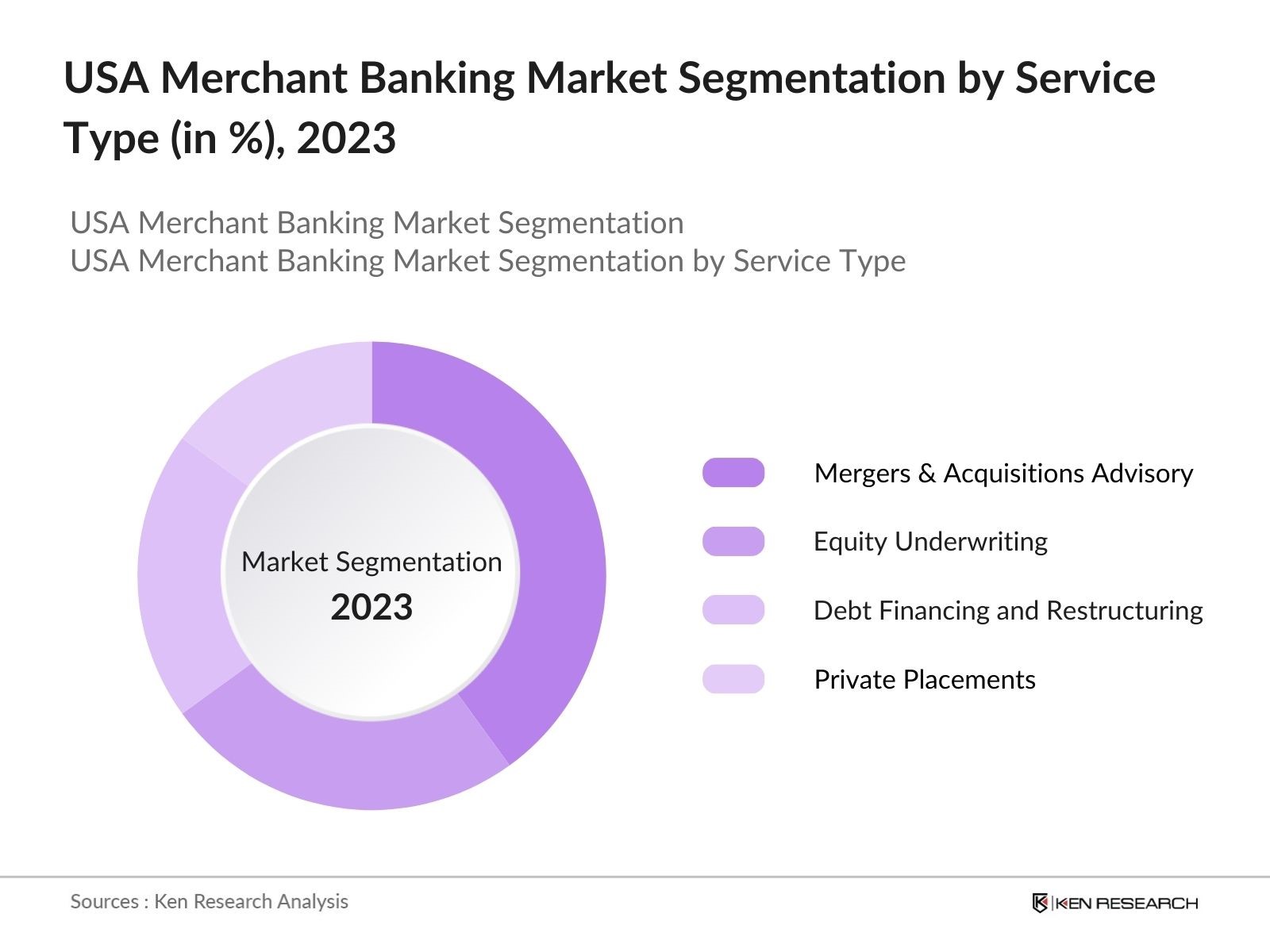
By Service Type: The market is segmented by service type into Mergers & Acquisitions Advisory, Equity Underwriting, Debt Financing and Restructuring, and Private Placements. Recently, Mergers & Acquisitions Advisory has a dominant market share under this segmentation due to the increased volume of M&A activities across the healthcare and technology sectors. The demand for advisory services has surged as corporations seek expertise in deal structuring and strategic acquisitions, particularly following the pandemic-driven shift towards consolidation and digital transformation.
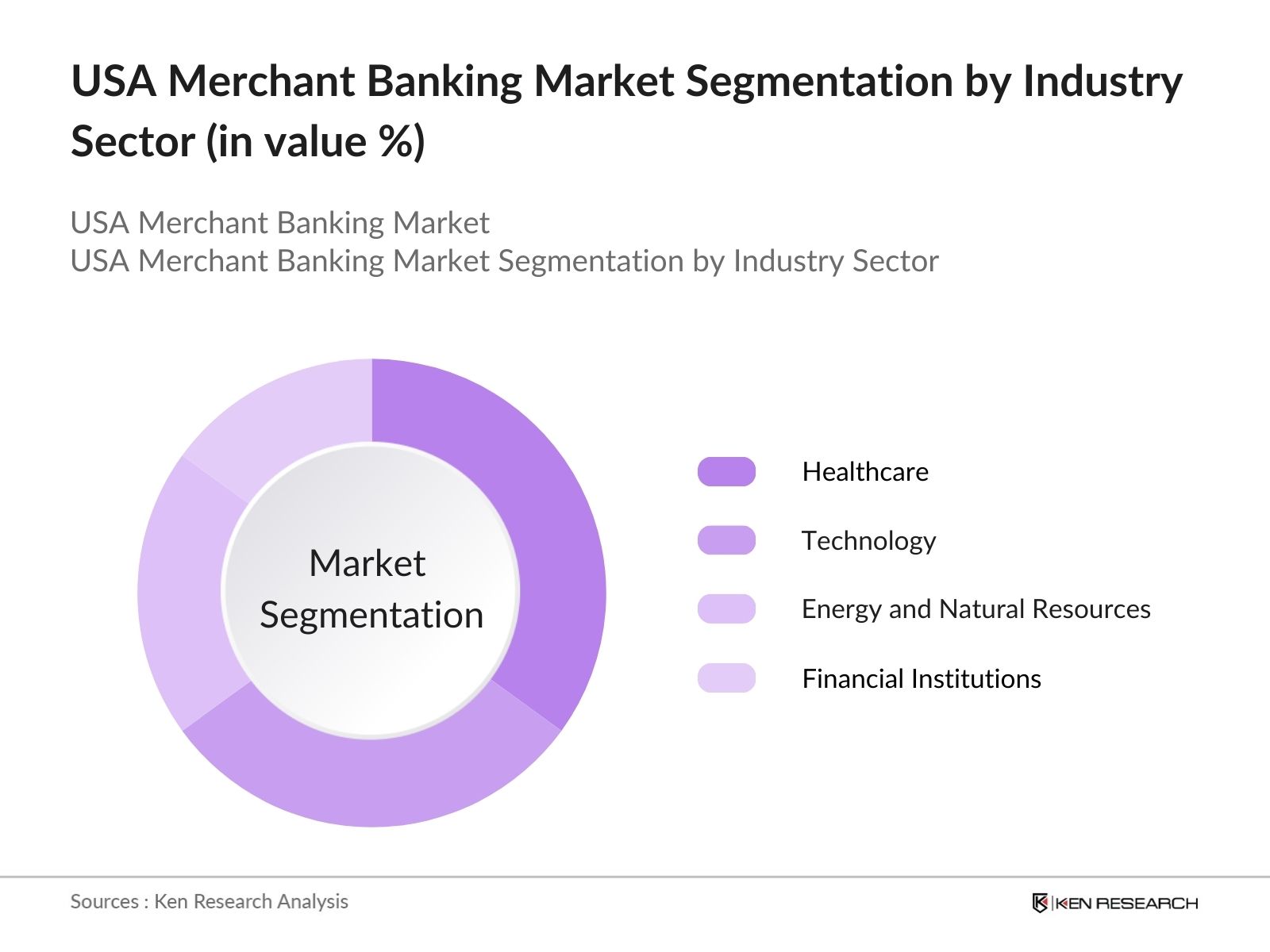
By Industry Sector: The market is further segmented by industry sector into Healthcare, Technology, Energy and Natural Resources, and Financial Institutions. The Healthcare sector dominates this market segment, driven by increased mergers, acquisitions, and the need for capital in light of rising healthcare costs and evolving technologies like telemedicine. The complexities of healthcare regulations and the growing need for investment in innovation and infrastructure make healthcare companies particularly reliant on merchant banks for strategic financial guidance.
The USA Merchant Banking Market is characterized by the dominance of a few key players, including major investment banks and independent merchant banking firms. These firms have established long-term relationships with corporations, institutional investors, and government bodies, consolidating their position within the market. Their competitive advantage lies in their ability to offer comprehensive financial solutions that cater to the diverse needs of clients, ranging from equity underwriting to restructuring services.
|
Company Name |
Year of Establishment |
Headquarters |
Key Services |
Revenue (2023) |
Employees |
M&A Deal Volume |
Private Equity Portfolio |
Regional Presence |
Client Retention Rate |
|
JPMorgan Chase & Co. |
1799 |
New York, USA |
|||||||
|
Goldman Sachs |
1869 |
New York, USA |
|||||||
|
Morgan Stanley |
1935 |
New York, USA |
|||||||
|
Citigroup Inc. |
1812 |
New York, USA |
|||||||
|
Bank of America Merrill Lynch |
1904 |
Charlotte, USA |
Over the next five years, the USA Merchant Banking Market is expected to grow steadily, driven by a continued demand for capital raising, increased private equity investments, and a surge in corporate restructuring. Advancements in financial technology (FinTech) and digital platforms are also expected to shape the future of merchant banking, enabling faster and more efficient transactions, particularly in M&A advisory and private placements. The increasing role of ESG (Environmental, Social, and Governance) investments will further enhance the market's growth as corporations look for sustainable and socially responsible investments.
|
By Service Type |
Mergers & Acquisitions Advisory Equity Underwriting Debt Financing and Restructuring Private Placements |
|
By Industry Sector |
Healthcare Technology Energy and Natural Resources Financial Institutions |
|
By Client Type |
Corporations Private Equity Firms Institutional Investors |
|
By Transaction Size |
Small to Mid-Cap Deals Large-Cap Deals |
|
By Region |
East Coast West Coast Midwest Southern States |
1.1. Definition and Scope
1.2. Market Taxonomy
1.3. Market Structure and Key Segments
1.4. Key Industry Stakeholders
2.1. Historical Market Size
2.2. Growth Rate (Year-on-Year)
2.3. Key Developments and Milestones
3.1. Growth Drivers
3.1.1. Corporate Finance and Capital Raising
3.1.2. Private Equity Investments
3.1.3. Advisory Services Demand
3.1.4. Regulatory Changes in Banking and Finance
3.2. Market Challenges
3.2.1. Regulatory Hurdles (Compliance Requirements)
3.2.2. Capital Requirement Challenges
3.2.3. Risk Management and Volatility Issues
3.3. Opportunities
3.3.1. Growth in Mergers & Acquisitions (Transaction Size)
3.3.2. Expansion of Debt and Equity Markets
3.3.3. FinTech Integration (Technological Solutions for Merchant Banking)
3.4. Trends
3.4.1. Digital Transformation in Financial Advisory
3.4.2. Cross-Border Transactions Growth
3.4.3. Sustainable Finance and ESG Investments
3.5. Government Regulations
3.5.1. Dodd-Frank Act (Impact on Merchant Banking)
3.5.2. SEC Regulatory Oversight
3.5.3. Basel III Compliance
3.6. SWOT Analysis
3.7. Stakeholder Ecosystem
3.8. Porters Five Forces Analysis
3.9. Competitive Landscape
4.1. By Service Type (In Value %)
4.1.1. Mergers & Acquisitions Advisory
4.1.2. Equity Underwriting
4.1.3. Debt Financing and Restructuring
4.1.4. Private Placements
4.2. By Industry Sector (In Value %)
4.2.1. Healthcare
4.2.2. Technology
4.2.3. Energy and Natural Resources
4.2.4. Financial Institutions
4.3. By Client Type (In Value %)
4.3.1. Corporations
4.3.2. Private Equity Firms
4.3.3. Institutional Investors
4.4. By Transaction Size (In Value %)
4.4.1. Small to Mid-Cap Deals
4.4.2. Large-Cap Deals
4.5. By Region (In Value %)
4.5.1. East Coast
4.5.2. West Coast
4.5.3. Midwest
4.5.4. Southern States
5.1. Detailed Profiles of Major Companies
5.1.1. JPMorgan Chase & Co.
5.1.2. Goldman Sachs
5.1.3. Morgan Stanley
5.1.4. Citigroup Inc.
5.1.5. Bank of America Merrill Lynch
5.1.6. Lazard Ltd.
5.1.7. Barclays Investment Bank
5.1.8. Credit Suisse
5.1.9. UBS Group AG
5.1.10. Evercore Inc.
5.1.11. Greenhill & Co.
5.1.12. Houlihan Lokey
5.1.13. Raymond James Financial
5.1.14. Rothschild & Co.
5.1.15. Moelis & Company
5.2. Cross Comparison Parameters (No. of Employees, Revenue, M&A Deal Volume, Client Retention Rate, Inception Year, Market Share, Key Services Offered, Regional Presence)
5.3. Market Share Analysis
5.4. Strategic Initiatives
5.5. Mergers and Acquisitions
5.6. Investment Analysis
5.7. Private Equity Investments
5.8. Venture Capital Involvement
6.1. Capital Requirements (Risk-Weighted Assets, Leverage Ratios)
6.2. Compliance with Anti-Money Laundering (AML) Regulations
6.3. Sarbanes-Oxley Act and Its Impact
6.4. SEC Registration Requirements
7.1. Key Factors Driving Future Market Growth
7.2. Changes in Regulatory Environment
7.3. Expansion of FinTech Integration
8.1. Strategic Expansion Opportunities
8.2. TAM/SAM/SOM Analysis
8.3. Emerging Growth Sectors (Healthcare, Technology, ESG)
8.4. White Space Opportunity Analysis
The initial phase involves constructing an ecosystem map encompassing all major stakeholders within the USA Merchant Banking Market. This step is underpinned by extensive desk research, utilizing secondary and proprietary databases to gather industry-level information. The objective is to define the critical variables that influence market dynamics.
This phase compiles historical data pertaining to the USA Merchant Banking Market. This includes assessing market penetration, transaction volumes, and service quality statistics. Additionally, an evaluation of service quality metrics will ensure the reliability of the data.
Market hypotheses will be developed and validated through interviews with industry experts from various companies. These consultations will offer insights into operational and financial performance, refining and corroborating the market data.
The final phase involves engagement with multiple merchant banking firms to acquire detailed insights into service segments, client preferences, and other market factors. This interaction will verify and complement the statistics derived from the bottom-up approach, ensuring a comprehensive and validated analysis.
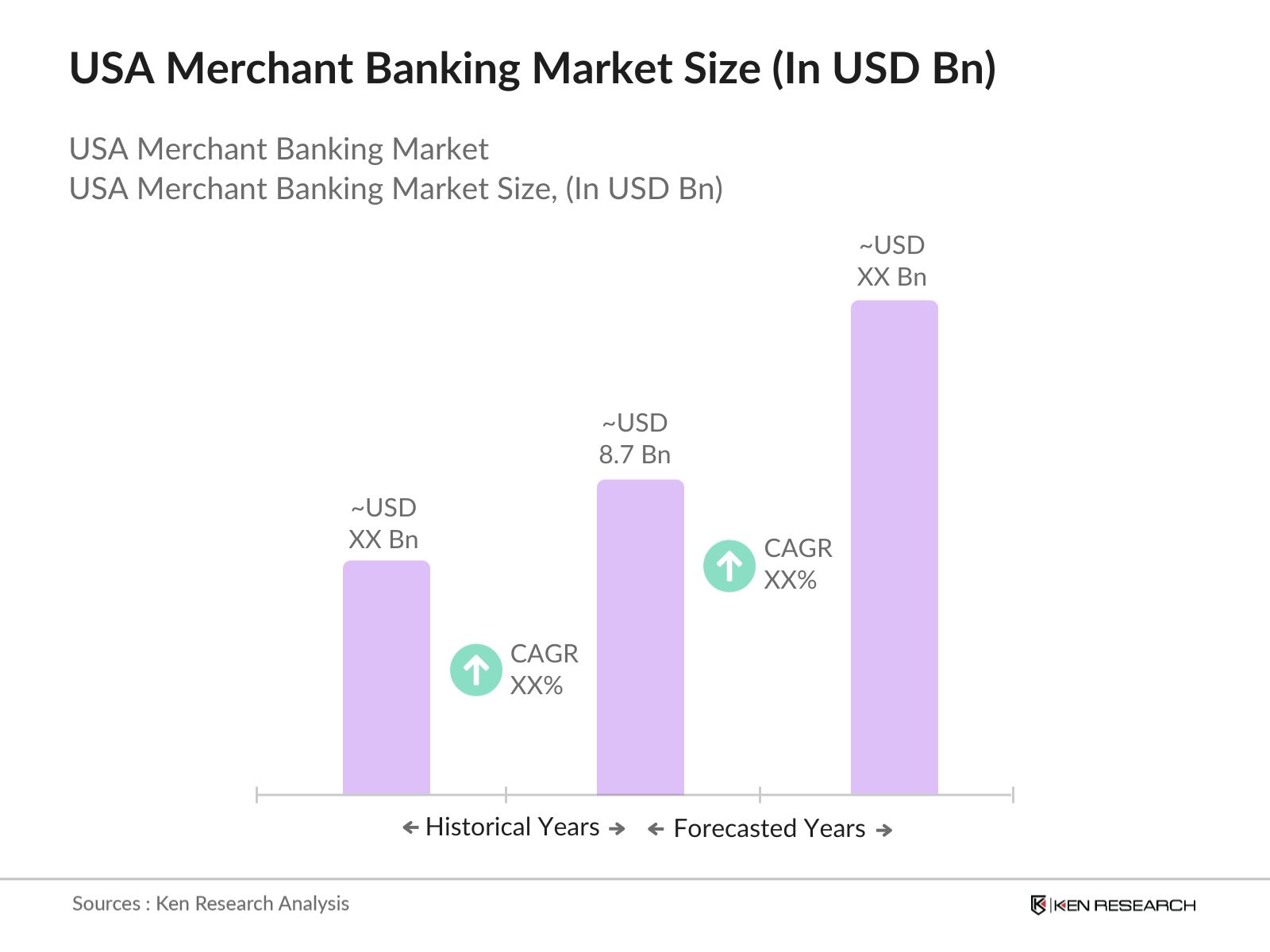
The USA Merchant Banking Market is valued at USD 8.7 billion, driven by increasing demand for corporate finance, private equity investments, and advisory services.
Challenges in the USA Merchant Banking Market include regulatory compliance, capital adequacy requirements, and risk management, which create barriers for smaller merchant banks and limit their expansion capabilities.
Key players in the USA Merchant Banking Market include JPMorgan Chase & Co., Goldman Sachs, Morgan Stanley, Citigroup Inc., and Bank of America Merrill Lynch. These companies dominate due to their extensive networks and diversified service offerings.
Growth drivers in the USA Merchant Banking Market include the increasing volume of M&A activities, the need for corporate restructuring, and growing private equity investments, particularly in the healthcare and technology sectors.
FinTech is enabling faster and more efficient transactions in merchant banking, particularly in private placements and M&A advisory, allowing for greater transparency and speed in deal-making in the USA Merchant Banking Market.

What makes us stand out is that our consultants follows Robust, Refine and Result (RRR) methodology. i.e. Robust for clear definitions, approaches and sanity checking, Refine for differentiating respondents facts and opinions and Result for presenting data with story

We have set a benchmark in the industry by offering our clients with syndicated and customized market research reports featuring coverage of entire market as well as meticulous research and analyst insights.

While we don't replace traditional research, we flip the method upside down. Our dual approach of Top Bottom & Bottom Top ensures quality deliverable by not just verifying company fundamentals but also looking at the sector and macroeconomic factors.

With one step in the future, our research team constantly tries to show you the bigger picture. We help with some of the tough questions you may encounter along the way: How is the industry positioned? Best marketing channel? KPI's of competitors? By aligning every element, we help maximize success.

Our report gives you instant access to the answers and sources that other companies might choose to hide. We elaborate each steps of research methodology we have used and showcase you the sample size to earn your trust.

If you need any support, we are here! We pride ourselves on universe strength, data quality, and quick, friendly, and professional service.