















USA Military Transport Aircraft Market Outlook to 2030
Region:North America
Author(s):Shubham
Product Code:KROD5769
November 2024
90
About the Report
USA Military Transport Aircraft Market Overview
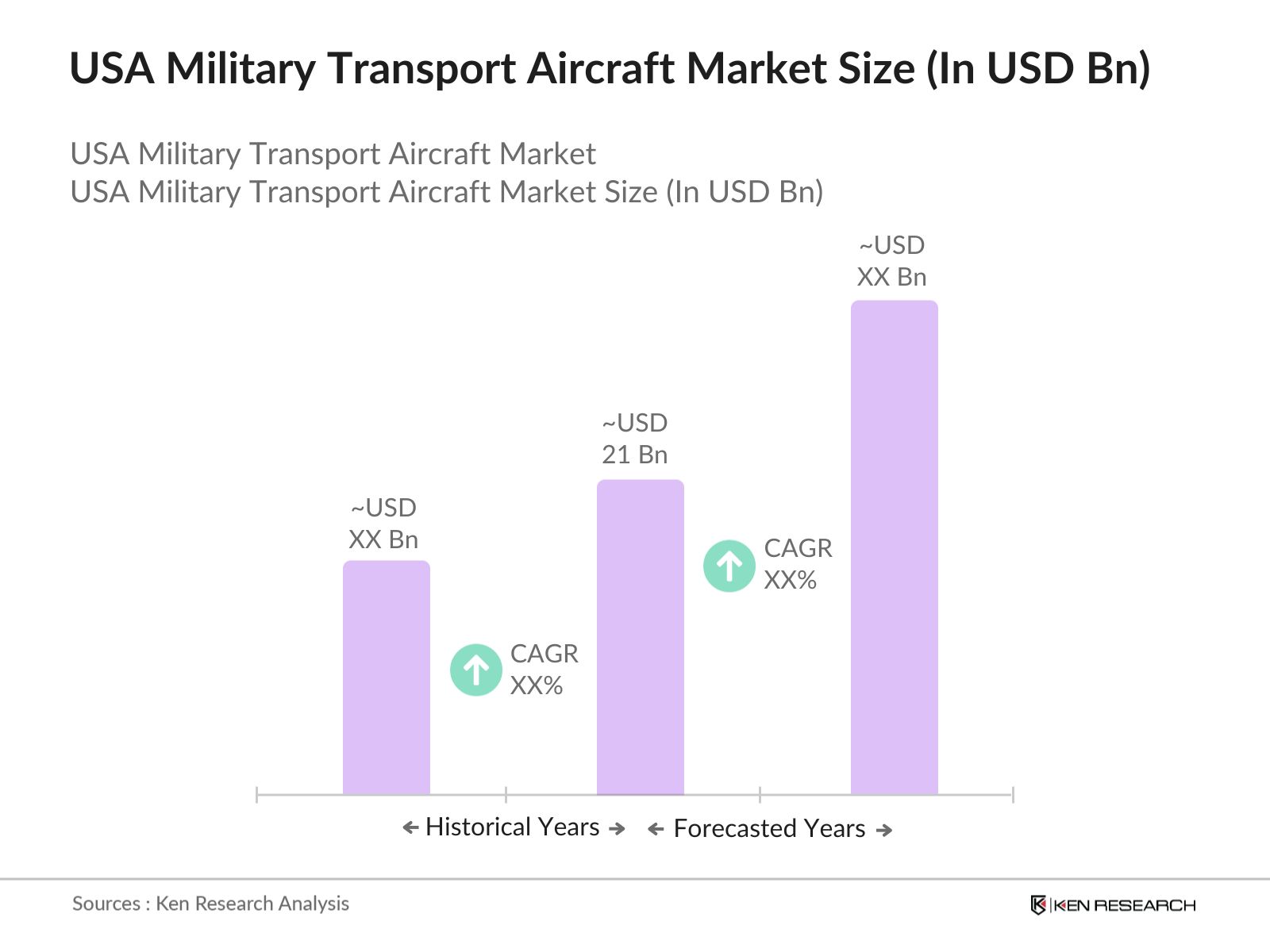
- The USA Military Transport Aircraft Market is valued at USD 21 billion, driven primarily by the U.S. Department of Defenses (DoD) focus on upgrading its fleet to meet new logistical and operational requirements. Significant investments in modernizing military transport capabilities underscore the need for robust, multi-functional aircraft capable of supporting rapid troop deployment, humanitarian aid, and supply chain logistics. These advanced aircraft models are equipped with state-of-the-art avionics and fuel-efficient engines, supporting a variety of mission-critical operations across different environments.
- Key regions, including Washington D.C., California, and Texas, play an essential role in the USA Military Transport Aircraft Market. Washington D.C. serves as the central hub for defense policy and funding allocation, while California and Texas host major manufacturing facilities and research institutions that drive innovation and production. These regions maintain dominance due to their proximity to critical military and aerospace infrastructures, along with a concentration of specialized professionals and contractors who support the development and deployment of advanced military transport aircraft.
- The U.S. defense acquisition process mandates a thorough assessment of costs, lifecycle maintenance, and multi-mission capabilities for transport aircraft. In 2024, the acquisition budget exceeded USD 100 billion, with stringent requirements on supplier certifications and asset evaluations. These processes ensure that military aircraft procured are operationally viable, cost-effective, and compliant with DoD specifications, which directly impacts supplier contracts and procurement timelines.
USA Military Transport Aircraft Market Segmentation
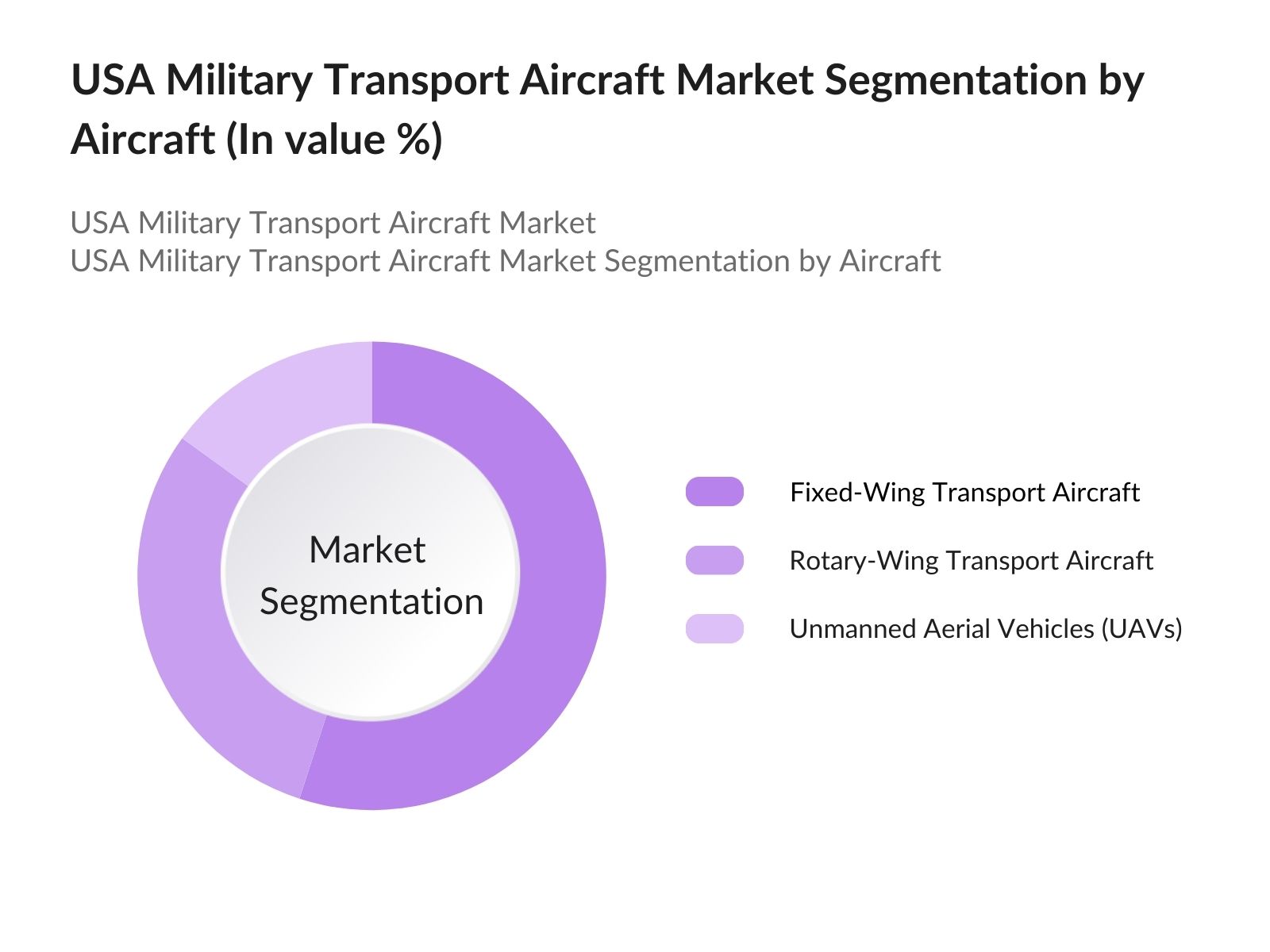
- By Aircraft Type: The market is segmented by aircraft type into fixed-wing transport aircraft, rotary-wing transport aircraft, and unmanned aerial vehicles (UAVs). Fixed-wing transport aircraft currently hold the largest market share due to their enhanced payload capacity and operational range, making them indispensable for large-scale missions. Models like the C-130 by Lockheed Martin have cemented this segments position, offering reliability and versatility for diverse military operations, including troop transportation and emergency evacuations.
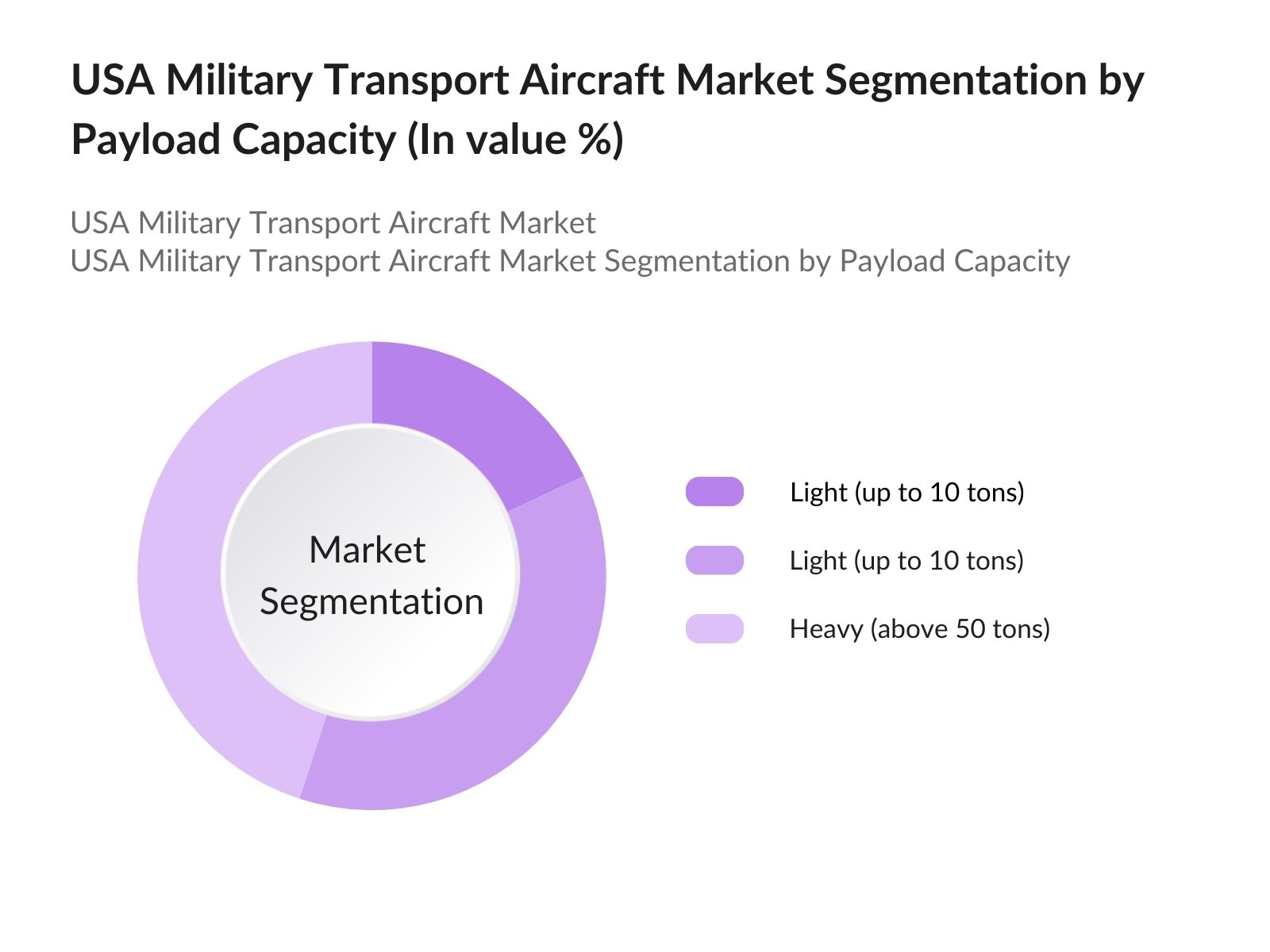
- By Payload Capacity: The market is segmented by payload capacity into light (up to 10 tons), medium (10-50 tons), and heavy (above 50 tons). Heavy payload capacity aircraft dominate the market, driven by their ability to carry substantial cargo and essential equipment over long distances. These aircraft are crucial for emergency deployments and logistical support, particularly in complex missions requiring heavy-duty transport solutions. Heavy payload aircraft offer strategic advantages, particularly in supporting overseas operations and delivering humanitarian aid in remote areas.
USA Military Transport Aircraft Market Competitive Landscape
The USA Military Transport Aircraft market is highly competitive, with both domestic and international companies vying for critical government contracts. Key players dominate by leveraging extensive research and development capabilities, as well as longstanding relationships with the Department of Defense. These companies focus on technological innovation, strategic alliances, and expanding their global reach to retain competitive advantages. 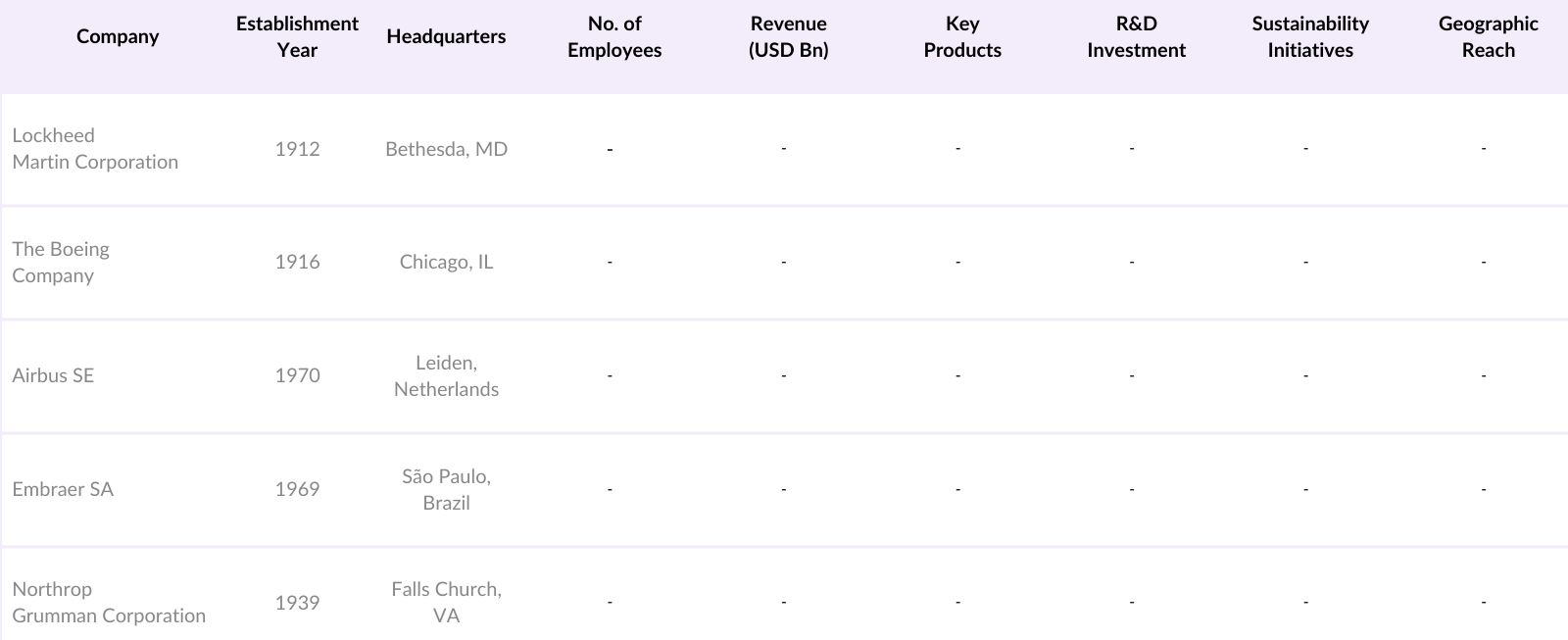
USA Military Transport Aircraft Market Analysis
Growth Drivers
- Increasing Defense Budgets: The U.S. defense budget in 2024 stands at USD 841 billion, reflecting the countrys strategic focus on maintaining global military superiority. Specifically, the Department of Defense (DoD) allocated a substantial amount toward military procurement, including transportation and air mobility assets, to ensure rapid deployment capabilities. This emphasis on strengthening airlift capacity aligns with national security policies aiming to support both domestic and international operations. The sustained increase in defense spending indicates the U.S. governments commitment to robust air transport capabilities.
- Modernization of Armed Forces: To enhance operational capabilities, the U.S. military launched modernization programs focused on updating aging aircraft fleets, such as the C-130 and C-17 models. A noteworthy amount is earmarked for upgrading transport fleets with state-of-the-art navigation, avionics, and surveillance systems to maintain operational efficacy in modern warfare. These enhancements address the need for interoperable, multi-theater operational aircraft to ensure rapid responsiveness across regions. The modernization aligns with global defense commitments and maximizes resource efficiency in diverse combat environments.
- Strategic Airlift Requirements: Strategic airlift requirements underscore the need for heavy transport capabilities, particularly with 250,000 active U.S. troops stationed worldwide. Air transport vehicles like the C-5 and KC-135 are instrumental in supporting military deployments, evacuations, and humanitarian aid, as well as ensuring equipment and personnel mobility. These requirements necessitate robust aircraft capable of long-haul missions, reflecting the DoDs emphasis on rapid deployment. This operational focus justifies ongoing investments in high-capacity, multi-role transport aircraft that offer versatility in strategic airlift scenarios.
Challenges
- High Maintenance and Operational Costs: Modernizing the U.S. transport fleet involves substantial costs for maintaining cutting-edge systems and ensuring compliance with safety standards. Continuous technological upgrades to meet mission-critical requirements create financial burdens, impacting budget allocations for other defense programs. The cost of maintaining a fleet capable of handling complex missions remains a financial challenge. The DoD prioritizes maintenance, repair, and overhaul (MRO) spending to maintain operational readiness, yet these high costs limit the capacity to expand fleets rapidly. Budget constraints, therefore, challenge the DoDs ability to increase the number of operational aircraft.
- Supply Chain Vulnerabilities: In the military transport aircraft sector, limited supplier options create dependency risks for the DoD. Dominated by a few manufacturers, the markets concentration restricts procurement flexibility and elevates negotiation challenges. In 2024, majority of military transport aircraft contracts were concentrated among two major players, reducing competitive pricing and increasing potential supply chain delays. This concentration can result in dependency on single-source suppliers, potentially leading to delays in fleet expansions or upgrades.
USA Military Transport Aircraft Market Future Outlook
The USA Military Transport Aircraft Market is projected to experience steady growth through 2028, driven by continued investments in next-generation aircraft, enhancements in avionics, and the increased adoption of sustainable aviation technologies. The U.S. military is expected to prioritize multi-role transport aircraft that meet diverse operational requirements, including troop deployment, logistical support, and humanitarian assistance. These investments aim to strengthen rapid response capabilities and expand the militarys operational reach in dynamic environments.
Future Market Opportunities
- Expansion of Multi-Role Aircraft Capabilities: As mission requirements evolve, there is a growing need for aircraft capable of executing multiple roles within a single mission framework. The U.S. military is investing in transport aircraft that offer versatile functionality, from cargo and personnel transport to medical evacuations. This trend is likely to provide significant opportunities for manufacturers specializing in multi-role transport solutions.
- Increased Demand for Advanced Avionics and Autonomous Features: Advanced avionics systems and semi-autonomous capabilities are becoming essential in the modern military transport aircraft sector. The U.S. military is allocating funds toward avionics systems that enhance situational awareness, improve navigation accuracy, and reduce pilot workload. Autonomous features, including automated takeoff and landing systems, are expected to improve mission efficiency and safety.
Scope of the Report
|
By Aircraft Type |
Fixed-Wing Transport Aircraft |
|
By Payload Capacity |
Light (up to 10 tons) |
|
By Engine Type |
Turbofan Engines |
|
By Application |
Airlift and Cargo Transport |
|
By Region |
Northeast Midwest Southern Western |
Products
Key Target Audience
Defense Procurement Agencies (U.S. Department of Defense)
Military Logistics Units
Defense Contractors and Subcontractors
Aircraft Maintenance and Repair Providers
Investors and Venture Capitalist Firms
Banks and Financial Institutions
Government and Regulatory Bodies (Federal Aviation Administration - FAA)
Suppliers of Aircraft Components and Avionics
Companies
Players Mentioned in the Report
Lockheed Martin Corporation
The Boeing Company
Northrop Grumman Corporation
Airbus SE
Embraer SA
Leonardo S.p.A.
Textron Inc.
Bell Helicopter (Textron Subsidiary)
Kawasaki Heavy Industries, Ltd.
Hindustan Aeronautics Limited (HAL)
Israel Aerospace Industries Ltd.
UAC (United Aircraft Corporation)
Antonov State Company
Sikorsky Aircraft Corporation (Lockheed Martin Subsidiary)
General Dynamics Corporation
Table of Contents
1. USA Military Transport Aircraft Market Overview
1.1 Definition and Scope
1.2 Market Taxonomy
1.3 Market Growth Rate and Drivers
1.4 Market Segmentation Overview
2. USA Military Transport Aircraft Market Size (In USD Billion)
2.1 Historical Market Size
2.2 Year-on-Year Growth Analysis
2.3 Key Market Developments and Milestones
3. USA Military Transport Aircraft Market Analysis
3.1 Growth Drivers
3.1.1 Increase in Defense Expenditure
3.1.2 Modernization of Armed Forces (Military Modernization Programs)
3.1.3 Strategic Airlift Requirements
3.1.4 Technological Advancements in Military Aviation
3.2 Market Challenges
3.2.1 High Cost of Aircraft Procurement and Maintenance
3.2.2 Limited Number of Suppliers
3.2.3 Regulatory Restrictions on Export
3.3 Opportunities
3.3.1 Demand for Multi-Role Aircraft
3.3.2 Emerging Markets for Military Aircraft Leasing
3.3.3 Expanding Applications in Humanitarian Missions
3.4 Trends
3.4.1 Adoption of Fuel-Efficient Engines (Fuel Efficiency Innovations)
3.4.2 Advanced Avionics Integration
3.4.3 Increased Emphasis on Cargo Versatility
3.5 Government Regulations
3.5.1 Defense Acquisition Processes
3.5.2 Environmental Regulations in Manufacturing
3.5.3 Export Compliance and Security Clearance
3.6 SWOT Analysis
3.7 Stakeholder Ecosystem
3.8 Porters Five Forces
3.9 Competitive Landscape
4. USA Military Transport Aircraft Market Segmentation
4.1 By Aircraft Type (In Value %)
4.1.1 Fixed-Wing Transport Aircraft
4.1.2 Rotary-Wing Transport Aircraft
4.1.3 Unmanned Aerial Vehicles (UAVs)
4.2 By Payload Capacity (In Value %)
4.2.1 Light (up to 10 tons)
4.2.2 Medium (10-50 tons)
4.2.3 Heavy (above 50 tons)
4.3 By Engine Type (In Value %)
4.3.1 Turbofan Engines
4.3.2 Turboprop Engines
4.3.3 Hybrid-Electric Engines
4.4 By Application (In Value %)
4.4.1 Airlift and Cargo Transport
4.4.2 Troop Deployment
4.4.3 Medical Evacuation
4.4.4 Humanitarian Relief Operations
4.5 By Region (In Value %)
4.5.1 Northeast
4.5.2 Midwest
4.5.3 Midwest
4.5.4 Western
5. USA Military Transport Aircraft Market Competitive Analysis
5.1 Detailed Profiles of Major Companies
5.1.1 Lockheed Martin Corporation
5.1.2 The Boeing Company
5.1.3 Northrop Grumman Corporation
5.1.4 Airbus SE
5.1.5 Embraer SA
5.1.6 Leonardo S.p.A.
5.1.7 Textron Inc.
5.1.8 Bell Helicopter (Textron Subsidiary)
5.1.9 Kawasaki Heavy Industries, Ltd.
5.1.10 Hindustan Aeronautics Limited (HAL)
5.1.11 Israel Aerospace Industries Ltd.
5.1.12 UAC (United Aircraft Corporation)
5.1.13 Antonov State Company
5.1.14 Sikorsky Aircraft Corporation (Lockheed Martin Subsidiary)
5.1.15 General Dynamics Corporation
5.2 Cross Comparison Parameters (Fleet Size, Operational Regions, Manufacturing Facilities, Market Share, Export Volume, Revenue, Product Diversification, R&D Expenditure)
5.3 Market Share Analysis
5.4 Strategic Initiatives
5.5 Mergers and Acquisitions
5.6 Investment Analysis
5.7 Government Contracts
5.8 Research and Development Collaborations
6. USA Military Transport Aircraft Market Regulatory Framework
6.1 Defense Industry Regulations
6.2 Export and Import Policies
6.3 Certification and Safety Standards
7. USA Military Transport Aircraft Future Market Size (In USD Billion)
7.1 Future Market Size Projections
7.2 Key Factors Driving Future Market Growth
8. USA Military Transport Aircraft Future Market Segmentation
8.1 By Aircraft Type (In Value %)
8.2 By Payload Capacity (In Value %)
8.3 By Engine Type (In Value %)
8.4 By Application (In Value %)
8.5 By Region (In Value %)
9. USA Military Transport Aircraft Market Analysts Recommendations
9.1 TAM/SAM/SOM Analysis
9.2 Customer Acquisition Strategies
9.3 Market Penetration and Expansion Opportunities
9.4 White Space Analysis for New Product Development
Disclaimer Contact UsResearch Methodology
Step 1: Identification of Key Variables
The initial phase involved constructing an ecosystem map encompassing all major stakeholders within the USA Military Transport Aircraft Market. This step is underpinned by extensive desk research, utilizing a combination of secondary and proprietary databases to gather comprehensive industry-level information. The primary objective is to identify and define the critical variables that influence market dynamics.
Step 2: Market Analysis and Construction
In this phase, historical data on military transport aircraft procurement, fleet size, and payload capacity were compiled to create a robust foundation for market size estimates. This includes assessing defense allocations and cost ratios for operational expenditures, ensuring accuracy in revenue projections and growth metrics.
Step 3: Hypothesis Validation and Expert Consultation
Market hypotheses were validated through direct interviews and computer-assisted telephone interviews (CATI) with industry experts. These consultations provided valuable insights, enhancing the accuracy and depth of the market estimations, particularly regarding future aircraft technology trends and fleet expansion strategies.
Step 4: Research Synthesis and Final Output
The final phase involved the synthesis of data collected from primary and secondary sources, cross-verified with insights from manufacturers and suppliers. This process ensured a validated analysis, with a bottom-up approach applied to estimate the size and growth trajectory of the USA Military Transport Aircraft Market.
Frequently Asked Questions
01. How big is the USA Military Transport Aircraft Market?
The USA Military Transport Aircraft Market is valued at USD 21 billion, driven by strategic demands for rapid deployment capabilities and advancements in transport aircraft technology.
02. What are the challenges in the USA Military Transport Aircraft Market?
Challenges in this USA Military Transport Aircraft Market include high operational and maintenance costs, along with vulnerabilities in the supply chain that impact production timelines and fleet readiness.
03. Who are the major players in the USA Military Transport Aircraft Market?
Key players in the USA Military Transport Aircraft Market include Lockheed Martin, Boeing, Northrop Grumman, Airbus, and Embraer, all of whom dominate due to strong DoD ties, advanced manufacturing capabilities, and global reach.
04. What are the growth drivers of the USA Military Transport Aircraft Market?
Growth in this USA Military Transport Aircraft Market is driven by increasing defense budgets, advancements in fuel-efficient engines, and a strategic focus on multi-role transport capabilities to support varied mission requirements.
Why Buy From Us?

What makes us stand out is that our consultants follows Robust, Refine and Result (RRR) methodology. i.e. Robust for clear definitions, approaches and sanity checking, Refine for differentiating respondents facts and opinions and Result for presenting data with story

We have set a benchmark in the industry by offering our clients with syndicated and customized market research reports featuring coverage of entire market as well as meticulous research and analyst insights.

While we don't replace traditional research, we flip the method upside down. Our dual approach of Top Bottom & Bottom Top ensures quality deliverable by not just verifying company fundamentals but also looking at the sector and macroeconomic factors.

With one step in the future, our research team constantly tries to show you the bigger picture. We help with some of the tough questions you may encounter along the way: How is the industry positioned? Best marketing channel? KPI's of competitors? By aligning every element, we help maximize success.

Our report gives you instant access to the answers and sources that other companies might choose to hide. We elaborate each steps of research methodology we have used and showcase you the sample size to earn your trust.

If you need any support, we are here! We pride ourselves on universe strength, data quality, and quick, friendly, and professional service.