
USA Modular Construction Market Outlook to 2030
Region:North America
Author(s):Paribhasha Tiwari
Product Code:KROD3466
October 2024
98
About the Report
USA Modular Construction Market Overview
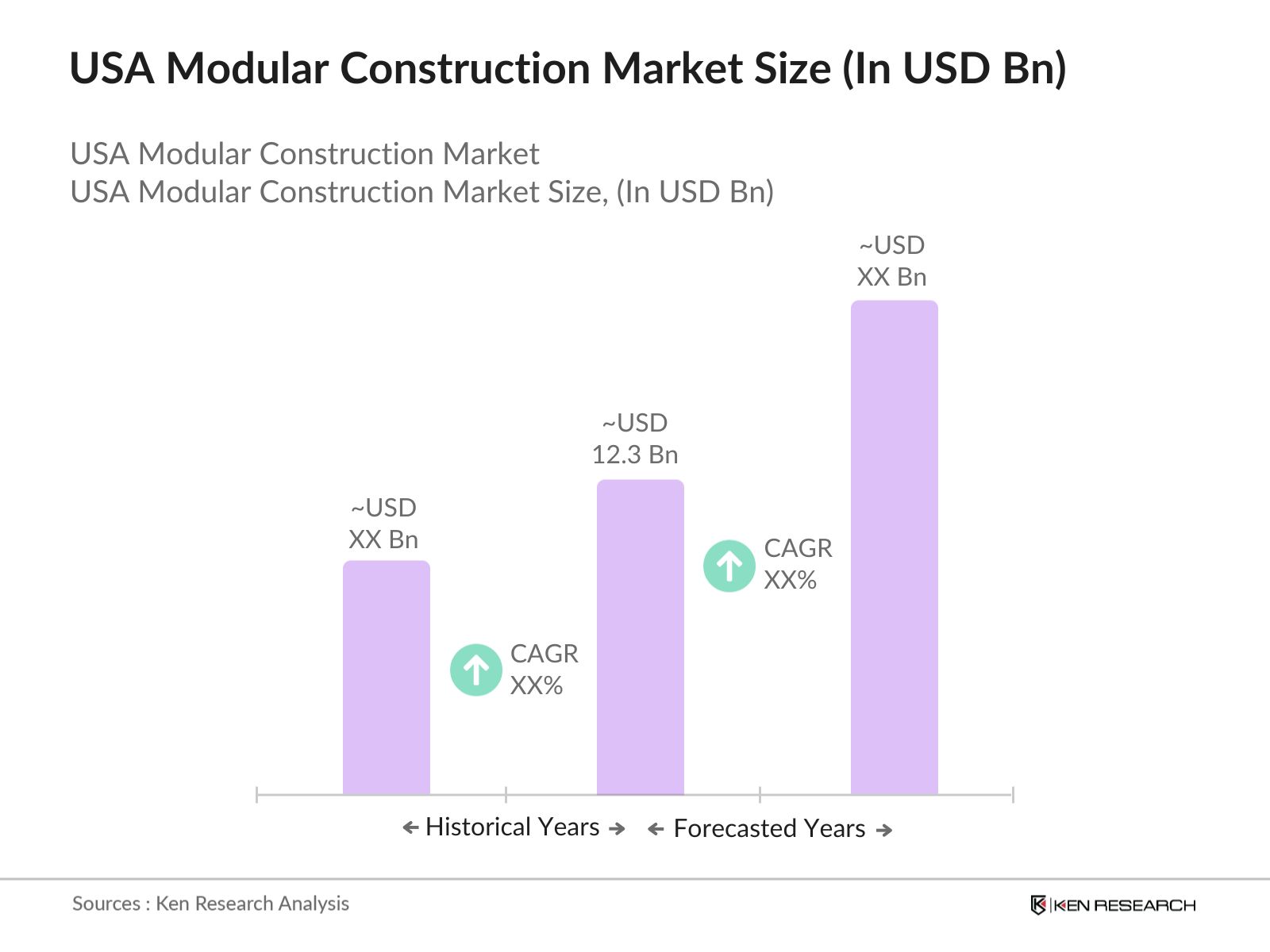
- The USA Modular Construction market is valued at based on a five-year historical analysis. The market has seen rapid growth due to its cost-efficiency, reduced construction time, and rising demand for sustainable building practices. Modular construction allows for the off-site assembly of buildings, leading to faster project completion while maintaining quality control. Key sectors driving this demand include residential, healthcare, and educational facilities, where the need for affordable and quick construction solutions is rising.
- Key regions dominating the USA Modular Construction market include the states of California, Texas, and New York. These states benefit from a combination of large population sizes, significant urbanization, and stringent building regulations favoring sustainable construction methods. California, in particular, leads in adopting modular construction due to its ambitious housing goals, coupled with policies promoting green building and climate resilience. Texas and New York follow closely due to booming commercial and residential developments.
- In early February 2024, the of Building Regulations and Standards (BBRS) proposed significant amendments to its building codes. These changes aimed to enhance the regulatory environment for modular construction, which had previously faced challenges that could have jeopardized the industry's viability in the state. The proposed updates are seen as a crucial step in fostering a more supportive framework for modular construction, enabling faster project approvals and facilitating the development of affordable housing solutions.
USA Modular Construction Market Segmentation
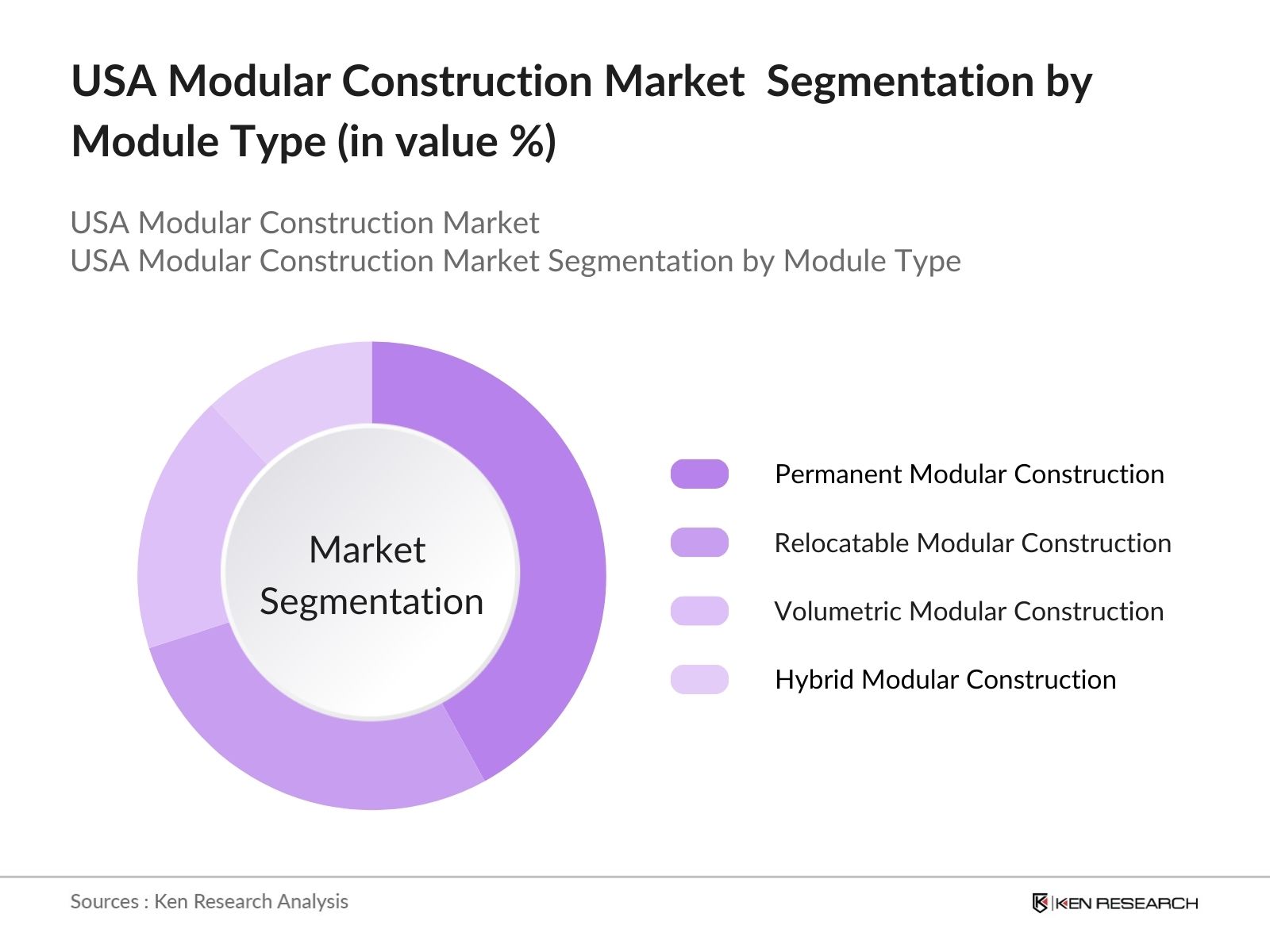
By Module Type: The USA Modular Construction market is segmented by module type into permanent modular construction, relocatable modular construction, volumetric modular construction, and hybrid modular construction. Recently, permanent modular construction holds a dominant market share due to its ability to deliver high-quality, durable structures that meet stringent building codes and standards. This method is popular in sectors such as education and healthcare, where long-term, high-performance buildings are necessary.
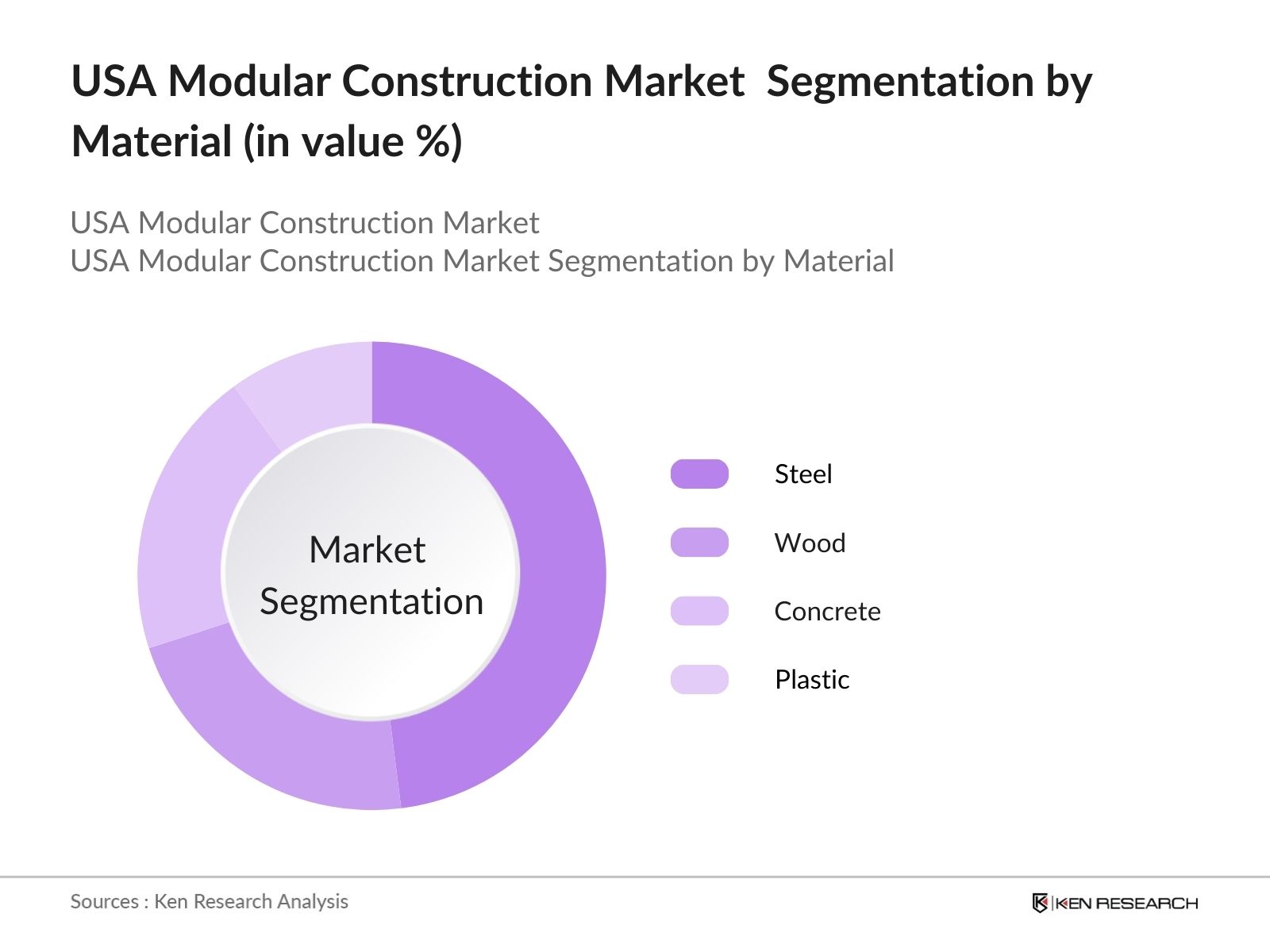
By Material: The market is segmented by material into steel, wood, concrete, and plastic. Steel dominates the modular construction market due to its structural strength, durability, and versatility in various applications, including residential, commercial, and industrial projects. Steel is also favored for its ability to withstand extreme weather conditions and provide long-lasting support, making it the material of choice for high-rise buildings and industrial complexes.
USA Modular Construction Market Competitive Landscape
The USA Modular Construction market is dominated by several key players with established reputations for quality, innovation, and market reach. The market is highly competitive, with companies leveraging advanced construction technologies such as 3D printing and Building Information Modeling (BIM) to gain an edge. Moreover, increased government interest in sustainable housing and infrastructure projects has led these companies to secure significant public contracts.
|
Company |
Establishment Year |
Headquarters |
Revenue (USD Bn) |
No. of Employees |
Key Projects |
Key Clients |
Market Focus |
Geographic Reach |
Green Building Certifications |
|
Guerdon Enterprises LLC |
1971 |
Boise, Idaho |
|||||||
|
Skender Construction |
1955 |
Chicago, Illinois |
|||||||
|
Red Sea International |
1967 |
Houston, Texas |
|||||||
|
Katerra |
2015 |
Menlo Park, California |
|||||||
|
Modular Genius |
2006 |
Baltimore, Maryland |
USA Modular Construction Market Analysis
Growth Drivers
- Increasing Urbanization: Urbanization in the nificant driver for modular construction, with approximately 83% of the population now residing in urban areas. This population increase is leading to greater demand for housing and commercial infrastructure. Major cities like New York, Los Angeles, and Houston continue to experience population growth, fueling the need for fast, efficient construction solutions that modular construction provides. Urban migration, driven by job opportunities and lifestyle changes, has made modular methods crucial to meeting new construction demands.
- Time and Cost Efficiency: Modular construction is significantly faster than traditional methods, with buildings being % faster. This is critical given the current U.S. labor shortage, where 500,000 workers are needed in the construction industry. Modular construction also cuts costs by reducing material waste by as much as 90% through recycling and reuse. These efficiencies in both time and material usage are helping to alleviate the cost pressures caused by labor shortages and tight project timelines.
- Growing Focus on Sustainability: Sustainability is increasingly prioritized in U.S. construction, with 69,000 commercial buildings now LEED-certified. Modular construction aligns well with green building practices, as it produces less waste and is energy-efficient. The federal government’s push for sustainable practices, alongside LEED certification requirements, is further driving modular construction adoption, especially in commercial and residential sectors looking to meet stringent energy efficiency standards.
Market Challenges
- Limited Design Flexibility: Modular construction is often constrained by standardized module dimensions, limiting design creativity. While this construction method excels in efficiency, it struggles to accommodate complex architectural designs, especially for high-end commercial or luxury projects. Innovations in design technology are slowly addressing these limitations, but the industry still faces challenges in meeting the diverse aesthetic demands of architects and developers.
- Transportation and Logistics Challenges (Transporting Modules): Transporting large, heavy modules is a logistical challenge in modular construction. The average cost for transporting prefabricated modules over a 500-mile journey is around $4,500. Additionally, delays caused by road restrictions, weather, and specialized vehicle requirements add to project costs and complexity, posing a challenge for wider modular construction adoption, especially for projects located in remote areas.
USA Modular Construction Market Future Outlook
Over the next five years, the USA Modular Construction market is expected to experience significant growth due to increasing demand for affordable housing, government support for sustainable building initiatives, and technological advancements. Modular construction, with its focus on off-site production, is well-positioned to capitalize on labor shortages in the construction industry while maintaining cost-effectiveness. Additionally, as urbanization continues to expand across key cities, the market is likely to witness further adoption of modular techniques in the commercial and healthcare sectors.
Market Opportunities
- Technological Advancements (3D Printing, Robotics in Modular Construction): 3D printing and robotics are revolutionizing modular construction, making it faster and more efficient. The integration of robotics and automation in factories is reducing labor costs and increasing the precision of construction, a critical factor given the current construction industry’s labor deficit of over 500,000 workers. These advancements are helping modular builders keep up with the growing demand for faster, more accurate construction processes.
- Rising Demand in Commercial and Educational Sectors (Schools, Offices, Healthcare): Modular construction is rapidly gaining traction in sectors like education and healthcare. Over 10,000 U.S. schools now use modular buildings to handle growing student populations, and modular construction is responsible for 15% of new healthcare facility construction. The ability to quickly deploy modular structures makes it an ideal solution for sectors needing rapid expansion, particularly in response to demographic shifts and healthcare needs.
Scope of the Report
|
Segment |
Sub-Segments |
|
By Module Type |
Permanent Modular Construction Relocatable Modular Construction Volumetric Modular Construction Hybrid Modular Construction |
|
By Material |
Steel Wood Concrete Plastic |
|
By Application |
Residential Commercial (Offices, Retail) Healthcare (Hospitals, Clinics) Education (Schools, Universities) Industrial (Factories, Warehouses) |
|
By End-User |
Developers Government Institutions Non-Profit Organizations Industrial and Commercial Property Owners |
|
By Region |
North South West East |
Products
Key Target Audience
Real Estate Developers
Modular Construction Companies
Commercial and Industrial Property Owners
Architects and Design Firms
Private Contractors
Investment and Venture Capitalist Firms
Prefabrication Manufacturing Companies
Government and Regulatory Bodies (e.g., Department of Housing and Urban Development (HUD), U.S. Green Building Council)
Companies
- Guerdon Enterprises LLC
- Skender Construction
- Red Sea International
- Katerra
- Modular Genius
- Prefab Logic
- Clayton Homes
- Champion Homes
- Palomar Modular Buildings
- Westchester Modular Homes
- NRB Inc.
- VBC Manufacturing
- Modspace
- ATCO Structures
- Kwikspace Modular Buildings
Table of Contents
1. USA Modular Construction Market Overview
1.1. Definition and Scope
1.2. Market Taxonomy
1.3. Market Growth Rate
1.4. Market Segmentation Overview
2. USA Modular Construction Market Size (In USD Billion)
2.1. Historical Market Size
2.2. Year-On-Year Growth Analysis
2.3. Key Market Developments and Milestones
3. USA Modular Construction Market Analysis
3.1. Growth Drivers
3.1.1. Increasing Urbanization
3.1.2. Time and Cost Efficiency (Reduced Construction Time, Cost Savings)
3.1.3. Growing Focus on Sustainability (Green Building Practices, LEED Certification)
3.1.4. Government Support and Incentives (Federal and State-Level Incentives)
3.2. Market Challenges
3.2.1. Limited Design Flexibility
3.2.2. Transportation and Logistics Challenges (Transporting Modules)
3.2.3. High Upfront Costs (Capital Investment in Manufacturing Facilities)
3.2.4. Regulatory Barriers (Building Codes, Zoning Restrictions)
3.3. Opportunities
3.3.1. Technological Advancements (3D Printing, Robotics in Modular Construction)
3.3.2. Rising Demand in Commercial and Educational Sectors (Schools, Offices, Healthcare)
3.3.3. Expansion of Prefabricated Homes Market (Residential Segment Growth)
3.3.4. International Expansion Opportunities (Emerging Markets)
3.4. Trends
3.4.1. Adoption of Digital Construction Tools (BIM, Automation)
3.4.2. Increasing Investment in Multifamily and Affordable Housing
3.4.3. Modular Integration with Smart City Initiatives
3.4.4. Increased Use of Lightweight Materials (Cross-Laminated Timber, Steel)
3.5. Government Regulation
3.5.1. Modular Construction Certification Standards (ISO, LEED, State Certifications)
3.5.2. Energy Efficiency Regulations (Energy Star, Zero Energy Codes)
3.5.3. Public-Private Partnerships for Infrastructure Projects
3.5.4. Federal Funding for Modular Housing Initiatives
3.6. SWOT Analysis
3.6.1. Strengths (Cost Efficiency, Speed)
3.6.2. Weaknesses (Design Limitations, Perceived Quality Issues)
3.6.3. Opportunities (Technological Advancements, Policy Support)
3.6.4. Threats (Economic Downturns, Regulatory Changes)
3.7. Stakeholder Ecosystem
3.7.1. Modular Construction Companies
3.7.2. Architects and Designers
3.7.3. Contractors and Subcontractors
3.7.4. Government Agencies and Regulators
3.8. Porter’s Five Forces Analysis
3.8.1. Bargaining Power of Suppliers
3.8.2. Bargaining Power of Buyers
3.8.3. Threat of New Entrants
3.8.4. Threat of Substitutes
3.8.5. Industry Rivalry
3.9. Competition Ecosystem
4. USA Modular Construction Market Segmentation
4.1. By Module Type (In Value %)
4.1.1. Permanent Modular Construction
4.1.2. Relocatable Modular Construction
4.1.3. Volumetric Modular Construction
4.1.4. Hybrid Modular Construction
4.2. By Material (In Value %)
4.2.1. Steel
4.2.2. Wood
4.2.3. Concrete
4.2.4. Plastic
4.3. By Application (In Value %)
4.3.1. Residential
4.3.2. Commercial (Offices, Retail)
4.3.3. Healthcare (Hospitals, Clinics)
4.3.4. Education (Schools, Universities)
4.3.5. Industrial (Factories, Warehouses)
4.4. By End-User (In Value %)
4.4.1. Developers
4.4.2. Government Institutions
4.4.3. Non-Profit Organizations
4.4.4. Industrial and Commercial Property Owners
4.5. By Region (In Value %)
4.5.1. North
4.5.2. South
4.5.3. West
4.5.4. East
5. USA Modular Construction Market Competitive Analysis
5.1. Detailed Profiles of Major Companies
5.1.1. Guerdon Enterprises LLC
5.1.2. Skender Construction
5.1.3. Red Sea International
5.1.4. Katerra
5.1.5. Modular Genius
5.1.6. Prefab Logic
5.1.7. Clayton Homes
5.1.8. Champion Homes
5.1.9. Palomar Modular Buildings
5.1.10. Westchester Modular Homes
5.1.11. NRB Inc.
5.1.12. VBC Manufacturing
5.1.13. Modspace
5.1.14. ATCO Structures
5.1.15. Kwikspace Modular Buildings
5.2. Cross Comparison Parameters (Inception Year, Revenue, Headquarters, No. of Employees, Market Share, Geographic Reach, Industry Focus, Key Customers)
5.3. Market Share Analysis
5.4. Strategic Initiatives (Product Launches, Regional Expansion, Mergers and Acquisitions, Joint Ventures)
5.5. Mergers and Acquisitions
5.6. Investment Analysis (Venture Capital, Private Equity)
5.7. Government Grants and Public Funding Initiatives
6. USA Modular Construction Market Regulatory Framework
6.1. Building Codes and Regulations
6.2. Certifications (ISO, LEED, Green Building Certifications)
6.3. Safety and Compliance Standards (OSHA, Construction Health and Safety Regulations)
7. USA Modular Construction Future Market Size (In USD Billion)
7.1. Future Market Size Projections
7.2. Key Factors Driving Future Market Growth
8. USA Modular Construction Future Market Segmentation
8.1. By Module Type (In Value %)
8.2. By Material (In Value %)
8.3. By Application (In Value %)
8.4. By End-User (In Value %)
8.5. By Region (In Value %)
9. USA Modular Construction Market Analysts’ Recommendations
9.1. TAM/SAM/SOM Analysis
9.2. Customer Cohort Analysis
9.3. Strategic Marketing Initiatives
9.4. White Space Opportunity Analysis
Disclaimer
Contact Us
Research Methodology
Step 1: Identification of Key Variables
The initial phase involved identifying critical factors driving the modular construction market, including cost-efficiency, sustainability, and off-site manufacturing technologies. Primary research was conducted through desk research, focusing on industry trends and key variables influencing the market.
Step 2: Market Analysis and Construction
In this step, historical data on modular construction trends and material usage were compiled, with a specific focus on project completion rates and sector-specific growth. The analysis was supported by both primary and secondary data, ensuring the integrity of market projections.
Step 3: Hypothesis Validation and Expert Consultation
The market hypotheses were validated through in-depth interviews with industry experts, including CEOs and project managers of leading modular construction firms. These insights allowed for refining market projections and ensuring the alignment of industry trends with key market drivers.
Step 4: Research Synthesis and Final Output
The final research synthesis was conducted through a combination of top-down and bottom-up approaches, ensuring that all market segments were accurately represented. The report was validated through consultations with industry practitioners and verified data from government agencies and trade associations.
Frequently Asked Questions
01. How big is the USA Modular Construction Market?
The USA Modular Construction market is valued at USD 12.3 billion based on a five-year historical analysis. It is driven by increasing demand for affordable housing and sustainable construction solutions across various sectors.
02. What are the challenges in the USA Modular Construction Market?
Key challenges in the USA Modular Construction market include high upfront costs associated with manufacturing facilities, regulatory barriers related to building codes, and logistics difficulties in transporting modular units across long distances.
03. Who are the major players in the USA Modular Construction Market?
Major players in the USA Modular Construction market include Guerdon Enterprises LLC, Skender Construction, Red Sea International, Katerra, and Modular Genius. These companies dominate the market due to their advanced technology, large-scale operations, and strong government contracts.
04. What are the growth drivers of the USA Modular Construction Market?
Growth drivers include a growing focus on sustainable construction, time and cost efficiency, government incentives for green building projects, and technological advancements like 3D printing and prefabrication technologies.
Why Buy From Us?

What makes us stand out is that our consultants follows Robust, Refine and Result (RRR) methodology. i.e. Robust for clear definitions, approaches and sanity checking, Refine for differentiating respondents facts and opinions and Result for presenting data with story

We have set a benchmark in the industry by offering our clients with syndicated and customized market research reports featuring coverage of entire market as well as meticulous research and analyst insights.

While we don't replace traditional research, we flip the method upside down. Our dual approach of Top Bottom & Bottom Top ensures quality deliverable by not just verifying company fundamentals but also looking at the sector and macroeconomic factors.

With one step in the future, our research team constantly tries to show you the bigger picture. We help with some of the tough questions you may encounter along the way: How is the industry positioned? Best marketing channel? KPI's of competitors? By aligning every element, we help maximize success.

Our report gives you instant access to the answers and sources that other companies might choose to hide. We elaborate each steps of research methodology we have used and showcase you the sample size to earn your trust.

If you need any support, we are here! We pride ourselves on universe strength, data quality, and quick, friendly, and professional service.