















USA Nanofibers Market Outlook to 2030
Region:North America
Author(s):Meenakshi Bisht
Product Code:KROD6364
December 2024
90
About the Report
USA Nanofibers Market Overview
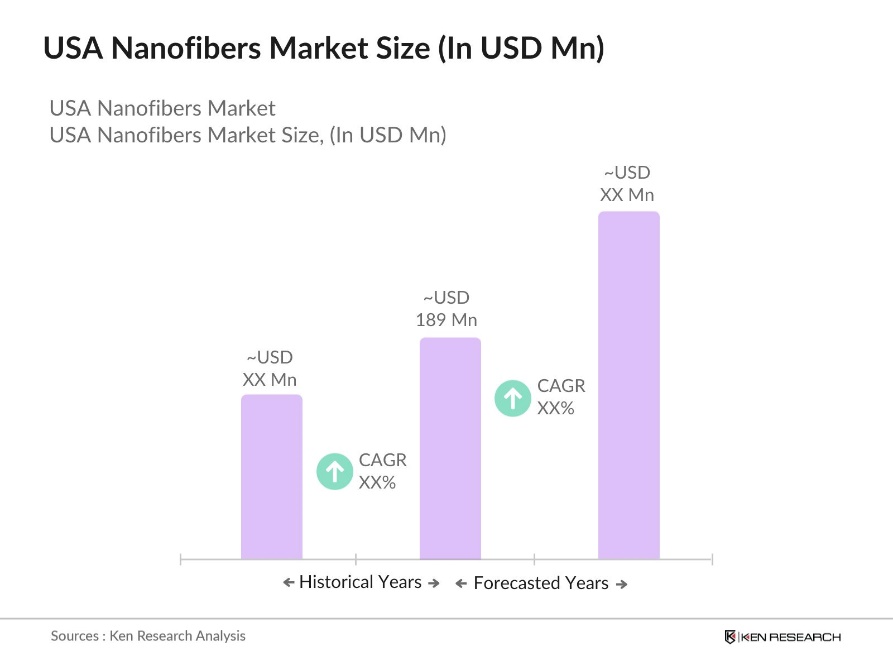
- The USA Nanofibers Market is valued at USD 189 million based on a comprehensive five-year historical analysis. This market is driven by growing demand in several high-potential sectors such as filtration, biomedical applications, and energy storage. The increasing use of nanofibers in filtration systems, both for air and water, is crucial for industries like healthcare and environmental services.
- The dominance of cities such as New York, San Francisco, and Chicago in the nanofibers market can be attributed to their leadership in innovation and industrial applications. These cities host a significant concentration of research and development facilities, universities, and key industries, which drives high demand for nanotechnology. Additionally, the presence of advanced manufacturing hubs in these cities has allowed for rapid adoption of nanofiber technologies in biomedical and filtration solutions.
- The Occupational Safety and Health Administration (OSHA) enforces strict workplace safety standards for nanofiber production facilities. In 2023, OSHA revised its guidelines to include specific protections against exposure to nanoparticles, ensuring that workers in nanofiber production environments have adequate protective equipment and ventilation. These regulations are crucial in safeguarding workers from potential health risks.
USA Nanofibers Market Segmentation
By Product Type: The USA nanofibers market is segmented by product type into polymer nanofibers, carbon nanofibers, metal oxide nanofibers, and ceramic nanofibers. Among these, polymer nanofibers hold the dominant share due to their versatility and wide range of applications across industries. Polymer nanofibers are extensively used in filtration systems, medical devices, and energy storage applications. Their ability to be easily manufactured through electrospinning and their customizable properties make them highly attractive for end-users. Additionally, the demand for high-performance filtration in healthcare, particularly in air and water purification, has contributed to their significant market presence.

By Application: The USA nanofibers market is segmented by application into filtration, medical and healthcare, energy storage and generation, electronics, and textiles. The filtration segment leads the market share owing to the increasing need for clean air and water, particularly in industrial and urban settings. Filtration nanofibers offer superior performance in removing particulate matter, bacteria, and harmful pollutants, making them a top choice for healthcare facilities and environmental services. The COVID-19 pandemic further accelerated this demand, as filtration systems became critical in preventing airborne contaminants. Additionally, advancements in nanofiber production technologies have led to more efficient and cost-effective solutions in filtration applications.

USA Nanofibers Market Competitive Landscape
The market is characterized by a mix of established industry leaders and emerging players, contributing to a competitive landscape. Major companies such as Donaldson Company, DuPont, and Ahlstrom-Munksj dominate the market. These companies benefit from extensive product portfolios, advanced manufacturing technologies, and significant R&D investments. Startups and small-scale manufacturers are also entering the market, especially in niche applications like biomedical and environmental services.
|
Company |
Establishment Year |
Headquarters |
Production Capacity |
R&D Expenditure |
Market Presence |
Key Products |
Employees |
Revenue (USD) |
|
Donaldson Company, Inc. |
1915 |
Bloomington, Minnesota |
||||||
|
DuPont |
1802 |
Wilmington, Delaware |
||||||
|
Ahlstrom-Munksj |
2017 |
Helsinki, Finland |
||||||
|
eSpin Technologies, Inc. |
1999 |
Chattanooga, Tennessee |
||||||
|
SNS Nanofiber Technology |
2007 |
Hudson, Ohio |
USA Nanofibers Industry Analysis
Growth Drivers
- Rising demand in filtration and air purification systems: Nanofibers have seen an increased demand in air filtration systems due to their efficiency in capturing ultrafine particles. In 2024, the U.S. Environmental Protection Agency (EPA) estimates that indoor air pollution remains a serious health issue, contributing to thousands of deaths yearly. With regulations becoming stricter on industrial emissions, nanofiber-based filters, which are proven to reduce harmful particulates, are being integrated into various filtration applications. Their increased adoption in high-efficiency particulate air (HEPA) filters and face masks further underpins this demand.
- Growth in renewable energy and storage applications (e.g., nanofibers in batteries): The use of nanofibers in renewable energy, particularly in battery technologies, is expanding rapidly. Nanofiber-based electrodes have been shown to improve the efficiency of lithium-ion batteries, a critical component in electric vehicles and energy storage solutions. The DOE has indeed announced significant funding for energy storage research. Specifically, it has allocated $125 million to support two Energy Innovation Hubs focused on energy storage challenges.
- Environmental sustainability concerns: Environmental concerns are driving the use of eco-friendly materials like nanofibers in applications such as air and water filtration. Their superior ability to remove contaminants makes them an attractive solution for pollution control. Additionally, the push for sustainable energy solutions has increased the development of nanofibers for renewable energy applications, reinforcing their role in addressing environmental challenges and promoting sustainability.
Market Challenges
- High initial production costs: Producing nanofibers requires advanced technologies and materials, resulting in higher upfront costs compared to conventional alternatives. These initial costs make it difficult for smaller firms to adopt nanofiber technologies, despite the potential benefits in various sectors. The expense involved in setting up specialized equipment and sourcing raw materials poses a significant barrier, limiting the broader adoption of nanofiber-based solutions.
- Technical challenges in scalability: Scaling nanofiber production from lab-scale to industrial levels is a major technical challenge due to the precision required in manufacturing. Many companies struggle to produce nanofibers in large quantities while maintaining quality and consistency. Despite advancements in production techniques, the complex nature of scaling these technologies limits widespread adoption in the industry.
USA Nanofibers Market Future Outlook
Over the next five years, the USA nanofibers market is expected to witness steady growth, driven by advancements in nanofiber production technologies, increased adoption across various industries, and supportive government policies on environmental sustainability. The filtration and healthcare sectors will continue to be key drivers of growth due to the rising need for clean air and water and the ongoing development of nanofiber-based medical solutions.
Market Opportunities
- Growth in nanotechnology and new material innovation: Technological advancements in nanotechnology are opening new opportunities for nanofibers in various industries. Innovations in nanomaterials are improving the performance and durability of nanofiber products, making them increasingly attractive for industrial applications. These advancements are driving the development of more efficient, versatile nanofiber solutions, enabling their use in a wider range of sectors.
- Collaborative R&D and innovation hubs with academic institutes: Collaborations between industry and academic institutions are playing a key role in driving innovation in the nanofibers market. These partnerships foster research and development, leading to the creation of new nanofiber applications. The combined efforts of universities and industry leaders are expected to accelerate the commercialization of nanofiber technologies, enhancing their market presence.
Scope of the Report
|
By Product Type |
Polymer Nanofibers Carbon Nanofibers Metal Oxide Nanofibers Ceramic Nanofibers |
|
By Application |
Filtration Medical and Healthcare Energy Storage Electronics Textiles |
|
By Technology |
Electrospinning Force Spinning Self-Assembly Template Synthesis |
|
By End-User Industry |
Healthcare and Biotechnology Energy and Environment Chemicals Electronics |
|
By Region |
Northeast Midwest Southern Western |
Products
Key Target Audience
Nanofiber Manufacturers
Medical Device Manufacturers
Energy Storage and Battery Manufacturers
Electronics Companies
Textile Manufacturers
Government and Regulatory Bodies (e.g., FDA, EPA, OSHA)
Investors and venture capital Firms
Banks and Financial Institutions
Companies
Players Mentioned in the Report
Donaldson Company, Inc.
DuPont
Ahlstrom-Munksj
eSpin Technologies, Inc.
SNS Nanofiber Technology
Revolution Fibres
Nanofiber Solutions
Toray Industries, Inc.
Hollingsworth & Vose
Asahi Kasei Corporation
Table of Contents
1. USA Nanofibers Market Overview
1.1. Definition and Scope
1.2. Market Taxonomy
1.3. Market Growth Rate
1.4. Market Segmentation Overview
2. USA Nanofibers Market Size (In USD Mn)
2.1. Historical Market Size
2.2. Year-On-Year Growth Analysis
2.3. Key Market Developments and Milestones
3. USA Nanofibers Market Analysis
3.1. Growth Drivers (Increased demand for nanofibers in filtration, biomedical applications, and energy storage)
3.1.1. Rising demand in filtration and air purification systems
3.1.2. Increased adoption in biomedical applications (e.g., wound healing, drug delivery)
3.1.3. Growth in renewable energy and storage applications (e.g., nanofibers in batteries)
3.1.4. Environmental sustainability concerns
3.2. Market Challenges (High production costs, scalability issues, regulatory concerns)
3.2.1. High initial production costs
3.2.2. Technical challenges in scalability
3.2.3. Regulatory and environmental approval hurdles
3.3. Opportunities (Technological advancements, partnerships with academia and industry)
3.3.1. Growth in nanotechnology and new material innovation
3.3.2. Collaborative R&D and innovation hubs with academic institutes
3.3.3. Potential for nanofibers in clean energy and environmental applications
3.4. Trends (Integration of AI in manufacturing, eco-friendly production techniques)
3.4.1. AI and machine learning for optimized production processes
3.4.2. Green manufacturing processes for nanofiber production
3.4.3. Shift toward biodegradable nanofibers
3.5. Government Regulation (FDA approvals, EPA compliance, OSHA standards)
3.5.1. Regulatory standards by FDA for biomedical nanofibers
3.5.2. Environmental Protection Agency (EPA) guidelines on emissions
3.5.3. Occupational Safety and Health Administration (OSHA) standards for workplace safety
3.6. SWOT Analysis
3.7. Stakeholder Ecosystem
3.8. Porters Five Forces Analysis
3.9. Competition Ecosystem
4. USA Nanofibers Market Segmentation
4.1. By Product Type (In Value %)
4.1.1. Polymer Nanofibers
4.1.2. Carbon Nanofibers
4.1.3. Metal Oxide Nanofibers
4.1.4. Ceramic Nanofibers
4.2. By Application (In Value %)
4.2.1. Filtration (Water and Air)
4.2.2. Medical and Healthcare
4.2.3. Energy Storage and Generation
4.2.4. Electronics
4.2.5. Textiles
4.3. By Technology (In Value %)
4.3.1. Electrospinning
4.3.2. Force Spinning
4.3.3. Self-Assembly
4.3.4. Template Synthesis
4.4. By End-User Industry (In Value %)
4.4.1. Healthcare and Biotechnology
4.4.2. Energy and Environment
4.4.3. Chemicals
4.4.4. Electronics
4.5. By Region (In Value %)
4.5.1. Northeast
4.5.2. Midwest
4.5.3. Southern
4.5.4. Western
5. USA Nanofibers Market Competitive Analysis
5.1 Detailed Profiles of Major Companies
5.1.1. Donaldson Company, Inc.
5.1.2. Ahlstrom-Munksj
5.1.3. eSpin Technologies, Inc.
5.1.4. Teijin Ltd.
5.1.5. DuPont
5.1.6. Hollingsworth & Vose
5.1.7. SNS Nanofiber Technology
5.1.8. Elmarco
5.1.9. Asahi Kasei Corporation
5.1.10. Toray Industries, Inc.
5.1.11. FibeRio Technology Corporation
5.1.12. Nanofiber Solutions
5.1.13. Nanoshel LLC
5.1.14. Revolution Fibres
5.1.15. Nanocomp Technologies
5.2 Cross Comparison Parameters (Production Capacity, Headquarters, Inception Year, Revenue, Employee Count, R&D Spending, Market Presence, Product Portfolio)
5.3. Market Share Analysis
5.4. Strategic Initiatives
5.5. Mergers and Acquisitions
5.6. Investment Analysis
5.7. Venture Capital Funding
5.8. Government Grants
5.9. Private Equity Investments
6. USA Nanofibers Market Regulatory Framework
6.1. FDA Approvals
6.2. Environmental Standards (EPA)
6.3. Certification Processes (ISO, ANSI, ASTM)
7. USA Nanofibers Future Market Size (In USD Mn)
7.1. Future Market Size Projections
7.2. Key Factors Driving Future Market Growth
8. USA Nanofibers Future Market Segmentation
8.1. By Product Type (In Value %)
8.2. By Application (In Value %)
8.3. By Technology (In Value %)
8.4. By End-User Industry (In Value %)
8.5. By Region (In Value %)
9. USA Nanofibers Market Analysts' Recommendations
9.1. TAM/SAM/SOM Analysis
9.2. Marketing Initiatives
9.3. Customer Cohort Analysis
9.4. White Space Opportunity Analysis
Disclaimer Contact UsResearch Methodology
Step 1: Identification of Key Variables
This phase involved the creation of an ecosystem map covering major stakeholders in the USA nanofibers market. Desk research was utilized to gather information from secondary and proprietary databases, helping to define critical variables influencing market trends and dynamics.
Step 2: Market Analysis and Construction
In this phase, historical market data was analyzed, focusing on key industry statistics such as market penetration, production capacity, and revenue generation across segments. This provided an in-depth understanding of how the market evolved over recent years.
Step 3: Hypothesis Validation and Expert Consultation
Market hypotheses were validated through consultations with industry experts via structured interviews. The insights gathered provided valuable perspectives on operational and financial aspects of nanofiber production, ensuring that the data was accurate and reliable.
Step 4: Research Synthesis and Final Output
The final research involved direct engagement with nanofiber manufacturers to refine the market estimates, validate the segmentation, and cross-check production data. This comprehensive approach ensured the accuracy and depth of the market analysis.
Frequently Asked Questions
01 How big is the USA Nanofibers Market?
The USA nanofibers market is valued at USD 189 million, driven by demand in filtration, biomedical, and energy applications.
02 What are the challenges in the USA Nanofibers Market?
Challenges in USA nanofibers market include high production costs, technical scalability issues, and regulatory approval hurdles for certain applications.
03 Who are the major players in the USA Nanofibers Market?
Key players in USA nanofibers market include Donaldson Company, DuPont, Ahlstrom-Munksj, eSpin Technologies, and SNS Nanofiber Technology, known for their technological advancements and extensive market presence.
04 What are the growth drivers of the USA Nanofibers Market?
Key growth drivers in USA nanofibers market include increased demand for nanofiber applications in air and water filtration, growing biomedical usage, and advancements in nanotechnology for energy storage solutions.
Why Buy From Us?

What makes us stand out is that our consultants follows Robust, Refine and Result (RRR) methodology. i.e. Robust for clear definitions, approaches and sanity checking, Refine for differentiating respondents facts and opinions and Result for presenting data with story

We have set a benchmark in the industry by offering our clients with syndicated and customized market research reports featuring coverage of entire market as well as meticulous research and analyst insights.

While we don't replace traditional research, we flip the method upside down. Our dual approach of Top Bottom & Bottom Top ensures quality deliverable by not just verifying company fundamentals but also looking at the sector and macroeconomic factors.

With one step in the future, our research team constantly tries to show you the bigger picture. We help with some of the tough questions you may encounter along the way: How is the industry positioned? Best marketing channel? KPI's of competitors? By aligning every element, we help maximize success.

Our report gives you instant access to the answers and sources that other companies might choose to hide. We elaborate each steps of research methodology we have used and showcase you the sample size to earn your trust.

If you need any support, we are here! We pride ourselves on universe strength, data quality, and quick, friendly, and professional service.