
USA Non-Alcoholic Beverages Market Outlook to 2030
Region:United States
Author(s):Sanjeev
Product Code:KROD4362
Region:United States
Author(s):Sanjeev
Product Code:KROD4362
December 2024
98
???????
???????
The USA non-alcoholic beverages market is dominated by several global giants, as well as some prominent local players. Major companies like Coca-Cola, PepsiCo, and Nestl Waters North America dominate due to their vast distribution networks, extensive product portfolios, and innovative marketing strategies. These firms have the financial resources and infrastructure to invest in R&D, allowing them to consistently introduce new products aligned with current trends such as functional and plant-based beverages. At the same time, emerging brands focusing on niche categories like kombucha or cold-pressed juices are also gaining market traction.
|
Company |
Establishment Year |
Headquarters |
Revenue (2023) |
Product Portfolio |
Sustainability Initiatives |
Market Penetration |
R&D Investment |
Brand Loyalty Programs |
Geographical Presence |
|
The Coca-Cola Company |
1886 |
Atlanta, USA |
|||||||
|
PepsiCo Inc. |
1965 |
New York, USA |
|||||||
|
Nestl Waters North America |
1976 |
Stamford, USA |
|||||||
|
Keurig Dr Pepper Inc. |
1981 |
Burlington, USA |
|||||||
|
Red Bull North America |
1987 |
Santa Monica, USA |
Over the next five years, the USA non-alcoholic beverages market is expected to show consistent growth driven by evolving consumer preferences for healthier, functional beverages and increasing investments in sustainability initiatives. The rise of e-commerce and direct-to-consumer sales will continue to shape distribution models, while innovations in packaging will cater to both consumer convenience and environmental concerns. Furthermore, the integration of plant-based and organic beverages into mainstream consumption will likely accelerate as consumer demand for clean-label products grows.
|
By Product Type |
Carbonated Soft Drinks Juices & Juice Drinks Bottled Water Sports & Energy Drinks Ready-to-Drink Teas and Coffees |
|
By End-User |
Household Consumption On-premise (Restaurants, Cafes, Bars) Institutional Sales (Hospitals, Schools) |
|
By Distribution Channel |
Supermarkets/Hypermarkets Convenience Stores Online Retail Direct-to-Consumer (DTC) |
|
By Packaging Type |
Plastic Bottles Cans, Glass Bottles Cartons |
|
By Region |
North East West South |
Definition and Scope
Market Taxonomy (Product Types, End-Users, Distribution Channels)
Market Growth Rate (Volume and Revenue)
Market Segmentation Overview (5 Key Segments)
Historical Market Size
Year-On-Year Growth Analysis
Key Market Developments and Milestones (Government Policies, Consumer Behavior Shifts, Technological Developments)
3.1. Growth Drivers (Consumer Preferences, Health Trends, Innovations)
Health-conscious consumer trends (Rise in functional and fortified beverages)
Growing demand for plant-based and organic beverages
Increasing penetration of convenient distribution channels (E-commerce, DTC, etc.)
Supportive government policies (FDA regulations, USDA Organic Certification)
3.2. Market Challenges (Operational and Structural)
High operational costs (Raw material sourcing, supply chain bottlenecks)
Intense competition from private-label and niche brands
Regulatory constraints (FDA labeling laws, sugar taxation policies)
3.3. Opportunities (Unmet Needs and Strategic Areas)
Expansion of premium product categories (Cold-pressed juices, kombucha)
Innovations in packaging sustainability (Eco-friendly alternatives)
Growth potential in low-calorie and sugar-free beverages (Sparkling water, zero-sugar sodas)
3.4. Trends (Key Consumer and Industry Shifts)
Increased focus on sustainability and eco-friendly packaging
Rise of functional beverages (Prebiotic, probiotic, adaptogen-infused drinks)
Growth in digital and direct-to-consumer sales models
Collaborative innovations in flavors and health benefits (Co-branded health drinks)
3.5. Government Regulations
Food and Drug Administration (FDA) Regulations (Nutritional labeling, safety standards)
USDA Organic Certifications (Labeling requirements, organic certifications)
Federal and State Level Beverage Taxation Policies (Sugar tax, recycling laws)
Import and Export Tariffs (Tariff implications on beverage ingredients)
3.6. SWOT Analysis
Strengths: Strong distribution networks, diverse product portfolios
Weaknesses: High costs in R&D and sustainability initiatives
Opportunities: Expansion in functional and health beverage categories
Threats: Regulatory pressures, price sensitivity
3.7. Stakeholder Ecosystem
Raw Material Suppliers (Fruit concentrates, sweeteners, flavor additives)
Manufacturing and Bottling Companies
Distributors and Retailers (Grocery chains, online platforms)
Consumers (Health-conscious buyers, Gen Z, Millennials)
3.8. Porters Five Forces
Bargaining Power of Suppliers
Bargaining Power of Buyers
Threat of Substitutes
Threat of New Entrants
Industry Rivalry
3.9. Competitive Ecosystem
Product Differentiation Strategies (Functional benefits, low-calorie options)
Innovation Pipelines (Plant-based beverages, innovative flavors)
Sustainability Initiatives (Eco-friendly packaging, reduced carbon footprints)
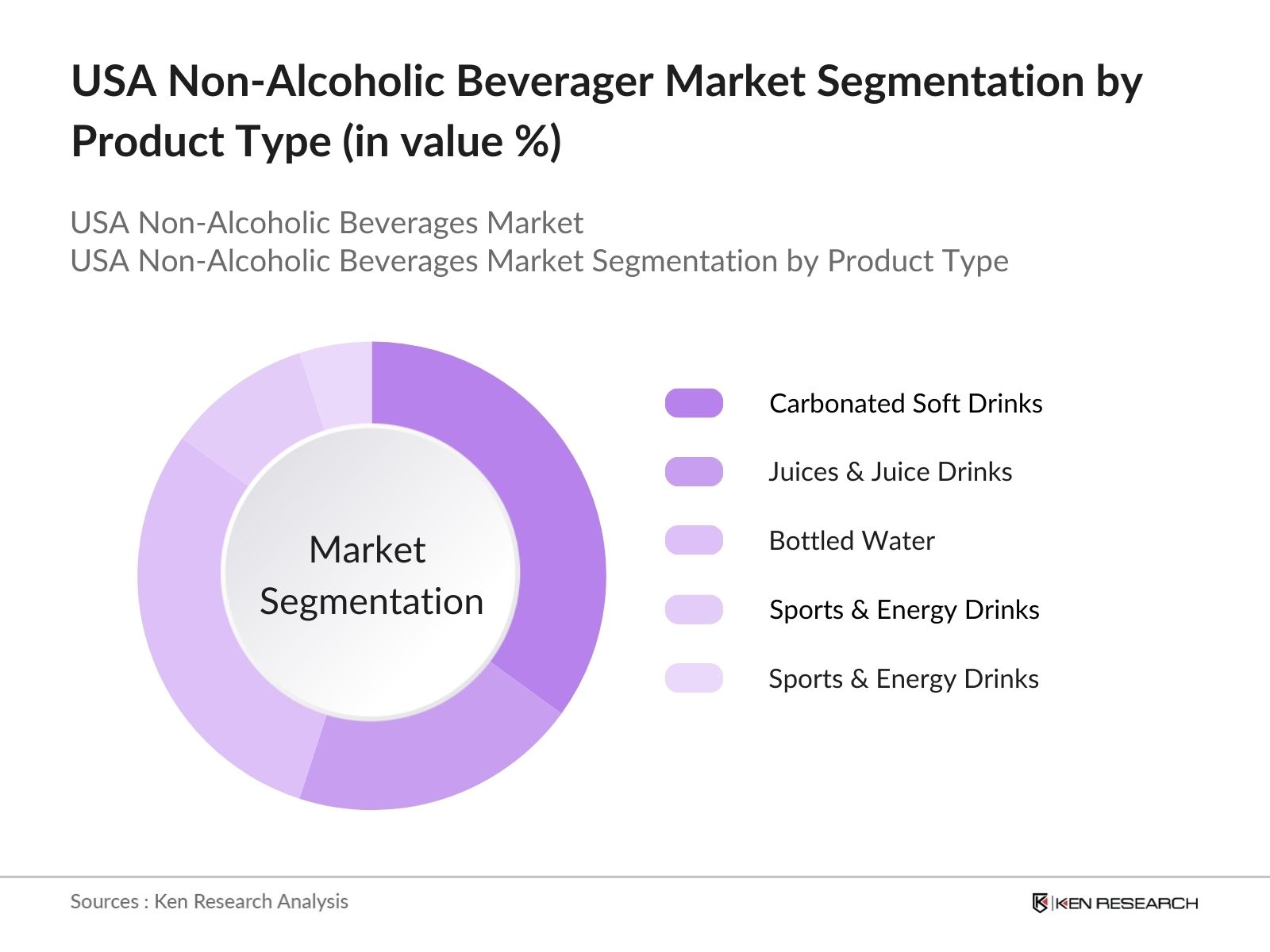
4.1. By Product Type (In Value %)
Carbonated Soft Drinks
Juices & Juice Drinks
Bottled Water
Sports & Energy Drinks
Ready-to-Drink Teas and Coffees
4.2. By End-User (In Value %)
Household Consumption
On-premise (Restaurants, Cafes, Bars)
Institutional Sales (Hospitals, Schools)
4.3. By Distribution Channel (In Value %)
Supermarkets/Hypermarkets
Convenience Stores
Online Retail
Direct-to-Consumer (DTC)
4.4. By Packaging Type (In Value %)
Plastic Bottles
Cans
Glass Bottles
Cartons
4.5. By Region (In Value %)
North
East
South
West
The Coca-Cola Company
PepsiCo Inc.
Nestl Waters North America
Keurig Dr Pepper Inc.
Red Bull North America
Monster Beverage Corporation
The Kraft Heinz Company
Danone North America
National Beverage Corp.
Arizona Beverages USA
Bolthouse Farms Inc.
Bai Brands LLC
Vita Coco
Hint Inc.
Talking Rain Beverage Company
5.2 Cross Comparison Parameters (Market-Specific)
Revenue, Market Share
Distribution Reach
Sustainability Initiatives
Number of SKUs (Stock Keeping Units)
Product Innovation Pipeline
Consumer Engagement (Brand Loyalty, Advertising Spend)
Retail Partnerships
Geographical Presence
5.3 Market Share Analysis
5.4 Strategic Initiatives
5.5 Mergers And Acquisitions
5.6 Investment Analysis
5.7 Venture Capital Funding
5.8 Government Grants
5.9 Private Equity Investments
FDA Compliance Regulations (Labeling, Ingredient Standards)
Beverage Taxation Policies (Sugar taxes, health-related tariffs)
Recycling and Waste Management Regulations (Bottle bills, sustainability targets)
Import-Export Tariff Regulations (Impact on raw materials and finished products)
Future Market Size Projections
Key Factors Driving Future Market Growth (Consumer Behavior Shifts, Regulatory Changes, Technological Advancements)
8.1. By Product Type (In Value %)
8.2. By End-User (In Value %)
8.3. By Distribution Channel (In Value %)
8.4. By Packaging Type (In Value %)
8.5. By Region (In Value %)
TAM/SAM/SOM Analysis (Total Addressable Market, Serviceable Available Market, Serviceable Obtainable Market)
Customer Cohort Analysis (Consumer Segmentation, Preferences)
Marketing Initiatives (Brand Engagement Strategies, Health-focused Campaigns)
White Space Opportunity Analysis (Unmet Needs, Growth Areas)
Disclaimer Contact Us
The initial phase of research involves constructing an ecosystem map encompassing all major stakeholders within the USA Non-Alcoholic Beverages Market. This step is grounded in extensive desk research, utilizing both secondary and proprietary databases to gather comprehensive industry-level data. The primary objective is to identify and define the critical variables influencing market dynamics.
In this phase, we compile and analyze historical data pertaining to the USA Non-Alcoholic Beverages Market. This includes assessing market penetration, product sales, and consumer behavior trends. Furthermore, the analysis evaluates revenue generation by key market segments, ensuring the reliability and accuracy of market size estimates.
Hypotheses based on initial research findings are developed and subsequently validated through interviews with industry experts from beverage companies, retail chains, and regulatory bodies. These consultations provide invaluable operational insights directly from market practitioners, which will help refine and corroborate market data.
The final phase of the research involves synthesizing all findings, supplemented by interactions with beverage manufacturers and retailers. This step aims to validate and complement data obtained through both top-down and bottom-up approaches, ensuring a comprehensive and validated analysis of the USA non-alcoholic beverages market.
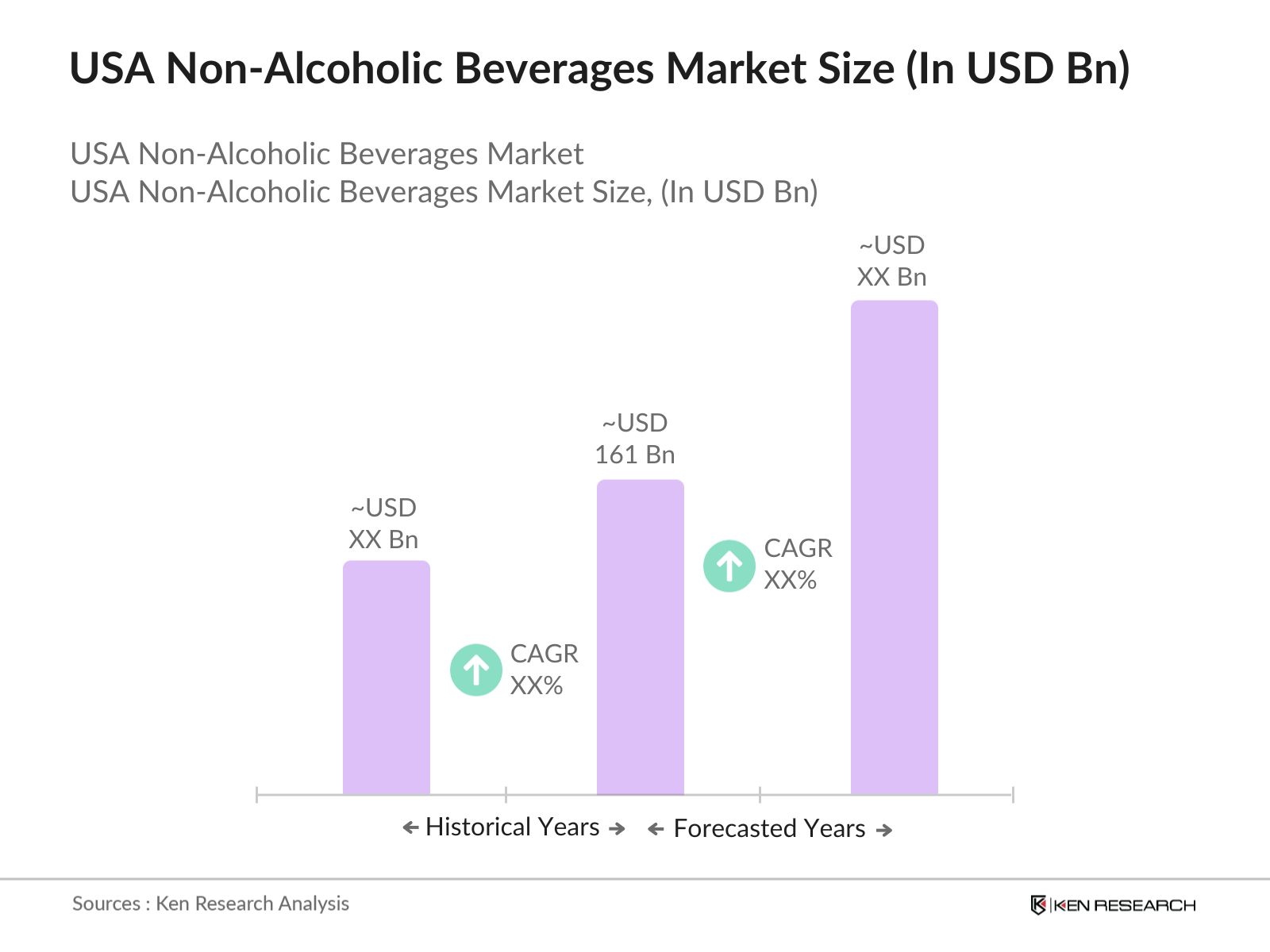
The USA non-alcoholic beverages market is valued at USD 161 billion. The market has been driven by the increasing consumer shift towards healthier options, innovative product offerings, and the growth of e-commerce channels.
The USA non-alcoholic beverages market faces challenges such as rising raw material costs, regulatory constraints around sugar content and labeling, and high competition from private-label brands and startups focusing on niche products.
The USA non-alcoholic beverages market is dominated by key players such as The Coca-Cola Company, PepsiCo Inc., Nestl Waters North America, Keurig Dr Pepper Inc., and Red Bull North America. These companies maintain their dominance through strong distribution networks, brand loyalty, and continuous innovation.
Growth is propelled by rising health consciousness among consumers, demand for plant-based and functional beverages, innovations in packaging, and increased penetration of online retail and direct-to-consumer sales models.
Emerging trends in the USA non-alcoholic beverages market include the rise of functional beverages infused with probiotics, adaptogens, and prebiotics, as well as an increased focus on sustainable packaging solutions and a shift towards organic and natural ingredients.

What makes us stand out is that our consultants follows Robust, Refine and Result (RRR) methodology. i.e. Robust for clear definitions, approaches and sanity checking, Refine for differentiating respondents facts and opinions and Result for presenting data with story

We have set a benchmark in the industry by offering our clients with syndicated and customized market research reports featuring coverage of entire market as well as meticulous research and analyst insights.

While we don't replace traditional research, we flip the method upside down. Our dual approach of Top Bottom & Bottom Top ensures quality deliverable by not just verifying company fundamentals but also looking at the sector and macroeconomic factors.

With one step in the future, our research team constantly tries to show you the bigger picture. We help with some of the tough questions you may encounter along the way: How is the industry positioned? Best marketing channel? KPI's of competitors? By aligning every element, we help maximize success.

Our report gives you instant access to the answers and sources that other companies might choose to hide. We elaborate each steps of research methodology we have used and showcase you the sample size to earn your trust.

If you need any support, we are here! We pride ourselves on universe strength, data quality, and quick, friendly, and professional service.