
USA Personal Protective Equipment (PPE) Market Outlook to 2030
Region:North America
Author(s):Yogita Sahu
Product Code:KROD7484
November 2024
85
About the Report
USA Personal Protective Equipment Market Overview
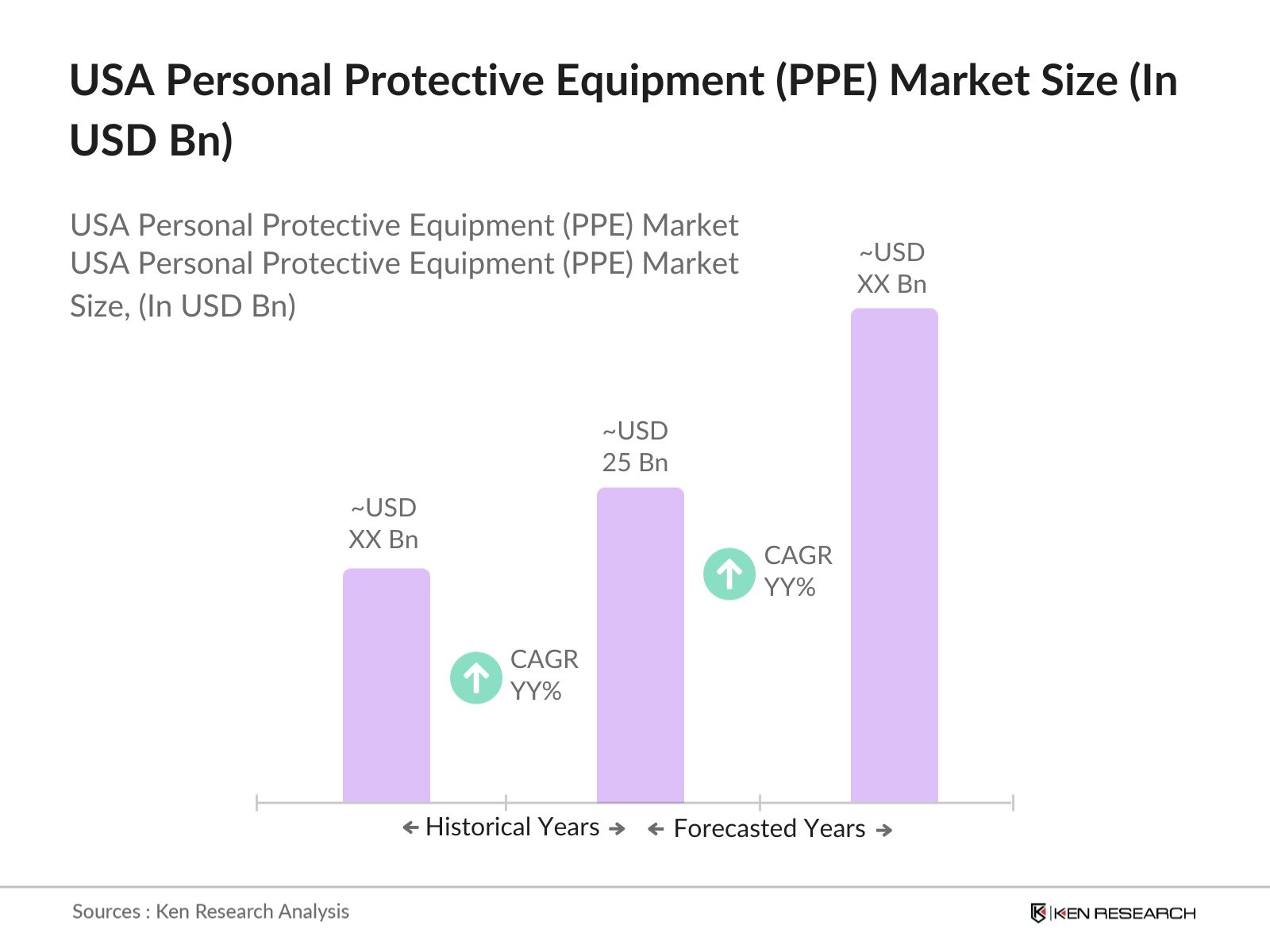
- The USA PPE market is valued at USD 25 bn, fueled by strong occupational safety regulations, heightened safety awareness across industries, and rising demand in the healthcare sector. Market growth is particularly driven by ongoing regulatory compliance requirements, especially in sectors like construction, manufacturing, and healthcare, where PPE has become essential for worker safety.
- Leading regions for PPE in the USA include California, Texas, and New York, primarily due to their high concentration of industries requiring PPE, including healthcare, construction, and manufacturing. These areas have large labor forces, and stringent local safety regulations further contribute to PPE adoption in these states.
- The federal government allocated $5 billion in 2024 for emergency PPE stockpiling in healthcare facilities across the U.S. This initiative not only stabilizes supply for frontline workers but also incentivizes production within the U.S., creating a consistent demand for domestically manufactured PPE.
USA PPE Market Segmentation
By Product Type: The market is segmented by product type into head, eye, and face protection; respiratory protection; hand and arm protection; foot and leg protection; protective clothing; and hearing protection. Recently, respiratory protection has dominated this segment due to increased demand from healthcare and industrial sectors, driven by the need for protective respirators and masks post-pandemic. In addition, stricter guidelines from OSHA and the CDC regarding air quality and worker safety have bolstered this segments importance.

By End-User Industry: The market is also segmented by end-user industry into healthcare, manufacturing, construction, oil & gas, and mining. The healthcare sector currently holds a dominant position in this segmentation due to increased PPE demand in medical settings, especially for masks, gowns, and gloves. This demand is largely influenced by the healthcare sectors focus on infection control and the recent establishment of rigorous health and safety standards.

USA PPE Market Competitive Landscape
The market is dominated by a few major players, including global brands and domestic manufacturers, highlighting a consolidated industry with key companies driving innovation and meeting regulatory standards.

USA PPE Market Analysis
Market Growth Drivers
- Rising Demand for PPE Across Healthcare and Industrial Sectors: In 2024, the healthcare sector has seen an additional demand of around 2.3 billion PPE units in the USA, driven by a surge in new healthcare facility projects and pandemic preparedness efforts by government health bodies. Similarly, the industrial sector, specially manufacturing and construction, requires around 1.8 billion PPE units annually to meet strict safety regulations for its workforce.
- Expansion of Government-Funded Safety Programs: The U.S. government allocated $3.2 billion in 2024 towards Occupational Safety and Health Administration (OSHA) compliance initiatives, aimed at enhancing workplace safety standards, particularly in high-risk industries. This funding directly impacts PPE adoption rates, as industries receiving government grants for compliance are required to maintain a minimum PPE inventory, increasing market demand.
- Rise in Workplace Accidents Encouraging Proactive Safety Measures: In 2024, the Bureau of Labor Statistics reported around 4.9 million workplace injuries in sectors like manufacturing and construction. This high incidence rate has driven companies to invest in PPE as a preventive measure to reduce employee injuries and potential liabilities. To meet the safety compliance required in these high-risk environments, companies have scaled up PPE procurement by nearly 30% compared to previous years.
Market Challenges
- Supply Chain Disruptions Leading to Production Delays: Due to recent geopolitical tensions, PPE manufacturers faced import delays of key materials, leading to an average production delay of 15-20 days in 2024. This disruption has significantly impacted inventory management for many firms, causing critical supply gaps across various sectors, especially healthcare, where consistent PPE availability is essential.
- High Cost of Raw Materials Increasing Production Costs: In 2024, the average price of essential raw materials, such as nitrile and non-woven polypropylene, surged by around $400 per ton, impacting production budgets for PPE manufacturers. This increase has led to a cost-pass-through to end consumers and institutions, affecting market affordability and slowing demand in cost-sensitive segments.
USA PPE Market Future Outlook
The USA PPE industry is expected to show steady growth over the next five years due to sustained demand in healthcare and high-risk industries, regulatory emphasis on workplace safety, and advancements in PPE technology.
Future Market Opportunities
- Integration of IoT in PPE for Real-Time Health Monitoring: Over the next five years, PPE is expected to increasingly incorporate IoT capabilities, with an estimated additional 5 million smart PPE units being produced annually. This trend will cater to sectors that prioritize health monitoring, such as manufacturing, enabling real-time data tracking of workers health metrics, thereby enhancing on-site safety.
- Expansion of PPE Recycling Initiatives to Address Waste: By 2029, it is projected that at least 2,500 PPE recycling centers will be established nationwide. These centers will focus on collecting and processing PPE waste, reducing the environmental footprint by over 500,000 tons annually and aligning with growing government sustainability mandates.
Scope of the Report
|
Product Type |
Head, Eye & Face Protection |
|
End-User Industry |
Healthcare |
|
Material Type |
Polyethylene |
|
Distribution Channel |
Direct Sales |
|
Region |
Northeast |
Products
Key Target Audience Organizations and Entities Who Can Benefit by Subscribing This Report:
PPE Manufacturers
Healthcare Providers and Hospitals
Banks and Financial Institution
Occupational Safety and Health Administration (OSHA)
Investor and Venture Capitalist Firms
Government and Regulatory Bodies (e.g., CDC, FDA)
Private Equity Firms
Companies
Players Mentioned in the Report:
3M Company
Honeywell International Inc.
MSA Safety Inc.
DuPont de Nemours, Inc.
Kimberly-Clark Corporation
Ansell Limited
Alpha Pro Tech Ltd.
Lakeland Industries, Inc.
Bullard
Radians, Inc.
Table of Contents
1. USA PPE Market Overview
1.1 Definition and Scope
1.2 Market Taxonomy
1.3 Market Dynamics and Growth Rate
1.4 Market Segmentation Overview
2. USA PPE Market Size (in USD Bn)
2.1 Historical Market Size
2.2 Year-On-Year Growth Analysis
2.3 Key Market Developments and Milestones
3. USA PPE Market Analysis
3.1 Growth Drivers
3.1.1 Occupational Safety Regulations
3.1.2 Rising Awareness for Worker Safety
3.1.3 Industrial Growth in Construction & Manufacturing
3.1.4 Increase in Healthcare Demand (Post-Pandemic Impact)
3.2 Market Challenges
3.2.1 High Production Costs
3.2.2 Supply Chain Vulnerabilities
3.2.3 Environmental Concerns with Disposal
3.3 Opportunities
3.3.1 Advanced Material Development (Nanotechnology, Biodegradable PPE)
3.3.2 Growth in Emerging End-Use Industries (Agriculture, Waste Management)
3.3.3 Technological Innovations (Smart PPE)
3.4 Trends
3.4.1 Integration of IoT in PPE
3.4.2 Increasing Use of Biodegradable Materials
3.4.3 Customization for Comfort and Usability
3.5 Government Regulation
3.5.1 OSHA Standards and Compliance
3.5.2 ANSI and ASTM Certifications
3.5.3 EPA Guidelines for PPE Disposal
3.6 SWOT Analysis
3.7 Stakeholder Ecosystem
3.8 Porters Five Forces Analysis
3.9 Competitive Landscape
4. USA PPE Market Segmentation
4.1 By Product Type (in Value %)
4.1.1 Head, Eye & Face Protection
4.1.2 Respiratory Protection
4.1.3 Hand & Arm Protection
4.1.4 Foot & Leg Protection
4.1.5 Protective Clothing
4.1.6 Hearing Protection
4.2 By End-User Industry (in Value %)
4.2.1 Healthcare
4.2.2 Manufacturing
4.2.3 Construction
4.2.4 Oil & Gas
4.2.5 Mining
4.3 By Material Type (in Value %)
4.3.1 Polyethylene
4.3.2 Nitrile
4.3.3 Polypropylene
4.3.4 Rubber
4.3.5 Leather
4.4 By Distribution Channel (in Value %)
4.4.1 Direct Sales
4.4.2 Distributor Network
4.4.3 E-Commerce
4.5 By Region (in Value %)
4.5.1 Northeast
4.5.2 Midwest
4.5.3 South
4.5.4 West
5. USA PPE Market Competitive Analysis
5.1 Detailed Profiles of Major Companies
5.1.1 3M Company
5.1.2 Honeywell International Inc.
5.1.3 MSA Safety Inc.
5.1.4 Kimberly-Clark Corporation
5.1.5 DuPont de Nemours, Inc.
5.1.6 Ansell Limited
5.1.7 Alpha Pro Tech Ltd.
5.1.8 Lakeland Industries, Inc.
5.1.9 Bullard
5.1.10 Radians, Inc.
5.1.11 Moldex-Metric, Inc.
5.1.12 Magid Glove & Safety
5.1.13 Tingley Rubber Corporation
5.1.14 Avon Protection
5.1.15 Protective Industrial Products, Inc.
5.2 Cross Comparison Parameters (Market Share, Employee Count, R&D Investments, Revenue, Product Portfolio, Certification Acquired, Regional Presence, Partnership Network)
5.3 Market Share Analysis
5.4 Strategic Initiatives
5.5 Mergers and Acquisitions
5.6 Investment Analysis
5.7 Government and Private Funding
6. USA PPE Market Regulatory Framework
6.1 OSHA and ANSI Standards
6.2 FDA Approvals for Medical PPE
6.3 ISO Certifications for Quality
6.4 Environmental Impact Regulations
7. USA PPE Future Market Size (in USD Bn)
7.1 Future Market Size Projections
7.2 Key Drivers for Future Growth
8. USA PPE Future Market Segmentation
8.1 By Product Type (in Value %)
8.2 By End-User Industry (in Value %)
8.3 By Material Type (in Value %)
8.4 By Distribution Channel (in Value %)
8.5 By Region (in Value %)
9. USA PPE Market Analysts Recommendations
9.1 TAM/SAM/SOM Analysis
9.2 Buyer Persona Analysis
9.3 Marketing Initiatives for Growth
9.4 Opportunity Mapping
Disclaimer Contact UsResearch Methodology
Step 1: Identification of Key Variables
The first step includes mapping out the primary stakeholders in the PPE market and gathering initial data through secondary research, which will provide insights into the variables influencing demand, regulatory compliance, and product innovation.
Step 2: Market Analysis and Construction
In this stage, historical data is analyzed to understand the trajectory of the PPE market. This includes examining the market penetration of various PPE products and identifying the ratio of suppliers to end-users to establish a comprehensive understanding of market revenue generation.
Step 3: Hypothesis Validation and Expert Consultation
Key market hypotheses are developed based on initial data analysis and validated through interviews with industry experts, ensuring accuracy in revenue projections, consumer trends, and product preferences.
Step 4: Research Synthesis and Final Output
The final synthesis phase involves compiling insights from manufacturers and key distributors, which helps refine the bottom-up approach in analyzing the demand for PPE across industries, ensuring that the report is both accurate and aligned with industry standards.
Frequently Asked Questions
1. How big is the USA PPE Market?
The USA PPE market is valued at USD 25 bn, with strong demand from healthcare, construction, and manufacturing sectors driving growth in recent years.
2. What challenges does the USA PPE Market face?
Key challenges in the USA PPE market include the high cost of production, environmental concerns over PPE disposal, and supply chain disruptions impacting timely delivery.
3. Who are the major players in the USA PPE Market?
The USA PPE market is led by major companies like 3M Company, Honeywell, MSA Safety, DuPont, and Kimberly-Clark, known for their comprehensive product portfolios and strong industry presence.
4. What factors drive the USA PPE Market?
The USA PPE market is driven by stringent safety regulations, increased focus on worker safety, and ongoing demand from high-risk sectors such as healthcare and construction.
Why Buy From Us?

What makes us stand out is that our consultants follows Robust, Refine and Result (RRR) methodology. i.e. Robust for clear definitions, approaches and sanity checking, Refine for differentiating respondents facts and opinions and Result for presenting data with story

We have set a benchmark in the industry by offering our clients with syndicated and customized market research reports featuring coverage of entire market as well as meticulous research and analyst insights.

While we don't replace traditional research, we flip the method upside down. Our dual approach of Top Bottom & Bottom Top ensures quality deliverable by not just verifying company fundamentals but also looking at the sector and macroeconomic factors.

With one step in the future, our research team constantly tries to show you the bigger picture. We help with some of the tough questions you may encounter along the way: How is the industry positioned? Best marketing channel? KPI's of competitors? By aligning every element, we help maximize success.

Our report gives you instant access to the answers and sources that other companies might choose to hide. We elaborate each steps of research methodology we have used and showcase you the sample size to earn your trust.

If you need any support, we are here! We pride ourselves on universe strength, data quality, and quick, friendly, and professional service.