USA Probiotic Beverages Market Outlook to 2030

Region:North America

Author(s):Shubham

Product Code:KROD5839

Published On

November 2024

Total pages

91

About the Report

USA Probiotic Beverages Market Overview

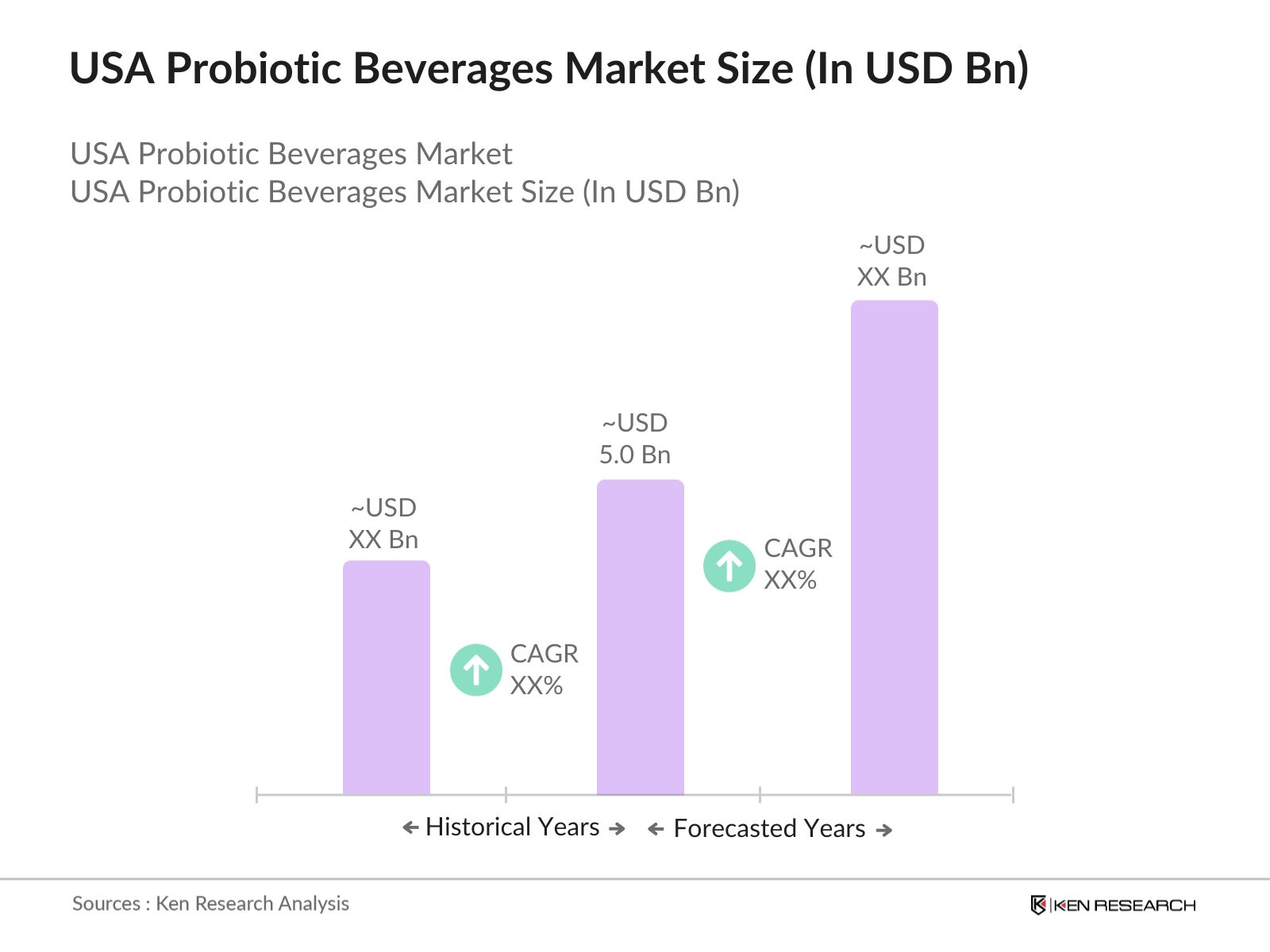
  • The USA Probiotic Beverages Market is valued at USD 5.0 billion, primarily driven by a rising consumer preference for functional health beverages that support digestive and immune health. Increasing awareness of gut health, along with innovations in probiotic strains, has fueled the demand for probiotic drinks across various consumer demographics. The expansion of distribution channels, especially online platforms and health-oriented retail stores, further contributes to the market's growth, establishing probiotic beverages as an integral part of the functional beverages sector in the U.S. market overviews
  • Major cities like New York, Los Angeles, and Chicago dominate the USA Probiotic Beverages Market due to their large populations and higher disposable incomes, which support the purchase of health-centric products. These urban areas have experienced a rapid rise in health-conscious consumers, who are drawn to probiotic drinks for their digestive and immune benefits. Additionally, these cities boast a diverse range of retail outlets, making probiotic beverages widely accessible and contributing to the market's robust growth in these regions.
  • The FDA mandates stringent guidelines on probiotic labeling, requiring manufacturers to provide verifiable evidence of strain efficacy. As of 2023, FDA reports show an increase in audits on probiotic products to ensure compliance with these guidelines. Manufacturers are required to submit detailed microbial strain data, a process that helps ensure consumer safety but can delay product launches and increase compliance costs.

USA Probiotic Beverages Market Segmentation

  • By Product Type: The market is segmented by product type into dairy-based probiotic beverages, plant-based probiotic beverages, and powdered probiotic beverages. Dairy-based probiotic beverages currently hold the largest market share due to their established consumer acceptance and association with digestive health benefits. Known for their efficacy in promoting gut health, these beverages continue to appeal to traditional consumers, while brands increasingly offer lactose-free and low-sugar options to cater to wider consumer needs. market overviews
  • By Distribution Channel: The distribution channels for probiotic beverages in the USA include supermarkets and hypermarkets, specialty stores, online retailers, and convenience stores. Supermarkets and hypermarkets dominate this segment as they offer extensive brand options, providing consumers with a wide selection of health-focused beverages. The popularity of these retail outlets among health-conscious consumers contributes significantly to their market share, allowing brands to reach diverse demographic groups. market overviews

USA Probiotic Beverages Market Competitive Landscape

The USA Probiotic Beverages Market is highly competitive, with major players like Danone S.A., Yakult Honsha Co., Ltd., and PepsiCo, Inc. These companies leverage strong brand loyalty, innovative product offerings, and extensive distribution networks to maintain market dominance. The competitive landscape highlights a focus on product innovation and strategic partnerships, enabling leading players to capture a larger share of this rapidly growing market. market overviews


USA Probiotic Beverages Market Analysis

Growth Drivers

  • Increasing Health Awareness and Consumer Demand for Functional Beverages: With rising health concerns in the USA, consumers are increasingly aware of the benefits of probiotics, particularly their impact on gut health. According to the CDC, gastrointestinal disorders affect 70 million Americans annually, fueling demand for gut health solutions like probiotic beverages. Furthermore, health-conscious choices drive daily purchases in majority of households with active wellness programs backed by employer incentives. These wellness initiatives contribute to a broader consumer shift toward functional health solutions, aligning with CDC data on improved health awareness levels across demographics.
  • Expansion in Retail Channels: The probiotic beverage market in the USA benefits from expanding retail channels that enhance consumer access. The U.S. Census Bureau reports a substantial increase in health product retailers since 2022, with over 3,000 new outlets dedicated to functional foods and beverages, many of which stock probiotic options. This growth is driven by increasing consumer demand for convenience, as shown by the rise in grocery and health retail stores within urban centres. Probiotic beverages have become a staple on retail shelves, facilitated by diversified retail channels that meet rising demand.
  • Technological Advancements in Product Development: Technological advances in food science are transforming probiotic beverage production, enabling new, durable strains and formulations that enhance product stability. Reports from the USDA show that, in 2023, over 60 new probiotic strains were registered for food applications, many of which support stable, long-lasting probiotics. These innovations make probiotic beverages a convenient option for consumers, especially in urban markets where longer shelf-life is essential. Additionally, increased investment in biotechnology R&D facilitates advancements in product preservation, ensuring wider availability of probiotic beverages nationwide.

Challenges

  • High Production Costs: The production of probiotic beverages involves meticulous microbial cultivation and rigorous storage standards, leading to elevated production costs. The process requires specialized microbial strains and controlled cold storage to maintain efficacy, which increases expenses compared to traditional beverages. These higher production costs can affect pricing structures, potentially limiting product accessibility for lower-income households and impacting market growth across various consumer demographics.
  • Regulatory Compliance and Labeling Standards: Probiotic beverage producers face stringent regulations on labeling and formulation that impact market growth. The FDA mandates that manufacturers validate probiotic strain efficacy, adding complexity and extending product launch timelines. Compliance with these standards can delay market entry, creating additional cost burdens for manufacturers and restricting the pace of market expansion. These regulatory requirements pose significant operational challenges, particularly for new entrants and smaller producers.

USA Probiotic Beverages Market Future Outlook

The USA Probiotic Beverages Market is projected to see substantial growth through 2028, supported by a steady rise in consumer interest in gut health and functional foods. The introduction of new probiotic strains, coupled with an increase in plant-based options, will likely diversify product offerings and cater to a broader audience. Future growth will also be driven by advancements in distribution channels, particularly online platforms, which will enhance accessibility and consumer reach.

Future Market Opportunities

  • Rising Product Innovation: Innovation in flavors, formulations, and packaging presents a significant opportunity for probiotic beverage producers. The USDA registered over hundreds of new probiotic product formulations in 2023, including shelf-stable varieties and plant-based options targeting diverse dietary needs. These new formulations support the growth of niche products, such as dairy-free probiotic drinks, catering to the majority of Americans who report dairy intolerance. Product innovation thus addresses a wider audience, supporting steady market expansion in urban and rural demographics.
  • Expansion into New Demographics: Growing interest from younger demographics, especially millennials and Gen Z, presents a significant market expansion opportunity. Data from the National Institute of Health shows that majority of individuals aged 18-30 actively purchase health-focused beverages, including probiotics, influenced by social media health trends. This demographic expansion provides a sustainable growth avenue as young adults increasingly adopt probiotic beverages as part of a health-conscious lifestyle.

Scope of the Report

By Product Type

Dairy-Based

Plant-Based

Powdered

Ready-to-Drink (RTD)

By Distribution Channel

Supermarkets and Hypermarkets

Specialty Stores

Online Retailers

Convenience Stores

By Ingredient Type

Lactobacillus

Bifidobacterium

Yeast

Others

By Packaging Type

Bottles

Tetra Packs

Cans

By Region

North East

Midwest

South

West

Products

Key Target Audience

  1. Probiotic Beverage Manufacturers

  2. Health and Wellness Retail Chains

  3. Investors and Venture Capitalist Firms

  4. Banks and Financial Institutions

  5. Government and Regulatory Bodies (FDA, USDA)

  6. Food and Beverage Distributors

  7. Online Retailers and E-commerce Platforms

  8. Nutritional and Dietary Supplement Companies

Companies

Players Mentioned in the Report

  • Danone S.A.

  • Yakult Honsha Co., Ltd.

  • PepsiCo, Inc.

  • Lifeway Foods, Inc.

  • Chobani LLC

  • NextFoods, Inc.

  • Bio-K Plus International Inc.

  • GoodBelly Probiotics

  • KeVita Inc.

  • Harmless Harvest

  • Health-Ade Kombucha

  • Nestl S.A.

  • Forager Project

  • Suja Life, LLC

  • The Hain Celestial Group, Inc.

Table of Contents

1. USA Probiotic Beverages Market Overview

1.1 Definition and Scope

1.2 Market Taxonomy

1.3 Market Dynamics Overview

1.4 Market Segmentation Overview

2. USA Probiotic Beverages Market Size (In USD Bn)

2.1 Historical Market Size

2.2 Year-On-Year Growth Analysis

2.3 Key Market Milestones and Developments

3. USA Probiotic Beverages Market Analysis

3.1 Growth Drivers

3.1.1 Health Awareness (Health Awareness Level)

3.1.2 Rise in Functional Foods (Functional Foods Market Size)

3.1.3 Expanding Retail Channels (Retail Channel Development)

3.1.4 Technological Advancements in Product Development (Technology Penetration Rate)

3.2 Market Challenges

3.2.1 High Production Costs (Production Cost Analysis)

3.2.2 Regulatory Constraints (Compliance Standards)

3.2.3 Consumer Misinformation (Education and Awareness Index)

3.3 Market Opportunities

3.3.1 Product Innovation (Product Innovation Index)

3.3.2 Strategic Partnerships (Partnership Volume)

3.3.3 Expansion into New Demographics (Target Audience Expansion Rate)

3.4 Trends

3.4.1 Rise of Plant-Based Probiotic Beverages (Plant-Based Product Share)

3.4.2 Personalized Nutrition (Personalization Demand Index)

3.4.3 Growth in Online Sales Channels (E-commerce Sales Share)

3.5 Regulatory Overview

3.5.1 FDA Guidelines on Probiotic Labeling (Compliance Requirements)

3.5.2 Food Safety Standards (Certification Processes)

3.6 SWOT Analysis

3.7 Stake Ecosystem

3.8 Porters Five Forces

3.9 Competition Ecosystem

4. USA Probiotic Beverages Market Segmentation

4.1 By Product Type (In Value %)

4.1.1 Dairy-Based Probiotic Beverages

4.1.2 Plant-Based Probiotic Beverages

4.1.3 Powdered Probiotic Beverages

4.1.4 Ready-to-Drink (RTD) Probiotic Beverages

4.2 By Distribution Channel (In Value %)

4.2.1 Supermarkets and Hypermarkets

4.2.2 Specialty Stores

4.2.3 Online Retailers

4.2.4 Convenience Stores

4.3 By Ingredient Type (In Value %)

4.3.1 Lactobacillus

4.3.2 Bifidobacterium

4.3.3 Yeast

4.3.4 Others

4.4 By Packaging Type (In Value %)

4.4.1 Bottles

4.4.2 Tetra Packs

4.4.3 Cans

4.5 By Region (In Value %)

4.5.1 North East

4.5.2 Midwest

4.5.3 South

4.5.4 West

5. USA Probiotic Beverages Market Competitive Analysis

5.1 Detailed Profiles of Major Companies

5.1.1 Danone S.A.

5.1.2 Yakult Honsha Co., Ltd.

5.1.3 PepsiCo, Inc.

5.1.4 Nestl S.A.

5.1.5 Lifeway Foods, Inc.

5.1.6 NextFoods, Inc.

5.1.7 Bio-K Plus International Inc.

5.1.8 GoodBelly Probiotics

5.1.9 KeVita Inc.

5.1.10 Harmless Harvest

5.1.11 Health-Ade Kombucha

5.1.12 Chobani LLC

5.1.13 Forager Project

5.1.14 Suja Life, LLC

5.1.15 The Hain Celestial Group, Inc.

5.2 Cross Comparison Parameters (Market Share %, R&D Investment, Regional Focus, Product Innovation, Distribution Reach, Sales Volume, Price Range, Sustainability Initiatives)

5.3 Market Share Analysis

5.4 Strategic Initiatives

5.5 Mergers and Acquisitions

5.6 Investment Analysis

5.7 Venture Capital Funding

5.8 Government Grants

5.9 Private Equity Investments

6. USA Probiotic Beverages Market Regulatory Framework

6.1 Labeling and Health Claims Requirements

6.2 Compliance Standards

6.3 Certification Processes

7. USA Probiotic Beverages Future Market Size (In USD Bn)

7.1 Future Market Size Projections

7.2 Key Drivers of Future Market Growth

8. USA Probiotic Beverages Future Market Segmentation

8.1 By Product Type (In Value %)

8.2 By Distribution Channel (In Value %)

8.3 By Ingredient Type (In Value %)

8.4 By Packaging Type (In Value %)

8.5 By Region (In Value %)

9. USA Probiotic Beverages Market Analysts Recommendations

9.1 TAM/SAM/SOM Analysis

9.2 Consumer Cohort Analysis

9.3 Market Penetration Strategy

9.4 White Space Opportunity Analysis

Disclaimer Contact Us

Research Methodology

Step 1: Identification of Key Variables


The research process begins with mapping out the entire USA Probiotic Beverages ecosystem, identifying critical stakeholders. Extensive desk research, drawing from secondary sources and proprietary databases, helps pinpoint variables that significantly impact the market.

Step 2: Market Analysis and Construction


This phase involves analyzing historical data and establishing a foundation for market trends, evaluating factors like market penetration across channels, product availability, and revenue generation statistics for product categories. The goal is to build a reliable market model.

Step 3: Hypothesis Validation and Expert Consultation


Hypotheses regarding market dynamics are validated through interviews with industry experts using CATI, offering in-depth insights into operational and strategic nuances directly from key market players.

Step 4: Research Synthesis and Final Output


Final report findings are synthesized through consultations with manufacturers, focusing on segmentation insights, product sales trends, and consumer behavior patterns. This step ensures accuracy and cross-verifies findings derived from the bottom-up approach, finalizing a comprehensive analysis.


Frequently Asked Questions

01. How big is the USA Probiotic Beverages Market?

The USA Probiotic Beverages market was valued at USD 5.0 billion, reflecting the steady demand for functional beverages that support digestive health and overall wellness.

02. What are the major challenges in the USA Probiotic Beverages Market?

Challenges in the USA Probiotic Beverages market include high production costs, regulatory compliance hurdles, and limited consumer awareness in specific regions, impacting market reach and profitability.

03. Who are the major players in the USA Probiotic Beverages Market?

Leading players in the USA Probiotic Beverages market include Danone, Yakult, PepsiCo, and Lifeway Foods, which dominate due to strong brand presence, extensive R&D investment, and wide distribution networks.

04. What drives the growth of the USA Probiotic Beverages Market?

Growth drivers in the USA Probiotic Beverages market include increased consumer awareness about gut health, the rise in functional foods, and innovations in probiotic formulations that meet diverse consumer preferences, including plant-based options.


Why Buy From Us?

RRR
Refine Robust Result (RRR) Framework

What makes us stand out is that our consultants follows Robust, Refine and Result (RRR) methodology. i.e. Robust for clear definitions, approaches and sanity checking, Refine for differentiating respondents facts and opinions and Result for presenting data with story

Our Reach Is Unmatched

We have set a benchmark in the industry by offering our clients with syndicated and customized market research reports featuring coverage of entire market as well as meticulous research and analyst insights.

Research
Shifting the Research Paradigm

While we don't replace traditional research, we flip the method upside down. Our dual approach of Top Bottom & Bottom Top ensures quality deliverable by not just verifying company fundamentals but also looking at the sector and macroeconomic factors.

Insite
More Insights-Better Decisions

With one step in the future, our research team constantly tries to show you the bigger picture. We help with some of the tough questions you may encounter along the way: How is the industry positioned? Best marketing channel? KPI's of competitors? By aligning every element, we help maximize success.

Trust
Transparency and Trust

Our report gives you instant access to the answers and sources that other companies might choose to hide. We elaborate each steps of research methodology we have used and showcase you the sample size to earn your trust.

support
Round the Clock Support

If you need any support, we are here! We pride ourselves on universe strength, data quality, and quick, friendly, and professional service.

Why Client Choose Us?

400000+ Reports in repository
150+ Consulting project a year
100+ Analysts
8000+ Client Queries in 2022