
USA Railway Track Market Outlook to 2030
Region:North America
Author(s):Shreya Garg
Product Code:KROD4382
Region:North America
Author(s):Shreya Garg
Product Code:KROD4382
November 2024
86
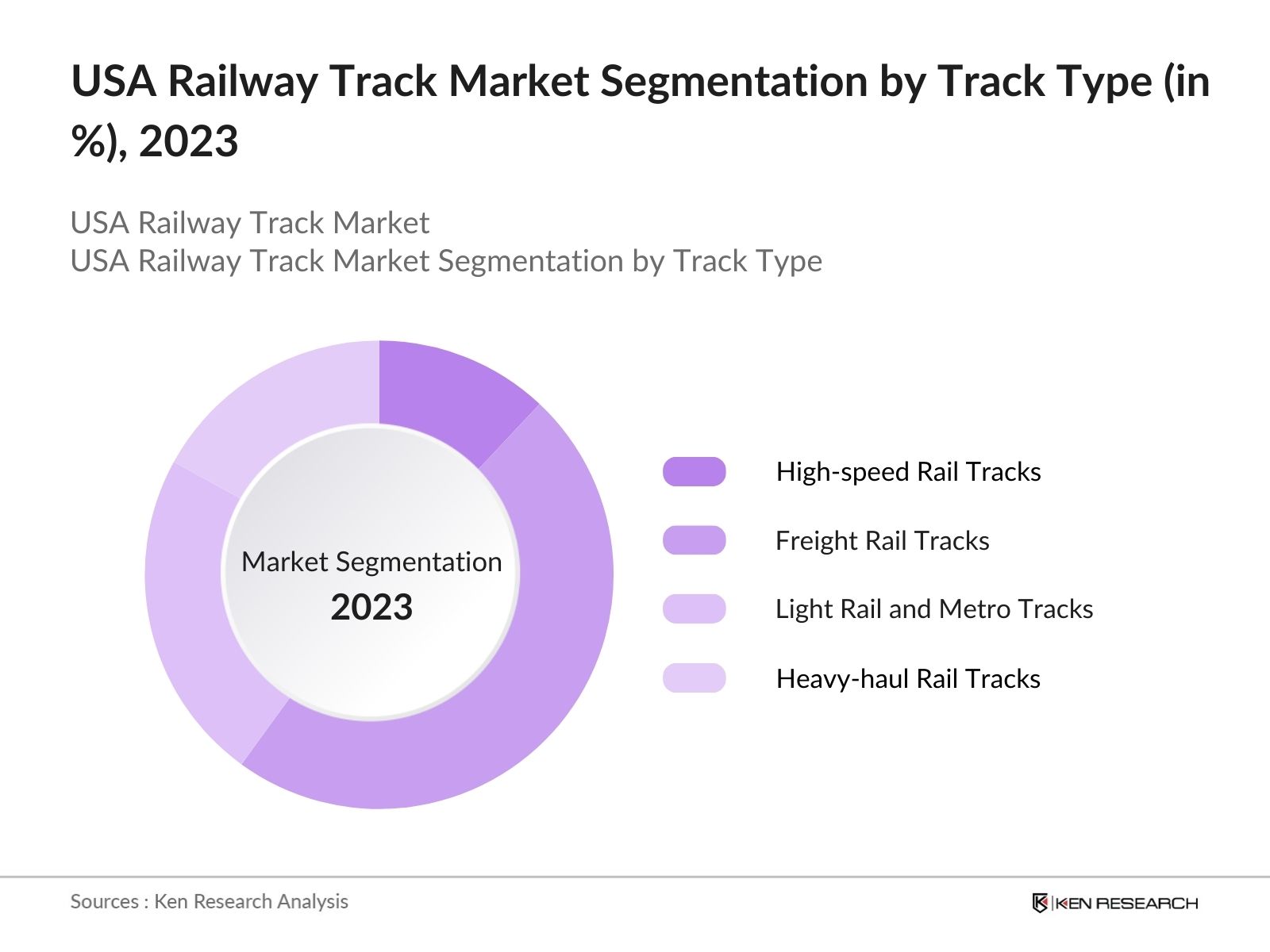
By Track Type: The Market is segmented by track type into high-speed rail tracks, freight rail tracks, light rail and metro tracks, and heavy-haul rail tracks. Freight rail tracks dominate this segment, primarily due to the vast network supporting the transport of goods across long distances in the Midwest and Western regions. Freight rail is critical for transporting agricultural products, chemicals, and manufactured goods, driving its market share in the track type segment.
 By Material Type: The Market is also segmented by material type into steel tracks, concrete tracks, composite tracks, and wooden ties. Steel tracks have a dominant market share due to their durability and strength, which are essential for supporting high loads and long-distance freight transport. The reliability and low maintenance costs associated with steel make it the material of choice for most rail projects, particularly in freight-heavy regions like the Midwest.
 USA Railway Track Market Competitive Landscape
The USA Railway Track Market is dominated by several key players who specialize in various segments, including infrastructure development, track manufacturing, and railway operations. Companies like Union Pacific and CSX are integral to freight rail, while Amtrak leads the passenger rail segment. These major players maintain competitive advantages through extensive rail networks, large fleets, and technological advancements in track management.
|
Company |
Establishment Year |
Headquarters |
Market Segment |
Revenue |
Rail Network (Miles) |
Fleet Size |
Technological Capabilities |
Mergers & Acquisitions |
Key Partnerships |
|
Union Pacific Railroad |
1862 |
Omaha, Nebraska |
|||||||
|
Norfolk Southern Corporation |
1982 |
Atlanta, Georgia |
|||||||
|
Amtrak |
1971 |
Washington, D.C. |
|||||||
|
CSX Transportation |
1980 |
Jacksonville, Florida |
|||||||
|
BNSF Railway |
1995 |
Fort Worth, Texas |
USA Railway Track Industry Analysis
Over the next few years, the USA Railway Track Market is expected to witness growth driven by continuous investments in infrastructure, particularly for high-speed and freight rail. Increasing government support for sustainable transportation and the integration of advanced technologies such as predictive maintenance and digital monitoring will further enhance the market's prospects. The shift towards greener energy, including the electrification of railways, is also poised to provide new opportunities for market players.
|
Track Type |
High-speed rail Freight rail Light rail Heavy-haul rail |
|
Material Type |
Steel Concrete Composite Wooden ties |
|
Application |
Passenger transport Freight transport Urban transit |
|
Technology |
Conventional track Electrified rail Automated track |
|
Region |
Northeast Midwest West South |
1.1 Definition and Scope
1.2 Market Taxonomy
1.3 Market Growth Drivers (Railway infrastructure, urban expansion, cargo transit demand)
1.4 Market Segmentation Overview
2.1 Historical Market Size (Infrastructure development, track maintenance, new construction)
2.2 Year-On-Year Growth Analysis (Factors like federal investments, energy efficiency trends)
2.3 Key Market Developments and Milestones (High-speed rail initiatives, electrification projects)
3.1 Growth Drivers
3.1.1 Federal investments in infrastructure
3.1.2 Growing freight demands
3.1.3 Shift towards sustainability
3.1.4 Urban population growth
3.2 Market Challenges
3.2.1 High costs of track renewal
3.2.2 Regulatory hurdles
3.2.3 Competition from road transport
3.2.4 Funding constraints in public-private partnerships
3.3 Opportunities
3.3.1 Technology-driven track optimization (smart rail, automation)
3.3.2 Expansion of intercity passenger services
3.3.3 Rail electrification and alternative energy use
3.4 Trends
3.4.1 Integration of digital track monitoring systems
3.4.2 Adoption of predictive maintenance technology
3.4.3 Increased public-private collaboration for infrastructure upgrades
3.5 Government Regulations
3.5.1 Federal Railroad Administration policies
3.5.2 Rail safety and environmental standards
3.5.3 Infrastructure Investment and Jobs Act implications
3.5.4 National transportation safety board directives
3.6 SWOT Analysis
3.7 Stakeholder Ecosystem (Rail operators, public transit agencies, engineering firms)
3.8 Porters Five Forces
3.9 Competition Ecosystem (Rail maintenance firms, track equipment manufacturers, rail logistics companies)
4.1 By Track Type (In Value %)
4.1.1 High-speed rail tracks
4.1.2 Freight rail tracks
4.1.3 Light rail and metro tracks
4.1.4 Heavy-haul rail tracks
4.2 By Material Type (In Value %)
4.2.1 Steel tracks
4.2.2 Concrete tracks
4.2.3 Composite tracks
4.2.4 Wooden ties
4.3 By Application (In Value %)
4.3.1 Passenger transport
4.3.2 Freight transport
4.3.3 Urban transit systems
4.4 By Technology (In Value %)
4.4.1 Conventional track systems
4.4.2 Electrified rail systems
4.4.3 Automated track systems
4.5 By Region (In Value %)
4.5.1 Northeast
4.5.2 Midwest
4.5.3 West
4.5.4 South
5.1 Detailed Profiles of Major Companies
5.1.1 Union Pacific Railroad
5.1.2 Norfolk Southern Corporation
5.1.3 CSX Transportation
5.1.4 BNSF Railway
5.1.5 Amtrak
5.1.6 Canadian Pacific Kansas City (CPKC)
5.1.7 Genesee & Wyoming Inc.
5.1.8 Watco Companies LLC
5.1.9 Trinity Industries
5.1.10 Herzog Contracting Corp.
5.1.11 Plasser American Corporation
5.1.12 Siemens Mobility
5.1.13 Wabtec Corporation
5.1.14 Caterpillar Rail Division
5.1.15 Progress Rail Services
5.2 Cross Comparison Parameters (Market share, production capacity, service network, operational efficiency, innovation initiatives, partnerships, market penetration)
5.3 Market Share Analysis
5.4 Strategic Initiatives
5.5 Mergers and Acquisitions
5.6 Investment Analysis
5.7 Government Support Programs
5.8 Private Sector Collaborations
5.9 Technological Advancements
6.1 Track Construction Standards
6.2 Safety Compliance and Certification
6.3 Environmental Impact Assessments
6.4 Funding and Grants for Rail Infrastructure
7.1 Future Market Size Projections
7.2 Key Factors Driving Future Market Growth
8.1 By Track Type (In Value %)
8.2 By Material Type (In Value %)
8.3 By Application (In Value %)
8.4 By Technology (In Value %)
8.5 By Region (In Value %)
9.1 Rail Infrastructure Investment Strategies
9.2 Technological Adoption and Future Readiness
9.3 White Space Opportunity Analysis
9.4 Government Collaboration and Public Engagement Initiatives
The initial phase involves constructing an ecosystem map encompassing all major stakeholders within the USA Railway Track Market. This step is underpinned by extensive desk research, utilizing a combination of secondary and proprietary databases to gather comprehensive industry-level information. The primary objective is to identify and define the critical variables that influence market dynamics.
In this phase, we will compile and analyze historical data pertaining to the USA Railway Track Market. This includes assessing market penetration, the ratio of freight to passenger rail usage, and the resultant revenue generation. Furthermore, an evaluation of track performance and safety statistics will be conducted to ensure the reliability and accuracy of the market estimates.
Market hypotheses will be developed and subsequently validated through interviews with industry experts representing a diverse array of companies. These consultations will provide valuable operational and financial insights directly from industry practitioners, which will be instrumental in refining and corroborating the market data.
The final phase involves direct engagement with railway operators and infrastructure developers to acquire detailed insights into product segments, track maintenance, and the impact of government policies. This interaction will serve to verify and complement the statistics derived from the bottom-up approach, thereby ensuring a comprehensive, accurate, and validated analysis of the USA Railway Track Market.
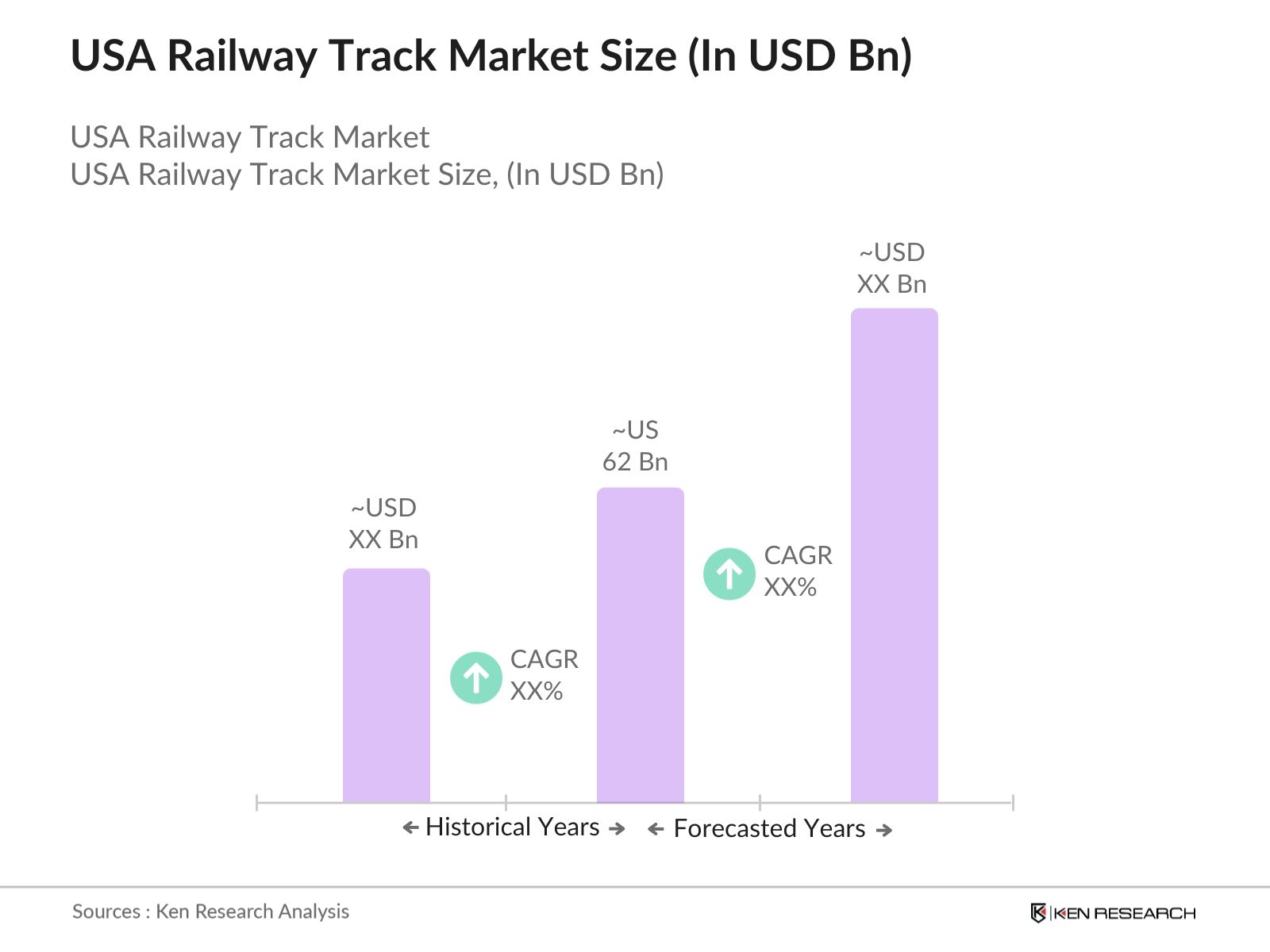
The USA Railway Track Market is valued at USD 62 billion, driven by consistent investments in railway infrastructure, including high-speed and freight rail networks, and growing demand for sustainable transport solutions.
Challenges in the USA Railway Track Market include high costs associated with rail track maintenance, regulatory compliance requirements, competition from road transport, and limited funding for public-private rail partnerships.
Key players in the USA Railway Track Market include Union Pacific Railroad, Norfolk Southern Corporation, CSX Transportation, Amtrak, and BNSF Railway, who dominate due to their extensive rail networks, large fleets, and technological advancements in rail infrastructure management.
The USA Railway Track Market is driven by government initiatives such as the Infrastructure Investment and Jobs Act, the growing demand for freight rail transport, and investments in high-speed rail technology. Additionally, the push for greener energy and rail electrification is boosting market growth.
Opportunities in the USA Railway Track Market exist in the adoption of digital rail technologies, including track monitoring systems, predictive maintenance, and automation. Expansion into high-speed rail and the shift towards electrification also present potential for growth.

What makes us stand out is that our consultants follows Robust, Refine and Result (RRR) methodology. i.e. Robust for clear definitions, approaches and sanity checking, Refine for differentiating respondents facts and opinions and Result for presenting data with story

We have set a benchmark in the industry by offering our clients with syndicated and customized market research reports featuring coverage of entire market as well as meticulous research and analyst insights.

While we don't replace traditional research, we flip the method upside down. Our dual approach of Top Bottom & Bottom Top ensures quality deliverable by not just verifying company fundamentals but also looking at the sector and macroeconomic factors.

With one step in the future, our research team constantly tries to show you the bigger picture. We help with some of the tough questions you may encounter along the way: How is the industry positioned? Best marketing channel? KPI's of competitors? By aligning every element, we help maximize success.

Our report gives you instant access to the answers and sources that other companies might choose to hide. We elaborate each steps of research methodology we have used and showcase you the sample size to earn your trust.

If you need any support, we are here! We pride ourselves on universe strength, data quality, and quick, friendly, and professional service.