
USA Rare Gases Market Outlook to 2030
Region:North America
Author(s):Vijay Kumar
Product Code:KROD5385
November 2024
83
About the Report
USA Rare Gases Market Overview
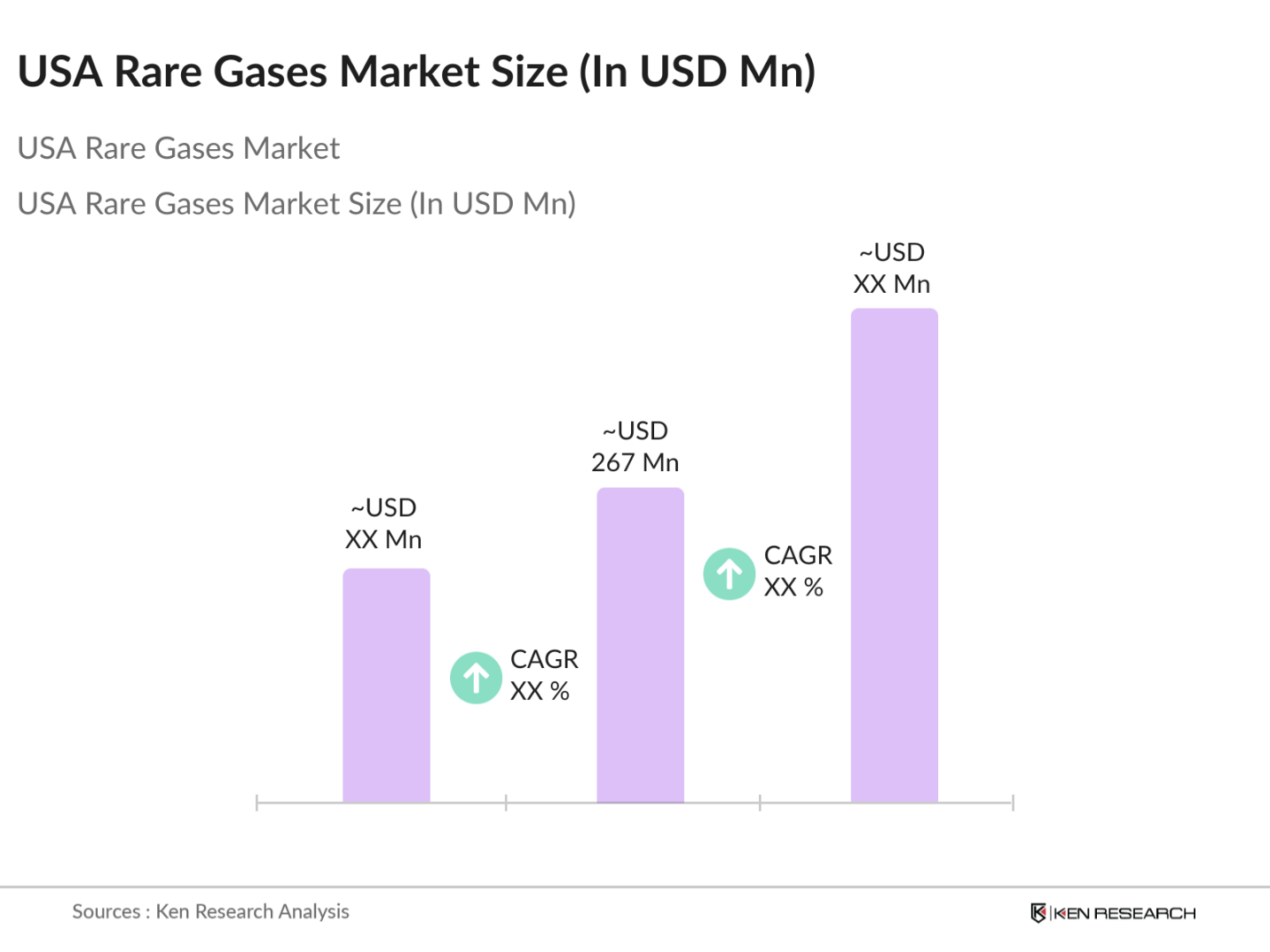
- The USA Rare Gases market is valued at USD 267 million, based on a five-year historical analysis. This market is primarily driven by the expansion of the semiconductor and electronics industries, where rare gases like neon, krypton, and xenon are essential for manufacturing processes. Increased demand for advanced technologies in sectors like healthcare, where helium is widely used for MRI machines, and the push for energy-efficient lighting solutions also fuel growth. With ongoing developments in photolithography and specialized medical applications, rare gases are becoming indispensable across diverse high-tech industries.
- Major cities like San Francisco and Austin dominate the rare gases market due to their robust technology sectors and concentration of semiconductor manufacturing facilities. The presence of leading tech companies and research institutions in these regions fosters a high demand for rare gases, essential for various applications in electronics and research. Additionally, the strategic location of these cities facilitates efficient distribution and supply chain operations, further solidifying their dominance in the market.
- Handling and transporting rare gases require compliance with strict safety standards due to the risks associated with pressurized gas cylinders. The Occupational Safety and Health Administration (OSHA) enforces protocols for safe handling and transportation, including storage requirements, to mitigate hazards in industrial and healthcare settings. These safety standards are essential to protect personnel and ensure safe transportation across supply chains.
USA Rare Gases Market Segmentation
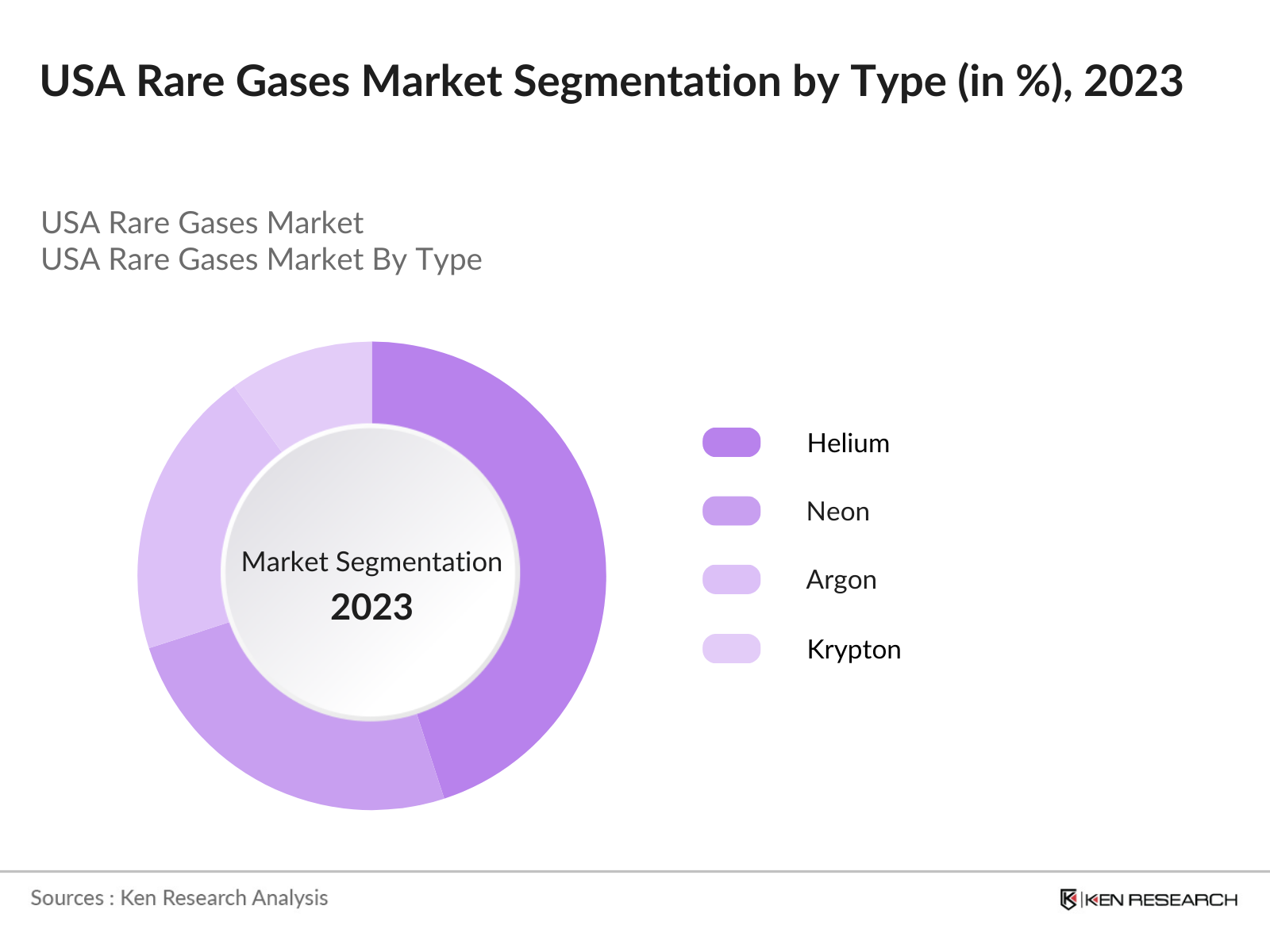
By Type: The USA rare gases market is segmented by type into helium, neon, argon, krypton, and xenon. In 2023, helium holds a dominant market share due to its extensive use in medical imaging, particularly in MRI machines, and its applications in cryogenics and as a cooling medium in nuclear reactors. The unique properties of helium, such as its low boiling point and inertness, make it indispensable across various industries, thereby sustaining its leading position in the market.
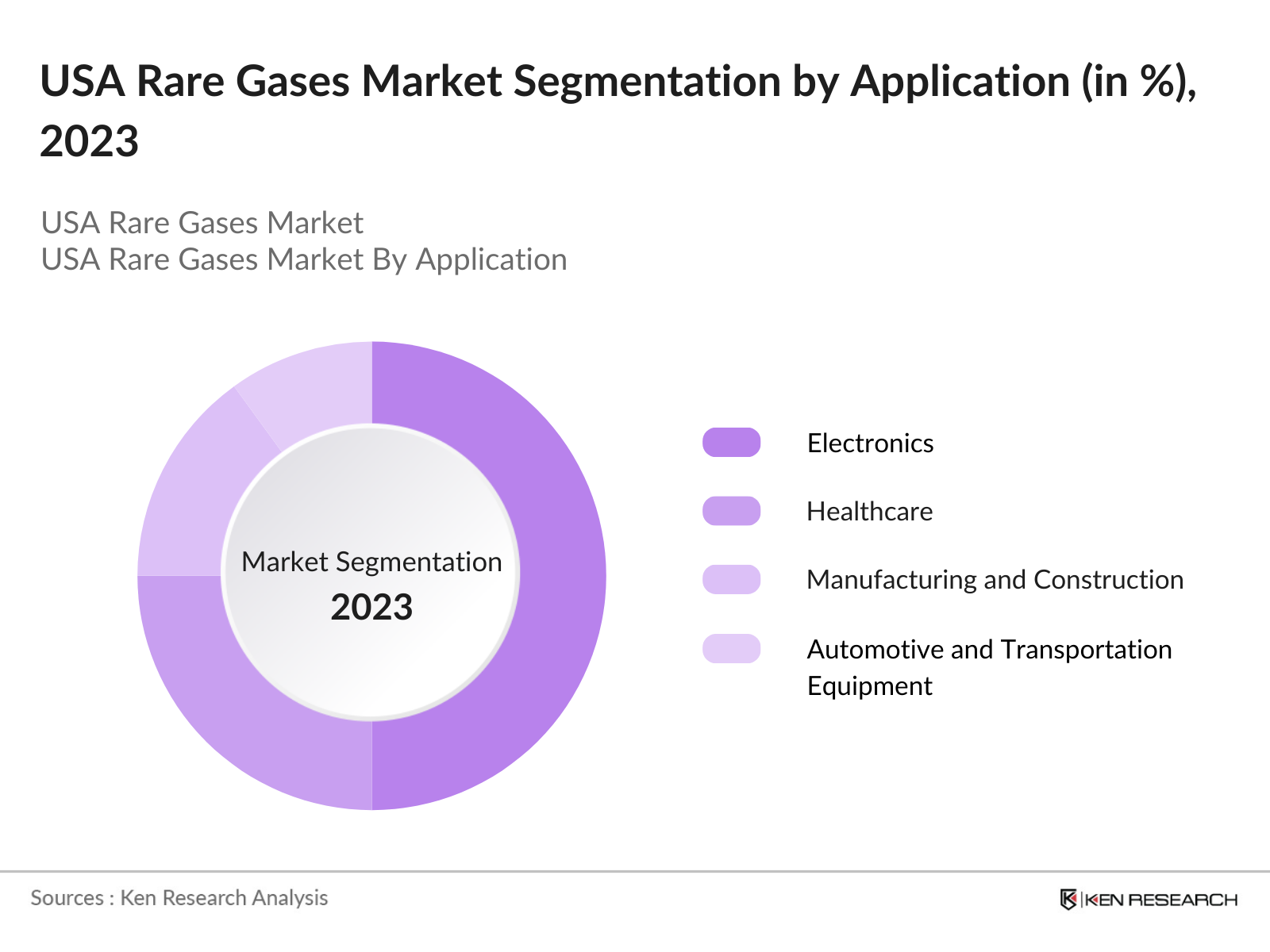
By Application: The market is further segmented by application into electronics, healthcare, manufacturing and construction, automotive and transportation equipment, and lighting. The electronics segment leads the market, driven by the critical role rare gases play in semiconductor manufacturing and the production of flat-panel displays. The continuous innovation and growth in the electronics industry, coupled with the increasing demand for consumer electronics, bolster the dominance of this segment.
USA Rare Gases Market Competitive Landscape
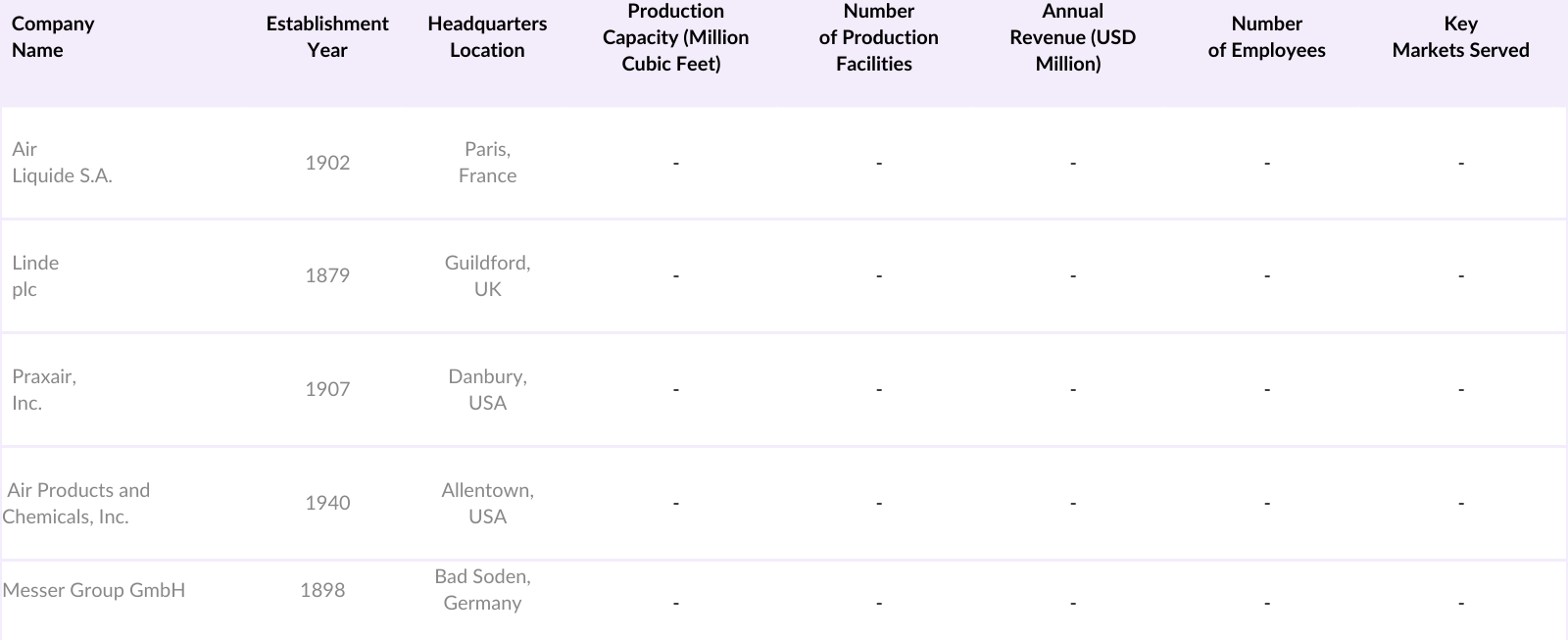
The USA rare gases market is characterized by the presence of several key players who contribute significantly to the industry's dynamics. These companies are instrumental in the production, distribution, and innovation within the market, ensuring a steady supply of rare gases to meet the diverse demands of various sectors.
USA Rare Gases Industry Analysis
Growth Drivers
- Expansion in Semiconductor and Electronics Industry: The United States' semiconductor and electronics sectors are pivotal consumers of rare gases such as neon, argon, and xenon, essential in processes like lithography and etching. In 2023, the U.S. semiconductor industry reported sales of $258 billion, reflecting robust demand for advanced manufacturing materials, including rare gases. The U.S. Department of Commerce highlighted that semiconductors are integral to the nation's economic and national security, underscoring the critical role of rare gases in sustaining this industry's growth.
- Increasing Demand in Healthcare and Medical Imaging: Rare gases, notably helium and xenon, are vital in medical imaging technologies such as MRI machines and anesthesia delivery systems. The U.S. healthcare sector's expenditure reached $4.3 trillion in 2022, with significant investments in advanced diagnostic equipment. The Centers for Medicare & Medicaid Services (CMS) reported that hospital spending accounted for $1.3 trillion, indicating substantial procurement of medical technologies reliant on rare gases.
- Adoption in Energy-Efficient Lighting Solutions: The shift towards energy-efficient lighting has increased the use of rare gases like neon and krypton in high-efficiency lighting systems. The U.S. Department of Energy noted that lighting accounts for approximately 15% of the nation's electricity consumption. The adoption of energy-efficient lighting solutions, supported by rare gases, contributes to significant energy savings and aligns with national energy conservation goals.
Market Challenges
- Supply Constraints and Availability Issues: The U.S. has faced helium shortages due to declining production from the Federal Helium Reserve, leading to supply constraints for industries reliant on this gas. The Bureau of Land Management reported that the Federal Helium Reserve's sales have been suspended, impacting the availability of helium for various applications.
- High Production and Extraction Costs: The extraction and purification of rare gases involve energy-intensive processes, contributing to high production costs. The U.S. Energy Information Administration noted that industrial energy consumption accounted for 32% of total U.S. energy use in 2022, with a portion attributed to gas extraction industries. These high energy requirements elevate operational costs for rare gas producers.
USA Rare Gases Market Future Outlook
Over the next five years, the USA rare gases market is expected to experience substantial growth, driven by continuous advancements in semiconductor technology, increasing applications in healthcare, and the rising demand for energy-efficient lighting solutions. The expansion of the electronics industry, particularly in emerging technologies such as 5G and IoT, will further augment the demand for rare gases.
Market Opportunities
- Technological Advancements in Extraction and Purification: Innovations in extraction and purification technologies present opportunities to enhance the efficiency and sustainability of rare gas production. The U.S. Department of Energy has invested in research to develop advanced separation technologies, aiming to reduce energy consumption and environmental impact in gas extraction processes. These advancements can lead to more cost-effective and eco-friendly production methods.
- Emerging Applications in Quantum Computing and Fusion Energy: Rare gases are finding new applications in cutting-edge fields like quantum computing and fusion energy research. The National Institute of Standards and Technology reported that noble gases are used in quantum sensors and atomic clocks, essential components in quantum computing systems. Additionally, the Department of Energy's fusion energy research programs utilize rare gases in plasma diagnostics and reactor designs, highlighting their expanding role in advanced technologies.
Scope of the Report
|
By Type |
Helium Neon Argon Krypton Xenon |
|
By Application |
Electronics Healthcare Manufacturing and Construction Automotive and Transportation Equipment Lighting |
|
By Function |
Illumination Insulation Scanning Anesthesia Semiconductors |
|
By End-Use Industry |
Electronics and Semiconductors Healthcare and Medical Devices Manufacturing and Industrial Processes Automotive and Aerospace Lighting and Display Technologies |
|
By Region |
Northeast Midwest South West |
Products
Key Target Audience
Semiconductor Manufacturers
Medical Device Manufacturers
Industrial Gas Suppliers
Automotive Manufacturers
Aerospace and Defense Contractors
Lighting Equipment Manufacturers
Investment and Venture Capitalist Firms
Government and Regulatory Bodies (e.g., U.S. Environmental Protection Agency)
Companies
Players Mentioned in the Report
Air Liquide S.A.
Linde plc
Praxair, Inc.
Air Products and Chemicals, Inc.
Messer Group GmbH
Matheson Tri-Gas, Inc.
Airgas, Inc.
Iwatani Corporation
Chengdu Taiyu Industrial Gases Co., Ltd.
Gulf Cryo
Table of Contents
1. USA Rare Gases Market Overview
1.1. Definition and Scope
1.2. Market Taxonomy
1.3. Market Growth Rate
1.4. Market Segmentation Overview
2. USA Rare Gases Market Size (USD Million)
2.1. Historical Market Size
2.2. Year-On-Year Growth Analysis
2.3. Key Market Developments and Milestones
3. USA Rare Gases Market Analysis
3.1. Growth Drivers
3.1.1. Expansion in Semiconductor and Electronics Industry
3.1.2. Increasing Demand in Healthcare and Medical Imaging
3.1.3. Adoption in Energy-Efficient Lighting Solutions
3.1.4. Industrial Applications in Manufacturing and Construction
3.2. Market Challenges
3.2.1. Supply Constraints and Availability Issues
3.2.2. High Production and Extraction Costs
3.2.3. Environmental Concerns Related to Extraction Processes
3.3. Opportunities
3.3.1. Technological Advancements in Extraction and Purification
3.3.2. Emerging Applications in Quantum Computing and Fusion Energy
3.3.3. Expansion into Untapped Regional Markets
3.4. Trends
3.4.1. Integration with Advanced Medical Imaging Technologies
3.4.2. Development of High-Purity Gases for Semiconductor Manufacturing
3.4.3. Increased Use in Automotive Lighting and Display Technologies
3.5. Regulatory Landscape
3.5.1. Environmental Regulations Governing Extraction and Emissions
3.5.2. Safety Standards for Handling and Transportation
3.5.3. Trade Policies Affecting Import and Export
3.6. SWOT Analysis
3.7. Stakeholder Ecosystem
3.8. Porters Five Forces Analysis
3.9. Competitive Landscape
4. USA Rare Gases Market Segmentation
4.1. By Type (Value %)
4.1.1. Helium
4.1.2. Neon
4.1.3. Argon
4.1.4. Krypton
4.1.5. Xenon
4.2. By Application (Value %)
4.2.1. Electronics
4.2.2. Healthcare
4.2.3. Manufacturing and Construction
4.2.4. Automotive and Transportation Equipment
4.2.5. Lighting
4.3. By Function (Value %)
4.3.1. Illumination
4.3.2. Insulation
4.3.3. Scanning
4.3.4. Anesthesia
4.3.5. Semiconductors
4.4. By End-Use Industry (Value %)
4.4.1. Electronics and Semiconductors
4.4.2. Healthcare and Medical Devices
4.4.3. Manufacturing and Industrial Processes
4.4.4. Automotive and Aerospace
4.4.5. Lighting and Display Technologies
4.5. By Region (Value %)
4.5.1. Northeast
4.5.2. Midwest
4.5.3. South
4.5.4. West
5. USA Rare Gases Market Competitive Analysis
5.1. Detailed Profiles of Major Companies
5.1.1. Air Liquide S.A.
5.1.2. Linde Group
5.1.3. Praxair, Inc.
5.1.4. Air Products and Chemicals, Inc.
5.1.5. Messer Group GmbH
5.1.6. Matheson Tri-Gas, Inc.
5.1.7. Airgas, Inc.
5.1.8. Iwatani Corporation
5.1.9. Chengdu Taiyu Industrial Gases Co., Ltd.
5.1.10. Gulf Cryo
5.1.11. Taiyo Nippon Sanso Corporation
5.1.12. Showa Denko K.K.
5.1.13. Yingde Gases Group Company Limited
5.1.14. Universal Industrial Gases, Inc.
5.1.15. Cryoin Engineering Ltd.
5.2. Cross Comparison Parameters
5.2.1. Number of Employees
5.2.2. Headquarters Location
5.2.3. Year of Establishment
5.2.4. Revenue
5.2.5. Market Share
5.2.6. Product Portfolio
5.2.7. Regional Presence
5.2.8. Strategic Initiatives
5.3. Market Share Analysis
5.4. Strategic Initiatives
5.5. Mergers and Acquisitions
5.6. Investment Analysis
5.6.1. Venture Capital Funding
5.6.2. Government Grants
5.6.3. Private Equity Investments
6. USA Rare Gases Market Regulatory Framework
6.1. Environmental Standards
6.2. Compliance Requirements
6.3. Certification Processes
7. USA Rare Gases Future Market Size (USD Million)
7.1. Future Market Size Projections
7.2. Key Factors Driving Future Market Growth
8. USA Rare Gases Future Market Segmentation
8.1. By Type (Value %)
8.2. By Application (Value %)
8.3. By Function (Value %)
8.4. By End-Use Industry (Value %)
8.5. By Region (Value %)
9. USA Rare Gases Market Analysts Recommendations
9.1. Total Addressable Market (TAM), Serviceable Available Market (SAM), and Serviceable Obtainable Market (SOM) Analysis
9.2. Customer Cohort Analysis
9.3. Marketing Initiatives
9.4. White Space Opportunity Analysis
Disclaimer Contact UsResearch Methodology
Step 1: Identification of Key Variables
The initial phase involves constructing an ecosystem map encompassing all major stakeholders within the USA rare gases market. This step is underpinned by extensive desk research, utilizing a combination of secondary and proprietary databases to gather comprehensive industry-level information. The primary objective is to identify and define the critical variables that influence market dynamics.
Step 2: Market Analysis and Construction
In this phase, we compile and analyze historical data pertaining to the USA rare gases market. This includes assessing market penetration, the ratio of marketplaces to service providers, and the resultant revenue generation. Furthermore, an evaluation of service quality statistics is conducted to ensure the reliability and accuracy of the revenue estimates.
Step 3: Hypothesis Validation and Expert Consultation
Market hypotheses are developed and subsequently validated through computer-assisted telephone interviews (CATIs) with industry experts representing a diverse array of companies. These consultations provide valuable operational and financial insights directly from industry practitioners, which are instrumental in refining and corroborating the market data.
Step 4: Research Synthesis and Final Output
The final phase involves direct engagement with multiple rare gas producers and end-users to acquire detailed insights into product segments, sales performance, consumer preferences, and other pertinent factors. This interaction serves to verify and complement the statistics derived from the bottom-up approach, thereby ensuring a comprehensive, accurate, and validated analysis of the USA rare gases market.
Frequently Asked Questions
01 How big is the USA Rare Gases Market?
The USA Rare Gases market is valued at USD 267 million, based on a five-year historical analysis. This market is primarily driven by the expansion of the semiconductor and electronics industries, where rare gases like neon, krypton, and xenon are essential for manufacturing processes.
02 What are the primary drivers of the USA Rare Gases Market?
Key drivers include the growing semiconductor industry, expanding applications in healthcare, and rising demand for energy-efficient lighting solutions, all of which rely heavily on rare gases for production.
03 Who are the major players in the USA Rare Gases Market?
Leading companies include Air Liquide S.A., Linde plc, Praxair, Inc., Air Products and Chemicals, Inc., and Messer Group GmbH, which dominate the market due to their extensive production capabilities and strategic partnerships.
04 What challenges does the USA Rare Gases Market face?
The market faces challenges such as supply constraints, high extraction and production costs, and environmental concerns related to the extraction processes of rare gases.
Why Buy From Us?

What makes us stand out is that our consultants follows Robust, Refine and Result (RRR) methodology. i.e. Robust for clear definitions, approaches and sanity checking, Refine for differentiating respondents facts and opinions and Result for presenting data with story

We have set a benchmark in the industry by offering our clients with syndicated and customized market research reports featuring coverage of entire market as well as meticulous research and analyst insights.

While we don't replace traditional research, we flip the method upside down. Our dual approach of Top Bottom & Bottom Top ensures quality deliverable by not just verifying company fundamentals but also looking at the sector and macroeconomic factors.

With one step in the future, our research team constantly tries to show you the bigger picture. We help with some of the tough questions you may encounter along the way: How is the industry positioned? Best marketing channel? KPI's of competitors? By aligning every element, we help maximize success.

Our report gives you instant access to the answers and sources that other companies might choose to hide. We elaborate each steps of research methodology we have used and showcase you the sample size to earn your trust.

If you need any support, we are here! We pride ourselves on universe strength, data quality, and quick, friendly, and professional service.