
USA Rechargeable Battery Market Outlook to 2030
Region:North America
Author(s):Meenakshi Bisht
Product Code:KROD7364
November 2024
96
About the Report
USA Rechargeable Battery Market Overview
- The USA Rechargeable Battery Market is valued at USD 30.4 billion, reflecting robust demand from sectors such as electric vehicles (EVs), consumer electronics, and renewable energy storage systems. This market growth is driven by technological advancements, increasing environmental concerns, and rising government incentives promoting clean energy adoption.
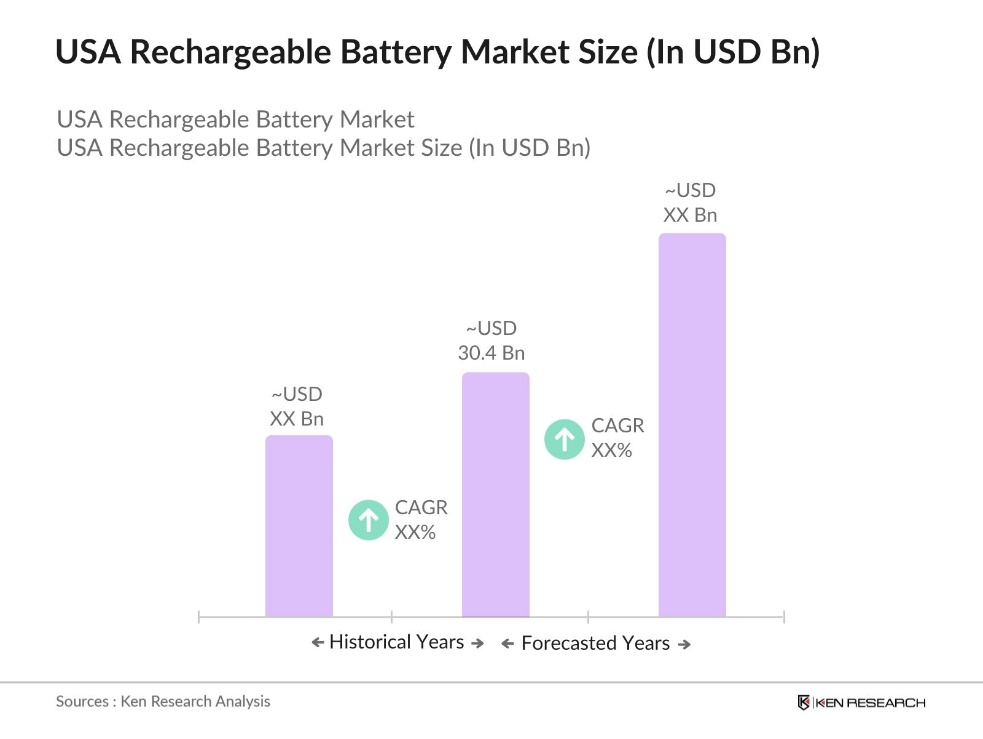
- The West Coast, including California, dominates the USA rechargeable battery market due to its progressive environmental policies, high concentration of tech industries, and a strong EV market driven by companies like Tesla. The Southeast is another significant region, primarily due to the presence of several manufacturing facilities, including large automotive players focused on EVs, supported by favorable state policies and tax incentives aimed at boosting regional manufacturing capacities.
- In response to environmental concerns, the U.S. Environmental Protection Agency (EPA) has imposed stricter standards on battery production emissions. As of 2024, manufacturers are required to adhere to new protocols that reduce hazardous emissions during battery production, reinforcing sustainability initiatives.
USA Rechargeable Battery Market Segmentation
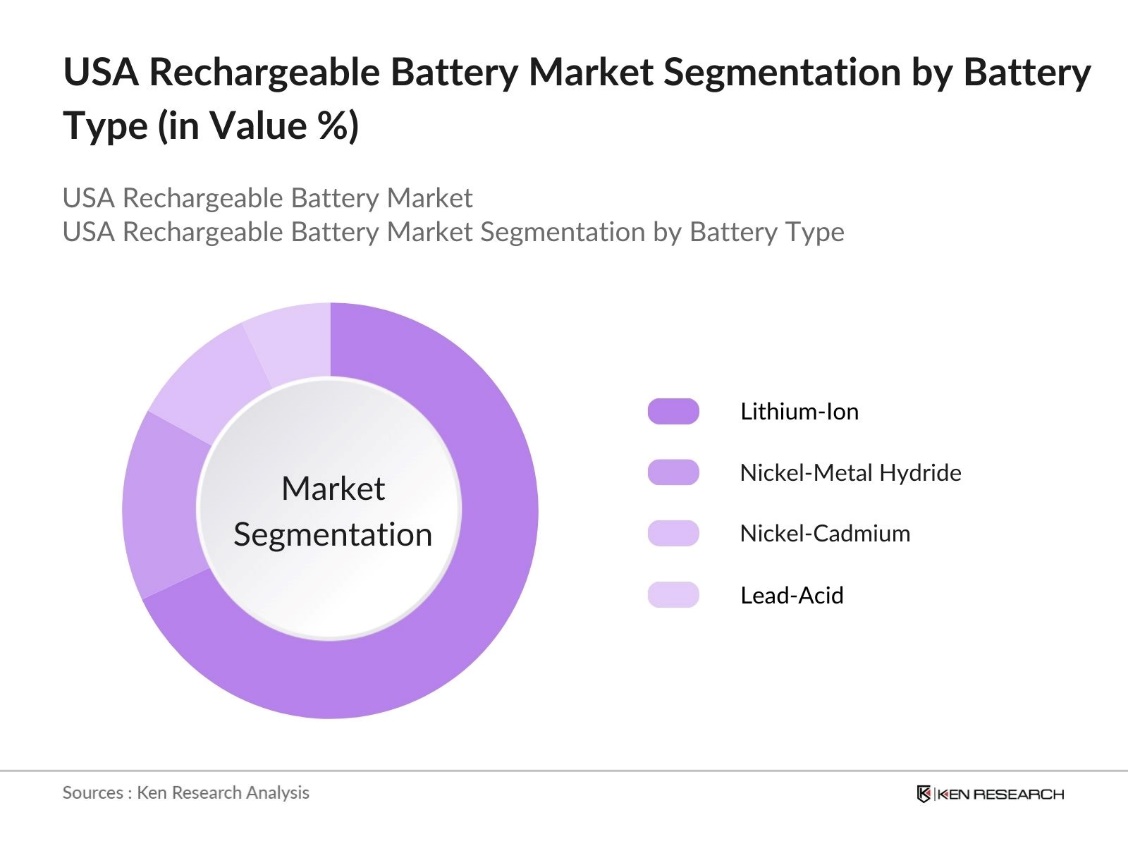
By Battery Type: The market is segmented by battery type into lithium-ion, nickel-metal hydride (NiMH), nickel-cadmium (NiCd), and lead-acid batteries. Lithium-ion batteries hold the largest market share, owing to their high energy density, efficiency, and widespread use in consumer electronics and electric vehicles. Additionally, advancements in lithium-ion technology and investments by major companies have enhanced the segments capabilities, making it a top choice for manufacturers aiming to meet the energy demands of high-performance applications.
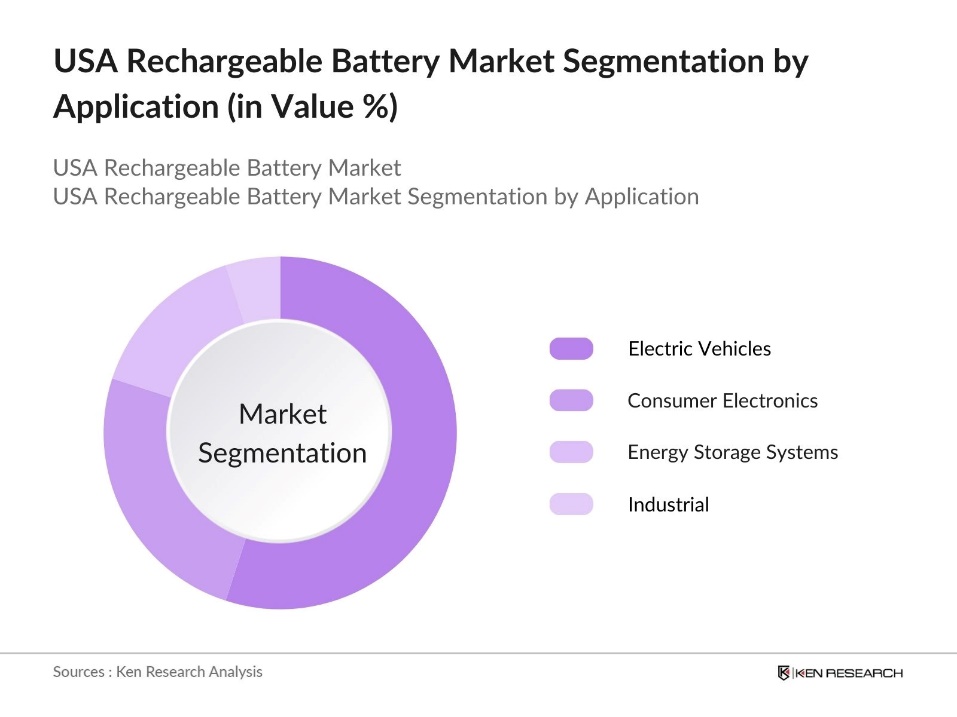
By Application: The market is segmented by application into electric vehicles, consumer electronics, energy storage systems, and industrial uses. Electric vehicles dominate this segment, driven by increasing consumer adoption, automaker commitments to EV production, and supportive government policies. Consumer interest in sustainable mobility, coupled with advancements in EV infrastructure, positions this segment as a leader in the USA rechargeable battery market, with demand projected to remain strong due to federal incentives and innovations in fast-charging solutions.
USA Rechargeable Battery Market Competitive Landscape
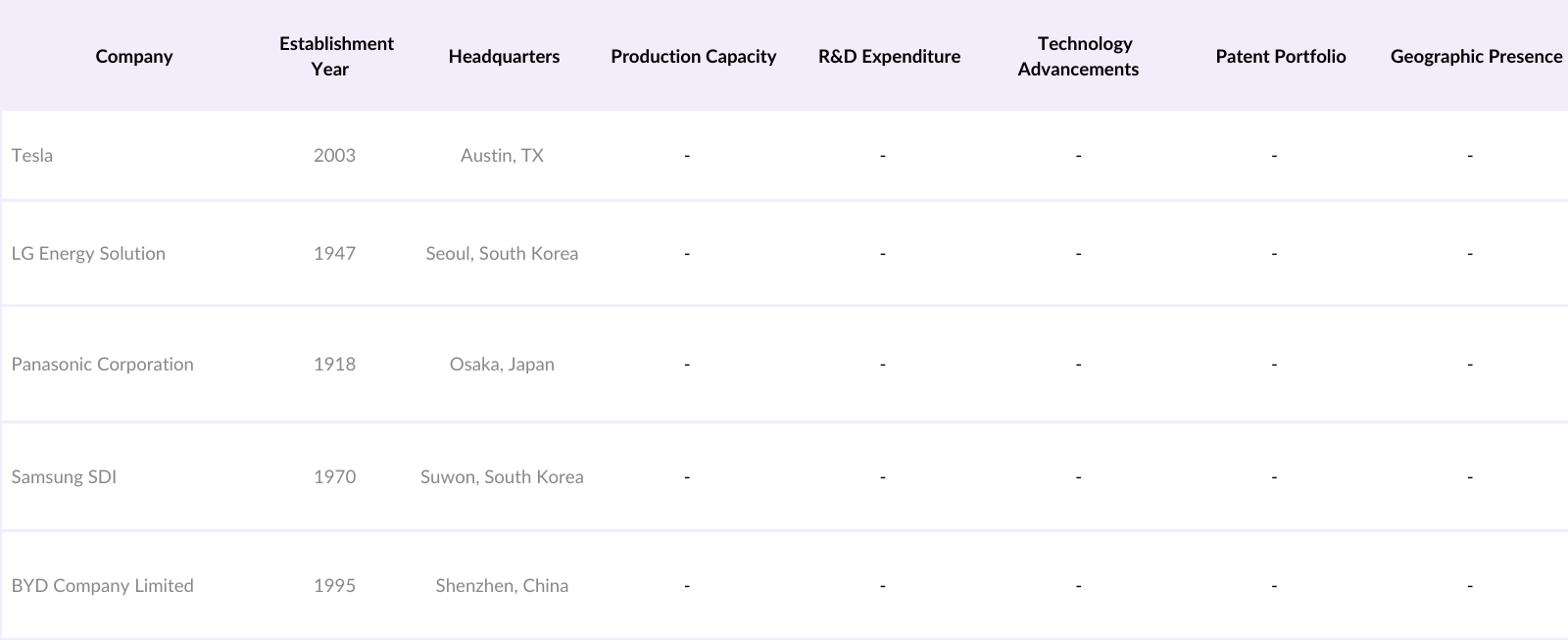
The USA rechargeable battery market is characterized by prominent domestic and international players, each contributing to the industry's advancement through innovations and strategic expansions. Companies such as Tesla, LG Energy Solution, and Panasonic hold substantial influence, backed by their extensive R&D capabilities, production capacities, and strategic partnerships within the market.
USA Rechargeable Battery Industry Analysis
Growth Drivers
- Demand for Renewable Energy Storage: In 2024, the U.S. has been significantly expanding its renewable energy storage capacities, largely due to the integration of solar and wind power across states. The U.S. Energy Information Administration (EIA) estimates that renewable energy capacity additions will reach approximately 42 GW (42,000 MW) in 2024. Storage installations, particularly for lithium-based batteries, are expected to balance the load and store surplus energy. This push for storage technologies strengthens the market potential for rechargeable batteries, crucial for grid resilience.
- Rising Electric Vehicle (EV) Adoption: Electric vehicles are central to the shift toward sustainable transportation in the U.S. Battery demands for EVs are substantial, driving advancements in rechargeable battery technology, particularly lithium-ion and solid-state variants. The Biden Administrations emphasis on electrifying transportation further supports this growth, with a target of 50% EV sales share by 2030, fueling immediate investment in battery infrastructure.
- Technological Advancements in Battery Chemistry: Technological advancements in battery chemistry are enhancing the efficiency, lifespan, and capacity of rechargeable batteries in the U.S. Innovations in lithium-ion technology, such as silicon anodes, allow for faster charging and extended life cycles. Additionally, solid-state batteries are emerging as a safer, more stable alternative, driven by growing investment in research, which supports the development of next-generation battery technologies for various applications.
Market Challenges
- High Production Costs: The high costs of essential raw materials like lithium, cobalt, and nickel have led to increased battery prices in the U.S. market, creating financial challenges for manufacturers. These elevated costs are a significant barrier to market growth, prompting efforts to reduce expenses through recycling initiatives and domestic material sourcing, which aim to lessen dependency on costly imports.
- Raw Material Supply Constraints: Limited availability of critical raw materials, such as lithium and cobalt, poses ongoing challenges for battery production in the U.S. Domestic reserves of these materials are insufficient to meet growing demand, particularly driven by the electric vehicle and renewable energy storage sectors. This dependency on imported materials continues to impact production volumes and supply chain stability.
USA Rechargeable Battery Market Future Outlook
Over the next five years, the USA rechargeable battery market is expected to experience sustained growth, driven by ongoing advancements in energy storage technology, expanding electric vehicle adoption, and favorable government policies. Increased demand for renewable energy integration and continued research into higher-density battery technologies are projected to shape the markets future trajectory, presenting lucrative opportunities for companies with robust R&D capabilities.
Market Opportunities
- Expansion of Utility Storage Applications: Utility providers are increasingly adopting battery storage systems to enhance grid stability and prevent blackouts. These systems enable energy storage during low-demand periods, which can then be distributed during peak demand, ensuring a more resilient energy infrastructure. This growing reliance on utility-scale battery storage creates significant opportunities for battery manufacturers to meet the rising demand for grid-supportive technologies.
- Growth in Portable Electronics Market: The continued growth of the portable electronics market, including smartphones, laptops, and tablets, is fueling demand for rechargeable batteries. Consumers seek compact, high-efficiency batteries to power their devices, creating a strong market for advanced battery solutions. As consumer electronics become more integral to daily life, the need for reliable and longer-lasting battery technology continues to drive opportunities for manufacturers in this sector.
Scope of the Report
|
Battery Type |
Lithium-Ion Nickel-Metal Hydride Nickel-Cadmium Lead-Acid |
|
Application |
Electric Vehicles Consumer Electronics Energy Storage Systems Industrial |
|
End-User Industry |
Automotive Consumer Electronics Energy & Power Aerospace & Defense |
|
Material |
Lithium Cobalt Nickel Lead |
|
Region |
Northeast Midwest South West |
Products
Key Target Audience
Battery Manufacturers
Electric Vehicle Manufacturers
Renewable Energy Companies
Industrial Equipment Manufacture
Consumer Electronics Manufacturers
Automotive Manufacturers
Government and Regulatory Bodies (e.g., U.S. Department of Energy, Environmental Protection Agency)
Investors and venture capital Firms
Banks and Financial Institutions
Companies
Players Mentioned in the Report
Tesla, Inc.
LG Energy Solution
Panasonic Corporation
Samsung SDI
BYD Company Limited
Contemporary Amperex Technology Co., Limited (CATL)
A123 Systems LLC
Enersys
Duracell Inc.
EnerDel, Inc.
Table of Contents
1. USA Rechargeable Battery Market Overview
1.1. Definition and Scope
1.2. Market Taxonomy
1.3. Market Growth Rate
1.4. Market Segmentation Overview
2. USA Rechargeable Battery Market Size (In USD Mn)
2.1. Historical Market Size
2.2. Year-On-Year Growth Analysis
2.3. Key Market Developments and Milestones
3. USA Rechargeable Battery Market Analysis
3.1. Growth Drivers
3.1.1. Demand for Renewable Energy Storage
3.1.2. Rising Electric Vehicle (EV) Adoption
3.1.3. Technological Advancements in Battery Chemistry
3.1.4. Government Incentives and Subsidies
3.2. Market Challenges
3.2.1. High Production Costs
3.2.2. Raw Material Supply Constraints
3.2.3. Safety and Disposal Concerns
3.3. Opportunities
3.3.1. Expansion of Utility Storage Applications
3.3.2. Growth in Portable Electronics Market
3.3.3. Innovations in Fast-Charging Technologies
3.4. Trends
3.4.1. Adoption of Solid-State Batteries
3.4.2. Increasing Use of Lithium-Iron-Phosphate (LFP) Batteries
3.4.3. Integration with Smart Energy Management Systems
3.5. Government Regulations
3.5.1. National Battery Manufacturing Initiatives
3.5.2. Environmental Protection Standards
3.5.3. Battery Recycling and Disposal Policies
3.6. SWOT Analysis
3.7. Stake Ecosystem
3.8. Porters Five Forces Analysis
3.9. Competition Ecosystem
4. USA Rechargeable Battery Market Segmentation
4.1. By Battery Type (In Value %)
4.1.1. Lithium-Ion Batteries
4.1.2. Nickel-Metal Hydride (NiMH) Batteries
4.1.3. Nickel-Cadmium (NiCd) Batteries
4.1.4. Lead-Acid Batteries
4.2. By Application (In Value %)
4.2.1. Electric Vehicles
4.2.2. Consumer Electronics
4.2.3. Energy Storage Systems
4.2.4. Industrial
4.3. By End-User Industry (In Value %)
4.3.1. Automotive
4.3.2. Consumer Electronics
4.3.3. Energy & Power
4.3.4. Aerospace & Defense
4.4. By Material (In Value %)
4.4.1. Lithium
4.4.2. Cobalt
4.4.3. Nickel
4.4.4. Lead
4.5. By Region (In Value %)
4.5.1. Northeast
4.5.2. Midwest
4.5.3. South
4.5.4. West
5. USA Rechargeable Battery Market Competitive Analysis
5.1. Detailed Profiles of Major Companies
5.1.1. Panasonic Corporation
5.1.2. LG Energy Solution
5.1.3. Samsung SDI
5.1.4. BYD Company Limited
5.1.5. Tesla, Inc.
5.1.6. Contemporary Amperex Technology Co., Limited (CATL)
5.1.7. A123 Systems LLC
5.1.8. Enersys
5.1.9. Duracell Inc.
5.1.10. EnerDel, Inc.
5.1.11. GS Yuasa Corporation
5.1.12. East Penn Manufacturing Co.
5.1.13. Hitachi Chemical Co., Ltd.
5.1.14. Toshiba Corporation
5.1.15. Amperex Technology Limited (ATL)
5.2. Cross Comparison Parameters (Production Capacity, R&D Expenditure, Technology Advancements, Patent Portfolio, Geographic Presence, Strategic Partnerships, Revenue, Employee Strength)
5.3. Market Share Analysis
5.4. Strategic Initiatives
5.5. Mergers and Acquisitions
5.6. Investment Analysis
5.7. Venture Capital Funding
5.8. Government Grants
5.9. Private Equity Investments
6. USA Rechargeable Battery Market Regulatory Framework
6.1. Environmental and Safety Standards
6.2. Compliance and Certification Processes
6.3. Import and Export Regulations
7. USA Rechargeable Battery Future Market Size (In USD Mn)
7.1. Future Market Size Projections
7.2. Key Factors Driving Future Market Growth
8. USA Rechargeable Battery Future Market Segmentation
8.1. By Battery Type (In Value %)
8.2. By Application (In Value %)
8.3. By End-User Industry (In Value %)
8.4. By Material (In Value %)
8.5. By Region (In Value %)
9. USA Rechargeable Battery Market Analysts Recommendations
9.1. TAM/SAM/SOM Analysis
9.2. Customer Cohort Analysis
9.3. Marketing Initiatives
9.4. White Space Opportunity Analysis
Disclaimer Contact UsResearch Methodology
Step 1: Identification of Key Variables
This phase involves building a comprehensive ecosystem map for the USA rechargeable battery market, focusing on key players, end-users, and regulatory frameworks. In-depth desk research from proprietary databases ensures an accurate mapping of industry dynamics and influential variables.
Step 2: Market Analysis and Construction
Historical data, including market penetration rates and growth trajectories, are analyzed to assess the revenue impact and segment distribution. Detailed evaluation of quality statistics and market presence supports the development of reliable market estimates.
Step 3: Hypothesis Validation and Expert Consultation
Market hypotheses are validated through structured interviews with industry experts, gathering insights into operational trends and competitive strategies. These insights refine the overall market data and strengthen the analysis of market segmentation.
Step 4: Research Synthesis and Final Output
Direct engagement with major rechargeable battery manufacturers enriches the report with insights on product segmentation, technology adoption, and sales trends, reinforcing the validity and comprehensiveness of the USA rechargeable battery market analysis.
Frequently Asked Questions
01 How big is the USA Rechargeable Battery Market?
The USA rechargeable battery market, valued at USD 30.4 billion, is driven by increasing demand from electric vehicles, consumer electronics, and energy storage systems.
02 What are the challenges in the USA Rechargeable Battery Market?
Key challenges in USA rechargeable battery market include high production costs, raw material supply constraints, and safety concerns related to battery recycling and disposal, impacting profitability and operational scalability.
03 Who are the major players in the USA Rechargeable Battery Market?
Prominent players in USA rechargeable battery market include Tesla, LG Energy Solution, Panasonic, Samsung SDI, and BYD, which lead due to their advanced technology, extensive R&D, and production capacities.
04 What are the growth drivers of the USA Rechargeable Battery Market?
The USA rechargeable battery market growth drivers encompass increasing electric vehicle adoption, renewable energy storage needs, technological advancements, and favorable governmental policies incentivizing sustainable energy solutions.
Why Buy From Us?

What makes us stand out is that our consultants follows Robust, Refine and Result (RRR) methodology. i.e. Robust for clear definitions, approaches and sanity checking, Refine for differentiating respondents facts and opinions and Result for presenting data with story

We have set a benchmark in the industry by offering our clients with syndicated and customized market research reports featuring coverage of entire market as well as meticulous research and analyst insights.

While we don't replace traditional research, we flip the method upside down. Our dual approach of Top Bottom & Bottom Top ensures quality deliverable by not just verifying company fundamentals but also looking at the sector and macroeconomic factors.

With one step in the future, our research team constantly tries to show you the bigger picture. We help with some of the tough questions you may encounter along the way: How is the industry positioned? Best marketing channel? KPI's of competitors? By aligning every element, we help maximize success.

Our report gives you instant access to the answers and sources that other companies might choose to hide. We elaborate each steps of research methodology we have used and showcase you the sample size to earn your trust.

If you need any support, we are here! We pride ourselves on universe strength, data quality, and quick, friendly, and professional service.