
USA Robot Market Outlook to 2030
Region:United States
Author(s):Shambhavi
Product Code:KROD10620
Region:United States
Author(s):Shambhavi
Product Code:KROD10620
December 2024
80
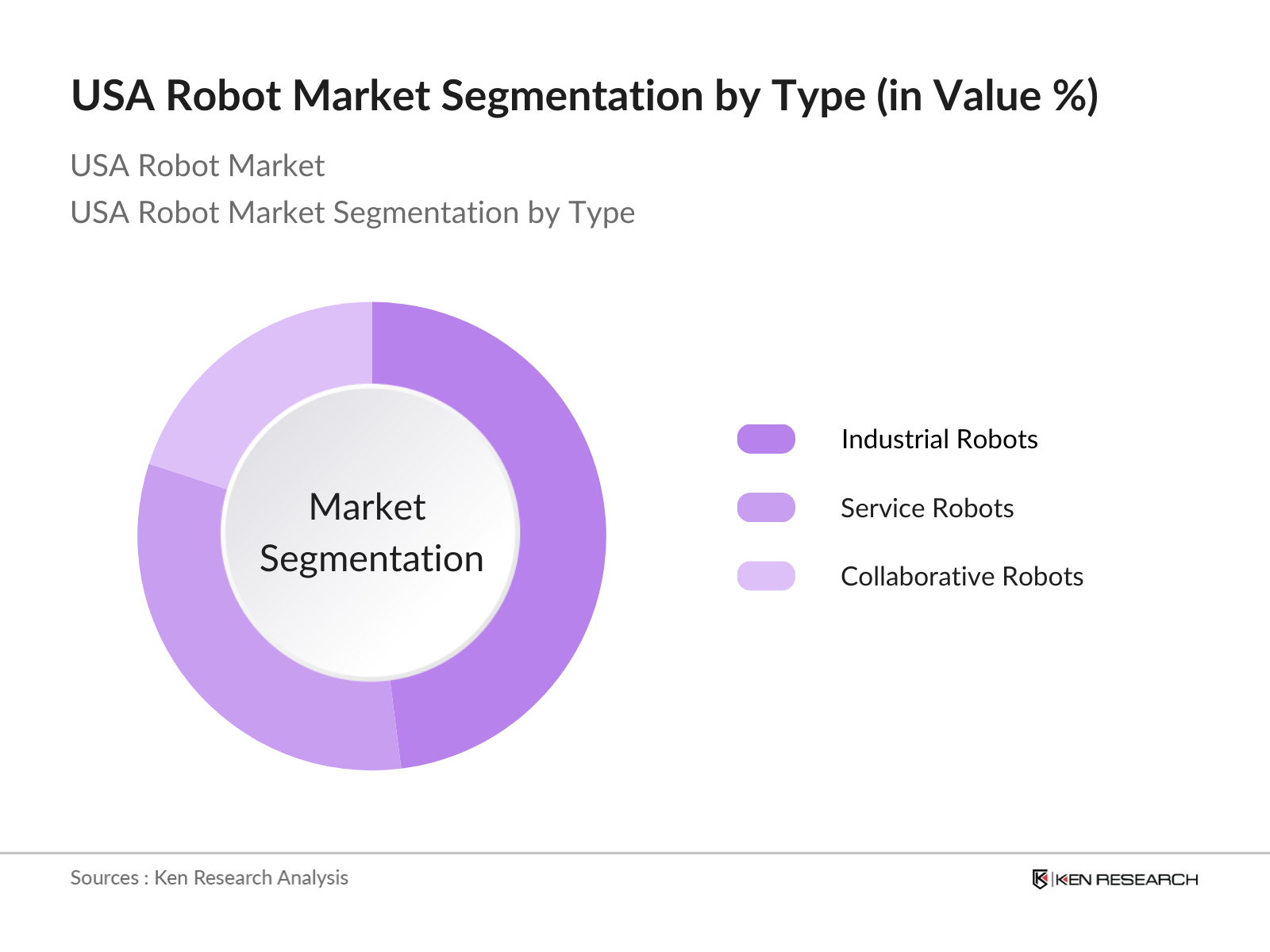
By Type: The USA Robot market is segmented by type into industrial robots, service robots, and collaborative robots (cobots). Industrial robots dominate the USA Robot market due to their widespread application in manufacturing industries. These robots are essential in automating repetitive tasks like welding, painting, and material handling, improving efficiency and reducing operational costs. Large-scale industries, especially in the automotive and electronics sectors, are heavily reliant on industrial robots to meet production demands and maintain competitiveness in the global market.
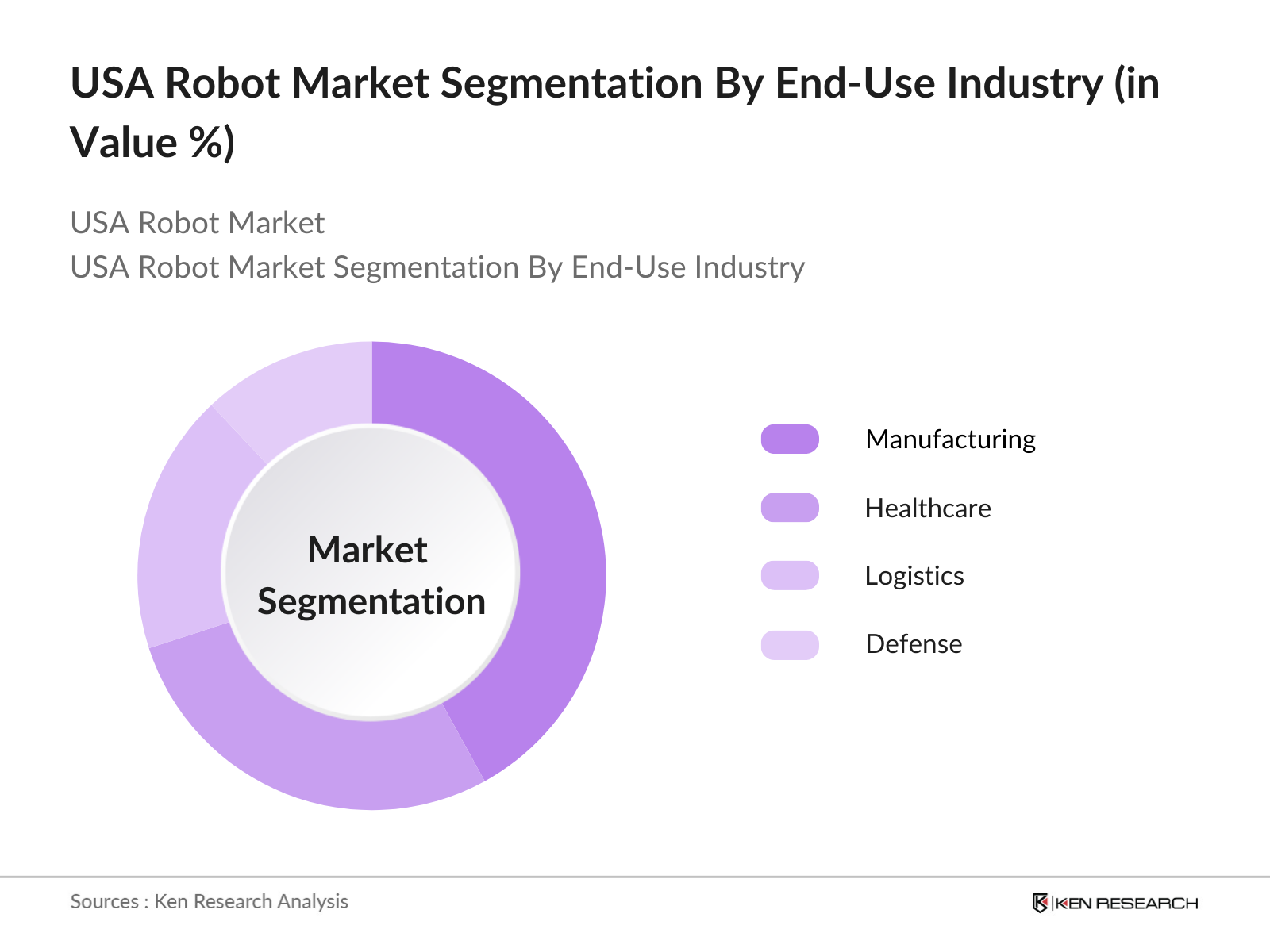
By End-Use Industry: The USA Robot market is segmented by end-use industry into manufacturing, healthcare, logistics, and defense. The manufacturing sector holds a dominant share in the USA Robot market. Automation has been a key driver for the sector as manufacturers seek to improve efficiency, reduce human errors, and meet high production targets. The automotive and electronics industries, in particular, are highly automated, with robots performing critical tasks such as assembly, painting, and packaging, making this sector a significant contributor to the robot market's growth.
The USA Robot market is dominated by a mix of global giants and local innovators. These companies are heavily invested in research and development to improve robot efficiency, expand their product portfolios, and capitalize on the growing demand for robotics in various sectors. The USA Robot market is highly competitive, with companies like ABB Ltd., KUKA AG, and FANUC Corporation leading the industrial robotics segment, while iRobot Corporation dominates the consumer robotics sector. These companies focus on innovation and strategic partnerships to maintain their market position.
|
Company |
Establishment Year |
Headquarters |
No. of Employees |
Annual Revenue |
R&D Spending |
Robots Deployed |
Production Capacity |
Key Sectors |
|---|---|---|---|---|---|---|---|---|
|
ABB Ltd. |
1883 |
Zurich, Switzerland |
||||||
|
KUKA AG |
1898 |
Augsburg, Germany |
||||||
|
FANUC Corporation |
1956 |
Yamanashi, Japan |
||||||
|
Boston Dynamics |
1992 |
Waltham, USA |
||||||
|
iRobot Corporation |
1990 |
Bedford, USA |
The USA Robot market is poised for robust growth in the coming years, driven by advancements in AI and machine learning, as well as increasing demand for automation across various industries. Key sectors such as manufacturing, healthcare, and logistics will continue to adopt robotic solutions to improve efficiency and reduce costs. Additionally, the development of collaborative robots (cobots) that can work alongside humans is expected to open up new opportunities in smaller-scale operations and service industries. Government initiatives supporting automation, along with technological innovations, will further propel market expansion.
|
By Type |
Industrial Robots |
|
Service Robots |
|
|
Collaborative Robots |
|
|
Mobile Robots |
|
|
By End-Use |
Manufacturing |
|
Healthcare |
|
|
Logistics and Warehousing |
|
|
Defense |
|
|
Agriculture |
|
|
By Technology |
AI-Based Robots |
|
Autonomous Robots |
|
|
Cloud-Based Robotics |
|
|
Humanoids |
|
|
By Component |
Hardware |
|
Software |
|
|
Services |
|
|
By Region |
North-East |
|
West |
|
|
Mid-West |
|
|
South |
1.1. Definition and Scope
1.2. Market Taxonomy
1.3. Market Growth Rate
1.4. Market Segmentation Overview
2.1. Historical Market Size
2.2. Year-On-Year Growth Analysis
2.3. Key Market Developments and Milestones
3.1. Growth Drivers (Automation, Industrial Demand, AI Integration, Healthcare Robotics, Aging Workforce)
3.1.1. Increased Adoption of AI and Machine Learning
3.1.2. Growing Demand for Industrial Automation
3.1.3. Advancements in Robotics Technology for Healthcare
3.1.4. Rise in Demand for Robots in Manufacturing
3.2. Market Challenges (High Initial Investment, Skilled Workforce Shortage, Regulatory Compliance, Safety Standards)
3.2.1. High Costs of Robot Installation and Maintenance
3.2.2. Regulatory Compliance and Safety Challenges
3.2.3. Shortage of Skilled Workforce for Operating Advanced Robotics
3.3. Opportunities (Collaborative Robots, Service Robots, Autonomous Mobile Robots, Expansion into New Sectors)
3.3.1. Growing Demand for Collaborative Robots (Cobots)
3.3.2. Emerging Applications of Service Robots in Hospitality and Retail
3.3.3. Expansion of Autonomous Mobile Robots in Warehousing and Logistics
3.4. Trends (AI and Robotics Convergence, Robotics as a Service, Cloud Robotics, Edge Computing in Robotics)
3.4.1. Integration of AI in Robotics for Enhanced Autonomy
3.4.2. Robotics as a Service (RaaS) Gaining Momentum
3.4.3. Cloud Robotics for Real-Time Data Processing and Control
3.5. Government Regulation (Safety Regulations, Compliance Standards, Robotics in Healthcare)
3.5.1. OSHA Safety Standards for Industrial Robotics
3.5.2. FDA Regulations on Medical Robots
3.5.3. National Robotics Initiative Programs
3.6. SWOT Analysis
3.7. Stake Ecosystem (Key Manufacturers, Suppliers, Software Providers, Integrators)
3.8. Porters Five Forces (Threat of New Entrants, Bargaining Power of Suppliers, Bargaining Power of Buyers, Threat of Substitutes, Industry Rivalry)
3.9. Competition Ecosystem (Market Dynamics, Innovation Strategy, Technology Collaborations)
4.1. By Type (In Value %)
4.1.1. Industrial Robots
4.1.2. Service Robots
4.1.3. Collaborative Robots
4.1.4. Mobile Robots
4.2. By End-Use Industry (In Value %)
4.2.1. Manufacturing
4.2.2. Healthcare
4.2.3. Logistics and Warehousing
4.2.4. Defense
4.2.5. Agriculture
4.3. By Technology (In Value %)
4.3.1. AI-Based Robots
4.3.2. Autonomous Robots
4.3.3. Cloud-Based Robotics
4.3.4. Humanoids
4.4. By Component (In Value %)
4.4.1. Hardware
4.4.2. Software
4.4.3. Services
4.5. By Region (In Value %)
4.5.1. North-East
4.5.2. West
4.5.3. Mid-West
4.5.4. South
5.1. Detailed Profiles of Major Companies
5.1.1. ABB Ltd.
5.1.2. KUKA AG
5.1.3. FANUC Corporation
5.1.4. iRobot Corporation
5.1.5. Boston Dynamics
5.1.6. Yaskawa Electric Corporation
5.1.7. Teradyne Inc.
5.1.8. Omron Adept Technologies
5.1.9. Rethink Robotics
5.1.10. Intuitive Surgical Inc.
5.1.11. Stryker Corporation
5.1.12. SoftBank Robotics
5.1.13. Universal Robots A/S
5.1.14. Mitsubishi Electric Corporation
5.1.15. Zebra Technologies
5.2. Cross Comparison Parameters (Revenue, Number of Robots Deployed, Geographical Presence, R&D Spending, Number of Patents, Market Share, Innovation Index, Production Capacity)
5.3. Market Share Analysis
5.4. Strategic Initiatives
5.5. Mergers and Acquisitions
5.6. Investment Analysis
5.7. Venture Capital Funding
5.8. Government Grants
5.9. Private Equity Investments
6.1. Safety Standards for Robotics (OSHA, ANSI, ISO)
6.2. Certification and Compliance (UL, CE, FDA)
6.3. Robotics in Healthcare Regulations (FDA, CMS)
6.4. Environmental Impact Regulations (EPA, State-level)
6.5. Data Privacy and Cybersecurity Regulations (FTC, NIST)
7.1. Future Market Size Projections
7.2. Key Factors Driving Future Market Growth
8.1. By Type (In Value %)
8.2. By End-Use Industry (In Value %)
8.3. By Technology (In Value %)
8.4. By Component (In Value %)
8.5. By Region (In Value %)
9.1. TAM/SAM/SOM Analysis
9.2. Customer Cohort Analysis
9.3. Marketing Initiatives
9.4. White Space Opportunity Analysis
The first step involves identifying the key variables that influence the USA Robot Market. This includes conducting a thorough analysis of major market drivers, challenges, and opportunities across different sectors such as manufacturing, healthcare, and logistics.
The second phase focuses on collecting historical data and market performance trends. This data is gathered through extensive secondary research using proprietary databases and publicly available sources to construct a clear picture of the current market landscape.
Market assumptions and hypotheses are validated through consultations with industry experts. These interviews are conducted using a combination of surveys and CATIs (computer-assisted telephone interviews) to refine market estimates and validate the findings.
In the final stage, data collected from secondary and primary research is synthesized to form a comprehensive market report. This involves verifying data points, cross-referencing industry trends, and ensuring accuracy through a bottom-up market analysis.
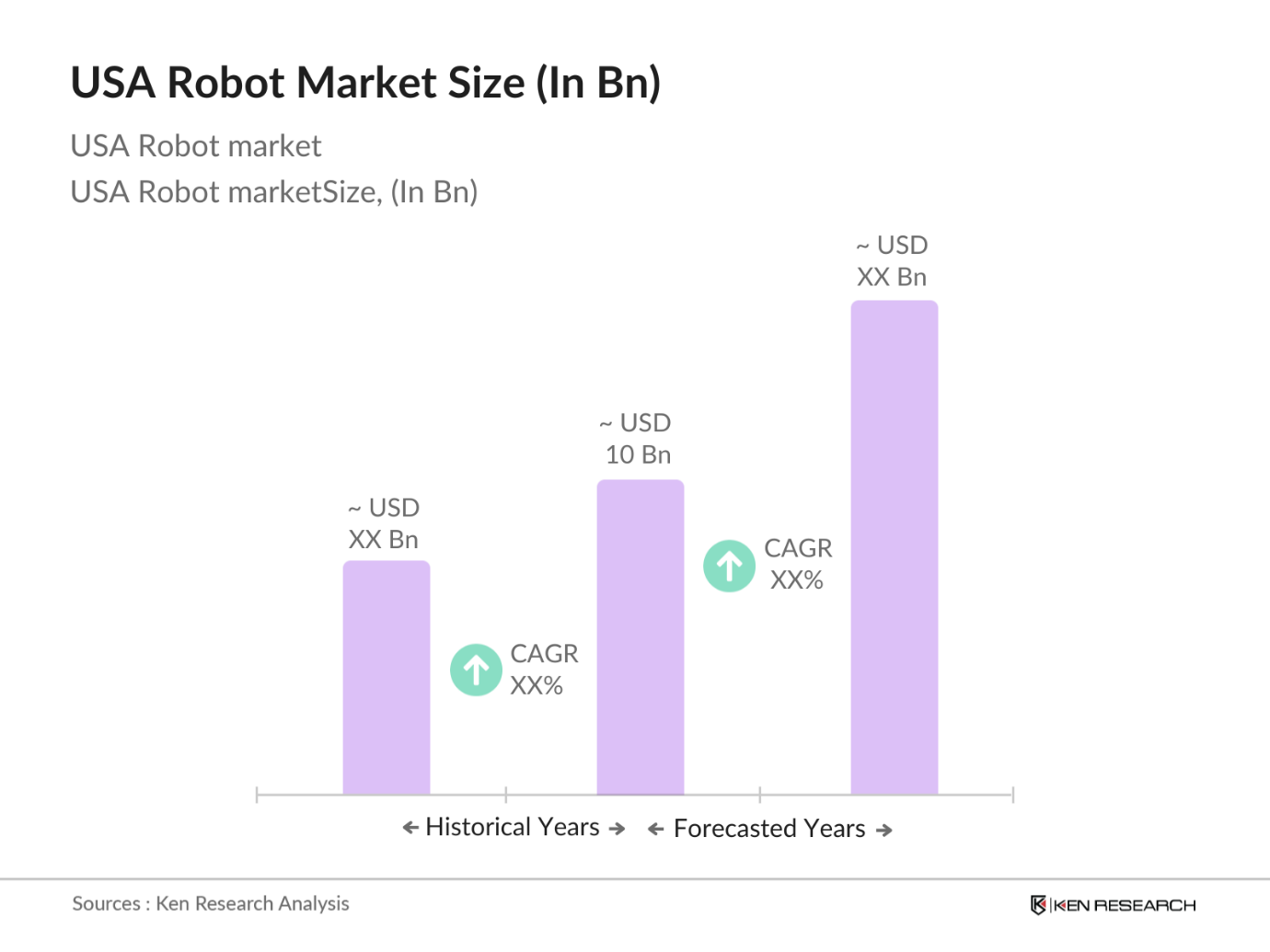
The USA Robot market is valued at USD 10 billion, driven by increasing demand for automation in manufacturing, healthcare, and logistics.
Key challenges in USA Robot market includes high initial costs for installation and maintenance, regulatory hurdles, and a shortage of skilled professionals capable of operating advanced robotics.
The major players in the USA Robot market includes ABB Ltd., KUKA AG, FANUC Corporation, Boston Dynamics, and iRobot Corporation, all of which lead due to strong R&D and innovation strategies.
Growth in USA Robot market is driven by the increasing adoption of automation across multiple industries, advancements in AI and machine learning, and supportive government policies.

What makes us stand out is that our consultants follows Robust, Refine and Result (RRR) methodology. i.e. Robust for clear definitions, approaches and sanity checking, Refine for differentiating respondents facts and opinions and Result for presenting data with story

We have set a benchmark in the industry by offering our clients with syndicated and customized market research reports featuring coverage of entire market as well as meticulous research and analyst insights.

While we don't replace traditional research, we flip the method upside down. Our dual approach of Top Bottom & Bottom Top ensures quality deliverable by not just verifying company fundamentals but also looking at the sector and macroeconomic factors.

With one step in the future, our research team constantly tries to show you the bigger picture. We help with some of the tough questions you may encounter along the way: How is the industry positioned? Best marketing channel? KPI's of competitors? By aligning every element, we help maximize success.

Our report gives you instant access to the answers and sources that other companies might choose to hide. We elaborate each steps of research methodology we have used and showcase you the sample size to earn your trust.

If you need any support, we are here! We pride ourselves on universe strength, data quality, and quick, friendly, and professional service.