
USA Silk Market Outlook to 2030
Region:United States
Author(s):Abhinav kumar
Product Code:KROD2550
Region:United States
Author(s):Abhinav kumar
Product Code:KROD2550
December 2024
96

By Silk Type: The USA silk market is segmented by silk type into Mulberry Silk, Eri Silk, Tussar Silk, and Spider Silk. Mulberry silk has a dominant share due to its widespread use in fashion and luxury textiles. Its fine texture and durability make it the most desirable silk type for high-end garments and accessories. Furthermore, its consistent quality and scalability of production have contributed to its dominance in the textile sector.

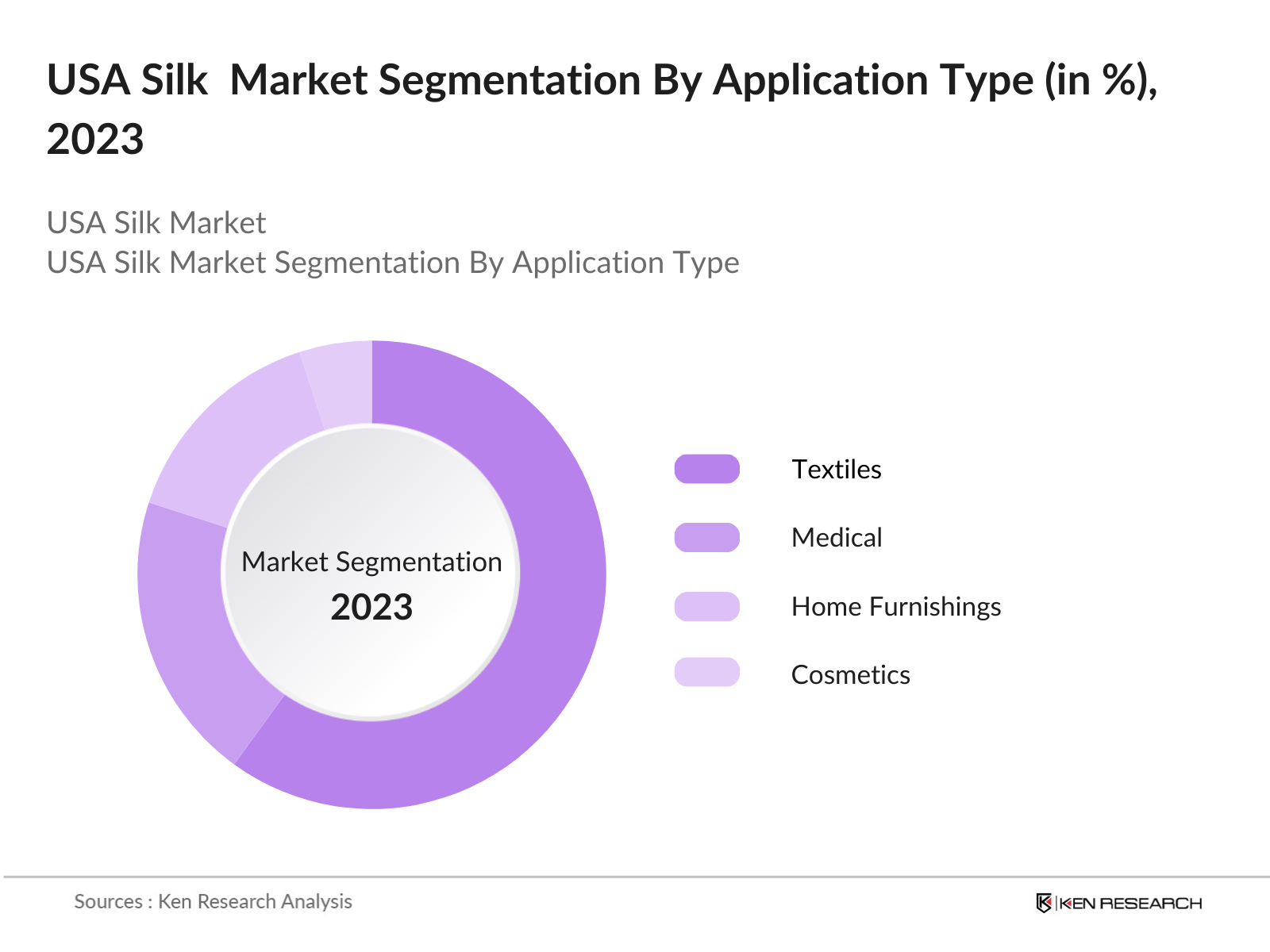
By Application: The market is segmented by application into Textiles, Medical, Home Furnishings, and Cosmetics. The textile segment holds the largest share, driven by the continued demand for luxury garments, bridal wear, and high-fashion accessories. The rising awareness of sustainability and demand for ethically sourced silk, particularly in the fashion industry, has also propelled the growth of this segment.
The USA silk market is characterized by several key players, ranging from traditional silk manufacturers to innovative firms utilizing bioengineered silk. Leading companies are focusing on sustainability, product diversification, and technological advancements to maintain their competitive edge. For instance, companies like Bolt Threads are pioneering the use of bioengineering to create synthetic spider silk, expanding the market's scope.
|
Company Name |
Establishment Year |
Headquarters |
Product Portfolio |
R&D Investment |
Sustainability Focus |
Global Presence |
Technological Innovation |
Partnerships/Collaborations |
Revenue |
|
Bolt Threads |
2010 |
Emeryville, CA |
_ |
_ |
_ |
_ |
_ |
_ |
_ |
|
AM Silk GmbH |
2008 |
Planegg, Germany |
_ |
_ |
_ |
_ |
_ |
_ |
_ |
|
Zhejiang Jiaxin Silk Co. |
1980 |
Jiaxing, China |
_ |
_ |
_ |
_ |
_ |
_ |
_ |
|
Kraig Biocraft Laboratories |
2006 |
Ann Arbor, MI |
_ |
_ |
_ |
_ |
_ |
_ |
_ |
|
Wensli Group Co. |
1975 |
Hangzhou, China |
_ |
_ |
_ |
_ |
_ |
_ |
_ |
Over the next five years, the USA silk market is expected to show significant growth, driven by the rising demand for luxury fabrics, the adoption of sustainable silk production techniques, and the development of bioengineered silk materials. The market is anticipated to benefit from increased research and innovation in silk applications across industries such as healthcare, where silk's biocompatibility and durability offer vast potential.
|
By Type |
Mulberry Silk Eri Silk Tussar Silk Spider Silk |
|
By Application |
Fashion Medical Home Furnishings Cosmetics |
|
By Sales Channel |
Retail Stores E-Commerce Specialty Stores |
|
By End-Use |
Fashion Industry Home Decor Healthcare Automotive |
|
By Region |
Northeast Midwest South West |
1.1. Definition and Scope
1.2. Market Taxonomy
1.3. Market Growth Rate
1.4. Market Segmentation Overview
2.1. Historical Market Size
2.2. Year-On-Year Growth Analysis
2.3. Key Market Developments and Milestones
3.1. Growth Drivers
3.1.1. Expansion in Sustainable Fashion (Key Trend: Sustainability)
3.1.2. Rising Consumer Demand for Premium Textiles (Consumer Preferences)
3.1.3. Government Initiatives Supporting Silk Industry (Government Policies)
3.1.4. Technological Advancements in Silk Production (Innovation and Automation)
3.2. Market Challenges
3.2.1. High Production Costs (Cost Efficiency)
3.2.2. Volatility in Raw Material Prices (Price Fluctuations)
3.2.3. Competition from Synthetic Fabrics (Market Competition)
3.2.4. Lack of Skilled Workforce (Labor Challenges)
3.3. Opportunities
3.3.1. Increasing Demand in Luxury Fashion (Premium Market Expansion)
3.3.2. Growth in Export Markets (International Trade)
3.3.3. Innovations in Silk Blending Technologies (Product Innovation)
3.3.4. Expansion of E-commerce Channels (Digital Commerce)
3.4. Trends
3.4.1. Integration of Ethical Silk Certifications (Sustainability Certifications)
3.4.2. Adoption of Eco-Friendly Dyeing Techniques (Green Manufacturing)
3.4.3. Growth in Customization Demand (Personalization Trends)
3.4.4. Partnership with Fashion Designers and Luxury Brands (Collaborations)
3.5. Government Regulations
3.5.1. USUSA Silk Export Regulations (Export Policies)
3.5.2. Silk Industry Subsidies (Government Support)
3.5.3. Silk Certification Standards (Regulatory Standards)
3.5.4. Tariffs and Import-Export Laws (Trade Policies)
3.6. SWOT Analysis
3.6.1. Strengths
3.6.2. Weaknesses
3.6.3. Opportunities
3.6.4. Threats
3.7. Stakeholder Ecosystem
3.7.1. Silk Farmers
3.7.2. Manufacturers
3.7.3. Retailers
3.7.4. Exporters
3.8. Porter’s Five Forces Analysis
3.8.1. Bargaining Power of Suppliers
3.8.2. Bargaining Power of Buyers
3.8.3. Threat of New Entrants
3.8.4. Threat of Substitutes
3.8.5. Industry Rivalry
3.9. Competitive Landscape
3.9.1. Competitor Analysis (Competitive Landscape Overview)
3.9.2. Market Share Analysis (Percentage Analysis by Competitor)
3.9.3. Key Market Strategies (Strategic Approaches of Major Players)
4.1. By Silk Type (In Value %)
4.1.1. Mulberry Silk
4.1.2. Eri Silk
4.1.3. Tussar Silk
4.1.4. Muga Silk
4.1.5. Spider Silk (Innovative Substitutes)
4.2. By Application (In Value %)
4.2.1. Apparel
4.2.2. Home Textiles
4.2.3. Medical (Biomedical Uses)
4.2.4. Industrial (Technical Textiles)
4.2..5. Personal Care
4.3. By Distribution Channel (In Value %)
4.3.1. Offline Retail
4.3.2. Online Retail
4.3.3. Wholesale
4.3.4. Direct Sales
4.3.4. Fashion Houses
4.4. By End-User (In Value %)
4.4.1. Fashion Industry
4.4.2. Healthcare
4.4.3. Textile Industry
4.4.5. Hospitality
4.4.6. Automotive
4.5. By Region (In Value %)
4.5.1. North America
4.5.2. Europe
4.5.3. Asia Pacific
4.5.4. Latin America
4.5.5. Middle East & Africa
5.1. Detailed Profiles of Major Competitors
5.1.1. Panda Silk Corp.
5.1.2. Mulberry Haven Textiles
5.1.3. LuxeSilk USA
5.1.4. SilkenCraft Industries
5.1.5. EriSustainable Corp.
5.1.6. Tussar Innovations Ltd.
5.1.7. PureSilk Fabrics Inc.
5.1.8. GreenWeave Silk Co.
5.1.9. Spider Silk Technologies
5.1.10. American Silk Farms
5.2. Cross Comparison Parameters
5.2.1. No. of Employees
5.2.2. Headquarters
5.2.3. Revenue
5.2.4. Export Volume
5.2.5.Product Portfolio
5.2.6. Sustainability Initiatives
5.2.7. Market Penetration
5.2.8. Innovation Score
5.3. Market Share Analysis
5.4. Strategic Initiatives
5.5. Mergers and Acquisitions
5.6. Investment Analysis
5.7. Government Grants and Subsidies
5.8. Private Equity Investments
5.9. Venture Capital Funding
6.1. Environmental Standards for Silk Production
6.2. Compliance Requirements for Silk Export
6.3. Certification Processes for Ethical Silk
7.1. Future Market Size Projections
7.2. Key Factors Driving Future Market Growth
8.1. By Silk Type (In Value %)
8.1.1. Mulberry Silk
8.1.2. Eri Silk
8.1.3. Tussar Silk
8.1.4. Muga Silk
8.1.5. Spider Silk
8.2. By Application (In Value %)
8.2.1. Apparel
8.2.2. Home Textiles
8.2.3. Medical
8.2.4. Industrial
8.2.5. Personal Care
8.3. By Distribution Channel (In Value %)
8.4. By End-User (In Value %)
8.5. By Region (In Value %)
9.1. TAM/SAM/SOM Analysis
9.2. Market Entry Strategy
9.3. White Space Opportunity Analysis
9.4. Strategic Partnerships & Alliances
The research process begins by identifying the major stakeholders in the USA silk market. This involves thorough desk research using secondary sources, proprietary databases, and industry reports to understand the key factors driving market growth.
The historical data from 2018-2023 is compiled to assess market dynamics such as penetration rates and revenue generation. This data is then used to forecast future market conditions, taking into account current industry trends and technological advancements
Market assumptions are validated through interviews with key players in the silk industry, including manufacturers, suppliers, and retailers. These consultations provide valuable insights into industry operations and confirm the accuracy of the data.
The final step involves combining primary and secondary research findings to produce a comprehensive market analysis. This is followed by validation of data through direct engagement with silk producers and experts, ensuring accuracy and reliability in the final report.
The USA silk market is valued at USD 3 billion, driven by increasing consumer demand for luxury textiles, sustainable materials, and bioengineered silk technologies.
Challenges include high production costs, ethical concerns regarding conventional silk harvesting, and competition from synthetic fibers. However, innovations in sustainable silk production are helping to mitigate these challenges.
Key players in the market include Bolt Threads, AM Silk GmbH, Kraig Biocraft Laboratories, Zhejiang Jiaxin Silk Co., and Wensli Group Co. Ltd., among others.
The market is driven by growing demand for luxury fashion, eco-friendly textiles, and advancements in bioengineered silk technologies. The rise in consumer awareness around sustainability also boosts demand.

What makes us stand out is that our consultants follows Robust, Refine and Result (RRR) methodology. i.e. Robust for clear definitions, approaches and sanity checking, Refine for differentiating respondents facts and opinions and Result for presenting data with story

We have set a benchmark in the industry by offering our clients with syndicated and customized market research reports featuring coverage of entire market as well as meticulous research and analyst insights.

While we don't replace traditional research, we flip the method upside down. Our dual approach of Top Bottom & Bottom Top ensures quality deliverable by not just verifying company fundamentals but also looking at the sector and macroeconomic factors.

With one step in the future, our research team constantly tries to show you the bigger picture. We help with some of the tough questions you may encounter along the way: How is the industry positioned? Best marketing channel? KPI's of competitors? By aligning every element, we help maximize success.

Our report gives you instant access to the answers and sources that other companies might choose to hide. We elaborate each steps of research methodology we have used and showcase you the sample size to earn your trust.

If you need any support, we are here! We pride ourselves on universe strength, data quality, and quick, friendly, and professional service.