
USA Space Technology Market Outlook to 2030
Region:United States
Author(s):Meenakshi Bisht
Product Code:KROD10744
Region:United States
Author(s):Meenakshi Bisht
Product Code:KROD10744
November 2024
82
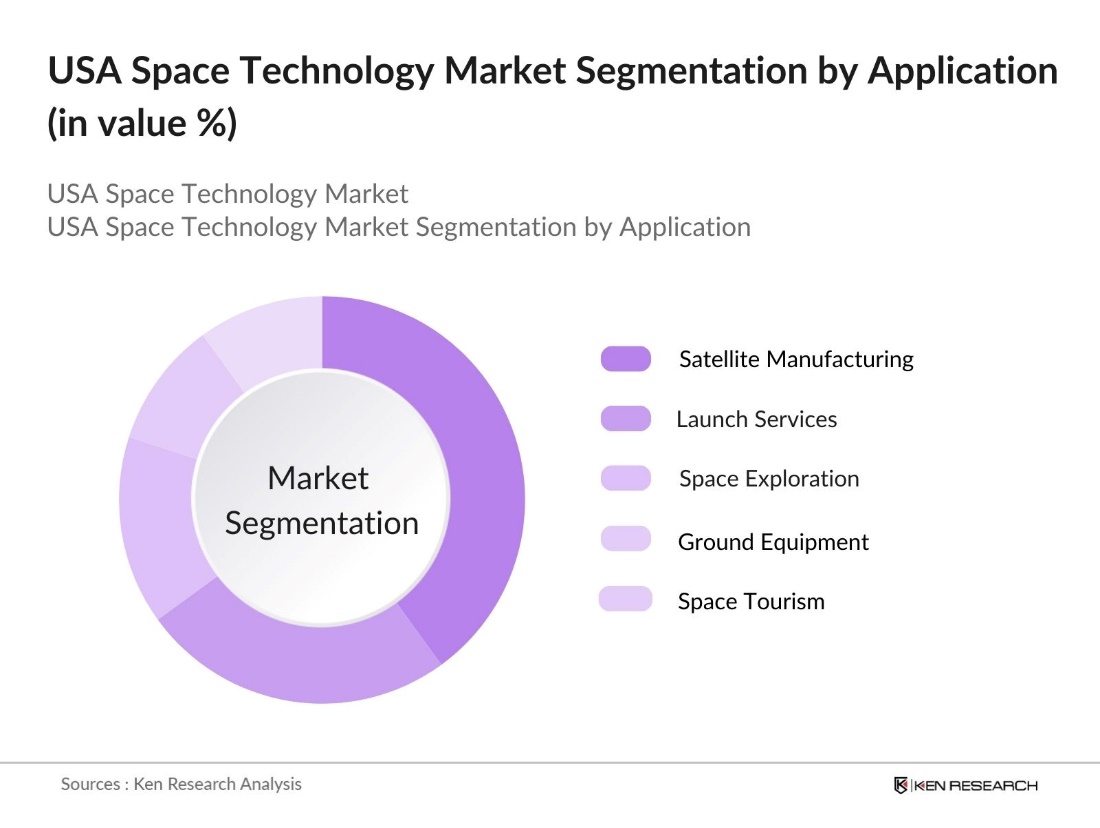
By Application: The market is segmented by application into satellite manufacturing, launch services, space exploration, ground equipment, and space tourism. Satellite manufacturing currently holds a dominant market share due to the high demand for communication and Earth observation satellites. Companies like Boeing and Lockheed Martin have established strong manufacturing capabilities, catering to both governmental and private sector needs. Increased global demand for internet access and real-time environmental monitoring sustains the dominance of this segment.
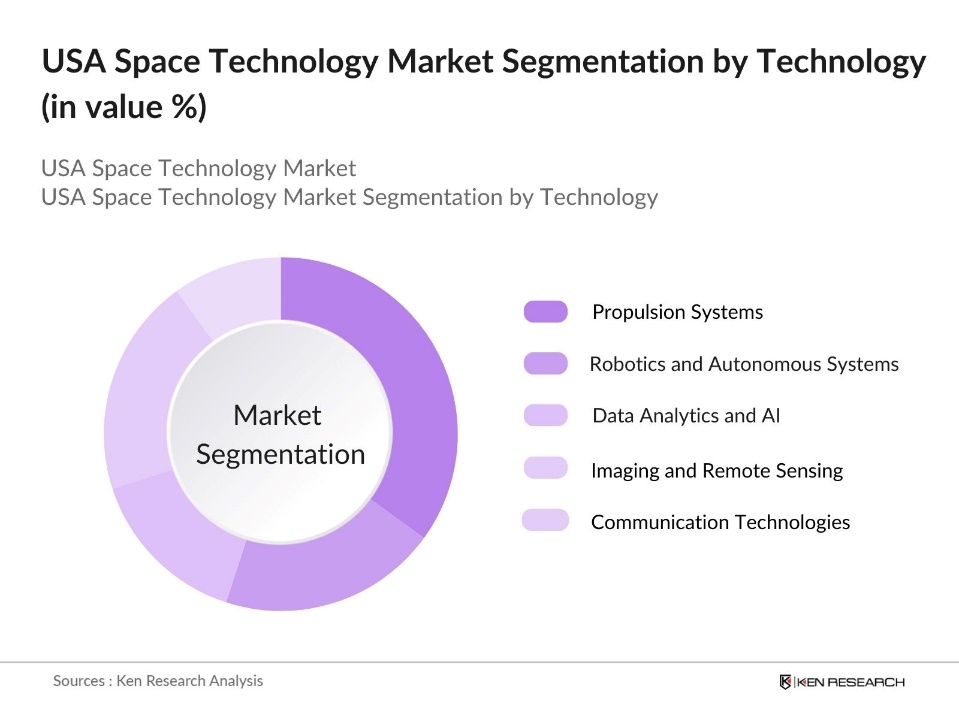
By Technology: The market is segmented by technology into propulsion systems, robotics and autonomous systems, data analytics and AI, imaging and remote sensing, and communication technologies. Propulsion systems dominate this segment, largely due to advancements in reusable rocket technologies by SpaceX and Blue Origin. The development of reliable and cost-efficient propulsion methods has made it feasible for both government agencies and private companies to embark on ambitious space exploration and satellite deployment missions.
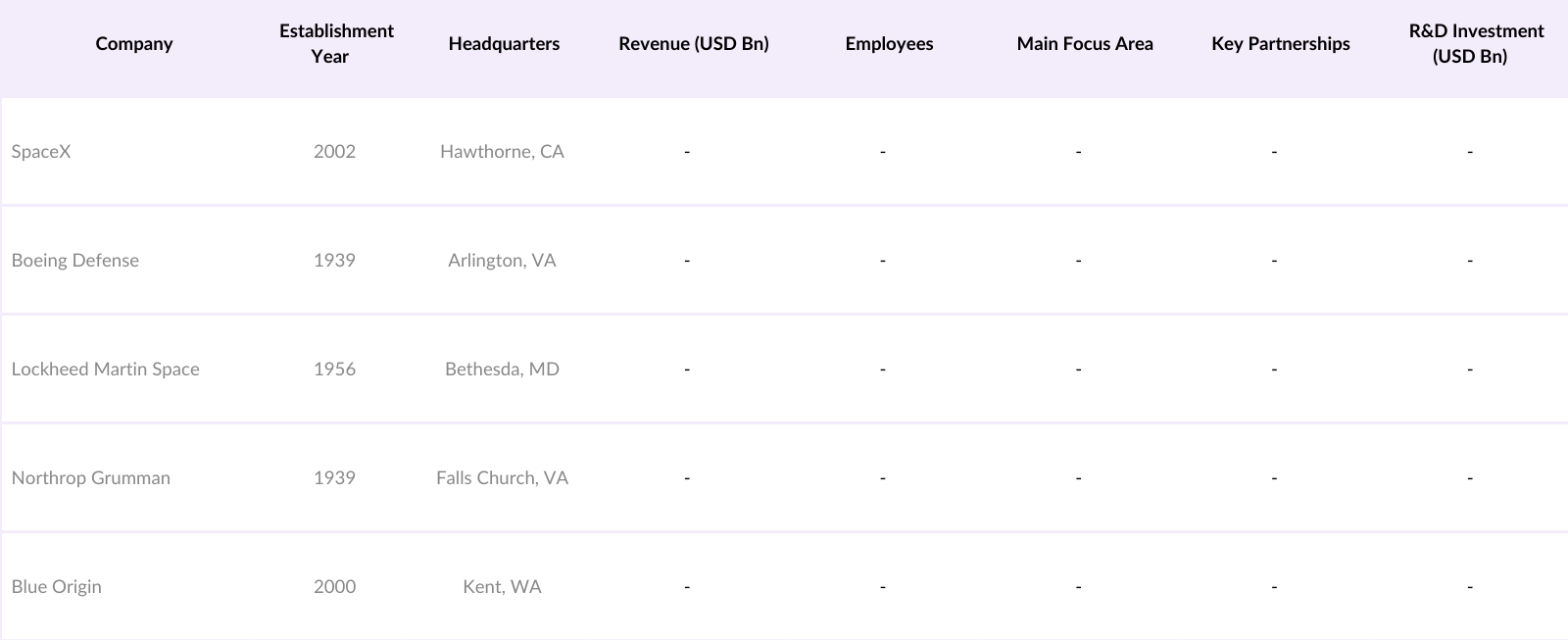
The USA Space Technology Market is dominated by major players, both from the private sector and government contractors, such as SpaceX, Boeing, and Northrop Grumman. These companies lead the market with advanced technology, secured government contracts, and international collaboration agreements. The concentration of industry leaders underscores the influence of these companies in shaping the market.
Over the coming years, the USA Space Technology Market is anticipated to continue on its growth trajectory, driven by ongoing government funding, private investments, and technological advancements. Developments in reusable launch systems, miniaturized satellites, and space tourism are expected to further boost market demand, with companies exploring opportunities for sustainable space operations and interplanetary exploration.
|
By Application |
Satellite Manufacturing and Operations |
|
By End-User |
Government |
|
By Technology |
Propulsion Systems |
|
By Spacecraft Type |
Satellites |
|
By Region |
North America |
1.1 Definition and Scope
1.2 Market Taxonomy
1.3 Market Growth Rate Analysis
1.4 Market Segmentation Overview
2.1 Historical Market Size
2.2 Year-On-Year Growth Analysis
2.3 Key Market Developments and Milestones
3.1 Growth Drivers
3.1.1 Government Investments (NASA, DoD Funding)
3.1.2 Private Sector Advancements (Commercial Launch Providers)
3.1.3 International Collaborations (ISS, Artemis Accords)
3.1.4 Technological Innovations (AI, IoT Integration in Space Systems)
3.2 Market Challenges
3.2.1 Regulatory and Policy Barriers (ITAR, Export Compliance)
3.2.2 High Capital Investment (Launch and R&D Costs)
3.2.3 Talent Shortage (STEM Workforce Gaps)
3.3 Opportunities
3.3.1 Expanding Satellite Applications (Earth Observation, IoT Networks)
3.3.2 Lunar and Mars Missions (Human and Robotic Exploration)
3.3.3 Space Tourism and Habitats (Commercial Space Stations)
3.4 Trends
3.4.1 Rise of Small Satellites (CubeSats, Nanosats)
3.4.2 Growth in Space-as-a-Service Models
3.4.3 Private Funding Surge (Venture Capital, SPACs)
3.5 Government Regulation
3.5.1 FCC Spectrum Regulations
3.5.2 FAA Launch Licensing
3.5.3 ITAR Compliance for Exports
3.5.4 NASAs Technology Transfer Programs
3.6 SWOT Analysis
3.7 Stake Ecosystem
3.8 Porters Five Forces
3.9 Competition Ecosystem
4.1 By Application (In Value %)
4.1.1 Satellite Manufacturing and Operations
4.1.2 Launch Services
4.1.3 Space Exploration
4.1.4 Ground Equipment
4.1.5 Space Tourism
4.2 By End-User (In Value %)
4.2.1 Government
4.2.2 Commercial Enterprises
4.2.3 Defense and Security Agencies
4.2.4 Research and Academic Institutions
4.2.5 Non-Governmental Organizations
4.3 By Technology (In Value %)
4.3.1 Propulsion Systems
4.3.2 Robotics and Autonomous Systems
4.3.3 Data Analytics and AI
4.3.4 Imaging and Remote Sensing
4.3.5 Communication Technologies
4.4 By Spacecraft Type (In Value %)
4.4.1 Satellites
4.4.2 Space Probes
4.4.3 Space Habitats
4.4.4 Rovers and Landers
4.5 By Region (In Value %)
4.5.1 North America
4.5.2 Europe
4.5.3 Asia-Pacific
4.5.4 Middle East and Africa
4.5.5 Latin America
5.1 Detailed Profiles of Major Companies
5.1.1 SpaceX
5.1.2 Boeing Defense, Space & Security
5.1.3 Lockheed Martin Space
5.1.4 Northrop Grumman Innovation Systems
5.1.5 Blue Origin
5.1.6 Virgin Galactic
5.1.7 Maxar Technologies
5.1.8 Raytheon Intelligence & Space
5.1.9 Sierra Nevada Corporation
5.1.10 Rocket Lab
5.1.11 Relativity Space
5.1.12 United Launch Alliance (ULA)
5.1.13 Planet Labs
5.1.14 Ball Aerospace
5.1.15 Firefly Aerospace
5.2 Cross Comparison Parameters (Revenue, Headquarters, No. of Employees, Patents, Spacecraft Type, Funding, R&D Spending, Technological Partnerships)
5.3 Market Share Analysis
5.4 Strategic Initiatives
5.5 Mergers And Acquisitions
5.6 Investment Analysis
5.7 Venture Capital Funding
5.8 Government Grants
5.9 Private Equity Investments
6.1 Export Control (ITAR, EAR Regulations)
6.2 Licensing Requirements (FAA, FCC)
6.3 Compliance Standards (ISO, AS9100)
6.4 Certification Processes (NASA Standards, MIL-SPEC)
7.1 Future Market Size Projections
7.2 Key Factors Driving Future Market Growth
8.1 By Application (In Value %)
8.2 By End-User (In Value %)
8.3 By Technology (In Value %)
8.4 By Spacecraft Type (In Value %)
8.5 By Region (In Value %)
9.1 TAM/SAM/SOM Analysis
9.2 Customer Cohort Analysis
9.3 Marketing Initiatives
9.4 White Space Opportunity Analysis
Disclaimer Contact UsThe initial phase includes identifying critical variables such as demand drivers, market restraints, and regulatory influences. A comprehensive ecosystem map is developed, outlining major stakeholders in the USA Space Technology Market and mapping out the dynamic relationships.
In this phase, historical data on industry growth, government investments, and technological advancements are analyzed. Proprietary databases and government reports are utilized to construct a detailed market analysis that covers market segments, application areas, and technology trends.
Market insights are validated through consultations with industry experts and stakeholders, including executives from leading space technology companies. Interviews and surveys are conducted to gain perspectives on market potential, technological trends, and investment strategies.
The final phase involves synthesizing all gathered data and expert insights into a cohesive market analysis report. This step ensures a holistic view of the market, backed by both primary and secondary research, to provide an accurate assessment of the USA Space Technology Market.
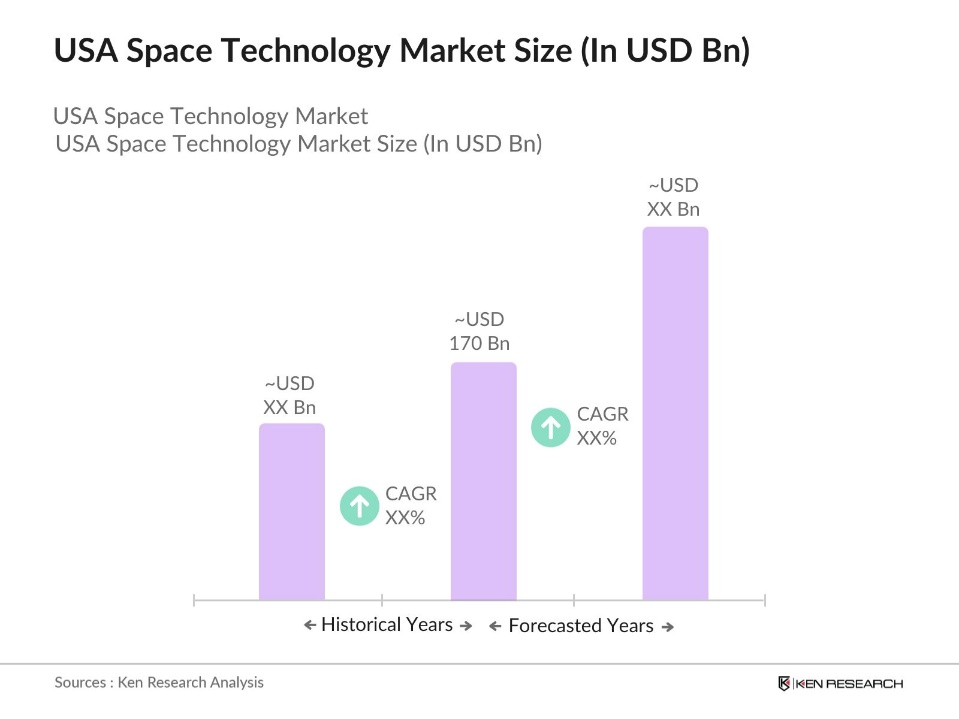
The USA Space Technology Market is valued at USD 170 billion, driven by government funding, commercial space exploration, and increasing satellite deployments.
Key challenges in USA Space Technology Market include high capital costs, regulatory barriers, and talent shortages in STEM fields, which impact the pace of innovation and project completion.
The USA Space Technology Market is led by SpaceX, Boeing, Lockheed Martin, Northrop Grumman, and Blue Origin, who dominate due to their technological expertise, government contracts, and private sector investments.
The USA Space Technology Market is driven by government investments, advancements in satellite technology, and the expansion of space tourism, alongside international collaborations in space exploration.

What makes us stand out is that our consultants follows Robust, Refine and Result (RRR) methodology. i.e. Robust for clear definitions, approaches and sanity checking, Refine for differentiating respondents facts and opinions and Result for presenting data with story

We have set a benchmark in the industry by offering our clients with syndicated and customized market research reports featuring coverage of entire market as well as meticulous research and analyst insights.

While we don't replace traditional research, we flip the method upside down. Our dual approach of Top Bottom & Bottom Top ensures quality deliverable by not just verifying company fundamentals but also looking at the sector and macroeconomic factors.

With one step in the future, our research team constantly tries to show you the bigger picture. We help with some of the tough questions you may encounter along the way: How is the industry positioned? Best marketing channel? KPI's of competitors? By aligning every element, we help maximize success.

Our report gives you instant access to the answers and sources that other companies might choose to hide. We elaborate each steps of research methodology we have used and showcase you the sample size to earn your trust.

If you need any support, we are here! We pride ourselves on universe strength, data quality, and quick, friendly, and professional service.