
USA Sun Care Market Outlook to 2030
Region:United States
Author(s):Shreya Garg
Product Code:KROD5449
Region:United States
Author(s):Shreya Garg
Product Code:KROD5449
December 2024
91
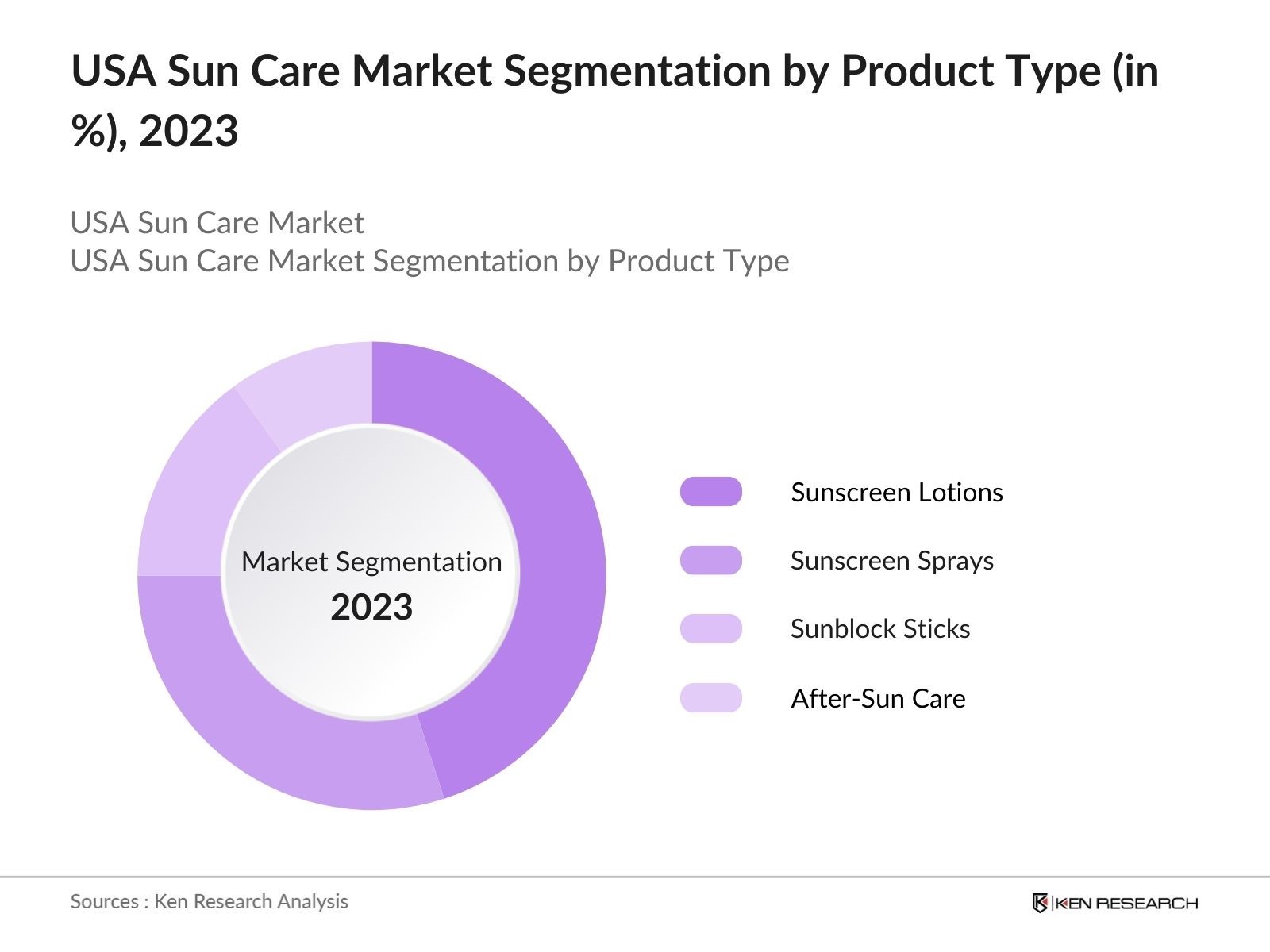
By Product Type: The market is segmented by product type into sunscreen lotions, sprays, sunblock sticks, and after-sun care products. Sunscreen lotions hold the dominant market share in 2023, attributed to their long-standing reputation and widespread consumer trust. Brands like Neutrogena and Coppertone have leveraged decades of research and consumer loyalty, particularly among individuals concerned with long-lasting skin protection. Lotion-based sunscreens are also favored for their easy application and versatility across different SPF ranges.
By SPF Range: The SPF range segmentation includes SPF 15-30, SPF 30-50, and SPF 50+. Products in the SPF 30-50 range dominate the market, accounting for a substantial share in 2023. This range balances protection with consumer preference for daily use, offering strong defense against harmful UV rays without feeling too heavy on the skin. Increased awareness of the risks associated with prolonged sun exposure has bolstered the demand for products in this category.
The USA sun care market is highly competitive, with both multinational corporations and smaller, niche brands competing for consumer attention. The major players, including global giants like Johnson & Johnson and LOral USA, dominate with their extensive distribution networks and established brand presence. These companies continue to innovate in product formulations, focusing on mineral-based and reef-safe products to cater to environmentally conscious consumers.
|
Company |
Establishment Year |
Headquarters |
Product Innovation |
Environmental Compliance |
Market Penetration |
R&D Spending |
Global Reach |
Revenue Growth |
|
Johnson & Johnson |
1886 |
New Brunswick, NJ |
||||||
|
LOral USA |
1909 |
New York, NY |
||||||
|
Neutrogena Corporation |
1930 |
Los Angeles, CA |
||||||
|
Procter & Gamble |
1837 |
Cincinnati, OH |
||||||
|
Beiersdorf AG |
1882 |
Hamburg, Germany |
Over the next five years, the USA sun care market is expected to witness steady growth, driven by increased awareness of skin protection and innovations in sun care formulations. A growing trend toward clean beauty and environmental consciousness will likely lead to a rise in demand for mineral-based and reef-safe sunscreens. Furthermore, expanding e-commerce platforms will make sun care products more accessible to a wider demographic, while the men's grooming segment shows potential for increased market penetration.
|
Product Type |
Sunscreen Lotions Sunscreen Sprays Sunblock Sticks After-Sun Care Products |
|
SPF Range |
SPF 15-30 SPF 30-50 SPF 50+ |
|
Distribution Channel |
Online Retail Supermarkets/Hypermarkets Specialty Stores |
|
Consumer Demographic |
Women Men Children |
|
Formulation Type |
Organic Sunscreens Chemical Sunscreens Mineral-Based Sunscreens |
1.1. Definition and Scope
1.2. Market Taxonomy
1.3. Market Growth Rate (CAGR, Y-o-Y growth)
1.4. Market Segmentation Overview
2.1. Historical Market Size
2.2. Year-On-Year Growth Analysis
2.3. Key Market Developments and Milestones
3.1. Growth Drivers
3.1.1. Rising Skin Cancer Awareness [Health Impact]
3.1.2. Increasing Consumer Focus on UV Protection [Consumer Behavior]
3.1.3. Expanding Range of Organic & Mineral-Based Products [Product Innovation]
3.1.4. Influence of E-commerce and Digital Marketing [Distribution Channels]
3.2. Market Challenges
3.2.1. Stringent Regulatory Compliance [FDA Regulations]
3.2.2. High Cost of Premium Sun Care Products [Pricing Structure]
3.2.3. Availability of Substitute Products [Competitive Landscape]
3.3. Opportunities
3.3.1. Increasing Demand for Anti-Aging Solutions [Product Development]
3.3.2. Expansion of Men's Grooming Segment [Consumer Demographics]
3.3.3. Rising Awareness about Reef-Safe Sunscreens [Environmental Impact]
3.4. Trends
3.4.1. Innovation in SPF Technologies [R&D and Patents]
3.4.2. Growth of Multi-functional Sun Care Products [Product Diversification]
3.4.3. Growing Preference for Vegan & Cruelty-Free Products [Consumer Ethics]
3.5. Government Regulation
3.5.1. FDA Sun Protection Guidelines [Product Labeling Standards]
3.5.2. Environmental Legislation on Sunscreen Ingredients [Reef-Safe Compliance]
3.5.3. Import and Export Duties [Global Trade Regulations]
3.6. SWOT Analysis
3.7. Porters Five Forces Analysis [Industry Structure]
3.8. Competition Ecosystem [Competitive Dynamics]
4.1. By Product Type (In Value %)
4.1.1. Sunscreen Lotions
4.1.2. Sunscreen Sprays
4.1.3. Sunblock Sticks
4.1.4. After-Sun Care Products
4.2. By SPF Range (In Value %)
4.2.1. SPF 15-30
4.2.2. SPF 30-50
4.2.3. SPF 50+
4.3. By Distribution Channel (In Value %)
4.3.1. Online Retail
4.3.2. Supermarkets/Hypermarkets
4.3.3. Specialty Stores
4.4. By Consumer Demographic (In Value %)
4.4.1. Women
4.4.2. Men
4.4.3. Children
4.5. By Formulation Type (In Value %)
4.5.1. Organic Sunscreens
4.5.2. Chemical Sunscreens
4.5.3. Mineral-Based Sunscreens
5.1. Detailed Profiles of Major Companies
5.1.1. Johnson & Johnson
5.1.2. LOral USA
5.1.3. Neutrogena Corporation
5.1.4. Shiseido Company, Ltd.
5.1.5. Procter & Gamble
5.1.6. Beiersdorf AG
5.1.7. Coty Inc.
5.1.8. The Este Lauder Companies Inc.
5.1.9. Banana Boat
5.1.10. Hawaiian Tropic
5.1.11. La Roche-Posay
5.1.12. Blue Lizard
5.1.13. Unilever (Sun Bum)
5.1.14. Edgewell Personal Care
5.1.15. Coppertone
5.2. Cross Comparison Parameters (Revenue, Market Share, Innovation Index, R&D Spending, Environmental Compliance, Product Diversification, Distribution Network, Employee Base)
5.3. Market Share Analysis [Competitive Landscape]
5.4. Strategic Initiatives [Mergers, Acquisitions, Product Launches]
5.5. Investment and Partnership Analysis [Venture Capital, Private Equity]
5.6. Government Support Programs [Subsidies, Grants]
5.7. Marketing and Branding Strategies [Influencer Marketing, Sustainability Initiatives]
6.1. FDA Regulations for Sun Care Products [Compliance Guidelines]
6.2. Environmental and Sustainability Regulations [Chemical Restrictions]
6.3. Certification Processes [USDA Organic, Cruelty-Free]
7.1. Future Market Size Projections [Forecasted Growth]
7.2. Key Factors Driving Future Growth [Rising Skin Health Awareness, Expansion in Emerging Markets]
8.1. TAM/SAM/SOM Analysis [Total Addressable Market, Serviceable Available Market]
8.2. White Space Opportunity Analysis [Untapped Markets]
8.3. Consumer Engagement Strategies [Brand Loyalty Programs]
8.1. By Product Type (In Value %)
8.2. By SPF Rating (In Value %)
8.3. By End-User (In Value %)
8.4. By Distribution Channel (In Value %)
8.5. By Region (In Value %)
The research begins with mapping the ecosystem of the USA sun care market, focusing on product types, consumer preferences, and regulatory frameworks. Extensive desk research is conducted using secondary sources to identify critical factors influencing market dynamics.
In this step, historical data on market penetration and revenue generation is compiled, assessing factors such as consumer behavior, product demand, and market competition. Key statistical data is derived from industry reports and validated through multiple sources.
The research hypotheses are validated through consultations with dermatologists, product developers, and sun care manufacturers. These interviews provide firsthand insights into the market's current state, product innovation, and future trends.
The final analysis integrates qualitative insights with quantitative data to create a comprehensive report. The report is reviewed by industry experts and adjusted for accuracy, ensuring a detailed and factual representation of the USA sun care market.
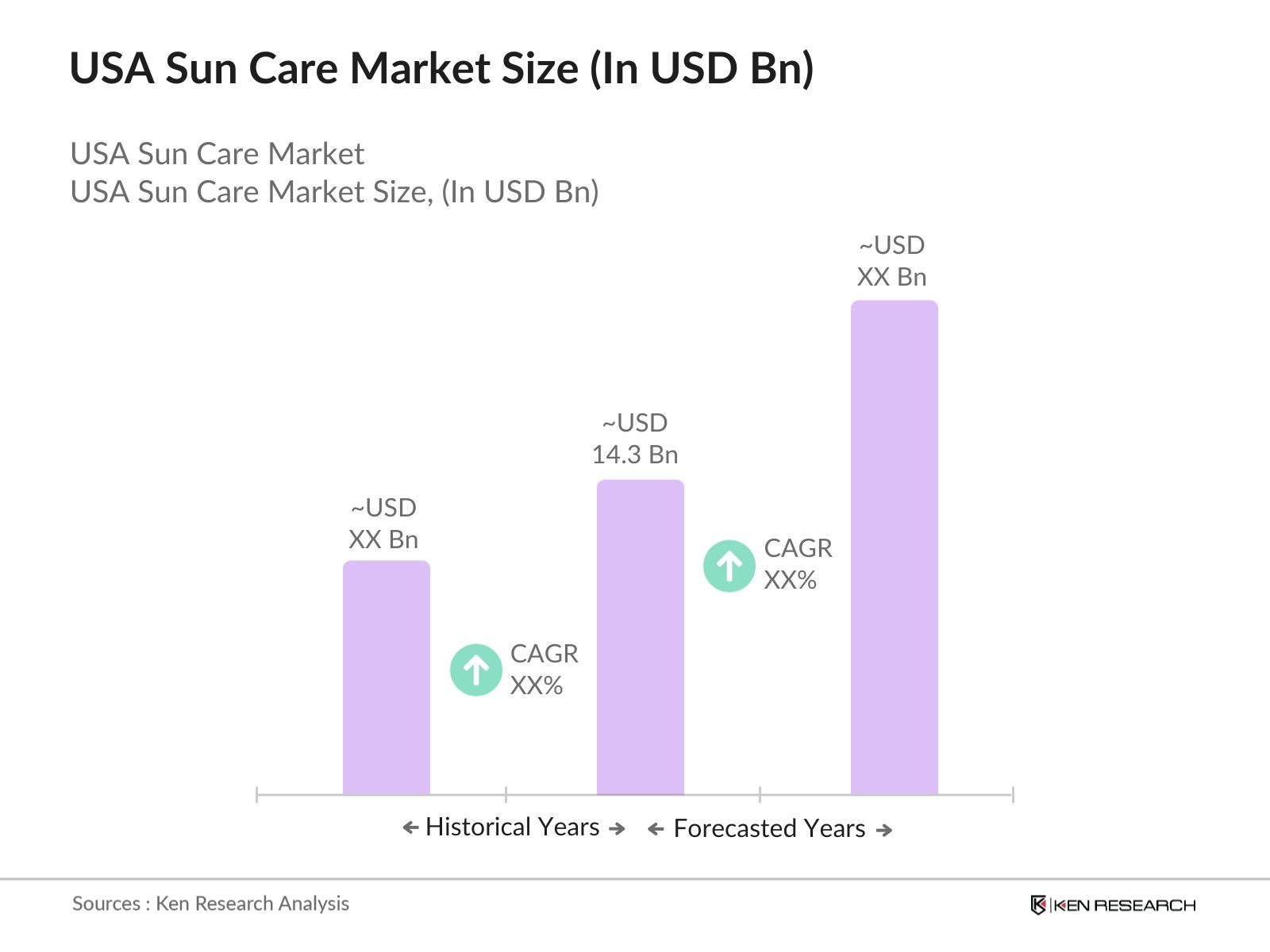
The USA sun care market is valued at USD 14.3 billion, driven by rising skin cancer awareness and increasing consumer demand for high-SPF and mineral-based sunscreens.
Challenges in the USA sun care market include stringent regulatory requirements from the FDA, the high cost of premium sun care products, and rising competition from emerging eco-friendly brands offering mineral-based sunscreens.
Key players in the USA sun care market include Johnson & Johnson, LOral USA, Neutrogena Corporation, Procter & Gamble, and Beiersdorf AG. These companies dominate due to their strong brand presence, wide distribution networks, and continual product innovation.
The growth in the USA sun care market is primarily driven by increasing awareness of skin protection, the expansion of organic and mineral-based products, and the influence of e-commerce platforms making these products more accessible.
Sunscreen lotions are the dominant product type in the USA sun care market, favored for their versatility, ease of use, and availability across a wide range of SPF levels in the USA sun care market.

What makes us stand out is that our consultants follows Robust, Refine and Result (RRR) methodology. i.e. Robust for clear definitions, approaches and sanity checking, Refine for differentiating respondents facts and opinions and Result for presenting data with story

We have set a benchmark in the industry by offering our clients with syndicated and customized market research reports featuring coverage of entire market as well as meticulous research and analyst insights.

While we don't replace traditional research, we flip the method upside down. Our dual approach of Top Bottom & Bottom Top ensures quality deliverable by not just verifying company fundamentals but also looking at the sector and macroeconomic factors.

With one step in the future, our research team constantly tries to show you the bigger picture. We help with some of the tough questions you may encounter along the way: How is the industry positioned? Best marketing channel? KPI's of competitors? By aligning every element, we help maximize success.

Our report gives you instant access to the answers and sources that other companies might choose to hide. We elaborate each steps of research methodology we have used and showcase you the sample size to earn your trust.

If you need any support, we are here! We pride ourselves on universe strength, data quality, and quick, friendly, and professional service.