
USA Third-Party Logistics (3PL) Market Outlook to 2030
Region:North America
Author(s):Yogita Sahu
Product Code:KROD4552
Region:North America
Author(s):Yogita Sahu
Product Code:KROD4552
October 2024
97
By Service Type: The market is segmented by service type into Dedicated Contract Carriage (DCC), Warehousing and Distribution, International Transportation Management (ITM), Domestic Transportation Management (DTM), and Value-Added Services (VAS). Warehousing and Distribution dominate the market, driven by the rise in e-commerce and the need for efficient inventory management solutions.

By Industry Vertical: The market is also segmented by industry vertical into Retail and E-commerce, Healthcare and Pharmaceuticals, Automotive, Consumer Goods, and Manufacturing. The Retail and E-commerce segment leads, driven by the rapid growth of online shopping and the necessity for seamless delivery solutions. As consumers increasingly prefer home delivery and faster shipping times, e-commerce retailers rely on 3PL providers for last-mile delivery, reverse logistics, and efficient warehouse management, ensuring timely fulfillment.

The market is dominated by a few large players and a competitive array of regional providers. Large firms such as C.H. Robinson, XPO Logistics, and UPS maintain strong positions through expansive infrastructure, innovative technological platforms, and end-to-end logistics solutions. These companies provide comprehensive services that encompass transportation, warehousing, and value-added services, allowing them to cater to the dynamic needs of large-scale businesses.
|
Company Name |
Establishment Year |
Headquarters |
Fleet Size |
No. of Warehouses |
Geographic Reach |
Digital Capabilities |
Revenue (USD Bn) |
Specialization |
|
C.H. Robinson |
1905 |
Eden Prairie, MN |
||||||
|
XPO Logistics |
1989 |
Greenwich, CT |
||||||
|
United Parcel Service (UPS) |
1907 |
Atlanta, GA |
||||||
|
FedEx Corporation |
1971 |
Memphis, TN |
||||||
|
J.B. Hunt Transport Services |
1961 |
Lowell, AR |
The USA 3PL industry is expected to witness considerable growth over the next five years, driven by the continuous expansion of e-commerce, increased adoption of digital technologies, and a greater focus on sustainable logistics solutions. As businesses across various industries seek to enhance supply chain efficiency, demand for 3PL providers offering tailored, integrated solutions is expected to rise.
|
By Service Type |
Dedicated Contract Carriage (DCC) |
|
Warehousing and Distribution |
|
|
International Transportation |
|
|
Domestic Transportation |
|
|
Value-Added Services |
|
|
By Industry Vertical |
Retail and E-commerce |
|
Healthcare and Pharmaceuticals |
|
|
Automotive |
|
|
Consumer Goods |
|
|
Manufacturing |
|
|
By Mode of Transport |
Road |
|
Rail |
|
|
Air |
|
|
Sea |
|
|
By Company Size |
Large Enterprises |
|
SMEs |
|
|
By Region |
North |
|
South |
|
|
East |
|
|
West |
1.1. Definition and Scope
1.2. Market Taxonomy
1.3. Market Growth Rate
1.4. Market Segmentation Overview
2.1. Historical Market Size
2.2. Year-on-Year Growth Analysis
2.3. Key Market Developments and Milestones
3.1. Growth Drivers
3.1.1. E-commerce Expansion (Parcel Volume, Customer Delivery Expectations)
3.1.2. Supply Chain Optimization (Cost Reduction, Resource Efficiency)
3.1.3. Technological Advancements (Automation, Data Analytics, IoT)
3.1.4. Strategic Outsourcing (Core Competency Focus, Flexibility)
3.2. Market Challenges
3.2.1. Capacity Constraints (Truckload Capacity, Labor Shortage)
3.2.2. Regulatory Compliance (Trade Tariffs, Data Security, FMCSA Regulations)
3.2.3. Competitive Market Fragmentation (Local vs. Global Providers)
3.3. Opportunities
3.3.1. Omni-Channel Distribution (B2C, B2B Integration)
3.3.2. Growth of Cold Chain Logistics (Pharmaceuticals, Perishables)
3.3.3. Expansion of Cross-Border Trade (NAFTA, Trade Agreements)
3.4. Trends
3.4.1. Adoption of Digital Freight Platforms (AI-Driven Platforms, Real-Time Tracking)
3.4.2. Sustainability and Green Logistics (Carbon Footprint Reduction, Electrification of Fleets)
3.4.3. Increased Collaboration in Logistics Ecosystem (3PL-4PL Integration, Strategic Partnerships)
3.5. Government Regulation
3.5.1. FMCSA Regulations (Hours of Service, ELD Mandates)
3.5.2. Trade and Tariff Regulations (USMCA, Import/Export Compliance)
3.5.3. Data Security and Privacy Laws (GDPR, CCPA Compliance)
3.6. SWOT Analysis
3.7. Stake Ecosystem (Carriers, Warehousing Providers, Tech Solutions Providers)
3.8. Porters Five Forces
3.9. Competition Ecosystem
4.1. By Service Type (In Value %)
4.1.1. Dedicated Contract Carriage (DCC)
4.1.2. Warehousing and Distribution
4.1.3. International Transportation Management (ITM)
4.1.4. Domestic Transportation Management (DTM)
4.1.5. Value-Added Services (VAS)
4.2. By Industry Vertical (In Value %)
4.2.1. Retail and E-commerce
4.2.2. Healthcare and Pharmaceuticals
4.2.3. Automotive
4.2.4. Consumer Goods
4.2.5. Manufacturing
4.3. By Mode of Transport (In Value %)
4.3.1. Road
4.3.2. Rail
4.3.3. Air
4.3.4. Sea
4.4. By Company Size (In Value %)
4.4.1. Large Enterprises
4.4.2. SMEs
4.5. By Region (In Value %)
4.5.1. North
4.5.2. South
4.5.3. East
4.5.4. West
5.1 Detailed Profiles of Major Companies
5.1.1. C.H. Robinson Worldwide, Inc.
5.1.2. XPO Logistics
5.1.3. United Parcel Service, Inc. (UPS)
5.1.4. FedEx Corporation
5.1.5. J.B. Hunt Transport Services, Inc.
5.1.6. Kuehne + Nagel Inc.
5.1.7. Ryder System, Inc.
5.1.8. DHL Supply Chain
5.1.9. Expeditors International of Washington, Inc.
5.1.10. Nippon Express
5.1.11. Schneider National
5.1.12. Ceva Logistics
5.1.13. Hub Group, Inc.
5.1.14. Landstar System
5.1.15. DB Schenker
5.2 Cross Comparison Parameters (Revenue, Headquarters, Fleet Size, Number of Warehouses, Geographic Coverage, Number of Employees, Inception Year, Strategic Focus)
5.3. Market Share Analysis
5.4. Strategic Initiatives
5.5. Mergers and Acquisitions
5.6. Investment Analysis
5.7. Venture Capital Funding
5.8. Government Grants
5.9. Private Equity Investments
6.1. Transportation Safety Regulations (USDOT, FMCSA)
6.2. Import/Export Compliance Regulations (Customs, C-TPAT)
6.3. Certification and Compliance Processes (ISO 9001, TAPA, CTPAT)
7.1. Future Market Size Projections
7.2. Key Factors Driving Future Market Growth
8.1. By Service Type (In Value %)
8.2. By Industry Vertical (In Value %)
8.3. By Mode of Transport (In Value %)
8.4. By Company Size (In Value %)
8.5. By Region (In Value %)
9.1. TAM/SAM/SOM Analysis
9.2. Customer Cohort Analysis
9.3. Marketing Initiatives
9.4. White Space Opportunity Analysis
In this phase, we developed a comprehensive map of the USA 3PL market ecosystem, incorporating insights from secondary research and proprietary databases. The key objective was to identify variables, including market drivers, challenges, and opportunities, that influence market dynamics.
We conducted a detailed analysis of historical data, focusing on supply chain metrics such as transportation volumes, warehousing capacity utilization, and service demand fluctuations across industry verticals. This data was crucial in formulating accurate market size and growth projections.
To ensure data accuracy, we consulted with logistics experts from 3PL companies via interviews. These discussions provided insights into operational strategies, service delivery performance, and evolving customer requirements, which supported the market estimates.
Lastly, we synthesized the data obtained from all sources to generate the final report, providing insights into current market trends, competitor strategies, and potential growth avenues in the USA 3PL market.
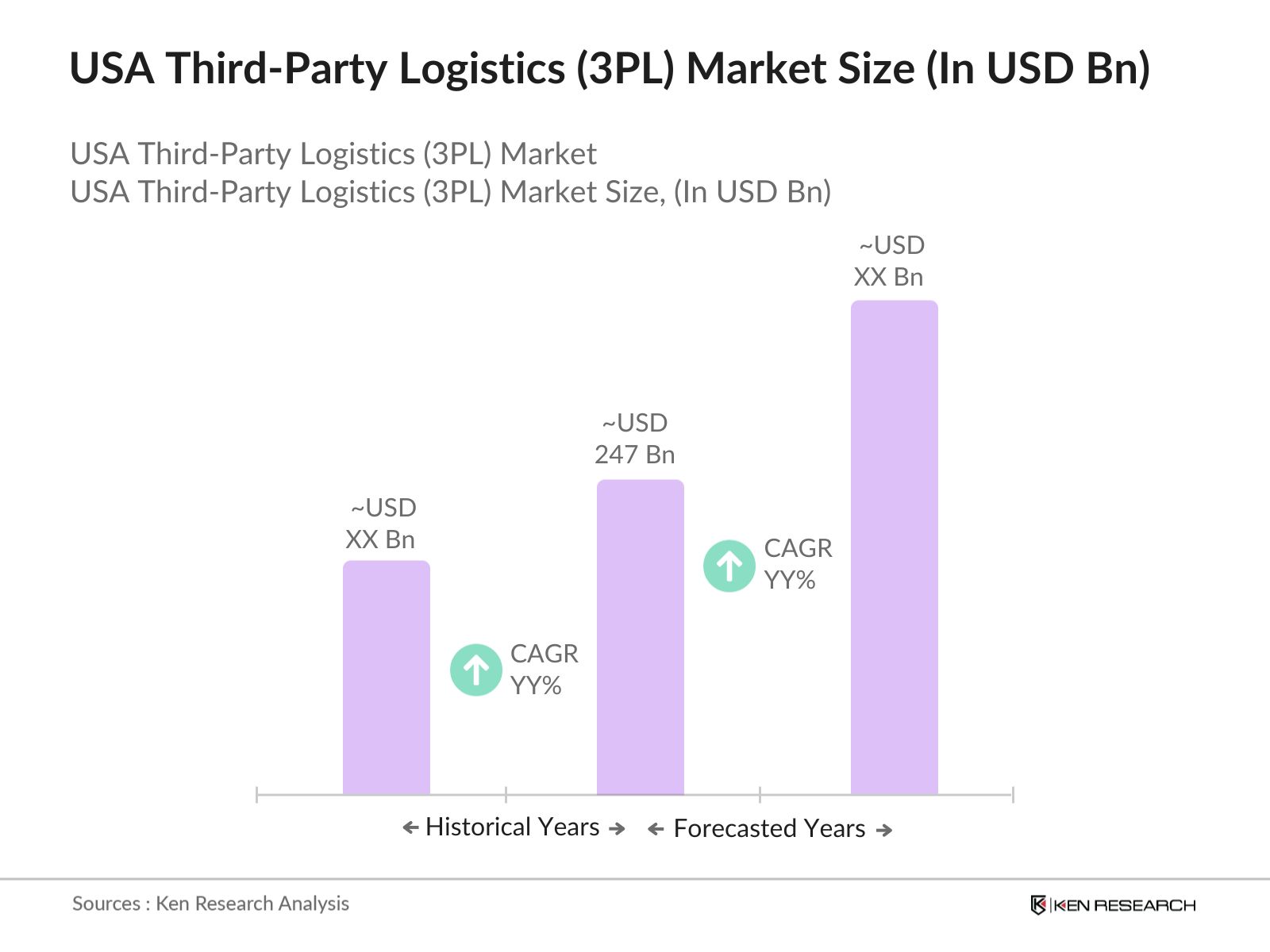
The USA 3PL market was valued at USD 247 billion, driven by the growing e-commerce industry and increased demand for logistics efficiency across various sectors.
Challenges in the USA 3PL market include capacity constraints in transportation, labor shortages, and the need for compliance with ever-changing regulatory frameworks, such as data security laws.
Key players in the USA 3PL market include C.H. Robinson, XPO Logistics, UPS, FedEx, and J.B. Hunt, all of which offer comprehensive logistics solutions across multiple industries.
Growth drivers in the USA 3PL market include the rise of e-commerce, technological innovations such as automation and AI-driven logistics, and the increasing trend of businesses outsourcing logistics to enhance operational efficiency.
Notable trends in the USA 3PL market include the adoption of digital freight platforms, increased demand for sustainability in logistics, and a greater focus on last-mile delivery optimization to meet customer expectations in e-commerce.

What makes us stand out is that our consultants follows Robust, Refine and Result (RRR) methodology. i.e. Robust for clear definitions, approaches and sanity checking, Refine for differentiating respondents facts and opinions and Result for presenting data with story

We have set a benchmark in the industry by offering our clients with syndicated and customized market research reports featuring coverage of entire market as well as meticulous research and analyst insights.

While we don't replace traditional research, we flip the method upside down. Our dual approach of Top Bottom & Bottom Top ensures quality deliverable by not just verifying company fundamentals but also looking at the sector and macroeconomic factors.

With one step in the future, our research team constantly tries to show you the bigger picture. We help with some of the tough questions you may encounter along the way: How is the industry positioned? Best marketing channel? KPI's of competitors? By aligning every element, we help maximize success.

Our report gives you instant access to the answers and sources that other companies might choose to hide. We elaborate each steps of research methodology we have used and showcase you the sample size to earn your trust.

If you need any support, we are here! We pride ourselves on universe strength, data quality, and quick, friendly, and professional service.