















USA Toaster Market Outlook to 2030
Region:North America
Author(s):Yogita Sahu
Product Code:KROD5919
November 2024
98
About the Report
USA Toaster Market Overview
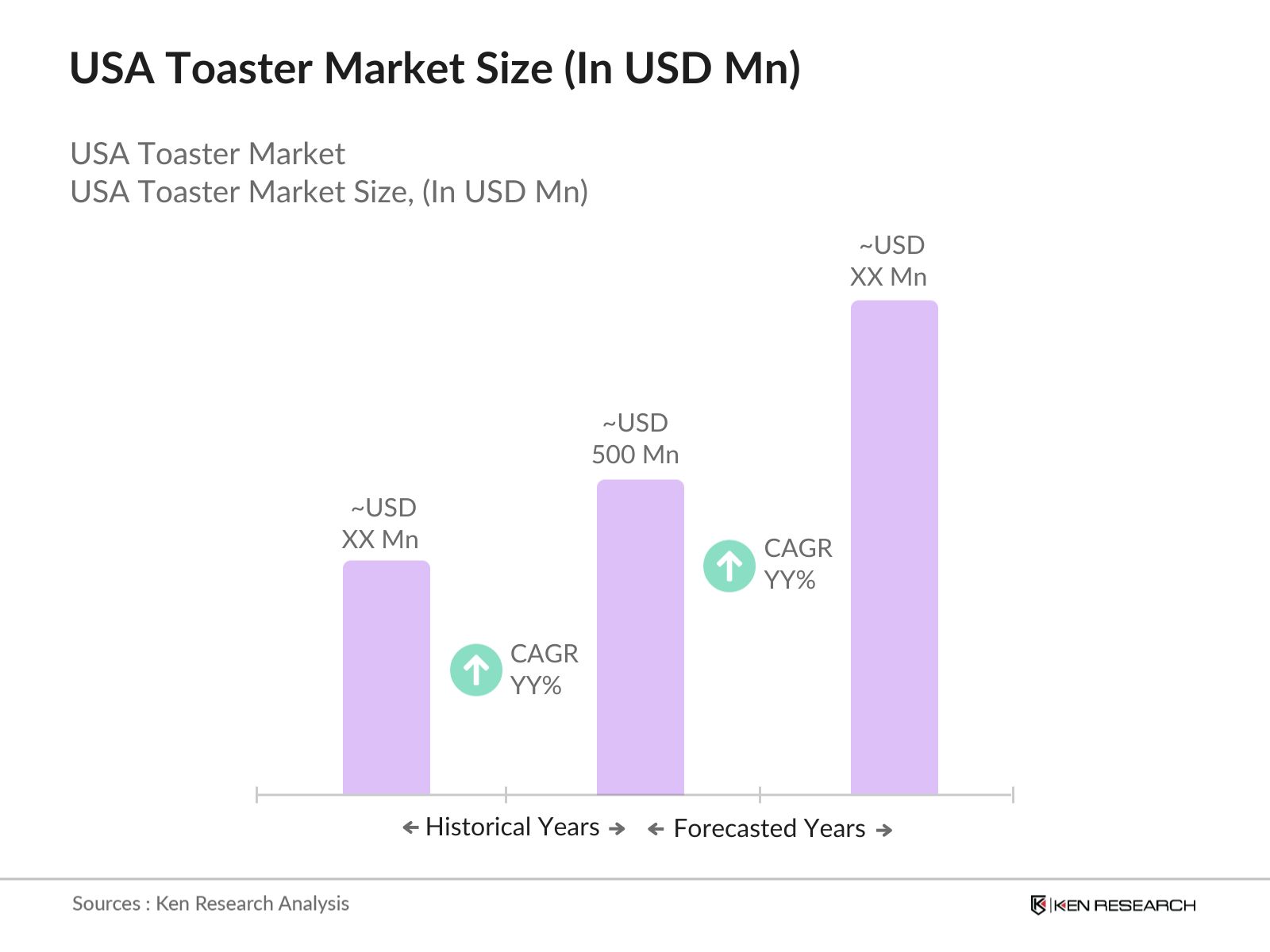
- The USA Toaster Market is valued at USD 500 million, based on a five-year historical analysis. This market is primarily driven by the increasing demand for convenient kitchen appliances, especially as consumers prioritize ease of use and energy efficiency in daily cooking tasks. The rise of smart toasters with advanced features such as app control, customizable settings, and voice-activated controls has gained popularity among tech-savvy households.
- Major cities like New York, Los Angeles, and Chicago dominate the market due to their large urban populations, higher purchasing power, and growing adoption of smart home technologies. These cities are hubs for consumer trends in lifestyle and convenience, making them key markets for premium and smart kitchen appliances.
- In 2024, the U.S. government continued to promote energy efficiency through the Energy Star program. Toaster manufacturers are encouraged to adopt energy-efficient designs, resulting in the certification of over 150 new toaster models in 2024. The initiative has incentivized consumers to purchase appliances that consume less power, driving sales of certified energy-efficient toasters by over 800,000 units.
USA Toaster Market Segmentation
By Product Type: The market is segmented by product type into two-slice toasters, four-slice toasters, smart toasters, and specialty toasters like conveyor or commercial models. Among these, two-slice toasters dominate the market due to their affordability, compact design, and suitability for small to medium households. Their widespread availability in major retail chains, both online and offline, makes them accessible to a broad audience.

By Distribution Channel: The market is segmented by distribution channel into supermarkets/hypermarkets, specialty stores, online channels, and direct-to-consumer sales. Online channels have captured a significant market share due to the convenience they offer and the growing consumer preference for e-commerce platforms. This trend is bolstered by attractive online deals and home delivery options, especially through platforms like Amazon and Walmart.

USA Toaster Market Competitive Landscape
The market is characterized by the presence of both well-established international brands and domestic players. This market sees intense competition in innovation, pricing, and product differentiation, particularly in the premium and smart toaster segments.
|
Company Name |
Established |
Headquarters |
Product Range |
Technological Innovation |
Energy Efficiency |
Brand Recognition |
Customer Support |
Market Presence |
Pricing Strategy |
|
Hamilton Beach |
1910 |
Glen Allen, VA |
|||||||
|
Breville Group |
1932 |
Sydney, Australia |
|||||||
|
De'Longhi |
1902 |
Treviso, Italy |
|||||||
|
Cuisinart |
1971 |
Stamford, CT |
|||||||
|
KitchenAid |
1919 |
Benton Harbor, MI |
USA Toaster Market Analysis
Market Growth Drivers
- Expanding Housing Market: In 2024, the housing market in the USA has seen the construction of around 1.6 million new homes, creating a demand for kitchen appliances like toasters. The increasing number of residential units, particularly in suburban areas, has contributed to a higher demand for home appliances. New homeowners often invest in modern and energy-efficient kitchen appliances, driving toaster sales by nearly 2 million units annually in the domestic market.
- Retail Expansion: Major retailers are expanding their footprint in both physical stores and online channels, with leading chains reporting a growth in appliance sales by 10 million units across various categories, including toasters. The availability of toasters across multiple price ranges, along with promotional campaigns, is a major driver of sales, especially during holiday seasons. Amazon alone sold over 600,000 toasters in the first half of 2024.
- Rise in Multi-functional Appliances: The demand for multifunctional toasters, which integrate grilling, baking, and warming functions, is rapidly increasing, with over 750,000 units sold in 2023-2024. Consumers are seeking more versatile kitchen tools, and toasters that offer multiple features are gaining traction, pushing growth in this segment by more than 1 million units annually.
Market Challenges
- Consumer Shifts to Smart Appliances: In 2024, more consumers are opting for smart kitchen appliances, which has shifted the focus away from traditional toasters. Around 2 million smart kitchen devices were sold in 2024, competing directly with basic toaster models. This has slowed growth in the traditional toaster market, particularly among younger, tech-savvy consumers who prefer integrated, connected home ecosystems.
- Increased Competition from Imported Brands: Imports from China, South Korea, and Germany in the small kitchen appliance segment grew by 1.2 million units in 2024, introducing more competitive pricing. Domestic manufacturers have struggled to maintain market share due to the affordability of imported toasters, leading to a loss of nearly 300,000 units in sales for domestic brands.
USA Toaster Market Future Outlook
Over the next five years, the USA Toaster industry is expected to grow steadily due to increasing demand for advanced smart kitchen appliances. Consumer preferences for energy-efficient and space-saving appliances are anticipated to drive innovation in toaster design and technology.
Future Market Opportunities
- Customization and Personalization Features: In the next five years, the toaster market is likely to see an increased focus on personalized appliances, with models that allow users to adjust settings for their preferred level of crispness, bread type, and more. This trend is expected to drive demand for customizable toasters, with projected sales reaching 2.5 million units annually by 2029.
- Shift Toward High-End Toasters: The demand for premium toasters with advanced features, such as self-cleaning mechanisms, will grow in the USA, with high-end models expected to account for over 25% of the market by 2029. Consumers will continue to seek out toasters that offer both functionality and aesthetics, leading to an increase in sales of luxury toaster models across the country.
Scope of the Report
|
Product Type |
Two-Slice Toasters Four-Slice Toasters Smart Toasters Specialty Toasters (Conveyor) |
|
Distribution Channel |
Supermarkets/Hypermarkets Specialty Stores Online Channels Direct-to-Consumer Sales |
|
Price Range |
Economy Mid-range Premium |
|
Technology |
Traditional Heating Elements Advanced Heating Elements IoT-Enabled Toasters Smart-Toasters with App-Control |
|
Region |
North East West South |
Products
Key Target Audience Organizations and Entities Who Can Benefit by Subscribing This Report:
Investments and Venture Capitalist Firms
Appliance Manufacturers
Banks and Financial Institution
Government and Regulatory Bodies (U.S. Department of Energy, Environmental Protection Agency)
Technology Partners (IoT and Smart Appliance Developers)
Private Equity Firms
Distribution and Logistics Companies
Companies
Players Mentioned in the Report:
Hamilton Beach Brands Holding Company
Breville Group Limited
De'Longhi Group
Cuisinart
KitchenAid
BLACK+DECKER (Stanley Black & Decker)
Dualit Limited
Sunbeam Products, Inc. (Newell Brands)
Oster (Sunbeam)
SMEG
Bella Housewares
KRUPS
Panasonic Corporation
Wolf Gourmet
Waring Commercial
Table of Contents
1. USA Toaster Market Overview
1.1. Definition and Scope
1.2. Market Taxonomy
1.3. Market Growth Rate (Units Sold, Sales Revenue)
1.4. Market Segmentation Overview
2. USA Toaster Market Size (In USD Mn)
2.1. Historical Market Size (Sales Volume, Revenue, Unit Growth)
2.2. Year-On-Year Growth Analysis (In Value and Volume)
2.3. Key Market Developments and Milestones
3. USA Toaster Market Analysis
3.1. Growth Drivers (Consumer Preferences, Smart Kitchen Appliances Adoption, Energy Efficiency)
Increasing Preference for Energy-Efficient Kitchen Appliances
Rise of Smart Toasters with IOT Integration
Growing Popularity of Compact Kitchen Appliances
Consumer Demand for Multi-Functionality
3.2. Market Challenges (Technological Barriers, Consumer Preferences, Cost)
High Cost of Smart Toasters
Low Consumer Awareness for Advanced Features
Challenges in New Product Differentiation
Price Sensitivity of Low-End Market Segments
3.3. Opportunities (Technological Advancements, Strategic Partnerships, Online Retail Expansion)
Emergence of Multi-Utility Kitchen Gadgets
Strategic Alliances and Brand Collaborations for Product Innovation
Growth in E-commerce and Direct-to-Consumer Channels
Expanding Into Smaller US Cities with Specialized Products
3.4. Trends (IoT-enabled Toasters, Health-Conscious Consumers, Customization)
Growing Popularity of Smart Toasters with Voice Integration
Introduction of Health-Conscious Features Like Gluten-Free Settings
Customizable Designs to Cater to Aesthetic Preferences
Integration of Advanced Heating Technologies
3.5. Government Regulations (Energy Efficiency Standards, Import/Export Policies)
US Energy Efficiency Regulations for Home Appliances
Tariffs and Trade Regulations Impacting Import Prices
Compliance with Electrical Safety Standards
Environmental Impact Standards for Manufacturing
3.6. SWOT Analysis
Strengths: Established Brands, Technological Innovation
Weaknesses: Price Competitiveness, Consumer Education
Opportunities: Market Expansion, Product Innovation
Threats: Economic Volatility, Competition from International Brands
3.7. Stakeholder Ecosystem (Manufacturers, Distributors, Retailers)
3.8. Porters Five Forces (Competitive Rivalry, Bargaining Power of Buyers, Bargaining Power of Suppliers, Threat of New Entrants, Threat of Substitutes)
3.9. Competition Ecosystem
4. USA Toaster Market Segmentation
4.1. By Product Type (In Value and Volume %)
Two-Slice Toasters
Four-Slice Toasters
Smart Toasters
Specialty Toasters (e.g., Conveyor, Commercial)
4.2. By Distribution Channel (In Value %)
Supermarkets/Hypermarkets
Specialty Stores
Online Channels
Direct-to-Consumer Sales
4.3. By Price Range (In Value %)
Economy
Mid-range
Premium
4.4. By Technology (In Value %)
Traditional Heating Elements
Advanced Heating Elements (Quartz, Carbon Fiber)
IoT-Enabled Toasters
Smart-Toasters with App-Control
4.5. By Region (In Value %)
North
East
South
West
5. USA Toaster Market Competitive Analysis
5.1 Detailed Profiles of Major Competitors
5.1.1. Hamilton Beach Brands Holding Company
5.1.2. Breville Group Limited
5.1.3. DeLonghi Group
5.1.4. Cuisinart
5.1.5. KitchenAid
5.1.6. BLACK+DECKER (Stanley Black & Decker)
5.1.7. Dualit Limited
5.1.8. Sunbeam Products, Inc. (Newell Brands)
5.1.9. Oster (Sunbeam)
5.1.10. SMEG
5.1.11. Bella Housewares
5.1.12. KRUPS
5.1.13. Panasonic Corporation
5.1.14. Wolf Gourmet
5.1.15. Waring Commercial
5.2 Cross Comparison Parameters (Product Range, Smart Features, Heating Efficiency, Market Share, Brand Recognition, Innovation in Design, Sustainability Efforts, Customer Support)
5.3. Market Share Analysis (By Revenue, By Volume)
5.4. Strategic Initiatives (R&D Investments, Product Launches, Distribution Partnerships)
5.5. Mergers And Acquisitions
5.6. Investment Analysis
5.7 Venture Capital Funding
5.8. Government Grants
5.9. Private Equity Investments
6. USA Toaster Market Regulatory Framework
6.1. Electrical Safety Compliance Standards
6.2. Energy Consumption Standards
6.3. Import Tariffs on Electrical Appliances
6.4. Environmental Compliance in Manufacturing
7. USA Toaster Market Future Market Size (In USD Mn)
7.1. Future Market Size Projections (In Value and Volume)
7.2. Key Factors Driving Future Market Growth (Technological Advances, Consumer Preferences, Regulatory Developments)
8. USA Toaster Market Future Market Segmentation
8.1. By Product Type (In Value and Volume %)
8.2. By Distribution Channel (In Value %)
8.3. By Technology (In Value %)
8.4. By Price Range (In Value %)
8.5. By Region (In Value %)
9. USA Toaster Market Analysts Recommendations
9.1. TAM/SAM/SOM Analysis
9.2. Customer Cohort Analysis
9.3. White Space Opportunity Analysis
9.4. Marketing Initiatives
Research Methodology
Step 1: Identification of Key Variables
The first phase involves constructing a market ecosystem map that includes all major stakeholders in the USA Toaster Market. This step is underpinned by thorough desk research, utilizing a combination of proprietary databases and secondary data sources to gather comprehensive information about market participants and trends.
Step 2: Market Analysis and Construction
In this phase, we compile and analyze historical data regarding the USA Toaster Market. This includes assessing product penetration, distribution channel growth, and revenue generation from both online and offline sales. Additionally, we conduct evaluations of sales performance across different product categories and regions.
Step 3: Hypothesis Validation and Expert Consultation
We develop market hypotheses, which are then validated through direct interviews with industry experts, including executives from major toaster manufacturers and retailers. These consultations provide insights into product innovation, consumer trends, and competitive dynamics.
Step 4: Research Synthesis and Final Output
The final step involves synthesizing the collected data to provide a comprehensive analysis. This includes validating data from primary sources through bottom-up market sizing, resulting in an accurate and reliable market report.
Frequently Asked Questions
01. How big is the USA Toaster Market?
The USA Toaster Market is valued at USD 500 million, driven by increasing demand for smart kitchen appliances and the growing trend of online shopping.
02. What are the challenges in the USA Toaster Market?
Challenges in the USA Toaster Market include intense competition, fluctuating raw material prices, and the high cost of incorporating advanced technologies like IoT into toasters.
03. Who are the major players in the USA Toaster Market?
Key players in the USA Toaster Market include Hamilton Beach, Breville, De'Longhi, Cuisinart, and KitchenAid. These companies dominate the market due to strong brand loyalty, extensive product portfolios, and established distribution networks.
04. What are the growth drivers of the USA Toaster Market?
The USA Toaster Market is driven by growing consumer interest in smart home appliances, rising disposable incomes, and technological advancements in toaster designs.
05. What trends are shaping the future of the USA Toaster Market?
Key trends include the integration of IoT in toasters, consumer preference for energy-efficient appliances, and increasing sales through online channels.
Why Buy From Us?

What makes us stand out is that our consultants follows Robust, Refine and Result (RRR) methodology. i.e. Robust for clear definitions, approaches and sanity checking, Refine for differentiating respondents facts and opinions and Result for presenting data with story

We have set a benchmark in the industry by offering our clients with syndicated and customized market research reports featuring coverage of entire market as well as meticulous research and analyst insights.

While we don't replace traditional research, we flip the method upside down. Our dual approach of Top Bottom & Bottom Top ensures quality deliverable by not just verifying company fundamentals but also looking at the sector and macroeconomic factors.

With one step in the future, our research team constantly tries to show you the bigger picture. We help with some of the tough questions you may encounter along the way: How is the industry positioned? Best marketing channel? KPI's of competitors? By aligning every element, we help maximize success.

Our report gives you instant access to the answers and sources that other companies might choose to hide. We elaborate each steps of research methodology we have used and showcase you the sample size to earn your trust.

If you need any support, we are here! We pride ourselves on universe strength, data quality, and quick, friendly, and professional service.