















USA Unmanned Aerial Vehicle (UAV) Market Outlook to 2030
Region:North America
Author(s):Vijay Kumar
Product Code:KROD8622
November 2024
89
About the Report
USA Unmanned Aerial Vehicle (UAV) Market Overview
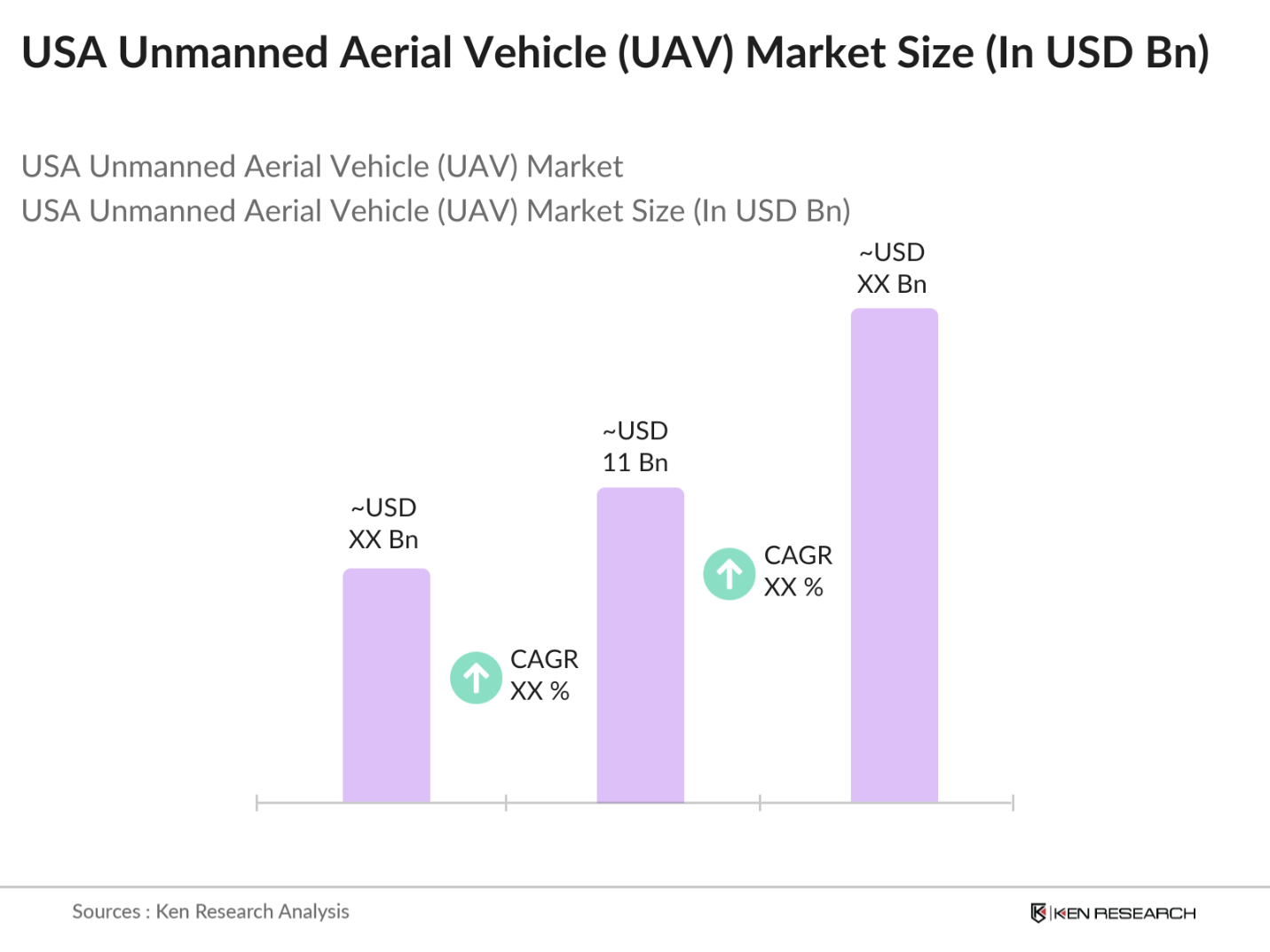
- The USA Unmanned Aerial Vehicle (UAV) market is valued at USD 11 billion, based on a five-year historical analysis. This market is primarily driven by substantial defense investments and innovations in commercial UAV applications. Key growth factors include government support for military-grade UAVs for surveillance and reconnaissance, along with rising demand in sectors such as logistics, agriculture, and infrastructure monitoring. Increasing automation capabilities and advancements in UAV technology, including AI integration, have positioned UAVs as indispensable tools across these sectors, enhancing operational efficiency and strategic capabilities.
- Major metropolitan hubs, including Los Angeles, Seattle, and Washington D.C., dominate the UAV market. These regions are home to leading aerospace companies, including Northrop Grumman and Boeing, contributing to significant regional market activity. Additionally, the high presence of defense contractors and technology hubs around Silicon Valley has intensified R&D activities and commercial UAV production, further solidifying these areas as leading centers for UAV technology advancement and adoption.
- The FAA enforces strict UAV operational guidelines to ensure airspace safety, particularly around manned aircraft. In 2024, FAA data showed a 10% increase in commercial UAV registrations following policy updates that streamlined certification processes. FAA guidelines now include requirements for detect-and-avoid systems, supporting safer UAV operations in civilian zones.
USA Unmanned Aerial Vehicle (UAV) Market Segmentation
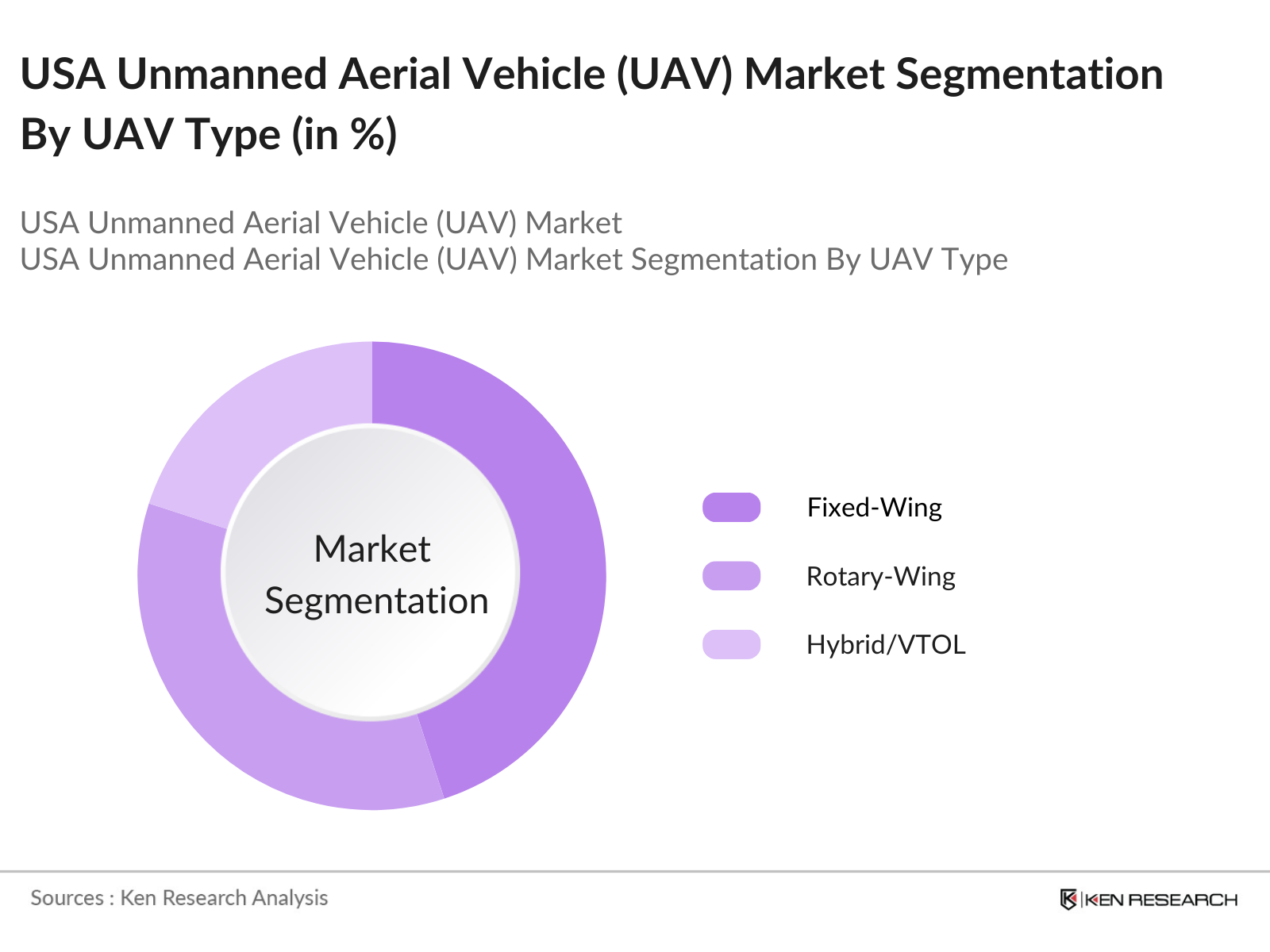
By UAV Type: The market is segmented by UAV type into Fixed-Wing, Rotary-Wing, and Hybrid/VTOL (Vertical Take-Off and Landing). Recently, Fixed-Wing UAVs hold a dominant market share in the UAV type segment. Their dominance is due to their high endurance and range, making them ideal for military reconnaissance and long-distance surveillance. Fixed-wing models are preferred in defense and industrial applications due to their longer flight times and better fuel efficiency, key considerations for government and defense contractors focused on sustained operational use.
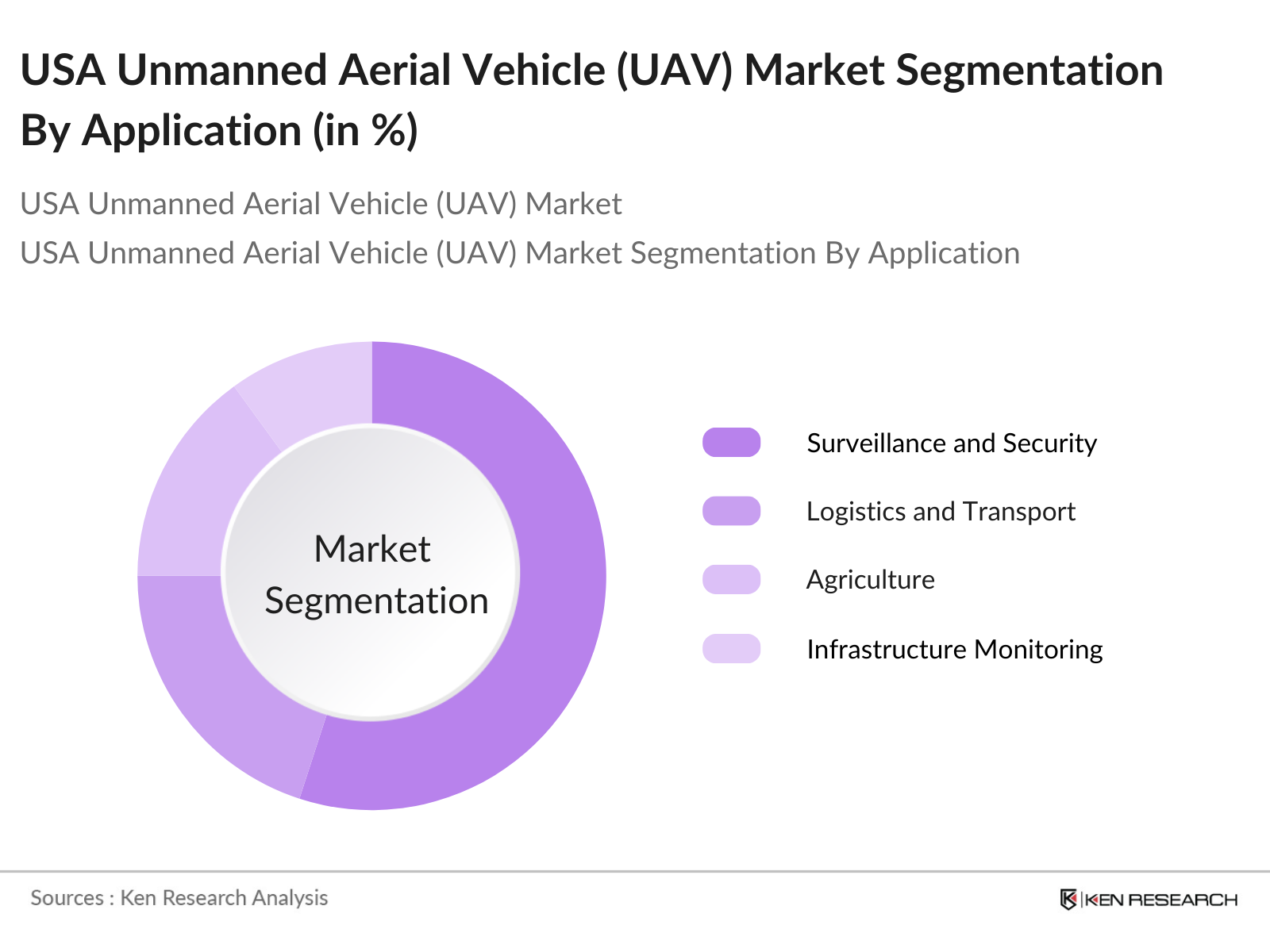
By Application: The USA UAV market is segmented by application into Surveillance and Security, Logistics and Transport, Agriculture, and Infrastructure Monitoring. Surveillance and Security applications currently lead the market due to substantial demand from the defense sector. UAVs are extensively used for intelligence, surveillance, and reconnaissance (ISR) activities, with military applications necessitating robust, high-quality drones.
USA Unmanned Aerial Vehicle (UAV) Market Competitive Landscape
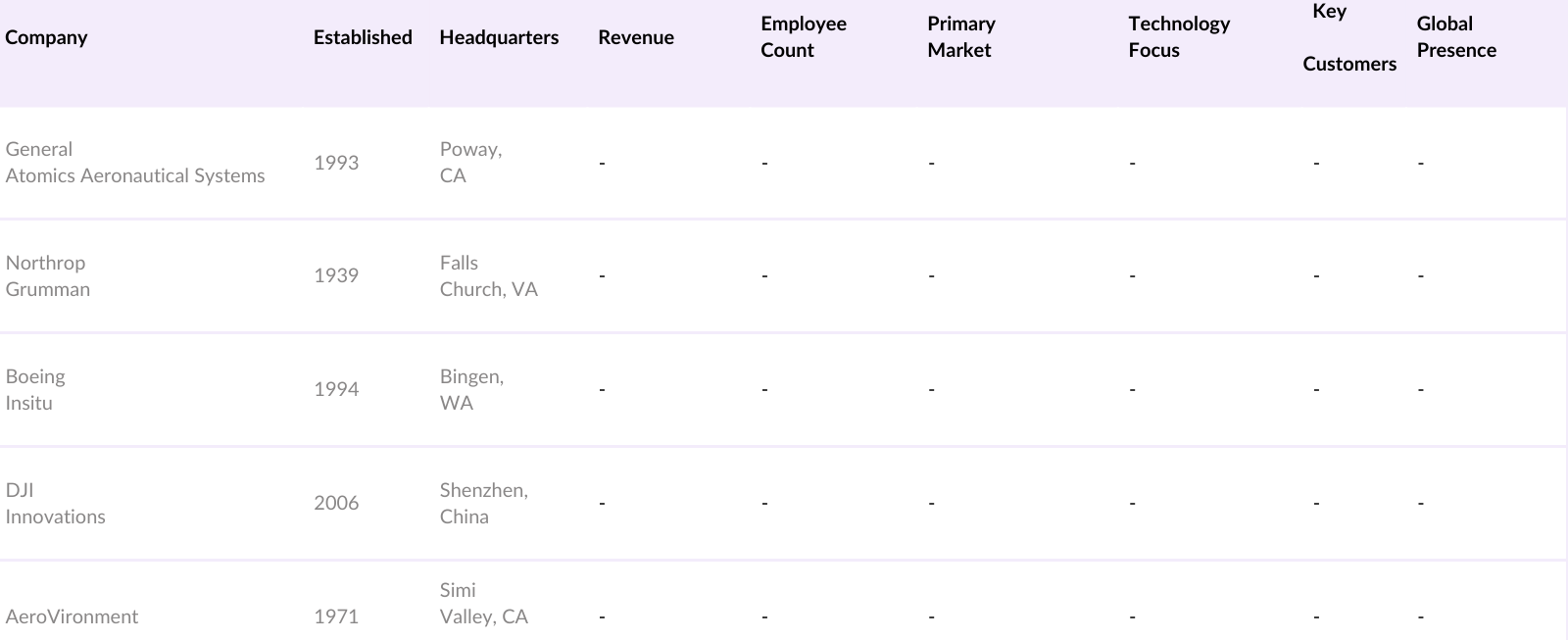
The USA UAV market is characterized by significant consolidation, with leading aerospace and defense companies, as well as tech startups, shaping the competitive landscape. Companies like General Atomics Aeronautical Systems and Northrop Grumman lead the military UAV segment, while DJI Innovations dominates the consumer and commercial UAV segment.
USA Unmanned Aerial Vehicle (UAV) Industry Analysis
Growth Drivers
- Commercial and Civilian Applications: The US commercial UAV market is expanding due to applications in sectors like delivery, agriculture, and infrastructure. The Federal Aviation Administration (FAA) reported over 873,000 registered commercial drones in 2024, showing a growth trend. The logistics industry, with giants like Amazon, utilizes UAVs to enhance last-mile delivery solutions, a sector estimated to cut delivery times by 40%. Additionally, agricultural UAVs provide insights into crop health, soil quality, and yield forecasts, aligning with USDA data on increased yields in UAV-utilizing regions.
- Technological Advancements: UAV technology has advanced through innovations in AI, GPS accuracy, and data analytics. Recent findings by the National Institute of Standards and Technology (NIST) highlight improvements in geospatial data precision, aiding UAV navigation even in GPS-compromised zones. These advancements improve UAV reliability in civilian and military applications, including urban monitoring. AI algorithms in UAVs are increasingly capable of autonomous flight and decision-making, responding to FAAs 2023 policies on enhanced UAV autonomy.
- Federal and State-Level Incentives: The US governments recent incentives support UAV industry expansion, with the 2024 Infrastructure Act designating $2 billion for UAV infrastructure development, including research in airspace safety and collision avoidance. Additionally, states like California offer tax benefits for commercial UAV use in agriculture and infrastructure inspection, directly affecting adoption rates. The Small Business Administration also allocated $200 million in 2024 to support UAV startups, fostering innovation in various applications.
Market Challenges
- Regulatory Compliance: UAV operators face stringent regulations from the FAA, especially around no-fly zones and airspace management, which restricts UAV deployment. In 2024, FAA data shows over 4,000 UAV-related airspace violations, demonstrating operational challenges. Compliance costs are high, as operators must meet both federal and state requirements for UAVs, including registration, pilot licensing, and operational limits, posing barriers to small businesses entering the UAV market.
- High Development and Maintenance Costs: The high costs of UAV development and maintenance are significant challenges. Data from the National Defense Industrial Association (NDIA) in 2024 indicates that UAV operational costs can be 60% higher than traditional aircraft due to specialized parts and maintenance needs. These costs impact both military and commercial users, especially as UAVs are deployed in rough environments, requiring frequent repairs and upgrades. This economic challenge impacts scalability and limits adoption by smaller entities.
USA Unmanned Aerial Vehicle (UAV) Market Future Outlook
The USA UAV market is poised for accelerated growth, driven by rising adoption across defense, commercial, and public sectors. Technological advancements such as AI integration and enhanced battery life are anticipated to fuel this growth further. Additionally, increasing regulatory support, particularly for commercial applications like delivery and agricultural monitoring, is expected to open new avenues, especially as industries seek to enhance operational efficiencies through UAV solutions.
Market Opportunities
- Integration with Artificial Intelligence (AI): Integrating AI into UAV systems offers vast potential, enhancing autonomy and operational efficiency. In 2024, NISTs AI UAV project enabled improved obstacle detection and autonomous navigation. This advancement supports complex applications, including real-time disaster management and predictive maintenance in agriculture, which improves productivity. AI-driven UAVs can analyze geospatial data and optimize paths, reducing fuel consumption by up to 20%, based on DOE estimates.
- Expansion in Agricultural Applications: Agricultural UAVs are pivotal in precision farming, with USDA findings revealing a 30% yield increase in farms using UAVs for crop monitoring and pest control. UAVs equipped with advanced sensors provide real-time data on soil moisture, crop health, and pest populations, crucial for large-scale farms. In 2024, government subsidies helped increase UAV adoption, particularly in states like Iowa and Nebraska, where agriculture represents a significant economic sector.
Scope of the Report
|
UAV Type |
Fixed-Wing Rotary-Wing Hybrid/VTOL |
|
Application |
Surveillance and Security Logistics and Transport Agriculture Infrastructure Monitoring |
|
End User |
Government and Defense Commercial Consumer |
|
Range |
Short Range Medium Range Long Range |
|
Region |
Northeast Midwest South West |
Products
Key Target Audience
UAV Manufacturers and Suppliers
Defense Contractors and Military Organizations
Government and Regulatory Bodies (Federal Aviation Administration, Department of Defense)
Agricultural Corporations
Logistics and Transport Firms
Infrastructure Monitoring Agencies
Investments and Venture Capitalist Firms
Security and Surveillance Providers
Companies
Players Mentioned in the Report
General Atomics Aeronautical Systems
Northrop Grumman
Boeing Insitu
AeroVironment
DJI Innovations
Textron Systems
Parrot Drones
Draganfly Inc.
Kratos Defense & Security Solutions
PrecisionHawk
Table of Contents
1. USA Unmanned Aerial Vehicle (UAV) Market Overview
1.1 Definition and Scope
1.2 Market Taxonomy
1.3 Market Growth Rate
1.4 Market Segmentation Overview
2. USA Unmanned Aerial Vehicle (UAV) Market Size (in USD)
2.1 Historical Market Size
2.2 Year-On-Year Growth Analysis
2.3 Key Market Developments and Milestones
3. USA UAV Market Analysis
3.1 Growth Drivers
3.1.1 Military and Defense Applications
3.1.2 Commercial and Civilian Applications
3.1.3 Technological Advancements
3.1.4 Federal and State-Level Incentives
3.2 Market Challenges
3.2.1 Regulatory Compliance
3.2.2 High Development and Maintenance Costs
3.2.3 Security and Privacy Concerns
3.3 Opportunities
3.3.1 Integration with Artificial Intelligence (AI)
3.3.2 Expansion in Agricultural Applications
3.3.3 Increase in Public-Private Partnerships
3.4 Trends
3.4.1 Miniaturization and Payload Efficiency
3.4.2 Autonomous UAV Systems
3.4.3 Enhanced Battery Life and Solar-Powered UAVs
3.5 Government Regulations
3.5.1 FAA Compliance and Guidelines
3.5.2 Airspace Management Policies
3.5.3 State-Level UAV Legislation
3.6 Competitive Landscape
3.7 Porters Five Forces Analysis
3.8 Stake Ecosystem
3.9 SWOT Analysis
4. USA UAV Market Segmentation
4.1 By UAV Type (Market Share %)
4.1.1 Fixed-Wing
4.1.2 Rotary-Wing
4.1.3 Hybrid/VTOL
4.2 By Application (Market Share %)
4.2.1 Surveillance and Security
4.2.2 Logistics and Transport
4.2.3 Agriculture
4.2.4 Infrastructure Monitoring
4.3 By End User (Market Share %)
4.3.1 Government and Defense
4.3.2 Commercial
4.3.3 Consumer
4.4 By Range (Market Share %)
4.4.1 Short Range
4.4.2 Medium Range
4.4.3 Long Range
4.5 By Region (Market Share %)
4.5.1 Northeast
4.5.2 Midwest
4.5.3 South
4.5.4 West
5. USA UAV Market Competitive Analysis
5.1 Profiles of Major Companies
5.1.1 General Atomics Aeronautical Systems
5.1.2 Northrop Grumman
5.1.3 Boeing Insitu
5.1.4 AeroVironment
5.1.5 DJI Innovations
5.1.6 Textron Systems
5.1.7 Parrot Drones
5.1.8 Draganfly Inc.
5.1.9 Kratos Defense & Security Solutions
5.1.10 PrecisionHawk
5.1.11 Skyfish UAV
5.1.12 Freefly Systems
5.1.13 Zipline International
5.1.14 3D Robotics
5.1.15 Yuneec International
5.2 Cross Comparison Parameters (Revenue, Market Share, Inception Year, Technology Specialization, Product Portfolio, Market Reach, Strategic Alliances, R&D Expenditure)
5.3 Market Share Analysis
5.4 Strategic Initiatives
5.5 Mergers and Acquisitions
5.6 Investment Analysis
5.7 Venture Capital Funding
5.8 Government Grants
5.9 Private Equity Investments
6. USA UAV Market Regulatory Framework
6.1 FAA Regulations and Compliance Standards
6.2 Safety and Operational Standards
6.3 Certification and Licensing Procedures
7. Future USA UAV Market Size (in USD)
7.1 Future Market Size Projections
7.2 Key Factors Driving Future Market Growth
8. Future USA UAV Market Segmentation
8.1 By UAV Type
8.2 By Application
8.3 By End User
8.4 By Range
8.5 By Region
9. Market Analysts Recommendations
9.1 TAM/SAM/SOM Analysis
9.2 Emerging Customer Segments
9.3 Key Marketing Initiatives
9.4 White Space Analysis
Disclaimer Contact UsResearch Methodology
Step 1: Identification of Key Variables
The initial step involved mapping the UAV ecosystem, covering all primary stakeholders in the USA market. This was achieved through extensive secondary research utilizing databases and proprietary sources to identify the critical variables impacting market trends and dynamics.
Step 2: Market Analysis and Data Compilation
Historical data collection on the UAV industry encompassed market growth trends, service providers, and revenue estimates. Data was analyzed to capture the ratio of defense to commercial applications, and evaluate their market influence, ensuring the reliability of market estimates.
Step 3: Hypothesis Validation through Expert Consultations
Hypotheses around UAV applications and market growth were validated through structured interviews with industry experts. This consultation phase provided actionable insights into operational and financial aspects directly from sector professionals.
Step 4: Synthesis and Final Output
In the final stage, comprehensive insights were obtained from UAV manufacturers and service providers to confirm data accuracy. This interaction verified statistics derived through the bottom-up approach, ensuring a well-rounded and accurate analysis of the USA UAV market.
Frequently Asked Questions
01. How big is the USA UAV market?
The USA Unmanned Aerial Vehicle (UAV) market is valued at USD 11 billion, based on a five-year historical analysis. This market is primarily driven by substantial defense investments and innovations in commercial UAV applications.
02. What are the major challenges in the USA UAV market?
Key challenges include strict regulatory requirements, high operational costs, and privacy concerns, especially in densely populated areas, limiting rapid adoption in the commercial sector.
03. Who are the leading players in the USA UAV market?
The market includes leaders like General Atomics, Northrop Grumman, DJI Innovations, AeroVironment, and Boeing Insitu, all known for extensive product portfolios and advanced UAV technology.
04. What factors drive growth in the USA UAV market?
Growth drivers include increasing military funding for ISR activities, expanding commercial uses like delivery and monitoring, and innovations in UAV battery life and AI integration.
Why Buy From Us?

What makes us stand out is that our consultants follows Robust, Refine and Result (RRR) methodology. i.e. Robust for clear definitions, approaches and sanity checking, Refine for differentiating respondents facts and opinions and Result for presenting data with story

We have set a benchmark in the industry by offering our clients with syndicated and customized market research reports featuring coverage of entire market as well as meticulous research and analyst insights.

While we don't replace traditional research, we flip the method upside down. Our dual approach of Top Bottom & Bottom Top ensures quality deliverable by not just verifying company fundamentals but also looking at the sector and macroeconomic factors.

With one step in the future, our research team constantly tries to show you the bigger picture. We help with some of the tough questions you may encounter along the way: How is the industry positioned? Best marketing channel? KPI's of competitors? By aligning every element, we help maximize success.

Our report gives you instant access to the answers and sources that other companies might choose to hide. We elaborate each steps of research methodology we have used and showcase you the sample size to earn your trust.

If you need any support, we are here! We pride ourselves on universe strength, data quality, and quick, friendly, and professional service.