















USA Variable Frequency Drive (VFD) Market Outlook to 2030
Region:North America
Author(s):Shreya
Product Code:KROD5477
November 2024
80
About the Report
USA Variable Frequency Drive (VFD) Market Overview
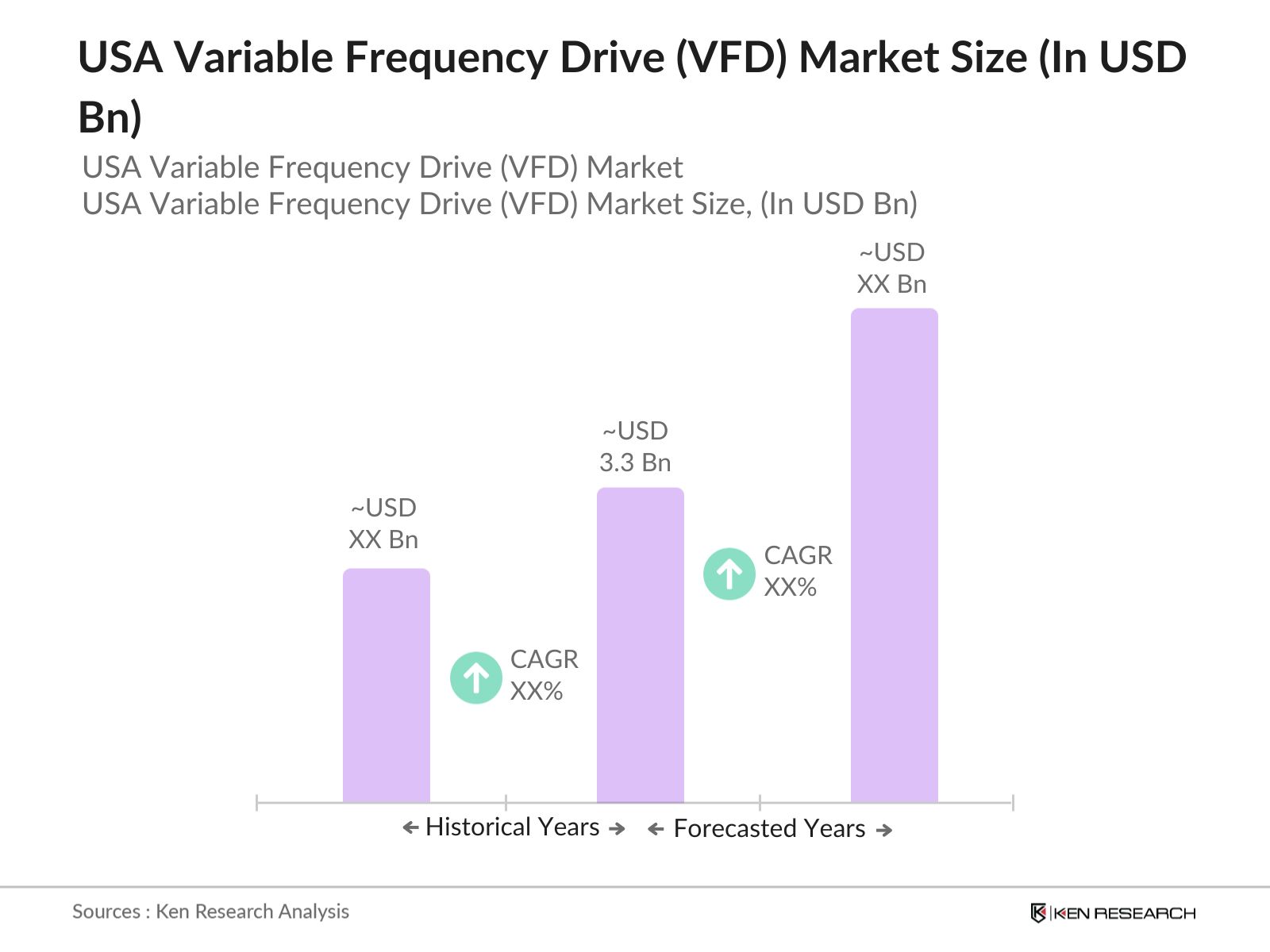
- The USA Variable Frequency Drive (VFD) market is currently valued at USD 3.3 billion, according to historical data of 5 years. The markets growth has been driven by the increasing emphasis on energy efficiency and regulatory pressures aimed at reducing energy consumption. Industrial applications in HVAC, pumps, and conveyors are particularly fueling demand for VFDs, as industries seek to optimize operational efficiency and minimize energy costs.
- Within the USA, the VFD market is dominated by key regions such as Texas and California due to their large industrial bases and a growing focus on renewable energy integration. Texas has a high concentration of oil & gas operations, where VFDs are critical for process control, while California's push for energy-efficient technologies in both industrial and commercial sectors has bolstered its position as a leading consumer of VFD solution.
- Government regulations such as the Minimum Efficiency Performance Standards (MEPS) set by the U.S. Department of Energy mandate energy efficiency in motor-driven systems, pushing for widespread adoption of VFDs. These standards are designed to reduce energy consumption and are updated regularly to reflect technological advancements. The U.S. DOE estimates that energy-efficient regulations in motor systems, including VFDs, could save over 100 billion kWh of electricity by 2025, making compliance crucial for manufacturers.
USA Variable Frequency Drive (VFD) Market Segmentation
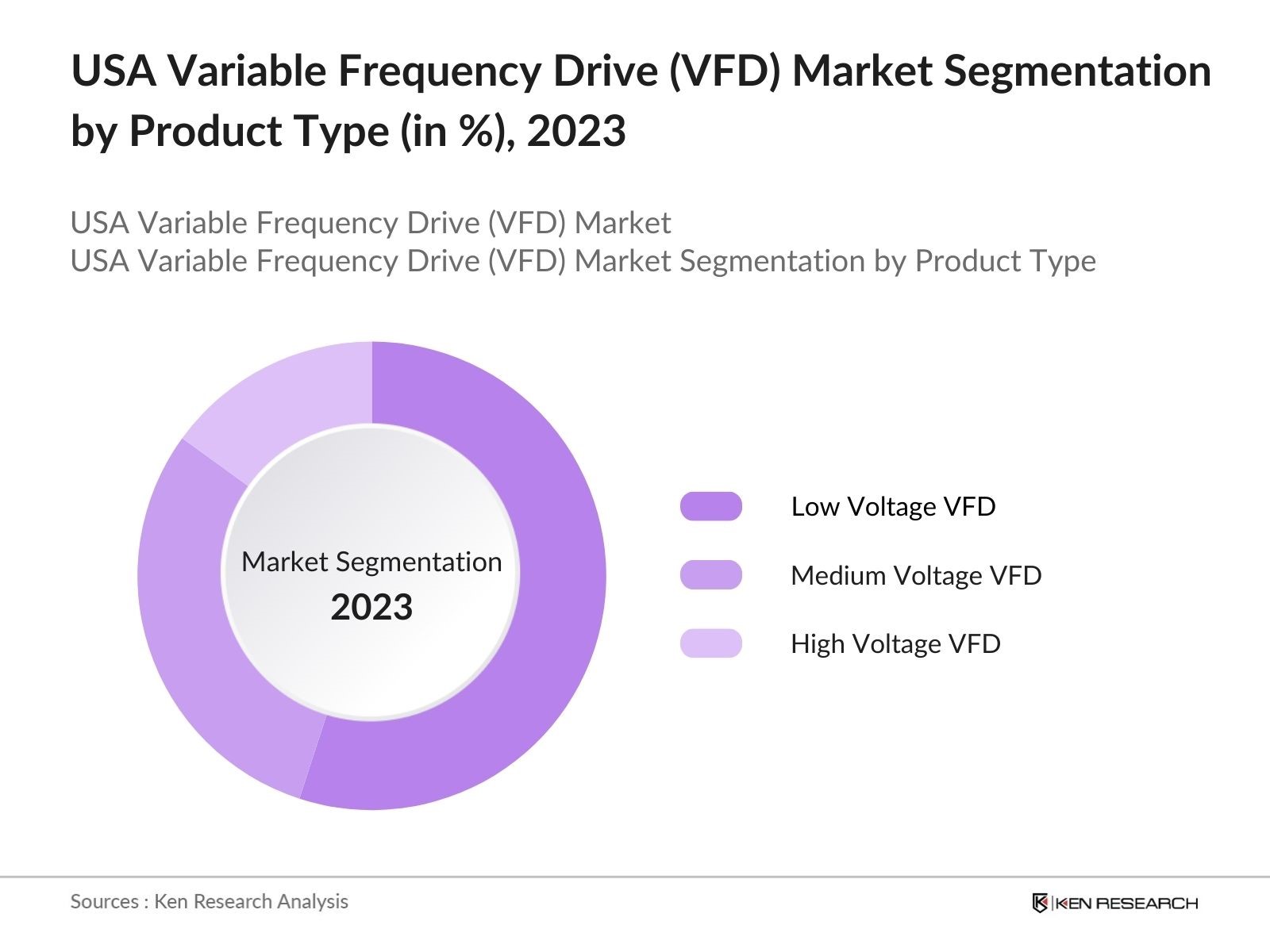
- By Product Type: The market is segmented by product type into low voltage, medium voltage, and high voltage VFDs. Low voltage VFDs hold a dominant market share under this segmentation, driven by their widespread use in HVAC systems and industrial motors. These VFDs are favored for their compatibility with various industrial applications and lower cost compared to higher voltage variants, making them an ideal choice for small to medium enterprises.
- By Application: The market is also segmented by application into HVAC, pumps, and conveyors. HVAC applications dominate the market due to the growing demand for energy-efficient building solutions. Commercial buildings and industrial facilities increasingly incorporate VFDs in HVAC systems to manage variable loads and reduce energy consumption, contributing significantly to this segments market leadership.

USA Variable Frequency Drive (VFD) Market Competitive Landscape
The USA VFD market is dominated by a few major players, both local and global, who have established a strong presence through product innovation and strategic partnerships. This consolidation highlights the significant influence of these key companies.
|
Company |
Establishment Year |
Headquarters |
Revenue (USD) |
Product Range |
Installed Base |
Energy Efficiency Compliance |
Geographic Reach |
Technological Innovation |
|
ABB Ltd. |
1883 |
|||||||
|
Siemens AG |
1847 |
|||||||
|
Rockwell Automation |
1903 |
|||||||
|
Schneider Electric |
1836 |
|||||||
|
Mitsubishi Electric |
1921 |
USA Variable Frequency Drive (VFD) Industry Analysis
Growth Drivers
- Increasing Energy Efficiency Requirements: The USA VFD market is seeing significant growth due to heightened energy efficiency standards. The Energy Policy Act mandates compliance for motors used in industrial applications, with VFDs becoming essential for reducing energy consumption in motor-driven systems. According to the U.S. Department of Energy, industrial motors consume 70% of electricity used by manufacturing plants, driving the need for VFDs to minimize energy loss. This shift is crucial as energy prices rise globally, and industries seek solutions to meet regulatory requirements and cut operational costs.
- Rising Demand for Automation: The demand for automation in industrial and commercial sectors is a key driver for VFD adoption. The U.S. manufacturing sector, contributing over $2.3 trillion to the economy, increasingly implements automation to improve efficiency. Automation enables factories and commercial buildings to reduce manual intervention and ensure smoother operations through VFDs controlling motor speeds. In commercial settings like HVAC systems, VFDs enable precise control, reducing energy waste, contributing to operational efficiency, and aligning with automation trends.
- Government Initiatives Promoting Sustainable Energy: Government initiatives promoting sustainable energy, such as the U.S. Department of Energy's Better Buildings Initiative, encourage the adoption of energy-efficient technologies, including VFDs. These initiatives aim to reduce energy consumption by 20% across commercial buildings, with VFDs playing a key role in this transition. Such programs are crucial as buildings consume 40% of total U.S. energy, and using VFDs can optimize the energy performance of HVAC systems and other equipment, aligning with national sustainability goals.
Market Challenges
- High Initial Capital Investment: One of the major challenges in the USA VFD market is the high initial capital investment required for VFDs. This makes the technology less accessible for small and medium-sized enterprises. According to the U.S. Small Business Administration, the average cost of installing VFDs in industrial applications can reach up to $10,000 per unit, creating financial barriers for adoption. While the long-term benefits in terms of energy savings are significant, the upfront costs remain a critical factor in decision-making, especially for budget-constrained organizations.
- Complexities in Retrofitting Older Systems: Retrofitting older systems with VFD technology poses several technical challenges, such as compatibility issues and the need for extensive system modifications. A report by the U.S. Department of Energy notes that retrofitting can require additional investments in ancillary equipment like sensors and controllers to integrate VFDs properly. This complexity can slow down the adoption of VFDs in older manufacturing plants and commercial facilities, especially where the infrastructure is outdated and incompatible with modern energy-saving technologies.
USA Variable Frequency Drive (VFD) Market Future Outlook
Over the next five years, the USA Variable Frequency Drive market is expected to experience strong growth, driven by advancements in industrial automation, the integration of renewable energy sources, and regulatory support for energy-efficient solutions. The continued adoption of IoT-enabled VFDs in smart factories and the expanding use of VFDs in HVAC systems will further propel market growth. Additionally, government incentives aimed at reducing carbon emissions are expected to play a key role in market expansion.
Future Market Opportunities
- Expansion of Renewable Energy Integration: The growth of renewable energy sources like wind and solar power in the USA presents significant opportunities for the VFD market. According to the U.S. Energy Information Administration, wind and solar contributed 12% of the total U.S. electricity generation in 2022. VFDs are essential for optimizing the performance of renewable energy systems by regulating motor speeds in wind turbines and solar trackers. As renewable energy continues to expand, VFDs will play a crucial role in ensuring efficient energy generation and distribution.
- Technological Advancements in Compact VFDs: Advancements in compact VFDs offer growth opportunities in the USA. The trend toward smaller, more efficient VFDs has been driven by technological innovations, allowing them to be used in applications where space is limited. Compact VFDs are increasingly used in HVAC systems in commercial buildings. The U.S. Environmental Protection Agency's ENERGY STAR program emphasizes the importance of energy efficiency in buildings, and compact VFDs contribute to significant energy savings, making them highly attractive for smaller facilities.
Scope of the Report
|
Segments |
Sub-Segments |
|---|---|
|
By Product Type |
Low Voltage VFD |
|
Medium Voltage VFD |
|
|
High Voltage VFD |
|
|
By Power Range |
0-100 kW |
|
101-500 kW |
|
|
Above 500 kW |
|
|
By Application |
HVAC |
|
Pumps |
|
|
Conveyors |
|
|
By End-User Industry |
Industrial Manufacturing |
|
Oil & Gas |
|
|
Power Generation |
|
|
Infrastructure |
|
|
By Region |
Northeast |
|
Midwest |
|
|
South |
|
|
West |
Products
Key Target Audience
Industrial Manufacturers
Power Generation Companies
Oil & Gas Companies
HVAC System Providers
Infrastructure Developers
Government and Regulatory Bodies (U.S. Department of Energy)
Renewable Energy Integrators
Investors and Venture Capitalist Firms
Banks and Financial Institutes
Companies
Major Players
ABB Ltd.
Siemens AG
Schneider Electric
Rockwell Automation
Mitsubishi Electric
Danfoss A/S
Eaton Corporation
Honeywell International Inc.
Yaskawa Electric Corporation
Fuji Electric
Toshiba International Corporation
Emerson Electric Co.
General Electric
Hitachi Ltd.
WEG Industries
Table of Contents
1. USA Variable Frequency Drive (VFD) Market Overview
1.1. Definition and Scope
1.2. Market Taxonomy
1.3. Industry Landscape Overview
1.4. Market Segmentation Overview
2. USA VFD Market Size (In USD Bn)
2.1. Historical Market Size
2.2. Year-on-Year Growth Analysis
2.3. Key Developments and Industry Milestones
3. USA VFD Market Analysis
3.1. Growth Drivers
3.1.1. Increasing Energy Efficiency Requirements (Energy Policy Act compliance)
3.1.2. Rising Demand for Automation (Industrial and Commercial Sectors)
3.1.3. Government Initiatives Promoting Sustainable Energy
3.1.4. Adoption of Smart Grid Technology (Power Distribution Efficiency)
3.2. Market Challenges
3.2.1. High Initial Capital Investment (Cost of VFDs)
3.2.2. Complexities in Retrofitting Older Systems
3.2.3. Limited Technical Knowledge in Smaller Enterprises
3.3. Opportunities
3.3.1. Expansion of Renewable Energy Integration (Wind and Solar Power)
3.3.2. Technological Advancements in Compact VFDs
3.3.3. Growth in HVAC and Infrastructure Sectors
3.4. Trends
3.4.1. Adoption of IoT-Enabled VFDs for Smart Control
3.4.2. Increased Demand for Energy-Efficient Motors
3.4.3. Expansion of Industry 4.0 and Automation Solutions
3.5. Government Regulations
3.5.1. Energy Efficiency Standards (Minimum Efficiency Performance Standards)
3.5.2. Incentives for Industrial Automation
3.5.3. Green Energy Programs and Certifications
3.6. SWOT Analysis
3.7. Industry Stakeholders and Ecosystem
3.8. Porters Five Forces Analysis
3.9. Competitive Landscape
4. USA VFD Market Segmentation
4.1. By Product Type (In Value %)
4.1.1. AC Drives
4.1.2. DC Drives
4.1.3. Servo Drives
4.2. By Power Rating (In Value %)
4.2.1. Low Voltage
4.2.2. Medium Voltage
4.3. By Application (In Value %)
4.3.1. HVAC
4.3.2. Pumping
4.3.3. Conveyors
4.4. By End-Use Industry (In Value %)
4.4.1. Oil & Gas
4.4.2. Automotive
4.4.3. Water & Wastewater
4.4.4. Power Generation
4.5. By Region (In Value %)
4.5.1. North-East
4.5.2. Midwest
4.5.3. West
4.5.4. South
5. USA VFD Market Competitive Analysis
5.1 Detailed Profiles of Major Companies
5.1.1. ABB Ltd.
5.1.2. Siemens AG
5.1.3. Rockwell Automation, Inc.
5.1.4. General Electric
5.1.5. Schneider Electric
5.1.6. Mitsubishi Electric Corporation
5.1.7. Danfoss
5.1.8. Hitachi Ltd.
5.1.9. Yaskawa Electric Corporation
5.1.10. Toshiba International Corporation
5.1.11. Fuji Electric
5.1.12. Eaton Corporation
5.1.13. WEG Industries
5.1.14. Emerson Electric Co.
5.1.15. Honeywell International Inc.
5.2 Cross Comparison Parameters (Revenue, Headquarters, No. of Employees, Market Presence, R&D Spending, Product Portfolio, Digital Strategy, Technological Innovation)
5.3. Market Share Analysis
5.4. Strategic Initiatives and Innovations
5.5. Mergers and Acquisitions
5.6. Investment and Funding Analysis
6. USA VFD Market Regulatory Framework
6.1. Compliance Requirements
6.2. Environmental and Energy Certifications
6.3. Industry Standards for Energy Efficiency
7. USA VFD Future Market Size (In USD Bn)
7.1. Market Growth Projections
7.2. Key Factors Driving Future Growth
8. USA VFD Future Market Segmentation
8.1. By Product Type (In Value %)
8.2. By Power Rating (In Value %)
8.3. By Application (In Value %)
8.4. By End-Use Industry (In Value %)
8.5. By Region (In Value %)
9. USA VFD Market Analysts Recommendations
9.1. TAM/SAM/SOM Analysis
9.2. Emerging Market Opportunities
9.3. Marketing and Sales Strategies
9.4. White Space Opportunity Analysis
Disclaimer
Contact Us
Research Methodology
Step 1: Identification of Key Variables
The initial phase involved constructing an ecosystem map encompassing all major stakeholders within the USA VFD Market. This step was underpinned by extensive desk research, utilizing secondary and proprietary databases to gather comprehensive industry-level information. The primary objective was to identify and define the critical variables that influence market dynamics.
Step 2: Market Analysis and Construction
In this phase, historical data for the USA VFD Market was compiled and analyzed. This included assessing market penetration, the ratio of installations to manufacturers, and the resultant revenue generation. An evaluation of service quality statistics was conducted to ensure the reliability of revenue estimates.
Step 3: Hypothesis Validation and Expert Consultation
Market hypotheses were developed and validated through interviews with industry experts from leading VFD companies. These consultations provided valuable insights into operational and financial performance, helping to refine and corroborate the market data.
Step 4: Research Synthesis and Final Output
The final phase involved direct engagement with VFD manufacturers to acquire detailed insights into product segments, sales performance, and consumer preferences. This interaction served to verify and complement the data derived from the bottom-up approach, ensuring a comprehensive and validated analysis of the USA VFD market.
Frequently Asked Questions
1. How big is the USA Variable Frequency Drive market?
The USA Variable Frequency Drive market is valued at USD 3.3 billion, driven by growing demand for energy-efficient solutions across industrial applications like HVAC, pumps, and conveyors.
2. What are the challenges in the USA VFD market?
The main challenges in the USA VFD market include the high initial costs of VFD systems, complexity in integration with existing systems, and consolidation among vendors which limits competition.
3. Who are the major players in the USA VFD market?
Key players in the USA VFD market include ABB Ltd., Siemens AG, Schneider Electric, Rockwell Automation, and Mitsubishi Electric. These companies dominate due to their extensive product ranges, strong geographic presence, and energy efficiency solutions.
4. What are the growth drivers for the USA VFD market?
The USA VFD market is propelled by the increasing need for energy efficiency, regulatory pressure on industries to reduce energy consumption, and the growing adoption of automation in industrial processes.
5. Which sectors dominate the application of VFDs in the USA?
The HVAC sector dominates the application of VFDs, followed by industrial pumps and conveyor systems, owing to the need for energy savings and operational efficiency in these sectors.
Why Buy From Us?

What makes us stand out is that our consultants follows Robust, Refine and Result (RRR) methodology. i.e. Robust for clear definitions, approaches and sanity checking, Refine for differentiating respondents facts and opinions and Result for presenting data with story

We have set a benchmark in the industry by offering our clients with syndicated and customized market research reports featuring coverage of entire market as well as meticulous research and analyst insights.

While we don't replace traditional research, we flip the method upside down. Our dual approach of Top Bottom & Bottom Top ensures quality deliverable by not just verifying company fundamentals but also looking at the sector and macroeconomic factors.

With one step in the future, our research team constantly tries to show you the bigger picture. We help with some of the tough questions you may encounter along the way: How is the industry positioned? Best marketing channel? KPI's of competitors? By aligning every element, we help maximize success.

Our report gives you instant access to the answers and sources that other companies might choose to hide. We elaborate each steps of research methodology we have used and showcase you the sample size to earn your trust.

If you need any support, we are here! We pride ourselves on universe strength, data quality, and quick, friendly, and professional service.